

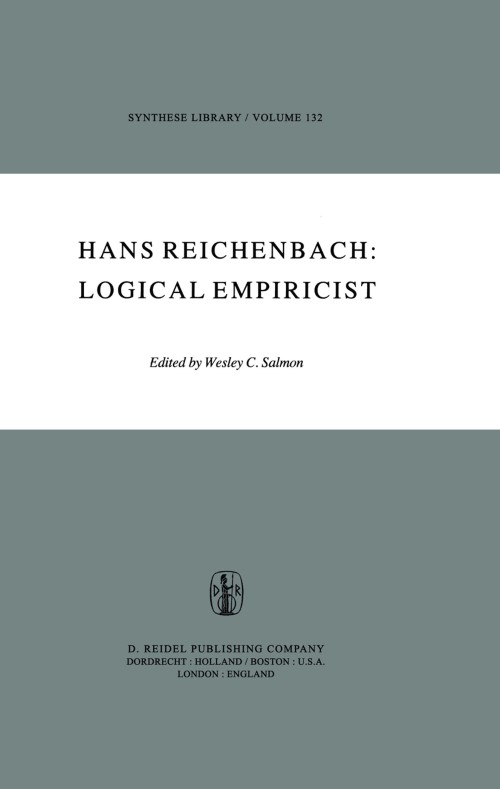
Hans Reichenbach: Logical Empiricist [electronic resource] / edited by M.H. Salmon.
Erişim Adresi
ISBN
9789400994041
Dil Kodu
İngilizce
Yer Numarası
DK/13810
Basım Bildirimi
1st ed. 1979.
Yayın Bilgisi
Dordrecht : Springer Netherlands : Imprint: Springer, 1979.
Fiziksel Niteleme
XI, 793 p. online resource.
Dizi
Synthese Library, Studies in Epistemology, Logic, Methodology, and Philosophy of Science, 2542-8292 ; 132
İçindekiler Notu
The Philosophy of Hans Reichenbach -- Inference, Practice and Theory -- Relative Frequencies -- The Probabilities of Theories as Frequencies -- Reichenbach, Reference Classes, and Single Case ‘Probabilities’ -- Reichenbach’s Entanglements -- Reichenbach on Convention -- Hans Reichenbach’s Relativity of Geometry -- Elective Affinities: Weyl and Reichenbach -- Reichenbach and Conventionalism -- The Geometry of the Rotating Disk in the Special Theory of Relativity -- Two Lectures on the Direction of Time -- What Might Be Right about the Causal Theory of Time -- Concerning a Probabilistic Theory of Causation Adequate for the Causal Theory of Time -- Why Ask, ‘Why?’?—An Inquiry Concerning Scientific Explanation -- Hans Reichenbach on the Logic of Quantum Mechanics -- Reichenbach and the Logic of Quantum Mechanics -- Reichenbach and the Interpretation of Quantum Mechanics -- Causal Anomalies and the Completeness of Quantum Theory -- Metaphysical Implications of the Quantum Theory -- Consistency Proofs for Applied Mathematics -- A Generative Model for Translating from Ordinary Language into Symbolic Notation -- Laws, Modalities and Counterfactuals -- Reichenbach’s Theory of Nomological Statements -- Appreciation and Criticism of Reichenbach’s Meta-ethics: Achilles’ Heel of the System? -- Index of Names -- Analytical Index of Subjects.
Özet, vb.
Logical empiricism - not to be confused with logical positivism (see pp. 40-44) - is a movement which has left an indelible mark on twentieth century philosophy; Hans Reichenbach (1891-1953) was one of its found ers and one of its most productive advocates. His sudden and untimely death in 1953 halted his work when he was at the height of his intellectual powers; nevertheless, he bequeathed to us a handsome philosophical inheritance. At the present time, twenty-five years later, we can survey our heritage and see to what extent we have been enriched. The present collection of essays constitutes an effort to do just that - to exhibit the scope and unity of Reichenbach's philosophy, and its relevance to current philosophical issues. There is no Nobel Prize in philosophy - the closest analogue is a volume in The Library of Living Philosophers, an honor which, like the Nobel Prize, cannot be awarded posthumously. Among 'scientific philosophers,' Rudolf Carnap, Albert Einstein, Karl Popper, and Bertrand Russell have been so honored. Had Reichenbach lived longer, he would have shared the honor with Carnap, for at the time of his death a volume on Logical Empiricism, treating the works of Carnap and Reichenbach, was in its early stages of preparation. In the volume which emerged, Carnap wrote, "In 1953, when Reichenbach's creative activity was suddenly ended by his premature death, our movement lost one of its most active leaders.
Konu
Science __ Philosophy.
History.
Philosophy of Science.
History.
History.
Philosophy of Science.
History.
Diğer Yazarlar
Kurum Adı
Eseri Alıntıla
Referansları kullanmadan önce gözden geçirmeniz ve varsa gerekli düzeltmeleri yapmanız önerilir.
Dijital Kaynak
MARC Görünümü
LEADER 05441nam a22005655i 4500
001 812561
003 TR_AnAIT
005 20260130234030
007 cr nn 008mamaa
008 121227s1979 ne | s |||| 0|eng d
020 |a9789400994041|9978-94-009-9404-1
024 7 |a10.1007/978-94-009-9404-1|2doi
041 |aeng
049 |aTürk Tarih Kurumu Kütüphanesi
050 4|aQ174-175.3
050 4|aB67
072 7|aPDA|2bicssc
072 7|aSCI075000|2bisacsh
072 7|aPDA|2thema
082 04|a501|223
090 |aDK/13810
245 10|aHans Reichenbach: Logical Empiricist|h[electronic resource] /|cedited by M.H. Salmon.
250 |a1st ed. 1979.
264 1|aDordrecht :|bSpringer Netherlands :|bImprint: Springer,|c1979.
300 |aXI, 793 p.|bonline resource.
336 |atext|btxt|2rdacontent
337 |acomputer|bc|2rdamedia
338 |aonline resource|bcr|2rdacarrier
347 |atext file|bPDF|2rda
490 1 |aSynthese Library, Studies in Epistemology, Logic, Methodology, and Philosophy of Science,|x2542-8292 ;|v132
505 0 |aThe Philosophy of Hans Reichenbach -- Inference, Practice and Theory -- Relative Frequencies -- The Probabilities of Theories as Frequencies -- Reichenbach, Reference Classes, and Single Case ‘Probabilities’ -- Reichenbach’s Entanglements -- Reichenbach on Convention -- Hans Reichenbach’s Relativity of Geometry -- Elective Affinities: Weyl and Reichenbach -- Reichenbach and Conventionalism -- The Geometry of the Rotating Disk in the Special Theory of Relativity -- Two Lectures on the Direction of Time -- What Might Be Right about the Causal Theory of Time -- Concerning a Probabilistic Theory of Causation Adequate for the Causal Theory of Time -- Why Ask, ‘Why?’?—An Inquiry Concerning Scientific Explanation -- Hans Reichenbach on the Logic of Quantum Mechanics -- Reichenbach and the Logic of Quantum Mechanics -- Reichenbach and the Interpretation of Quantum Mechanics -- Causal Anomalies and the Completeness of Quantum Theory -- Metaphysical Implications of the Quantum Theory -- Consistency Proofs for Applied Mathematics -- A Generative Model for Translating from Ordinary Language into Symbolic Notation -- Laws, Modalities and Counterfactuals -- Reichenbach’s Theory of Nomological Statements -- Appreciation and Criticism of Reichenbach’s Meta-ethics: Achilles’ Heel of the System? -- Index of Names -- Analytical Index of Subjects.
520 |aLogical empiricism - not to be confused with logical positivism (see pp. 40-44) - is a movement which has left an indelible mark on twentieth century philosophy; Hans Reichenbach (1891-1953) was one of its found ers and one of its most productive advocates. His sudden and untimely death in 1953 halted his work when he was at the height of his intellectual powers; nevertheless, he bequeathed to us a handsome philosophical inheritance. At the present time, twenty-five years later, we can survey our heritage and see to what extent we have been enriched. The present collection of essays constitutes an effort to do just that - to exhibit the scope and unity of Reichenbach's philosophy, and its relevance to current philosophical issues. There is no Nobel Prize in philosophy - the closest analogue is a volume in The Library of Living Philosophers, an honor which, like the Nobel Prize, cannot be awarded posthumously. Among 'scientific philosophers,' Rudolf Carnap, Albert Einstein, Karl Popper, and Bertrand Russell have been so honored. Had Reichenbach lived longer, he would have shared the honor with Carnap, for at the time of his death a volume on Logical Empiricism, treating the works of Carnap and Reichenbach, was in its early stages of preparation. In the volume which emerged, Carnap wrote, "In 1953, when Reichenbach's creative activity was suddenly ended by his premature death, our movement lost one of its most active leaders.
532 8 |aAccessibility summary: This PDF is not accessible. It is based on scanned pages and does not support features such as screen reader compatibility or described non-text content (images, graphs etc). However, it likely supports searchable and selectable text based on OCR (Optical Character Recognition). Users with accessibility needs may not be able to use this content effectively. Please contact us at accessibilitysupport@springernature.com if you require assistance or an alternative format.
532 8 |aInaccessible, or known limited accessibility
532 8 |aNo reading system accessibility options actively disabled
532 8 |aPublisher contact for further accessibility information: accessibilitysupport@springernature.com
650 0|aScience|xPhilosophy.
650 0|aHistory.
650 14|aPhilosophy of Science.
650 24|aHistory.
700 1 |aSalmon, M.H.|eeditor.|4edt|4http://id.loc.gov/vocabulary/relators/edt
710 2 |aSpringerLink (Online service)
773 0 |tSpringer Nature eBook
776 08|iPrinted edition:|z9789027709585
776 08|iPrinted edition:|z9789400994058
776 08|iPrinted edition:|z9789400994065
830 0|aSynthese Library, Studies in Epistemology, Logic, Methodology, and Philosophy of Science,|x2542-8292 ;|v132
856 40|uhttps://doi.org/10.1007/978-94-009-9404-1
912 |aZDB-2-SHU
912 |aZDB-2-SXPR
912 |aZDB-2-BAE
950 |aHumanities, Social Sciences and Law (SpringerNature-11648)
950 |aPhilosophy and Religion (R0) (SpringerNature-43725)
001 812561
003 TR_AnAIT
005 20260130234030
007 cr nn 008mamaa
008 121227s1979 ne | s |||| 0|eng d
020 |a9789400994041|9978-94-009-9404-1
024 7 |a10.1007/978-94-009-9404-1|2doi
041 |aeng
049 |aTürk Tarih Kurumu Kütüphanesi
050 4|aQ174-175.3
050 4|aB67
072 7|aPDA|2bicssc
072 7|aSCI075000|2bisacsh
072 7|aPDA|2thema
082 04|a501|223
090 |aDK/13810
245 10|aHans Reichenbach: Logical Empiricist|h[electronic resource] /|cedited by M.H. Salmon.
250 |a1st ed. 1979.
264 1|aDordrecht :|bSpringer Netherlands :|bImprint: Springer,|c1979.
300 |aXI, 793 p.|bonline resource.
336 |atext|btxt|2rdacontent
337 |acomputer|bc|2rdamedia
338 |aonline resource|bcr|2rdacarrier
347 |atext file|bPDF|2rda
490 1 |aSynthese Library, Studies in Epistemology, Logic, Methodology, and Philosophy of Science,|x2542-8292 ;|v132
505 0 |aThe Philosophy of Hans Reichenbach -- Inference, Practice and Theory -- Relative Frequencies -- The Probabilities of Theories as Frequencies -- Reichenbach, Reference Classes, and Single Case ‘Probabilities’ -- Reichenbach’s Entanglements -- Reichenbach on Convention -- Hans Reichenbach’s Relativity of Geometry -- Elective Affinities: Weyl and Reichenbach -- Reichenbach and Conventionalism -- The Geometry of the Rotating Disk in the Special Theory of Relativity -- Two Lectures on the Direction of Time -- What Might Be Right about the Causal Theory of Time -- Concerning a Probabilistic Theory of Causation Adequate for the Causal Theory of Time -- Why Ask, ‘Why?’?—An Inquiry Concerning Scientific Explanation -- Hans Reichenbach on the Logic of Quantum Mechanics -- Reichenbach and the Logic of Quantum Mechanics -- Reichenbach and the Interpretation of Quantum Mechanics -- Causal Anomalies and the Completeness of Quantum Theory -- Metaphysical Implications of the Quantum Theory -- Consistency Proofs for Applied Mathematics -- A Generative Model for Translating from Ordinary Language into Symbolic Notation -- Laws, Modalities and Counterfactuals -- Reichenbach’s Theory of Nomological Statements -- Appreciation and Criticism of Reichenbach’s Meta-ethics: Achilles’ Heel of the System? -- Index of Names -- Analytical Index of Subjects.
520 |aLogical empiricism - not to be confused with logical positivism (see pp. 40-44) - is a movement which has left an indelible mark on twentieth century philosophy; Hans Reichenbach (1891-1953) was one of its found ers and one of its most productive advocates. His sudden and untimely death in 1953 halted his work when he was at the height of his intellectual powers; nevertheless, he bequeathed to us a handsome philosophical inheritance. At the present time, twenty-five years later, we can survey our heritage and see to what extent we have been enriched. The present collection of essays constitutes an effort to do just that - to exhibit the scope and unity of Reichenbach's philosophy, and its relevance to current philosophical issues. There is no Nobel Prize in philosophy - the closest analogue is a volume in The Library of Living Philosophers, an honor which, like the Nobel Prize, cannot be awarded posthumously. Among 'scientific philosophers,' Rudolf Carnap, Albert Einstein, Karl Popper, and Bertrand Russell have been so honored. Had Reichenbach lived longer, he would have shared the honor with Carnap, for at the time of his death a volume on Logical Empiricism, treating the works of Carnap and Reichenbach, was in its early stages of preparation. In the volume which emerged, Carnap wrote, "In 1953, when Reichenbach's creative activity was suddenly ended by his premature death, our movement lost one of its most active leaders.
532 8 |aAccessibility summary: This PDF is not accessible. It is based on scanned pages and does not support features such as screen reader compatibility or described non-text content (images, graphs etc). However, it likely supports searchable and selectable text based on OCR (Optical Character Recognition). Users with accessibility needs may not be able to use this content effectively. Please contact us at accessibilitysupport@springernature.com if you require assistance or an alternative format.
532 8 |aInaccessible, or known limited accessibility
532 8 |aNo reading system accessibility options actively disabled
532 8 |aPublisher contact for further accessibility information: accessibilitysupport@springernature.com
650 0|aScience|xPhilosophy.
650 0|aHistory.
650 14|aPhilosophy of Science.
650 24|aHistory.
700 1 |aSalmon, M.H.|eeditor.|4edt|4http://id.loc.gov/vocabulary/relators/edt
710 2 |aSpringerLink (Online service)
773 0 |tSpringer Nature eBook
776 08|iPrinted edition:|z9789027709585
776 08|iPrinted edition:|z9789400994058
776 08|iPrinted edition:|z9789400994065
830 0|aSynthese Library, Studies in Epistemology, Logic, Methodology, and Philosophy of Science,|x2542-8292 ;|v132
856 40|uhttps://doi.org/10.1007/978-94-009-9404-1
912 |aZDB-2-SHU
912 |aZDB-2-SXPR
912 |aZDB-2-BAE
950 |aHumanities, Social Sciences and Law (SpringerNature-11648)
950 |aPhilosophy and Religion (R0) (SpringerNature-43725)
Materyaller
Depodan talep edilen materyal sadece kütüphane içerisinde kullanılmaktadır.
Materyal dışarıya ödünç verilmemektedir.
Materyal dışarıya ödünç verilmemektedir.
