

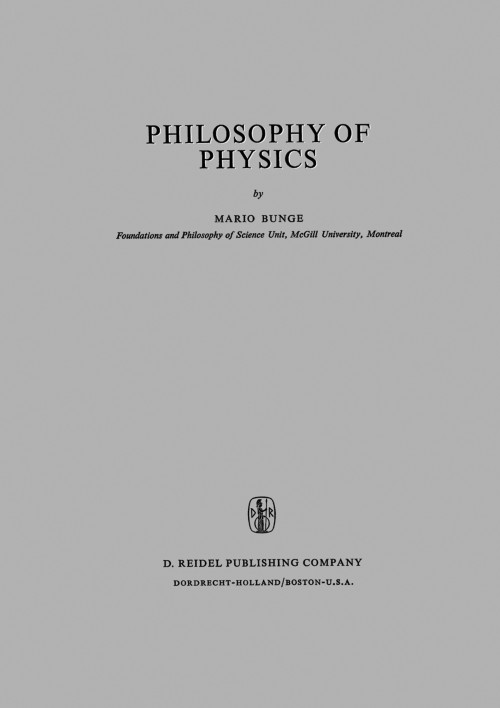
Philosophy of Physics [electronic resource] / by M. Bunge.
Erişim Adresi
ISBN
9789401025225
Dil Kodu
İngilizce
Yer Numarası
DK/13823
Yazar
Basım Bildirimi
1st ed. 1973.
Yayın Bilgisi
Dordrecht : Springer Netherlands : Imprint: Springer, 1973.
Fiziksel Niteleme
IX, 251 p. online resource.
Dizi
Synthese Library, Studies in Epistemology, Logic, Methodology, and Philosophy of Science, 2542-8292 ; 45
İçindekiler Notu
1 / Philosophy: Beacon or Trap -- 2 / Foundations: Clarity and Order -- 3 / Physical Theory: Overview -- 4 / The Referents of a Physical Theory -- 5 / Quantum Mechanics in Search of its Referent -- 6 / Analogy and Complementarity -- 7 / The Axiomatic Format -- 8 / Examples and Advantages of Axiomatics -- 9 / The Network of Theories -- 10 / The Theory/Experiment Interface -- Index of Names -- Index of Subjects.
Özet, vb.
This book deals with some of the current issues in the philosophy, methodology and foundations of physics. Some such problems are: - Do mathematical formalisms interpret themselves or is it necessary to adjoin them interpretation assumptions, and if so how are these as sumptions to be framed? - What are physical theories about: physical systems or laboratory operations or both or neither? - How are the basic concepts of a theory to be introduced: by ref erence to measurements or by explicit definition or axiomatically? - What is the use ofaxiomatics in physics? - How are the various physical theories inter-related: like Chinese boxes or in more complex ways? - What is the role of analogy in the construction and in the inter pretation of physical theories? In particular, are classical analogues like those of particle and wave indispensable in quantum theories? - What is the role of the apparatus in quantum phenomena and what is the place of measurement theory in quantum mechanics? - How does a theory face experiment: single-handed or with the help of further theories? These and several other questions of the kind are met with by the research physicist, the physics teacher and the physics student in their everyday work. If dodged they will recur. And a wrong answer to them may obscure the understanding of what has been achieved and may even hamper further advancement. Philosophy, methodology and foundations, like rose bushes, are enjoyable when cultivated but become ugly and thorny when neglected.
Konu
Science __ Philosophy.
Philosophy of Science.
Philosophy of Science.
Kurum Adı
Eseri Alıntıla
Referansları kullanmadan önce gözden geçirmeniz ve varsa gerekli düzeltmeleri yapmanız önerilir.
Dijital Kaynak
MARC Görünümü
LEADER 04480nam a22005415i 4500
001 812574
003 TR_AnAIT
005 20260130233935
007 cr nn 008mamaa
008 121227s1973 ne | s |||| 0|eng d
020 |a9789401025225|9978-94-010-2522-5
024 7 |a10.1007/978-94-010-2522-5|2doi
041 |aeng
049 |aTürk Tarih Kurumu Kütüphanesi
050 4|aQ174-175.3
050 4|aB67
072 7|aPDA|2bicssc
072 7|aSCI075000|2bisacsh
072 7|aPDA|2thema
082 04|a501|223
090 |aDK/13823
100 1 |aBunge, M.|eauthor.|4aut|4http://id.loc.gov/vocabulary/relators/aut
245 10|aPhilosophy of Physics|h[electronic resource] /|cby M. Bunge.
250 |a1st ed. 1973.
264 1|aDordrecht :|bSpringer Netherlands :|bImprint: Springer,|c1973.
300 |aIX, 251 p.|bonline resource.
336 |atext|btxt|2rdacontent
337 |acomputer|bc|2rdamedia
338 |aonline resource|bcr|2rdacarrier
347 |atext file|bPDF|2rda
490 1 |aSynthese Library, Studies in Epistemology, Logic, Methodology, and Philosophy of Science,|x2542-8292 ;|v45
505 0 |a1 / Philosophy: Beacon or Trap -- 2 / Foundations: Clarity and Order -- 3 / Physical Theory: Overview -- 4 / The Referents of a Physical Theory -- 5 / Quantum Mechanics in Search of its Referent -- 6 / Analogy and Complementarity -- 7 / The Axiomatic Format -- 8 / Examples and Advantages of Axiomatics -- 9 / The Network of Theories -- 10 / The Theory/Experiment Interface -- Index of Names -- Index of Subjects.
520 |aThis book deals with some of the current issues in the philosophy, methodology and foundations of physics. Some such problems are: - Do mathematical formalisms interpret themselves or is it necessary to adjoin them interpretation assumptions, and if so how are these as sumptions to be framed? - What are physical theories about: physical systems or laboratory operations or both or neither? - How are the basic concepts of a theory to be introduced: by ref erence to measurements or by explicit definition or axiomatically? - What is the use ofaxiomatics in physics? - How are the various physical theories inter-related: like Chinese boxes or in more complex ways? - What is the role of analogy in the construction and in the inter pretation of physical theories? In particular, are classical analogues like those of particle and wave indispensable in quantum theories? - What is the role of the apparatus in quantum phenomena and what is the place of measurement theory in quantum mechanics? - How does a theory face experiment: single-handed or with the help of further theories? These and several other questions of the kind are met with by the research physicist, the physics teacher and the physics student in their everyday work. If dodged they will recur. And a wrong answer to them may obscure the understanding of what has been achieved and may even hamper further advancement. Philosophy, methodology and foundations, like rose bushes, are enjoyable when cultivated but become ugly and thorny when neglected.
532 8 |aAccessibility summary: This PDF is not accessible. It is based on scanned pages and does not support features such as screen reader compatibility or described non-text content (images, graphs etc). However, it likely supports searchable and selectable text based on OCR (Optical Character Recognition). Users with accessibility needs may not be able to use this content effectively. Please contact us at accessibilitysupport@springernature.com if you require assistance or an alternative format.
532 8 |aInaccessible, or known limited accessibility
532 8 |aNo reading system accessibility options actively disabled
532 8 |aPublisher contact for further accessibility information: accessibilitysupport@springernature.com
650 0|aScience|xPhilosophy.
650 14|aPhilosophy of Science.
710 2 |aSpringerLink (Online service)
773 0 |tSpringer Nature eBook
776 08|iPrinted edition:|z9789027702531
776 08|iPrinted edition:|z9789401025232
776 08|iPrinted edition:|z9789401025249
830 0|aSynthese Library, Studies in Epistemology, Logic, Methodology, and Philosophy of Science,|x2542-8292 ;|v45
856 40|uhttps://doi.org/10.1007/978-94-010-2522-5
912 |aZDB-2-SHU
912 |aZDB-2-SXPR
912 |aZDB-2-BAE
950 |aHumanities, Social Sciences and Law (SpringerNature-11648)
950 |aPhilosophy and Religion (R0) (SpringerNature-43725)
001 812574
003 TR_AnAIT
005 20260130233935
007 cr nn 008mamaa
008 121227s1973 ne | s |||| 0|eng d
020 |a9789401025225|9978-94-010-2522-5
024 7 |a10.1007/978-94-010-2522-5|2doi
041 |aeng
049 |aTürk Tarih Kurumu Kütüphanesi
050 4|aQ174-175.3
050 4|aB67
072 7|aPDA|2bicssc
072 7|aSCI075000|2bisacsh
072 7|aPDA|2thema
082 04|a501|223
090 |aDK/13823
100 1 |aBunge, M.|eauthor.|4aut|4http://id.loc.gov/vocabulary/relators/aut
245 10|aPhilosophy of Physics|h[electronic resource] /|cby M. Bunge.
250 |a1st ed. 1973.
264 1|aDordrecht :|bSpringer Netherlands :|bImprint: Springer,|c1973.
300 |aIX, 251 p.|bonline resource.
336 |atext|btxt|2rdacontent
337 |acomputer|bc|2rdamedia
338 |aonline resource|bcr|2rdacarrier
347 |atext file|bPDF|2rda
490 1 |aSynthese Library, Studies in Epistemology, Logic, Methodology, and Philosophy of Science,|x2542-8292 ;|v45
505 0 |a1 / Philosophy: Beacon or Trap -- 2 / Foundations: Clarity and Order -- 3 / Physical Theory: Overview -- 4 / The Referents of a Physical Theory -- 5 / Quantum Mechanics in Search of its Referent -- 6 / Analogy and Complementarity -- 7 / The Axiomatic Format -- 8 / Examples and Advantages of Axiomatics -- 9 / The Network of Theories -- 10 / The Theory/Experiment Interface -- Index of Names -- Index of Subjects.
520 |aThis book deals with some of the current issues in the philosophy, methodology and foundations of physics. Some such problems are: - Do mathematical formalisms interpret themselves or is it necessary to adjoin them interpretation assumptions, and if so how are these as sumptions to be framed? - What are physical theories about: physical systems or laboratory operations or both or neither? - How are the basic concepts of a theory to be introduced: by ref erence to measurements or by explicit definition or axiomatically? - What is the use ofaxiomatics in physics? - How are the various physical theories inter-related: like Chinese boxes or in more complex ways? - What is the role of analogy in the construction and in the inter pretation of physical theories? In particular, are classical analogues like those of particle and wave indispensable in quantum theories? - What is the role of the apparatus in quantum phenomena and what is the place of measurement theory in quantum mechanics? - How does a theory face experiment: single-handed or with the help of further theories? These and several other questions of the kind are met with by the research physicist, the physics teacher and the physics student in their everyday work. If dodged they will recur. And a wrong answer to them may obscure the understanding of what has been achieved and may even hamper further advancement. Philosophy, methodology and foundations, like rose bushes, are enjoyable when cultivated but become ugly and thorny when neglected.
532 8 |aAccessibility summary: This PDF is not accessible. It is based on scanned pages and does not support features such as screen reader compatibility or described non-text content (images, graphs etc). However, it likely supports searchable and selectable text based on OCR (Optical Character Recognition). Users with accessibility needs may not be able to use this content effectively. Please contact us at accessibilitysupport@springernature.com if you require assistance or an alternative format.
532 8 |aInaccessible, or known limited accessibility
532 8 |aNo reading system accessibility options actively disabled
532 8 |aPublisher contact for further accessibility information: accessibilitysupport@springernature.com
650 0|aScience|xPhilosophy.
650 14|aPhilosophy of Science.
710 2 |aSpringerLink (Online service)
773 0 |tSpringer Nature eBook
776 08|iPrinted edition:|z9789027702531
776 08|iPrinted edition:|z9789401025232
776 08|iPrinted edition:|z9789401025249
830 0|aSynthese Library, Studies in Epistemology, Logic, Methodology, and Philosophy of Science,|x2542-8292 ;|v45
856 40|uhttps://doi.org/10.1007/978-94-010-2522-5
912 |aZDB-2-SHU
912 |aZDB-2-SXPR
912 |aZDB-2-BAE
950 |aHumanities, Social Sciences and Law (SpringerNature-11648)
950 |aPhilosophy and Religion (R0) (SpringerNature-43725)
Materyaller
Depodan talep edilen materyal sadece kütüphane içerisinde kullanılmaktadır.
Materyal dışarıya ödünç verilmemektedir.
Materyal dışarıya ödünç verilmemektedir.
