LEADER 04122nam a22005295i 4500
001 812577
003 TR_AnAIT
005 20260130233930
007 cr nn 008mamaa
008 150610s2015 xxu| s |||| 0|eng d
020 |a9781493922796|9978-1-4939-2279-6
024 7 |a10.1007/978-1-4939-2279-6|2doi
041 |aeng
049 |aTürk Tarih Kurumu Kütüphanesi
050 4|aHV6001-7220.5
072 7|aJKV|2bicssc
072 7|aSOC004000|2bisacsh
072 7|aJKV|2thema
082 04|a364|223
090 |aDK/13826
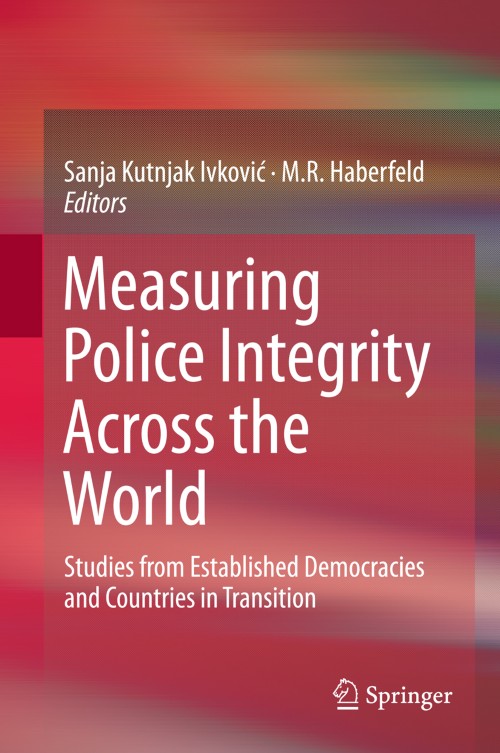
245 10|aMeasuring Police Integrity Across the World|h[electronic resource] :|bStudies from Established Democracies and Countries in Transition /|cedited by Sanja Kutnjak Ivković, M.R. Haberfeld.
250 |a1st ed. 2015.
264 1|aNew York, NY :|bSpringer New York :|bImprint: Springer,|c2015.
300 |aXIX, 376 p. 22 illus.|bonline resource.
336 |atext|btxt|2rdacontent
337 |acomputer|bc|2rdamedia
338 |aonline resource|bcr|2rdacarrier
347 |atext file|bPDF|2rda
505 0 |aPreface.- Studying Police Integrity -- Police Integrity in Armenia -- Police Integrity in Australia -- Police Integrity in Croatia -- Police Integrity in Estonia -- Police Integrity in Russia -- Police Integrity in Slovenia -- Police Integrity in South Africa -- Police Integrity in South Korea -- Police Integrity in Thailand -- Police Integrity in the United States -- A Comparative Perspective on Police Integrity -- Index.
520 |aThis book brings together research on police integrity on regions worldwide. The results for each country indicate whether police officers know the official rules, how seriously they view police misconduct, what they think the appropriate and expected discipline for misconduct should be, and how willing they are to report it. Police misconduct refers to everything from corruption and use excessive force, to perjury, falsification of evidence, and failure to react. Police Integrity and police misconduct are topics of great concern worldwide. Police integrity is envisioned as the inclination to resist temptations to abuse the rights and privileges of police occupation. Using their extensive experience studying police integrity in the United States, the editors have created an applicable framework for measuring police integrity in other countries. The results of their research are brought together in this timely volume, including contributions from both established democracies and countries in transition, which each present unique challenges for improving police integrity. Each chapter follows the same format and contains a theoretical analysis of the relevant legal, historical, political, social, and economic conditions in the country, followed by the analyses of empirical results and policy recommendations. In the last chapter, editors Kutnjak Ivković and Haberfeld take a comparative look across the countries by engaging in the in-depth comparative analysis. This work will be of interest to researchers and policy-makers studying policing both in the United States and internationally, presenting a theoretical framework that can be applied to other regions for further research.
650 0|aCriminology.
650 0|aPrivate international law.
650 0|aConflict of laws.
650 0|aInternational law.
650 0|aComparative law.
650 14|aCriminology.
650 24|aPrivate International Law, International and Foreign Law, Comparative Law.
700 1 |aKutnjak Ivković, Sanja.|eeditor.|4edt|4http://id.loc.gov/vocabulary/relators/edt
700 1 |aHaberfeld, M.R.|eeditor.|4edt|4http://id.loc.gov/vocabulary/relators/edt
710 2 |aSpringerLink (Online service)
773 0 |tSpringer Nature eBook
776 08|iPrinted edition:|z9781493922789
776 08|iPrinted edition:|z9781493922802
776 08|iPrinted edition:|z9781493942916
776 08|iPrinted edition:|z9781493976546
856 40|uhttps://doi.org/10.1007/978-1-4939-2279-6
912 |aZDB-2-SHU
912 |aZDB-2-SXS
950 |aHumanities, Social Sciences and Law (SpringerNature-11648)
950 |aSocial Sciences (R0) (SpringerNature-43726)