LEADER 04281nam a22006135i 4500
001 812587
003 TR_AnAIT
005 20260130233919
007 cr nn 008mamaa
008 100623s2010 ne | s |||| 0|eng d
020 |a9789048136155|9978-90-481-3615-5
024 7 |a10.1007/978-90-481-3615-5|2doi
041 |aeng
049 |aTürk Tarih Kurumu Kütüphanesi
050 4|aQ174-175.3
050 4|aB67
072 7|aPDA|2bicssc
072 7|aSCI075000|2bisacsh
072 7|aPDA|2thema
082 04|a501|223
090 |aDK/13836
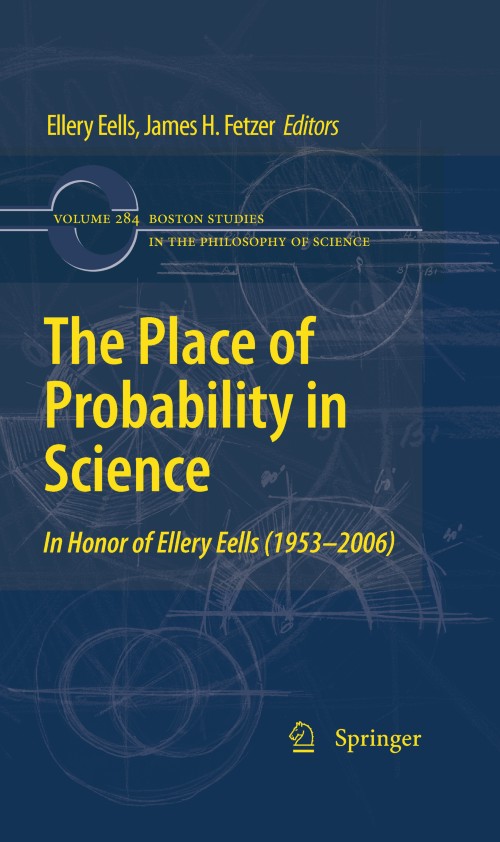
245 14|aThe Place of Probability in Science|h[electronic resource] :|bIn Honor of Ellery Eells (1953-2006) /|cedited by Ellery Eells, J.H. Fetzer.
250 |a1st ed. 2010.
264 1|aDordrecht :|bSpringer Netherlands :|bImprint: Springer,|c2010.
300 |aXLIV, 368 p.|bonline resource.
336 |atext|btxt|2rdacontent
337 |acomputer|bc|2rdamedia
338 |aonline resource|bcr|2rdacarrier
347 |atext file|bPDF|2rda
490 1 |aBoston Studies in the Philosophy and History of Science,|x2214-7942 ;|v284
505 0 |aALTERNATIVE CONCEPTIONS OF PROBABILITY -- Probabilistic Causality and Causal Generalizations -- Probabilistic Causality and Causal Generalizations -- The Possibility of Infinitesimal Chances -- Probabilistic Metaphysics -- THE OBJECTIVITY OF MACRO-PROBABILITIES -- Chance and Necessity -- Evolutionary Theory and the Reality of Macro-Probabilities -- Is Evolution An Optimizing Process? -- PROBABILITIES AS EXPLANATORY PROPERTIES -- Propensity Trajectories, Preemption, and the Identity of Events -- Miraculous Consilience of Quantum Mechanics -- Probability and Objectivity in Deterministic and Indeterministic Situations -- PROBABILITIES IN INFERENCE AND DECISION -- How Bayesian Confirmation Theory Handles the Paradox of the Ravens -- Learning to Network -- Probabilities in Decision Rules -- Propensities and Frequencies.
520 |aScience aims at the discovery of general principles of special kinds that are applicable for the explanation and prediction of the phenomena of the world in the form of theories and laws. When the phenomena themselves happen to be general, the principlesinvolved assume the form of theories; and when they are p- ticular, they assume the form of general laws. Theories themselves are sets of laws and de nitions that apply to a common domain, which makes laws indispensable to science. Understanding science thus depends upon understanding the nature of theories and laws, the logical structure of explanations and predictions based upon them, and the principles of inference and decision that apply to theories and laws. Laws and theories can differ in their form as well as in their content. The laws of quantum mechanics are indeterministic (or probabilistic), for example, while those of classical mechanics are deterministic (or universal) instead. The history of science re ects an increasing role for probabilities as properties of the world but also as measures of evidential support and as degrees of subjective belief. Our purpose is to clarify and illuminate the place of probability in science.
650 0|aScience|xPhilosophy.
650 0|aProbabilities.
650 0|aKnowledge, Theory of.
650 0|aStatistics.
650 0|aPhilosophy and social sciences.
650 0|aPhilosophy, Modern.
650 14|aPhilosophy of Science.
650 24|aProbability Theory.
650 24|aEpistemology.
650 24|aStatistical Theory and Methods.
650 24|aPhilosophy of the Social Sciences.
650 24|aEarly Modern Philosophy.
700 1 |aEells, Ellery.|eeditor.|4edt|4http://id.loc.gov/vocabulary/relators/edt
700 1 |aFetzer, J.H.|eeditor.|4edt|4http://id.loc.gov/vocabulary/relators/edt
710 2 |aSpringerLink (Online service)
773 0 |tSpringer Nature eBook
776 08|iPrinted edition:|z9789048136148
776 08|iPrinted edition:|z9789048136247
776 08|iPrinted edition:|z9789400732513
830 0|aBoston Studies in the Philosophy and History of Science,|x2214-7942 ;|v284
856 40|uhttps://doi.org/10.1007/978-90-481-3615-5
912 |aZDB-2-SHU
912 |aZDB-2-SXPR
950 |aHumanities, Social Sciences and Law (SpringerNature-11648)
950 |aPhilosophy and Religion (R0) (SpringerNature-43725)