

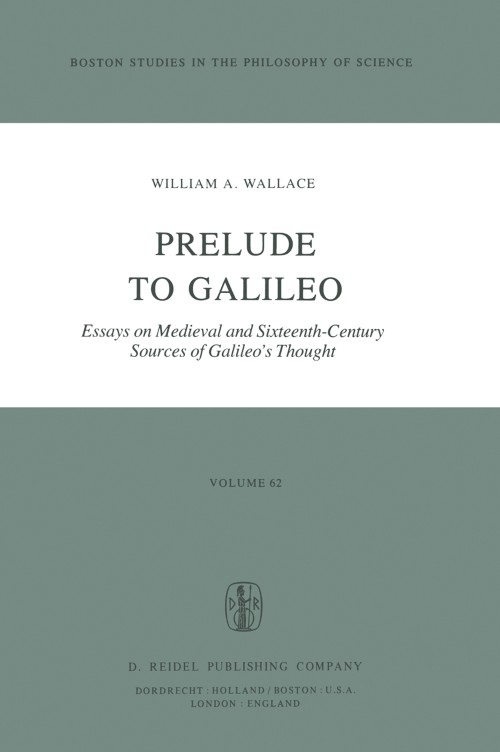
Prelude to Galileo [electronic resource] : Essays on Medieval and Sixteenth-Century Sources of Galileo’s Thought / by W. A. Wallace.
Erişim Adresi
ISBN
9789400984042
Dil Kodu
İngilizce
Yer Numarası
DK/13874
Yazar
Basım Bildirimi
1st ed. 1981.
Yayın Bilgisi
Dordrecht : Springer Netherlands : Imprint: Springer, 1981.
Fiziksel Niteleme
XVI, 372 p. online resource.
Dizi
Boston Studies in the Philosophy and History of Science, 2214-7942 ; 62
İçindekiler Notu
I: Medieval Prologue -- 1. The Philosophical Setting of Medieval Science -- 2. The Medieval Accomplishment in Mechanics and Optics -- II: The Sixteenth-Century Achievement -- 3. The Development of Mechanics to the Sixteenth Century -- 4. The Concept of Motion in the Sixteenth Century -- 5. The Calculatores in the Sixteenth Century -- 6. The Enigma of Domingo de Soto -- 7. Causes and Forces at the Collegio Romano -- III: Galileo in the Sixteenth-Century Context -- 8. Galileo and Reasoning Ex suppositione -- 9. Galileo and the Thomists -- 10. Galileo and the Doctores Parisienses -- 11. Galileo and the Scotists -- 12. Galileo and Albertus Magnus -- 13. Galileo and the Causality of Nature -- IV: From Medieval to Early Modern Science -- 14. Pierre Duhem: Galileo and the Science of Motion -- 15. Anneliese Maier: Galileo and Theories of Impetus -- 16. Ernest Moody: Galileo and Nominalism -- Index of Names.
Özet, vb.
Can it be true that Galilean studies will be without end, without conclusion, that each interpreter will find his own Galileo? William A. Wallace seems to have a historical grasp which will have to be matched by any further workers: he sees directly into Galileo's primary epoch of intellectual formation, the sixteenth century. In this volume, Wallace provides the companion to his splendid annotated translation of Galileo 's Early Notebooks: The Physical Questions (University of Notre Dame Press, 1977), pointing to the 'realist' sources, mainly unearthed by the author himself during the past two decades. Explicit controversy arises, for the issues are serious: nominalism and realism, two early rivals for the foundation of knowledge, contend at the birth of modem science, OI better yet, contend in our modem efforts to understand that birth. Related to this, continuity and discontinuity, so opposed to each other, are interwoven in the interpretive writings ever since those striking works of Duhem in the first years of this century, and the later studies of Annaliese Maier, Alexandre Koyre and E. A. Moody. Historio grapher as well as philosopher, WaUace has critically supported the continuity of scientific development without abandoning the revolutionary transforma tive achievement of Galileo's labors. That continuity had its contemporary as well as developmental quality; and we note that William Wallace's Prelude studies are complementary to Maurice A.
Konu
Science __ Philosophy.
History.
Philosophy and social sciences.
Philosophy of Science.
History.
Philosophy of the Social Sciences.
History.
Philosophy and social sciences.
Philosophy of Science.
History.
Philosophy of the Social Sciences.
Kurum Adı
Eseri Alıntıla
Referansları kullanmadan önce gözden geçirmeniz ve varsa gerekli düzeltmeleri yapmanız önerilir.
Dijital Kaynak
MARC Görünümü
LEADER 05096nam a22005895i 4500
001 812628
003 TR_AnAIT
005 20260130233726
007 cr nn 008mamaa
008 121227s1981 ne | s |||| 0|eng d
020 |a9789400984042|9978-94-009-8404-2
024 7 |a10.1007/978-94-009-8404-2|2doi
041 |aeng
049 |aTürk Tarih Kurumu Kütüphanesi
050 4|aQ174-175.3
050 4|aB67
072 7|aPDA|2bicssc
072 7|aSCI075000|2bisacsh
072 7|aPDA|2thema
082 04|a501|223
090 |aDK/13874
100 1 |aWallace, W. A.|eauthor.|4aut|4http://id.loc.gov/vocabulary/relators/aut
245 10|aPrelude to Galileo|h[electronic resource] :|bEssays on Medieval and Sixteenth-Century Sources of Galileo’s Thought /|cby W. A. Wallace.
250 |a1st ed. 1981.
264 1|aDordrecht :|bSpringer Netherlands :|bImprint: Springer,|c1981.
300 |aXVI, 372 p.|bonline resource.
336 |atext|btxt|2rdacontent
337 |acomputer|bc|2rdamedia
338 |aonline resource|bcr|2rdacarrier
347 |atext file|bPDF|2rda
490 1 |aBoston Studies in the Philosophy and History of Science,|x2214-7942 ;|v62
505 0 |aI: Medieval Prologue -- 1. The Philosophical Setting of Medieval Science -- 2. The Medieval Accomplishment in Mechanics and Optics -- II: The Sixteenth-Century Achievement -- 3. The Development of Mechanics to the Sixteenth Century -- 4. The Concept of Motion in the Sixteenth Century -- 5. The Calculatores in the Sixteenth Century -- 6. The Enigma of Domingo de Soto -- 7. Causes and Forces at the Collegio Romano -- III: Galileo in the Sixteenth-Century Context -- 8. Galileo and Reasoning Ex suppositione -- 9. Galileo and the Thomists -- 10. Galileo and the Doctores Parisienses -- 11. Galileo and the Scotists -- 12. Galileo and Albertus Magnus -- 13. Galileo and the Causality of Nature -- IV: From Medieval to Early Modern Science -- 14. Pierre Duhem: Galileo and the Science of Motion -- 15. Anneliese Maier: Galileo and Theories of Impetus -- 16. Ernest Moody: Galileo and Nominalism -- Index of Names.
520 |aCan it be true that Galilean studies will be without end, without conclusion, that each interpreter will find his own Galileo? William A. Wallace seems to have a historical grasp which will have to be matched by any further workers: he sees directly into Galileo's primary epoch of intellectual formation, the sixteenth century. In this volume, Wallace provides the companion to his splendid annotated translation of Galileo 's Early Notebooks: The Physical Questions (University of Notre Dame Press, 1977), pointing to the 'realist' sources, mainly unearthed by the author himself during the past two decades. Explicit controversy arises, for the issues are serious: nominalism and realism, two early rivals for the foundation of knowledge, contend at the birth of modem science, OI better yet, contend in our modem efforts to understand that birth. Related to this, continuity and discontinuity, so opposed to each other, are interwoven in the interpretive writings ever since those striking works of Duhem in the first years of this century, and the later studies of Annaliese Maier, Alexandre Koyre and E. A. Moody. Historio grapher as well as philosopher, WaUace has critically supported the continuity of scientific development without abandoning the revolutionary transforma tive achievement of Galileo's labors. That continuity had its contemporary as well as developmental quality; and we note that William Wallace's Prelude studies are complementary to Maurice A.
532 8 |aAccessibility summary: This PDF is not accessible. It is based on scanned pages and does not support features such as screen reader compatibility or described non-text content (images, graphs etc). However, it likely supports searchable and selectable text based on OCR (Optical Character Recognition). Users with accessibility needs may not be able to use this content effectively. Please contact us at accessibilitysupport@springernature.com if you require assistance or an alternative format.
532 8 |aInaccessible, or known limited accessibility
532 8 |aNo reading system accessibility options actively disabled
532 8 |aPublisher contact for further accessibility information: accessibilitysupport@springernature.com
650 0|aScience|xPhilosophy.
650 0|aHistory.
650 0|aPhilosophy and social sciences.
650 14|aPhilosophy of Science.
650 24|aHistory.
650 24|aPhilosophy of the Social Sciences.
710 2 |aSpringerLink (Online service)
773 0 |tSpringer Nature eBook
776 08|iPrinted edition:|z9789027712158
776 08|iPrinted edition:|z9789400984059
776 08|iPrinted edition:|z9789400984066
830 0|aBoston Studies in the Philosophy and History of Science,|x2214-7942 ;|v62
856 40|uhttps://doi.org/10.1007/978-94-009-8404-2
912 |aZDB-2-SHU
912 |aZDB-2-SXPR
912 |aZDB-2-BAE
950 |aHumanities, Social Sciences and Law (SpringerNature-11648)
950 |aPhilosophy and Religion (R0) (SpringerNature-43725)
001 812628
003 TR_AnAIT
005 20260130233726
007 cr nn 008mamaa
008 121227s1981 ne | s |||| 0|eng d
020 |a9789400984042|9978-94-009-8404-2
024 7 |a10.1007/978-94-009-8404-2|2doi
041 |aeng
049 |aTürk Tarih Kurumu Kütüphanesi
050 4|aQ174-175.3
050 4|aB67
072 7|aPDA|2bicssc
072 7|aSCI075000|2bisacsh
072 7|aPDA|2thema
082 04|a501|223
090 |aDK/13874
100 1 |aWallace, W. A.|eauthor.|4aut|4http://id.loc.gov/vocabulary/relators/aut
245 10|aPrelude to Galileo|h[electronic resource] :|bEssays on Medieval and Sixteenth-Century Sources of Galileo’s Thought /|cby W. A. Wallace.
250 |a1st ed. 1981.
264 1|aDordrecht :|bSpringer Netherlands :|bImprint: Springer,|c1981.
300 |aXVI, 372 p.|bonline resource.
336 |atext|btxt|2rdacontent
337 |acomputer|bc|2rdamedia
338 |aonline resource|bcr|2rdacarrier
347 |atext file|bPDF|2rda
490 1 |aBoston Studies in the Philosophy and History of Science,|x2214-7942 ;|v62
505 0 |aI: Medieval Prologue -- 1. The Philosophical Setting of Medieval Science -- 2. The Medieval Accomplishment in Mechanics and Optics -- II: The Sixteenth-Century Achievement -- 3. The Development of Mechanics to the Sixteenth Century -- 4. The Concept of Motion in the Sixteenth Century -- 5. The Calculatores in the Sixteenth Century -- 6. The Enigma of Domingo de Soto -- 7. Causes and Forces at the Collegio Romano -- III: Galileo in the Sixteenth-Century Context -- 8. Galileo and Reasoning Ex suppositione -- 9. Galileo and the Thomists -- 10. Galileo and the Doctores Parisienses -- 11. Galileo and the Scotists -- 12. Galileo and Albertus Magnus -- 13. Galileo and the Causality of Nature -- IV: From Medieval to Early Modern Science -- 14. Pierre Duhem: Galileo and the Science of Motion -- 15. Anneliese Maier: Galileo and Theories of Impetus -- 16. Ernest Moody: Galileo and Nominalism -- Index of Names.
520 |aCan it be true that Galilean studies will be without end, without conclusion, that each interpreter will find his own Galileo? William A. Wallace seems to have a historical grasp which will have to be matched by any further workers: he sees directly into Galileo's primary epoch of intellectual formation, the sixteenth century. In this volume, Wallace provides the companion to his splendid annotated translation of Galileo 's Early Notebooks: The Physical Questions (University of Notre Dame Press, 1977), pointing to the 'realist' sources, mainly unearthed by the author himself during the past two decades. Explicit controversy arises, for the issues are serious: nominalism and realism, two early rivals for the foundation of knowledge, contend at the birth of modem science, OI better yet, contend in our modem efforts to understand that birth. Related to this, continuity and discontinuity, so opposed to each other, are interwoven in the interpretive writings ever since those striking works of Duhem in the first years of this century, and the later studies of Annaliese Maier, Alexandre Koyre and E. A. Moody. Historio grapher as well as philosopher, WaUace has critically supported the continuity of scientific development without abandoning the revolutionary transforma tive achievement of Galileo's labors. That continuity had its contemporary as well as developmental quality; and we note that William Wallace's Prelude studies are complementary to Maurice A.
532 8 |aAccessibility summary: This PDF is not accessible. It is based on scanned pages and does not support features such as screen reader compatibility or described non-text content (images, graphs etc). However, it likely supports searchable and selectable text based on OCR (Optical Character Recognition). Users with accessibility needs may not be able to use this content effectively. Please contact us at accessibilitysupport@springernature.com if you require assistance or an alternative format.
532 8 |aInaccessible, or known limited accessibility
532 8 |aNo reading system accessibility options actively disabled
532 8 |aPublisher contact for further accessibility information: accessibilitysupport@springernature.com
650 0|aScience|xPhilosophy.
650 0|aHistory.
650 0|aPhilosophy and social sciences.
650 14|aPhilosophy of Science.
650 24|aHistory.
650 24|aPhilosophy of the Social Sciences.
710 2 |aSpringerLink (Online service)
773 0 |tSpringer Nature eBook
776 08|iPrinted edition:|z9789027712158
776 08|iPrinted edition:|z9789400984059
776 08|iPrinted edition:|z9789400984066
830 0|aBoston Studies in the Philosophy and History of Science,|x2214-7942 ;|v62
856 40|uhttps://doi.org/10.1007/978-94-009-8404-2
912 |aZDB-2-SHU
912 |aZDB-2-SXPR
912 |aZDB-2-BAE
950 |aHumanities, Social Sciences and Law (SpringerNature-11648)
950 |aPhilosophy and Religion (R0) (SpringerNature-43725)
Materyaller
Depodan talep edilen materyal sadece kütüphane içerisinde kullanılmaktadır.
Materyal dışarıya ödünç verilmemektedir.
Materyal dışarıya ödünç verilmemektedir.
