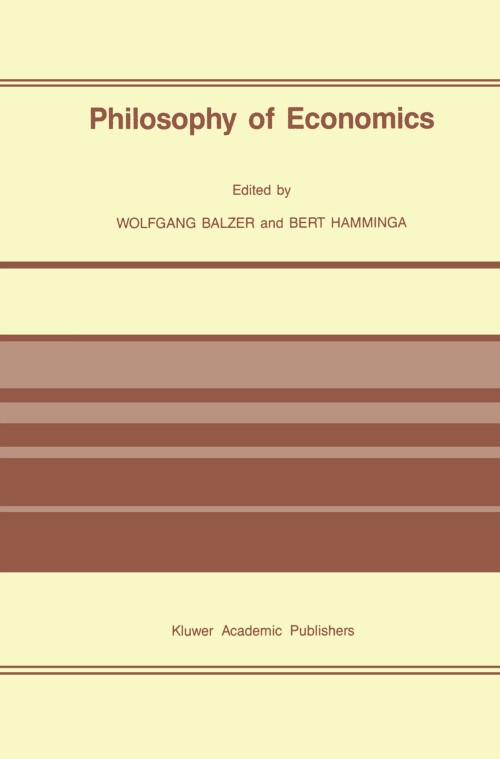
Philosophy of Economics [electronic resource] / edited by W. Balzer, Bert Hamminga.
Erişim Adresi
ISBN
9789400923195
Dil Kodu
İngilizce
Yer Numarası
DK/13897
Basım Bildirimi
1st ed. 1989.
Yayın Bilgisi
Dordrecht : Springer Netherlands : Imprint: Springer, 1989.
Fiziksel Niteleme
IV, 276 p. online resource.
İçindekiler Notu
Philosophy of Economics -- Arbitrage Arguments -- Average Explanations -- Are Generic Predictions Enough? -- Self-Refuting Theories of Strategic Interaction: A Paradox of Common Knowledge -- Open Problems in the Foundations of Price Formation Dynamics -- Economics and Technological Change: Some Conceptual and Methodological Issues -- Ordinary Least Squares as a Method of Measurement -- The Development of Marx’s Economic Theory -- Structuralist Reconstructions of Classical and Keynesian Macroeconomics -- Stratification of General Equilibrium Theory: A Synthesis of Reconstructions -- Micro-Economic Models of Problem Choice in Basic Science -- On the (Idealizational) Structure of Economic Theories -- Sneed Versus Nowak: An Illustration in Economics -- Further Publications of the Authors.
Özet, vb.
The last decade witnessed an unprecedented annual growth of the literature dealing with the philosophy of economics,as well as the first signs of an institutionalization (conferences, an international journal) of the philosophy of economics as a scientific subject in itself - in particular in the U.S. In 1981 a meeting took place with participants mainly of European "continental" origin. In July 1987, we organized a second conference "Philosophy of Economics II" at Tilburg Uni versity, The Netherlands, mainly aiming at the establishment of first contacts between the middle-European group and researchers from the U.S. The present volume contains the papers presented at this conference. Philosophical thought on economics in recent years split up in many different streams, two of which are represented in the larger part of this volume. The first of these streams was formed by a group of researchers mainly from middle-Europe, who make empirical studies of the logical structures of the different theories as they find them presented in economic literature. Two methods prevail here. First, the structuralist method, as exemplified in the writings of Sneed, Stegmiiller and others, of describing the object of a theory as a set of ("partial potential") models. Such models consist of sets and relationships between these sets, which represent the concepts used in the theory.
Konu
Science __ Philosophy.
Economics.
Sociology __ Methodology.
Philosophy of Science.
Economics.
Sociological Methods.
Economics.
Sociology __ Methodology.
Philosophy of Science.
Economics.
Sociological Methods.
Diğer Yazarlar
Kurum Adı

Eseri Alıntıla
Referansları kullanmadan önce gözden geçirmeniz ve varsa gerekli düzeltmeleri yapmanız önerilir.
Dijital Kaynak
MARC Görünümü
LEADER 04725nam a22005775i 4500
001 812651
003 TR_AnAIT
005 20260130233548
007 cr nn 008mamaa
008 121227s1989 ne | s |||| 0|eng d
020 |a9789400923195|9978-94-009-2319-5
024 7 |a10.1007/978-94-009-2319-5|2doi
041 |aeng
049 |aTürk Tarih Kurumu Kütüphanesi
050 4|aQ174-175.3
050 4|aB67
072 7|aPDA|2bicssc
072 7|aSCI075000|2bisacsh
072 7|aPDA|2thema
082 04|a501|223
090 |aDK/13897
245 10|aPhilosophy of Economics|h[electronic resource] /|cedited by W. Balzer, Bert Hamminga.
250 |a1st ed. 1989.
264 1|aDordrecht :|bSpringer Netherlands :|bImprint: Springer,|c1989.
300 |aIV, 276 p.|bonline resource.
336 |atext|btxt|2rdacontent
337 |acomputer|bc|2rdamedia
338 |aonline resource|bcr|2rdacarrier
347 |atext file|bPDF|2rda
505 0 |aPhilosophy of Economics -- Arbitrage Arguments -- Average Explanations -- Are Generic Predictions Enough? -- Self-Refuting Theories of Strategic Interaction: A Paradox of Common Knowledge -- Open Problems in the Foundations of Price Formation Dynamics -- Economics and Technological Change: Some Conceptual and Methodological Issues -- Ordinary Least Squares as a Method of Measurement -- The Development of Marx’s Economic Theory -- Structuralist Reconstructions of Classical and Keynesian Macroeconomics -- Stratification of General Equilibrium Theory: A Synthesis of Reconstructions -- Micro-Economic Models of Problem Choice in Basic Science -- On the (Idealizational) Structure of Economic Theories -- Sneed Versus Nowak: An Illustration in Economics -- Further Publications of the Authors.
520 |aThe last decade witnessed an unprecedented annual growth of the literature dealing with the philosophy of economics,as well as the first signs of an institutionalization (conferences, an international journal) of the philosophy of economics as a scientific subject in itself - in particular in the U.S. In 1981 a meeting took place with participants mainly of European "continental" origin. In July 1987, we organized a second conference "Philosophy of Economics II" at Tilburg Uni versity, The Netherlands, mainly aiming at the establishment of first contacts between the middle-European group and researchers from the U.S. The present volume contains the papers presented at this conference. Philosophical thought on economics in recent years split up in many different streams, two of which are represented in the larger part of this volume. The first of these streams was formed by a group of researchers mainly from middle-Europe, who make empirical studies of the logical structures of the different theories as they find them presented in economic literature. Two methods prevail here. First, the structuralist method, as exemplified in the writings of Sneed, Stegmiiller and others, of describing the object of a theory as a set of ("partial potential") models. Such models consist of sets and relationships between these sets, which represent the concepts used in the theory.
532 8 |aAccessibility summary: This PDF is not accessible. It is based on scanned pages and does not support features such as screen reader compatibility or described non-text content (images, graphs etc). However, it likely supports searchable and selectable text based on OCR (Optical Character Recognition). Users with accessibility needs may not be able to use this content effectively. Please contact us at accessibilitysupport@springernature.com if you require assistance or an alternative format.
532 8 |aInaccessible, or known limited accessibility
532 8 |aNo reading system accessibility options actively disabled
532 8 |aPublisher contact for further accessibility information: accessibilitysupport@springernature.com
650 0|aScience|xPhilosophy.
650 0|aEconomics.
650 0|aSociology|xMethodology.
650 14|aPhilosophy of Science.
650 24|aEconomics.
650 24|aSociological Methods.
700 1 |aBalzer, W.|eeditor.|4edt|4http://id.loc.gov/vocabulary/relators/edt
700 1 |aHamminga, Bert.|eeditor.|4edt|4http://id.loc.gov/vocabulary/relators/edt
710 2 |aSpringerLink (Online service)
773 0 |tSpringer Nature eBook
776 08|iPrinted edition:|z9780792301578
776 08|iPrinted edition:|z9789400923201
776 08|iPrinted edition:|z9789401075428
856 40|uhttps://doi.org/10.1007/978-94-009-2319-5
912 |aZDB-2-SHU
912 |aZDB-2-SXPR
912 |aZDB-2-BAE
950 |aHumanities, Social Sciences and Law (SpringerNature-11648)
950 |aPhilosophy and Religion (R0) (SpringerNature-43725)
001 812651
003 TR_AnAIT
005 20260130233548
007 cr nn 008mamaa
008 121227s1989 ne | s |||| 0|eng d
020 |a9789400923195|9978-94-009-2319-5
024 7 |a10.1007/978-94-009-2319-5|2doi
041 |aeng
049 |aTürk Tarih Kurumu Kütüphanesi
050 4|aQ174-175.3
050 4|aB67
072 7|aPDA|2bicssc
072 7|aSCI075000|2bisacsh
072 7|aPDA|2thema
082 04|a501|223
090 |aDK/13897
245 10|aPhilosophy of Economics|h[electronic resource] /|cedited by W. Balzer, Bert Hamminga.
250 |a1st ed. 1989.
264 1|aDordrecht :|bSpringer Netherlands :|bImprint: Springer,|c1989.
300 |aIV, 276 p.|bonline resource.
336 |atext|btxt|2rdacontent
337 |acomputer|bc|2rdamedia
338 |aonline resource|bcr|2rdacarrier
347 |atext file|bPDF|2rda
505 0 |aPhilosophy of Economics -- Arbitrage Arguments -- Average Explanations -- Are Generic Predictions Enough? -- Self-Refuting Theories of Strategic Interaction: A Paradox of Common Knowledge -- Open Problems in the Foundations of Price Formation Dynamics -- Economics and Technological Change: Some Conceptual and Methodological Issues -- Ordinary Least Squares as a Method of Measurement -- The Development of Marx’s Economic Theory -- Structuralist Reconstructions of Classical and Keynesian Macroeconomics -- Stratification of General Equilibrium Theory: A Synthesis of Reconstructions -- Micro-Economic Models of Problem Choice in Basic Science -- On the (Idealizational) Structure of Economic Theories -- Sneed Versus Nowak: An Illustration in Economics -- Further Publications of the Authors.
520 |aThe last decade witnessed an unprecedented annual growth of the literature dealing with the philosophy of economics,as well as the first signs of an institutionalization (conferences, an international journal) of the philosophy of economics as a scientific subject in itself - in particular in the U.S. In 1981 a meeting took place with participants mainly of European "continental" origin. In July 1987, we organized a second conference "Philosophy of Economics II" at Tilburg Uni versity, The Netherlands, mainly aiming at the establishment of first contacts between the middle-European group and researchers from the U.S. The present volume contains the papers presented at this conference. Philosophical thought on economics in recent years split up in many different streams, two of which are represented in the larger part of this volume. The first of these streams was formed by a group of researchers mainly from middle-Europe, who make empirical studies of the logical structures of the different theories as they find them presented in economic literature. Two methods prevail here. First, the structuralist method, as exemplified in the writings of Sneed, Stegmiiller and others, of describing the object of a theory as a set of ("partial potential") models. Such models consist of sets and relationships between these sets, which represent the concepts used in the theory.
532 8 |aAccessibility summary: This PDF is not accessible. It is based on scanned pages and does not support features such as screen reader compatibility or described non-text content (images, graphs etc). However, it likely supports searchable and selectable text based on OCR (Optical Character Recognition). Users with accessibility needs may not be able to use this content effectively. Please contact us at accessibilitysupport@springernature.com if you require assistance or an alternative format.
532 8 |aInaccessible, or known limited accessibility
532 8 |aNo reading system accessibility options actively disabled
532 8 |aPublisher contact for further accessibility information: accessibilitysupport@springernature.com
650 0|aScience|xPhilosophy.
650 0|aEconomics.
650 0|aSociology|xMethodology.
650 14|aPhilosophy of Science.
650 24|aEconomics.
650 24|aSociological Methods.
700 1 |aBalzer, W.|eeditor.|4edt|4http://id.loc.gov/vocabulary/relators/edt
700 1 |aHamminga, Bert.|eeditor.|4edt|4http://id.loc.gov/vocabulary/relators/edt
710 2 |aSpringerLink (Online service)
773 0 |tSpringer Nature eBook
776 08|iPrinted edition:|z9780792301578
776 08|iPrinted edition:|z9789400923201
776 08|iPrinted edition:|z9789401075428
856 40|uhttps://doi.org/10.1007/978-94-009-2319-5
912 |aZDB-2-SHU
912 |aZDB-2-SXPR
912 |aZDB-2-BAE
950 |aHumanities, Social Sciences and Law (SpringerNature-11648)
950 |aPhilosophy and Religion (R0) (SpringerNature-43725)
Materyaller
Depodan talep edilen materyal sadece kütüphane içerisinde kullanılmaktadır.
Materyal dışarıya ödünç verilmemektedir.
