

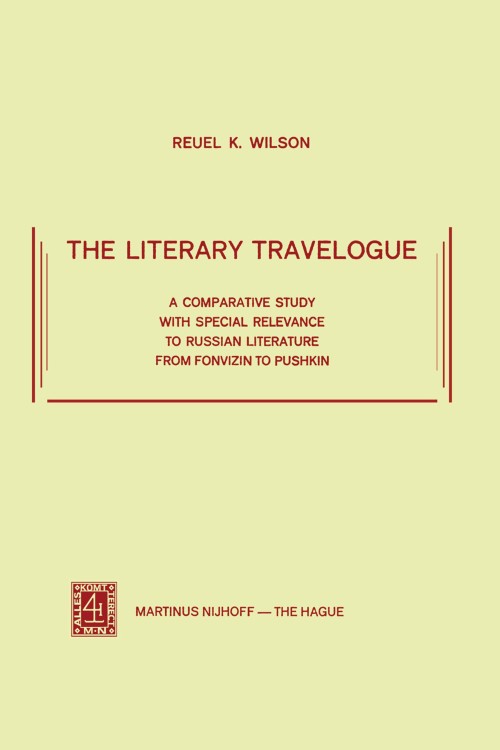
The Literary Travelogue [electronic resource] : A Comparative Study with Special Relevance to Russian Literature from Fonvizin to Pushkin / by R.K. Wilson.
Erişim Adresi
ISBN
9789401019972
Dil Kodu
İngilizce
Yer Numarası
DK/13921
Yazar
Basım Bildirimi
1st ed. 1973.
Yayın Bilgisi
Dordrecht : Springer Netherlands : Imprint: Springer, 1973.
Fiziksel Niteleme
XIV, 136 p. online resource.
İçindekiler Notu
I: Evolution of the Travel Genre in Western Europe -- I: Some Historical Examples — The Eighteenth Century. Goethe and Moritz -- II: Sterne’s Sentimental Journey -- III: Demaistre’s Voyage autour de ma Chambre -- IV: Dupaty’s Lettres sur l’Italie -- II: The Travel Memoir in Russia -- V: Fonvizin’s Letters from Abroad -- VI: Radishchev’s Journey from St. Petersburg to Moscow -- VII: Pushkin’s Journey from Moscow to Petersburg -- VIII: Karamzin’s Letters of a Russian Traveler -- IX: The Epigones -- X: Pushkin’s Journey to Erzurum -- XI: Conclusion -- Appendix A: Ermenonville -- Appendix B: Auch ich in Arkadien -- Appendix C: Karamzin’s Island of Bornholm -- Appendix D: Onegin’s Journey -- Selected Bibliography.
Özet, vb.
The aim of this study is to trace the development of the literary travel memoir in Russia during the last decades of the eighteenth century and the first decades of the nineteenth. Having indicated the prove nances of this genre in Western Europe, I shall evaluate its role in Russian literary history. Because this study is not intended to be an historical survey of all significant travel works that appeared in Russia, I shall pass over such early pioneer travelers as the Abbot Daniil who visited Palestine at the beginning of the twelfth century and recorded for his countrymen detailed descriptions of the Holy places, or the merchant, Afanasij Nikitin, whose travel notes concerning a trip to India are preserved in a fifteenth century chronicle. The travel genre, which had become enormously popular in eight eenth century Western Europe,l was cleverly exploited by Fonvizin, Radishchev, and Karamzin to expound to the Russian reading public certain important notions on literary theory, on society (foreign and domestic), on themselves, and on nature. The travel genre - then as now a flexible instrument for transmitting, by means of diary-style narrative, information about distant, often exotic people and place- had been adapted by Sterne and others to themes having little relation to a conventional journey. The Russians were quick to grasp the genre's literary as well as its polemical possibilities, and influenced by Western models, they too used it to convey theoretical assertions on a variety of SUbjects.
Konu
Political science __ Philosophy.
Political Philosophy.
Political Philosophy.
Kurum Adı
Eseri Alıntıla
Referansları kullanmadan önce gözden geçirmeniz ve varsa gerekli düzeltmeleri yapmanız önerilir.
Dijital Kaynak
MARC Görünümü
LEADER 04607nam a22004935i 4500
001 812675
003 TR_AnAIT
005 20260130233400
007 cr nn 008mamaa
008 121227s1973 ne | s |||| 0|eng d
020 |a9789401019972|9978-94-010-1997-2
024 7 |a10.1007/978-94-010-1997-2|2doi
041 |aeng
049 |aTürk Tarih Kurumu Kütüphanesi
050 4|aB65
072 7|aHPS|2bicssc
072 7|aPHI019000|2bisacsh
072 7|aQDTS|2thema
082 04|a320.01|223
090 |aDK/13921
100 1 |aWilson, R.K.|eauthor.|4aut|4http://id.loc.gov/vocabulary/relators/aut
245 14|aThe Literary Travelogue|h[electronic resource] :|bA Comparative Study with Special Relevance to Russian Literature from Fonvizin to Pushkin /|cby R.K. Wilson.
250 |a1st ed. 1973.
264 1|aDordrecht :|bSpringer Netherlands :|bImprint: Springer,|c1973.
300 |aXIV, 136 p.|bonline resource.
336 |atext|btxt|2rdacontent
337 |acomputer|bc|2rdamedia
338 |aonline resource|bcr|2rdacarrier
347 |atext file|bPDF|2rda
505 0 |aI: Evolution of the Travel Genre in Western Europe -- I: Some Historical Examples — The Eighteenth Century. Goethe and Moritz -- II: Sterne’s Sentimental Journey -- III: Demaistre’s Voyage autour de ma Chambre -- IV: Dupaty’s Lettres sur l’Italie -- II: The Travel Memoir in Russia -- V: Fonvizin’s Letters from Abroad -- VI: Radishchev’s Journey from St. Petersburg to Moscow -- VII: Pushkin’s Journey from Moscow to Petersburg -- VIII: Karamzin’s Letters of a Russian Traveler -- IX: The Epigones -- X: Pushkin’s Journey to Erzurum -- XI: Conclusion -- Appendix A: Ermenonville -- Appendix B: Auch ich in Arkadien -- Appendix C: Karamzin’s Island of Bornholm -- Appendix D: Onegin’s Journey -- Selected Bibliography.
520 |aThe aim of this study is to trace the development of the literary travel memoir in Russia during the last decades of the eighteenth century and the first decades of the nineteenth. Having indicated the prove nances of this genre in Western Europe, I shall evaluate its role in Russian literary history. Because this study is not intended to be an historical survey of all significant travel works that appeared in Russia, I shall pass over such early pioneer travelers as the Abbot Daniil who visited Palestine at the beginning of the twelfth century and recorded for his countrymen detailed descriptions of the Holy places, or the merchant, Afanasij Nikitin, whose travel notes concerning a trip to India are preserved in a fifteenth century chronicle. The travel genre, which had become enormously popular in eight eenth century Western Europe,l was cleverly exploited by Fonvizin, Radishchev, and Karamzin to expound to the Russian reading public certain important notions on literary theory, on society (foreign and domestic), on themselves, and on nature. The travel genre - then as now a flexible instrument for transmitting, by means of diary-style narrative, information about distant, often exotic people and place- had been adapted by Sterne and others to themes having little relation to a conventional journey. The Russians were quick to grasp the genre's literary as well as its polemical possibilities, and influenced by Western models, they too used it to convey theoretical assertions on a variety of SUbjects.
532 8 |aAccessibility summary: This PDF is not accessible. It is based on scanned pages and does not support features such as screen reader compatibility or described non-text content (images, graphs etc). However, it likely supports searchable and selectable text based on OCR (Optical Character Recognition). Users with accessibility needs may not be able to use this content effectively. Please contact us at accessibilitysupport@springernature.com if you require assistance or an alternative format.
532 8 |aInaccessible, or known limited accessibility
532 8 |aNo reading system accessibility options actively disabled
532 8 |aPublisher contact for further accessibility information: accessibilitysupport@springernature.com
650 0|aPolitical science|xPhilosophy.
650 14|aPolitical Philosophy.
710 2 |aSpringerLink (Online service)
773 0 |tSpringer Nature eBook
776 08|iPrinted edition:|z9789024715589
776 08|iPrinted edition:|z9789401019989
856 40|uhttps://doi.org/10.1007/978-94-010-1997-2
912 |aZDB-2-SHU
912 |aZDB-2-SXPR
912 |aZDB-2-BAE
950 |aHumanities, Social Sciences and Law (SpringerNature-11648)
950 |aPhilosophy and Religion (R0) (SpringerNature-43725)
001 812675
003 TR_AnAIT
005 20260130233400
007 cr nn 008mamaa
008 121227s1973 ne | s |||| 0|eng d
020 |a9789401019972|9978-94-010-1997-2
024 7 |a10.1007/978-94-010-1997-2|2doi
041 |aeng
049 |aTürk Tarih Kurumu Kütüphanesi
050 4|aB65
072 7|aHPS|2bicssc
072 7|aPHI019000|2bisacsh
072 7|aQDTS|2thema
082 04|a320.01|223
090 |aDK/13921
100 1 |aWilson, R.K.|eauthor.|4aut|4http://id.loc.gov/vocabulary/relators/aut
245 14|aThe Literary Travelogue|h[electronic resource] :|bA Comparative Study with Special Relevance to Russian Literature from Fonvizin to Pushkin /|cby R.K. Wilson.
250 |a1st ed. 1973.
264 1|aDordrecht :|bSpringer Netherlands :|bImprint: Springer,|c1973.
300 |aXIV, 136 p.|bonline resource.
336 |atext|btxt|2rdacontent
337 |acomputer|bc|2rdamedia
338 |aonline resource|bcr|2rdacarrier
347 |atext file|bPDF|2rda
505 0 |aI: Evolution of the Travel Genre in Western Europe -- I: Some Historical Examples — The Eighteenth Century. Goethe and Moritz -- II: Sterne’s Sentimental Journey -- III: Demaistre’s Voyage autour de ma Chambre -- IV: Dupaty’s Lettres sur l’Italie -- II: The Travel Memoir in Russia -- V: Fonvizin’s Letters from Abroad -- VI: Radishchev’s Journey from St. Petersburg to Moscow -- VII: Pushkin’s Journey from Moscow to Petersburg -- VIII: Karamzin’s Letters of a Russian Traveler -- IX: The Epigones -- X: Pushkin’s Journey to Erzurum -- XI: Conclusion -- Appendix A: Ermenonville -- Appendix B: Auch ich in Arkadien -- Appendix C: Karamzin’s Island of Bornholm -- Appendix D: Onegin’s Journey -- Selected Bibliography.
520 |aThe aim of this study is to trace the development of the literary travel memoir in Russia during the last decades of the eighteenth century and the first decades of the nineteenth. Having indicated the prove nances of this genre in Western Europe, I shall evaluate its role in Russian literary history. Because this study is not intended to be an historical survey of all significant travel works that appeared in Russia, I shall pass over such early pioneer travelers as the Abbot Daniil who visited Palestine at the beginning of the twelfth century and recorded for his countrymen detailed descriptions of the Holy places, or the merchant, Afanasij Nikitin, whose travel notes concerning a trip to India are preserved in a fifteenth century chronicle. The travel genre, which had become enormously popular in eight eenth century Western Europe,l was cleverly exploited by Fonvizin, Radishchev, and Karamzin to expound to the Russian reading public certain important notions on literary theory, on society (foreign and domestic), on themselves, and on nature. The travel genre - then as now a flexible instrument for transmitting, by means of diary-style narrative, information about distant, often exotic people and place- had been adapted by Sterne and others to themes having little relation to a conventional journey. The Russians were quick to grasp the genre's literary as well as its polemical possibilities, and influenced by Western models, they too used it to convey theoretical assertions on a variety of SUbjects.
532 8 |aAccessibility summary: This PDF is not accessible. It is based on scanned pages and does not support features such as screen reader compatibility or described non-text content (images, graphs etc). However, it likely supports searchable and selectable text based on OCR (Optical Character Recognition). Users with accessibility needs may not be able to use this content effectively. Please contact us at accessibilitysupport@springernature.com if you require assistance or an alternative format.
532 8 |aInaccessible, or known limited accessibility
532 8 |aNo reading system accessibility options actively disabled
532 8 |aPublisher contact for further accessibility information: accessibilitysupport@springernature.com
650 0|aPolitical science|xPhilosophy.
650 14|aPolitical Philosophy.
710 2 |aSpringerLink (Online service)
773 0 |tSpringer Nature eBook
776 08|iPrinted edition:|z9789024715589
776 08|iPrinted edition:|z9789401019989
856 40|uhttps://doi.org/10.1007/978-94-010-1997-2
912 |aZDB-2-SHU
912 |aZDB-2-SXPR
912 |aZDB-2-BAE
950 |aHumanities, Social Sciences and Law (SpringerNature-11648)
950 |aPhilosophy and Religion (R0) (SpringerNature-43725)
Materyaller
Depodan talep edilen materyal sadece kütüphane içerisinde kullanılmaktadır.
Materyal dışarıya ödünç verilmemektedir.
Materyal dışarıya ödünç verilmemektedir.
