

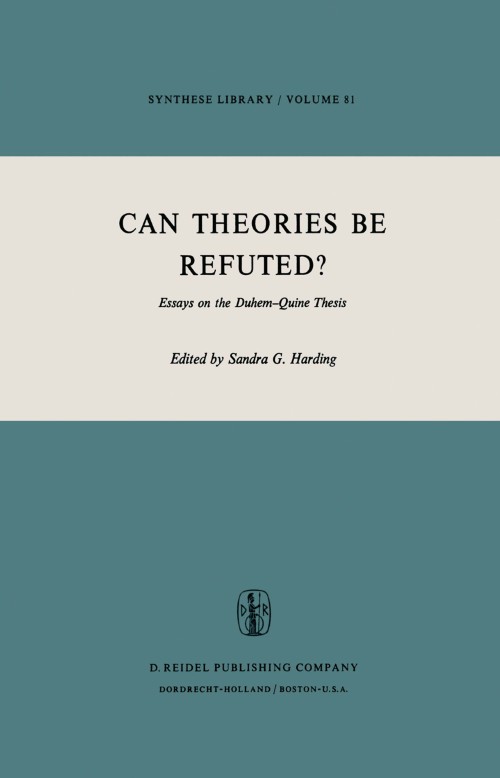
Can Theories be Refuted? [electronic resource] : Essays on the Duhem-Quine Thesis / edited by Sandra Harding.
Erişim Adresi
ISBN
9789401018630
Dil Kodu
İngilizce
Yer Numarası
DK/13950
Basım Bildirimi
1st ed. 1976.
Yayın Bilgisi
Dordrecht : Springer Netherlands : Imprint: Springer, 1976.
Fiziksel Niteleme
XXI, 323 p. online resource.
Dizi
Synthese Library, Studies in Epistemology, Logic, Methodology, and Philosophy of Science, 2542-8292 ; 81
İçindekiler Notu
Physical Theory and Experiment -- Two Dogmas of Empiricism -- Empiricist Criteria of Cognitive Significance: Problems and Changes -- Some Fundamental Problems in the Logic of Scientific Discovery -- Background Knowledge and Scientific Growth -- The Duhemian Argument -- A Comment on Grünbaum’s Claim -- Scientific Revolutions as Changes of World View -- Grünbaum on ‘The Duhemian Argument’ -- Quine, Grünbaum, and the Duhemian Thesis -- Duhem, Quine and Grünbaum on Falsification -- Duhem, Quine and a New Empiricism -- Falsification and the Methodology of Scientific Research Programmes -- Is it never Possible to Falsify a Hypothesis Irrevocably? -- The Rationality of Science (From‘Against Method’) -- Index of Names.
Özet, vb.
According to a view assumed by many scientists and philosophers of science and standardly found in science textbooks, it is controlled ex perience which provides the basis for distinguishing between acceptable and unacceptable theories in science: acceptable theories are those which can pass empirical tests. It has often been thought that a certain sort of test is particularly significant: 'crucial experiments' provide supporting empiri cal evidence for one theory while providing conclusive evidence against another. However, in 1906 Pierre Duhem argued that the falsification of a theory is necessarily ambiguous and therefore that there are no crucial experiments; one can never be sure that it is a given theory rather than auxiliary or background hypotheses which experiment has falsified. w. V. Quine has concurred in this judgment, arguing that "our statements about the external world face the tribunal of sense experience not indi vidually but only as a corporate body". Some philosophers have thought that the Duhem-Quine thesis gra tuitously raises perplexities. Others see it as doubly significant; these philosophers think that it provides a base for criticism of the foundational view of knowledge which has dominated much of western thought since Descartes, and they think that it opens the door to a new and fruitful way to conceive of scientific progress in particular and of the nature and growth of knowledge in general.
Konu
Science __ Philosophy.
Philosophy of Science.
Philosophy of Science.
Diğer Yazarlar
Kurum Adı
Eseri Alıntıla
Referansları kullanmadan önce gözden geçirmeniz ve varsa gerekli düzeltmeleri yapmanız önerilir.
Dijital Kaynak
MARC Görünümü
LEADER 04786nam a22005415i 4500
001 812704
003 TR_AnAIT
005 20260130233239
007 cr nn 008mamaa
008 121227s1976 ne | s |||| 0|eng d
020 |a9789401018630|9978-94-010-1863-0
024 7 |a10.1007/978-94-010-1863-0|2doi
041 |aeng
049 |aTürk Tarih Kurumu Kütüphanesi
050 4|aQ174-175.3
050 4|aB67
072 7|aPDA|2bicssc
072 7|aSCI075000|2bisacsh
072 7|aPDA|2thema
082 04|a501|223
090 |aDK/13950
245 10|aCan Theories be Refuted?|h[electronic resource] :|bEssays on the Duhem-Quine Thesis /|cedited by Sandra Harding.
250 |a1st ed. 1976.
264 1|aDordrecht :|bSpringer Netherlands :|bImprint: Springer,|c1976.
300 |aXXI, 323 p.|bonline resource.
336 |atext|btxt|2rdacontent
337 |acomputer|bc|2rdamedia
338 |aonline resource|bcr|2rdacarrier
347 |atext file|bPDF|2rda
490 1 |aSynthese Library, Studies in Epistemology, Logic, Methodology, and Philosophy of Science,|x2542-8292 ;|v81
505 0 |aPhysical Theory and Experiment -- Two Dogmas of Empiricism -- Empiricist Criteria of Cognitive Significance: Problems and Changes -- Some Fundamental Problems in the Logic of Scientific Discovery -- Background Knowledge and Scientific Growth -- The Duhemian Argument -- A Comment on Grünbaum’s Claim -- Scientific Revolutions as Changes of World View -- Grünbaum on ‘The Duhemian Argument’ -- Quine, Grünbaum, and the Duhemian Thesis -- Duhem, Quine and Grünbaum on Falsification -- Duhem, Quine and a New Empiricism -- Falsification and the Methodology of Scientific Research Programmes -- Is it never Possible to Falsify a Hypothesis Irrevocably? -- The Rationality of Science (From‘Against Method’) -- Index of Names.
520 |aAccording to a view assumed by many scientists and philosophers of science and standardly found in science textbooks, it is controlled ex perience which provides the basis for distinguishing between acceptable and unacceptable theories in science: acceptable theories are those which can pass empirical tests. It has often been thought that a certain sort of test is particularly significant: 'crucial experiments' provide supporting empiri cal evidence for one theory while providing conclusive evidence against another. However, in 1906 Pierre Duhem argued that the falsification of a theory is necessarily ambiguous and therefore that there are no crucial experiments; one can never be sure that it is a given theory rather than auxiliary or background hypotheses which experiment has falsified. w. V. Quine has concurred in this judgment, arguing that "our statements about the external world face the tribunal of sense experience not indi vidually but only as a corporate body". Some philosophers have thought that the Duhem-Quine thesis gra tuitously raises perplexities. Others see it as doubly significant; these philosophers think that it provides a base for criticism of the foundational view of knowledge which has dominated much of western thought since Descartes, and they think that it opens the door to a new and fruitful way to conceive of scientific progress in particular and of the nature and growth of knowledge in general.
532 8 |aAccessibility summary: This PDF is not accessible. It is based on scanned pages and does not support features such as screen reader compatibility or described non-text content (images, graphs etc). However, it likely supports searchable and selectable text based on OCR (Optical Character Recognition). Users with accessibility needs may not be able to use this content effectively. Please contact us at accessibilitysupport@springernature.com if you require assistance or an alternative format.
532 8 |aInaccessible, or known limited accessibility
532 8 |aNo reading system accessibility options actively disabled
532 8 |aPublisher contact for further accessibility information: accessibilitysupport@springernature.com
650 0|aScience|xPhilosophy.
650 14|aPhilosophy of Science.
700 1 |aHarding, Sandra.|eeditor.|4edt|4http://id.loc.gov/vocabulary/relators/edt
710 2 |aSpringerLink (Online service)
773 0 |tSpringer Nature eBook
776 08|iPrinted edition:|z9789027706294
776 08|iPrinted edition:|z9789027706300
776 08|iPrinted edition:|z9789401018647
830 0|aSynthese Library, Studies in Epistemology, Logic, Methodology, and Philosophy of Science,|x2542-8292 ;|v81
856 40|uhttps://doi.org/10.1007/978-94-010-1863-0
912 |aZDB-2-SHU
912 |aZDB-2-SXPR
912 |aZDB-2-BAE
950 |aHumanities, Social Sciences and Law (SpringerNature-11648)
950 |aPhilosophy and Religion (R0) (SpringerNature-43725)
001 812704
003 TR_AnAIT
005 20260130233239
007 cr nn 008mamaa
008 121227s1976 ne | s |||| 0|eng d
020 |a9789401018630|9978-94-010-1863-0
024 7 |a10.1007/978-94-010-1863-0|2doi
041 |aeng
049 |aTürk Tarih Kurumu Kütüphanesi
050 4|aQ174-175.3
050 4|aB67
072 7|aPDA|2bicssc
072 7|aSCI075000|2bisacsh
072 7|aPDA|2thema
082 04|a501|223
090 |aDK/13950
245 10|aCan Theories be Refuted?|h[electronic resource] :|bEssays on the Duhem-Quine Thesis /|cedited by Sandra Harding.
250 |a1st ed. 1976.
264 1|aDordrecht :|bSpringer Netherlands :|bImprint: Springer,|c1976.
300 |aXXI, 323 p.|bonline resource.
336 |atext|btxt|2rdacontent
337 |acomputer|bc|2rdamedia
338 |aonline resource|bcr|2rdacarrier
347 |atext file|bPDF|2rda
490 1 |aSynthese Library, Studies in Epistemology, Logic, Methodology, and Philosophy of Science,|x2542-8292 ;|v81
505 0 |aPhysical Theory and Experiment -- Two Dogmas of Empiricism -- Empiricist Criteria of Cognitive Significance: Problems and Changes -- Some Fundamental Problems in the Logic of Scientific Discovery -- Background Knowledge and Scientific Growth -- The Duhemian Argument -- A Comment on Grünbaum’s Claim -- Scientific Revolutions as Changes of World View -- Grünbaum on ‘The Duhemian Argument’ -- Quine, Grünbaum, and the Duhemian Thesis -- Duhem, Quine and Grünbaum on Falsification -- Duhem, Quine and a New Empiricism -- Falsification and the Methodology of Scientific Research Programmes -- Is it never Possible to Falsify a Hypothesis Irrevocably? -- The Rationality of Science (From‘Against Method’) -- Index of Names.
520 |aAccording to a view assumed by many scientists and philosophers of science and standardly found in science textbooks, it is controlled ex perience which provides the basis for distinguishing between acceptable and unacceptable theories in science: acceptable theories are those which can pass empirical tests. It has often been thought that a certain sort of test is particularly significant: 'crucial experiments' provide supporting empiri cal evidence for one theory while providing conclusive evidence against another. However, in 1906 Pierre Duhem argued that the falsification of a theory is necessarily ambiguous and therefore that there are no crucial experiments; one can never be sure that it is a given theory rather than auxiliary or background hypotheses which experiment has falsified. w. V. Quine has concurred in this judgment, arguing that "our statements about the external world face the tribunal of sense experience not indi vidually but only as a corporate body". Some philosophers have thought that the Duhem-Quine thesis gra tuitously raises perplexities. Others see it as doubly significant; these philosophers think that it provides a base for criticism of the foundational view of knowledge which has dominated much of western thought since Descartes, and they think that it opens the door to a new and fruitful way to conceive of scientific progress in particular and of the nature and growth of knowledge in general.
532 8 |aAccessibility summary: This PDF is not accessible. It is based on scanned pages and does not support features such as screen reader compatibility or described non-text content (images, graphs etc). However, it likely supports searchable and selectable text based on OCR (Optical Character Recognition). Users with accessibility needs may not be able to use this content effectively. Please contact us at accessibilitysupport@springernature.com if you require assistance or an alternative format.
532 8 |aInaccessible, or known limited accessibility
532 8 |aNo reading system accessibility options actively disabled
532 8 |aPublisher contact for further accessibility information: accessibilitysupport@springernature.com
650 0|aScience|xPhilosophy.
650 14|aPhilosophy of Science.
700 1 |aHarding, Sandra.|eeditor.|4edt|4http://id.loc.gov/vocabulary/relators/edt
710 2 |aSpringerLink (Online service)
773 0 |tSpringer Nature eBook
776 08|iPrinted edition:|z9789027706294
776 08|iPrinted edition:|z9789027706300
776 08|iPrinted edition:|z9789401018647
830 0|aSynthese Library, Studies in Epistemology, Logic, Methodology, and Philosophy of Science,|x2542-8292 ;|v81
856 40|uhttps://doi.org/10.1007/978-94-010-1863-0
912 |aZDB-2-SHU
912 |aZDB-2-SXPR
912 |aZDB-2-BAE
950 |aHumanities, Social Sciences and Law (SpringerNature-11648)
950 |aPhilosophy and Religion (R0) (SpringerNature-43725)
Materyaller
Depodan talep edilen materyal sadece kütüphane içerisinde kullanılmaktadır.
Materyal dışarıya ödünç verilmemektedir.
Materyal dışarıya ödünç verilmemektedir.
