

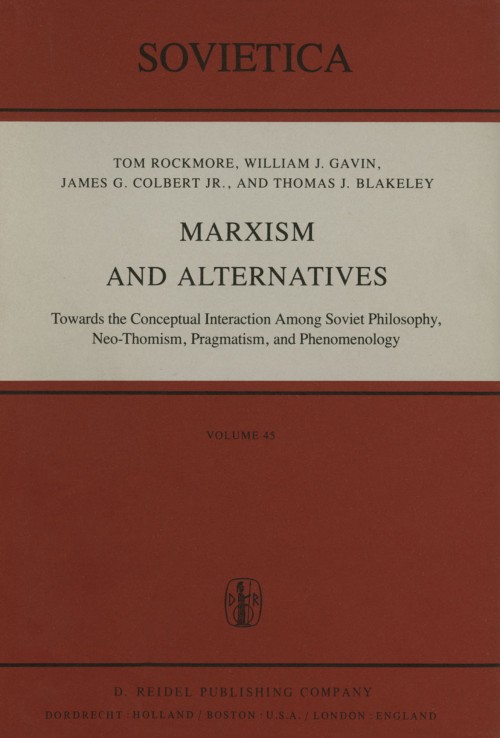
Marxism and Alternatives [electronic resource] : Towards the Conceptual Interaction Among Soviet Philosophy, Neo-Thomism, Pragmatism, and Phenomenology / by I Rockmore, W.J. Gavin, J.G. Colbert Jr., J.E. Blakeley.
Erişim Adresi
ISBN
9789400984950
Dil Kodu
İngilizce
Yer Numarası
DK/13956
Yazar
Basım Bildirimi
1st ed. 1981.
Yayın Bilgisi
Dordrecht : Springer Netherlands : Imprint: Springer, 1981.
Fiziksel Niteleme
XIV, 314 p. online resource.
Dizi
Sovietica ; 45
İçindekiler Notu
One: The Immanence of Marxism-Leninism -- 1. Emergence of the “New Soviet Man” -- 2. The Scientific-Technological Revolution -- 3. Dialectical Logic -- 4. The Dialectic of Nature -- 5. Meta-Marxism -- Two: The Transcendence of Neo-Thomism -- 6. Natural Law and the Common Good -- 7. Nature and Knowledge -- 8. Logic and Knowledge -- 9. Immateriality -- 10. The “Predicamental” Perspective -- Three: The Concreteness of Pragmatism -- 11. Context -- 12. Science and Progress -- 13. Making Logic Practical -- 14. Nature and the Natural -- 15. “Context” as a Philosophical Concept -- Four: The Transcendentalism of Phenomenology -- 16. The Phenomenological Movement -- 17. An Approach to Social Context -- 18. Phenomenological Methodology -- 19. An Ontological Phenomenology? -- 20. Meta-Phenomenology -- Five: Conclusion -- Notes -- Index of Names -- Index of Subjects.
Özet, vb.
Contemporary philosophy is by its nature pluralistic, to a perhaps greater extent than at any moment of the preceding tradition, in that there are multiple forms of thought competing for a position on the center of the philosophic stage. The reasons for this conceptual proliferation are numerous. But certainly one factor is the increasing development of contemporary means of publication and communication, which in turn make possible the rapid dissemination of ideas as well as an informed reaction to them. And this in turn has increased the possibility for serious philosophic exchange by enhancing the available opportunities for the interaction of competing forms of thought. But, although informed philosophic interaction has in principle become increasingly possible in recent years, the frequency, scope and quality of such discussion has often been less than satisfactory. Contemporary philosophic viewpoints tend not to interact in a Hegelian manner, as complementary aspects of a totally satisfactory and a-perspectival view, facets of a singly and all-embracing true position. Rather, contemporary philosophic viewpoints tend to portray themselves as mutually exclusive alternatives only occasionally willing to acknowledge the possible validity or even the intrinsic interest of other perspectives. Thus, although the multiplication of different forms of philosophy in principle means that there are greater possibilities for meaning ful exchange between them, in practice the tendency of each of the various philosophic positions to raise claims to philosophic truth from its point of view alone has had the effect of impeding such interaction.
Konu
Political science __ Philosophy.
Political Philosophy.
Political Philosophy.
Diğer Yazarlar
Kurum Adı
Eseri Alıntıla
Referansları kullanmadan önce gözden geçirmeniz ve varsa gerekli düzeltmeleri yapmanız önerilir.
Dijital Kaynak
MARC Görünümü
LEADER 05309nam a22005655i 4500
001 812710
003 TR_AnAIT
005 20260130233228
007 cr nn 008mamaa
008 121227s1981 ne | s |||| 0|eng d
020 |a9789400984950|9978-94-009-8495-0
024 7 |a10.1007/978-94-009-8495-0|2doi
041 |aeng
049 |aTürk Tarih Kurumu Kütüphanesi
050 4|aB65
072 7|aHPS|2bicssc
072 7|aPHI019000|2bisacsh
072 7|aQDTS|2thema
082 04|a320.01|223
090 |aDK/13956
100 1 |aRockmore, I.|eauthor.|4aut|4http://id.loc.gov/vocabulary/relators/aut
245 10|aMarxism and Alternatives|h[electronic resource] :|bTowards the Conceptual Interaction Among Soviet Philosophy, Neo-Thomism, Pragmatism, and Phenomenology /|cby I Rockmore, W.J. Gavin, J.G. Colbert Jr., J.E. Blakeley.
250 |a1st ed. 1981.
264 1|aDordrecht :|bSpringer Netherlands :|bImprint: Springer,|c1981.
300 |aXIV, 314 p.|bonline resource.
336 |atext|btxt|2rdacontent
337 |acomputer|bc|2rdamedia
338 |aonline resource|bcr|2rdacarrier
347 |atext file|bPDF|2rda
490 1 |aSovietica ;|v45
505 0 |aOne: The Immanence of Marxism-Leninism -- 1. Emergence of the “New Soviet Man” -- 2. The Scientific-Technological Revolution -- 3. Dialectical Logic -- 4. The Dialectic of Nature -- 5. Meta-Marxism -- Two: The Transcendence of Neo-Thomism -- 6. Natural Law and the Common Good -- 7. Nature and Knowledge -- 8. Logic and Knowledge -- 9. Immateriality -- 10. The “Predicamental” Perspective -- Three: The Concreteness of Pragmatism -- 11. Context -- 12. Science and Progress -- 13. Making Logic Practical -- 14. Nature and the Natural -- 15. “Context” as a Philosophical Concept -- Four: The Transcendentalism of Phenomenology -- 16. The Phenomenological Movement -- 17. An Approach to Social Context -- 18. Phenomenological Methodology -- 19. An Ontological Phenomenology? -- 20. Meta-Phenomenology -- Five: Conclusion -- Notes -- Index of Names -- Index of Subjects.
520 |aContemporary philosophy is by its nature pluralistic, to a perhaps greater extent than at any moment of the preceding tradition, in that there are multiple forms of thought competing for a position on the center of the philosophic stage. The reasons for this conceptual proliferation are numerous. But certainly one factor is the increasing development of contemporary means of publication and communication, which in turn make possible the rapid dissemination of ideas as well as an informed reaction to them. And this in turn has increased the possibility for serious philosophic exchange by enhancing the available opportunities for the interaction of competing forms of thought. But, although informed philosophic interaction has in principle become increasingly possible in recent years, the frequency, scope and quality of such discussion has often been less than satisfactory. Contemporary philosophic viewpoints tend not to interact in a Hegelian manner, as complementary aspects of a totally satisfactory and a-perspectival view, facets of a singly and all-embracing true position. Rather, contemporary philosophic viewpoints tend to portray themselves as mutually exclusive alternatives only occasionally willing to acknowledge the possible validity or even the intrinsic interest of other perspectives. Thus, although the multiplication of different forms of philosophy in principle means that there are greater possibilities for meaning ful exchange between them, in practice the tendency of each of the various philosophic positions to raise claims to philosophic truth from its point of view alone has had the effect of impeding such interaction.
532 8 |aAccessibility summary: This PDF is not accessible. It is based on scanned pages and does not support features such as screen reader compatibility or described non-text content (images, graphs etc). However, it likely supports searchable and selectable text based on OCR (Optical Character Recognition). Users with accessibility needs may not be able to use this content effectively. Please contact us at accessibilitysupport@springernature.com if you require assistance or an alternative format.
532 8 |aInaccessible, or known limited accessibility
532 8 |aNo reading system accessibility options actively disabled
532 8 |aPublisher contact for further accessibility information: accessibilitysupport@springernature.com
650 0|aPolitical science|xPhilosophy.
650 14|aPolitical Philosophy.
700 1 |aGavin, W.J.|eauthor.|4aut|4http://id.loc.gov/vocabulary/relators/aut
700 1 |aColbert Jr., J.G.|eauthor.|4aut|4http://id.loc.gov/vocabulary/relators/aut
700 1 |aBlakeley, J.E.|eauthor.|4aut|4http://id.loc.gov/vocabulary/relators/aut
710 2 |aSpringerLink (Online service)
773 0 |tSpringer Nature eBook
776 08|iPrinted edition:|z9789027712851
776 08|iPrinted edition:|z9789400984967
776 08|iPrinted edition:|z9789400984974
830 0|aSovietica ;|v45
856 40|uhttps://doi.org/10.1007/978-94-009-8495-0
912 |aZDB-2-SHU
912 |aZDB-2-SXPR
912 |aZDB-2-BAE
950 |aHumanities, Social Sciences and Law (SpringerNature-11648)
950 |aPhilosophy and Religion (R0) (SpringerNature-43725)
001 812710
003 TR_AnAIT
005 20260130233228
007 cr nn 008mamaa
008 121227s1981 ne | s |||| 0|eng d
020 |a9789400984950|9978-94-009-8495-0
024 7 |a10.1007/978-94-009-8495-0|2doi
041 |aeng
049 |aTürk Tarih Kurumu Kütüphanesi
050 4|aB65
072 7|aHPS|2bicssc
072 7|aPHI019000|2bisacsh
072 7|aQDTS|2thema
082 04|a320.01|223
090 |aDK/13956
100 1 |aRockmore, I.|eauthor.|4aut|4http://id.loc.gov/vocabulary/relators/aut
245 10|aMarxism and Alternatives|h[electronic resource] :|bTowards the Conceptual Interaction Among Soviet Philosophy, Neo-Thomism, Pragmatism, and Phenomenology /|cby I Rockmore, W.J. Gavin, J.G. Colbert Jr., J.E. Blakeley.
250 |a1st ed. 1981.
264 1|aDordrecht :|bSpringer Netherlands :|bImprint: Springer,|c1981.
300 |aXIV, 314 p.|bonline resource.
336 |atext|btxt|2rdacontent
337 |acomputer|bc|2rdamedia
338 |aonline resource|bcr|2rdacarrier
347 |atext file|bPDF|2rda
490 1 |aSovietica ;|v45
505 0 |aOne: The Immanence of Marxism-Leninism -- 1. Emergence of the “New Soviet Man” -- 2. The Scientific-Technological Revolution -- 3. Dialectical Logic -- 4. The Dialectic of Nature -- 5. Meta-Marxism -- Two: The Transcendence of Neo-Thomism -- 6. Natural Law and the Common Good -- 7. Nature and Knowledge -- 8. Logic and Knowledge -- 9. Immateriality -- 10. The “Predicamental” Perspective -- Three: The Concreteness of Pragmatism -- 11. Context -- 12. Science and Progress -- 13. Making Logic Practical -- 14. Nature and the Natural -- 15. “Context” as a Philosophical Concept -- Four: The Transcendentalism of Phenomenology -- 16. The Phenomenological Movement -- 17. An Approach to Social Context -- 18. Phenomenological Methodology -- 19. An Ontological Phenomenology? -- 20. Meta-Phenomenology -- Five: Conclusion -- Notes -- Index of Names -- Index of Subjects.
520 |aContemporary philosophy is by its nature pluralistic, to a perhaps greater extent than at any moment of the preceding tradition, in that there are multiple forms of thought competing for a position on the center of the philosophic stage. The reasons for this conceptual proliferation are numerous. But certainly one factor is the increasing development of contemporary means of publication and communication, which in turn make possible the rapid dissemination of ideas as well as an informed reaction to them. And this in turn has increased the possibility for serious philosophic exchange by enhancing the available opportunities for the interaction of competing forms of thought. But, although informed philosophic interaction has in principle become increasingly possible in recent years, the frequency, scope and quality of such discussion has often been less than satisfactory. Contemporary philosophic viewpoints tend not to interact in a Hegelian manner, as complementary aspects of a totally satisfactory and a-perspectival view, facets of a singly and all-embracing true position. Rather, contemporary philosophic viewpoints tend to portray themselves as mutually exclusive alternatives only occasionally willing to acknowledge the possible validity or even the intrinsic interest of other perspectives. Thus, although the multiplication of different forms of philosophy in principle means that there are greater possibilities for meaning ful exchange between them, in practice the tendency of each of the various philosophic positions to raise claims to philosophic truth from its point of view alone has had the effect of impeding such interaction.
532 8 |aAccessibility summary: This PDF is not accessible. It is based on scanned pages and does not support features such as screen reader compatibility or described non-text content (images, graphs etc). However, it likely supports searchable and selectable text based on OCR (Optical Character Recognition). Users with accessibility needs may not be able to use this content effectively. Please contact us at accessibilitysupport@springernature.com if you require assistance or an alternative format.
532 8 |aInaccessible, or known limited accessibility
532 8 |aNo reading system accessibility options actively disabled
532 8 |aPublisher contact for further accessibility information: accessibilitysupport@springernature.com
650 0|aPolitical science|xPhilosophy.
650 14|aPolitical Philosophy.
700 1 |aGavin, W.J.|eauthor.|4aut|4http://id.loc.gov/vocabulary/relators/aut
700 1 |aColbert Jr., J.G.|eauthor.|4aut|4http://id.loc.gov/vocabulary/relators/aut
700 1 |aBlakeley, J.E.|eauthor.|4aut|4http://id.loc.gov/vocabulary/relators/aut
710 2 |aSpringerLink (Online service)
773 0 |tSpringer Nature eBook
776 08|iPrinted edition:|z9789027712851
776 08|iPrinted edition:|z9789400984967
776 08|iPrinted edition:|z9789400984974
830 0|aSovietica ;|v45
856 40|uhttps://doi.org/10.1007/978-94-009-8495-0
912 |aZDB-2-SHU
912 |aZDB-2-SXPR
912 |aZDB-2-BAE
950 |aHumanities, Social Sciences and Law (SpringerNature-11648)
950 |aPhilosophy and Religion (R0) (SpringerNature-43725)
Materyaller
Depodan talep edilen materyal sadece kütüphane içerisinde kullanılmaktadır.
Materyal dışarıya ödünç verilmemektedir.
Materyal dışarıya ödünç verilmemektedir.
