LEADER 04170nam a22005055i 4500
001 812733
003 TR_AnAIT
005 20260130233141
007 cr nn 008mamaa
008 121227s1983 ne | s |||| 0|eng d
020 |a9789400969728|9978-94-009-6972-8
024 7 |a10.1007/978-94-009-6972-8|2doi
041 |aeng
049 |aTürk Tarih Kurumu Kütüphanesi
050 4|aBH1-301
072 7|aHPN|2bicssc
072 7|aPHI001000|2bisacsh
072 7|aQDTN|2thema
082 04|a111.85|223
090 |aDK/13979
100 1 |aAschenbrenner, L.|eauthor.|4aut|4http://id.loc.gov/vocabulary/relators/aut
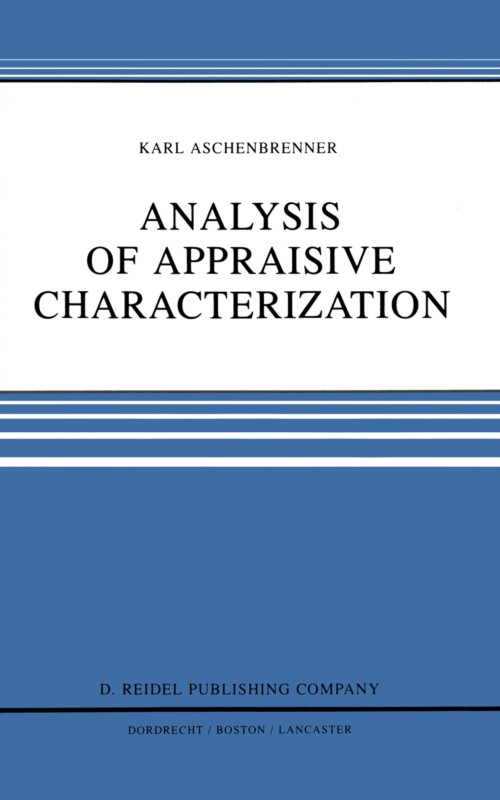
245 10|aAnalysis of Appraisive Characterization|h[electronic resource] /|cby L. Aschenbrenner.
250 |a1st ed. 1983.
264 1|aDordrecht :|bSpringer Netherlands :|bImprint: Springer,|c1983.
300 |aXI, 230 p.|bonline resource.
336 |atext|btxt|2rdacontent
337 |acomputer|bc|2rdamedia
338 |aonline resource|bcr|2rdacarrier
347 |atext file|bPDF|2rda
505 0 |aOne / The Emergence of Appraisive Concepts and their Nature -- 1.0 The Etiology of Values -- 2.0 The Fourfold Root of Appraisal -- 3.0 Modes of Appraisal -- 4.0 Creditation and Qualification -- 5.0 Character and Characterization -- 6.0 Areas of Appraisal Compared -- Two / Critical Characterization -- 7.0 Aesthetic Appraisal Illustrated -- 8.0 Musical Characterization -- 9.0 The Structure of Aesthetic Concepts -- 10.0 Metalinguistic Terms in Evaluation -- 11.0 The Importance of Appraisal -- Notes.
520 |aThe present work addresses itself to the question of the nature of appraisive concepts such as were the subject of investigation in The Concepts of Value* and The Concepts of Criticism. ** Many problems of prime importance in the theory of value could not be adequately treated there without diminishing the basic purpose of those studies which was above all to identify, classify and provide a general theoretical framework for the host of concepts with which we characterize and commend subjects of appraisal in all of the principal areas of human interest. The author might have forestalled the disappointment of some of his critics had he then explicitly promised to consider those problems at a later time. But his reluctance to promise what he might not be in a position to produce outweighed a keen awareness of what the problems are and of their evident seriousness. Although my treatment of such problems has only now been undertaken, in point of time my concern with them antedates by far the em pirical explorations of the two texts mentioned. Anyone who undertakes such a study is likely to have come under the in fluence of Professor Frank Sibley's 'Aesthetic Concepts't and of later develop ments in his analysis of certain appraisive concepts. What do such concepts mean and how do they mean9 These are the questions he treated in such a stimulating fashion.
532 8 |aAccessibility summary: This PDF is not accessible. It is based on scanned pages and does not support features such as screen reader compatibility or described non-text content (images, graphs etc). However, it likely supports searchable and selectable text based on OCR (Optical Character Recognition). Users with accessibility needs may not be able to use this content effectively. Please contact us at accessibilitysupport@springernature.com if you require assistance or an alternative format.
532 8 |aInaccessible, or known limited accessibility
532 8 |aNo reading system accessibility options actively disabled
532 8 |aPublisher contact for further accessibility information: accessibilitysupport@springernature.com
650 0|aAesthetics.
650 14|aAesthetics.
710 2 |aSpringerLink (Online service)
773 0 |tSpringer Nature eBook
776 08|iPrinted edition:|z9789027714527
776 08|iPrinted edition:|z9789400969735
776 08|iPrinted edition:|z9789400969742
856 40|uhttps://doi.org/10.1007/978-94-009-6972-8
912 |aZDB-2-SHU
912 |aZDB-2-SXPR
912 |aZDB-2-BAE
950 |aHumanities, Social Sciences and Law (SpringerNature-11648)
950 |aPhilosophy and Religion (R0) (SpringerNature-43725)