

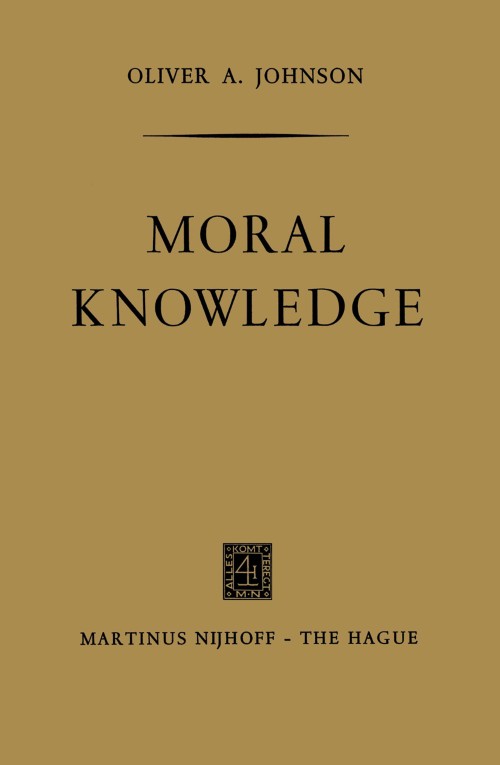
Moral Knowledge [electronic resource] / by Oliver A. Johnson.
Erişim Adresi
ISBN
9789401193177
Dil Kodu
İngilizce
Yer Numarası
DK/13982
Yazar
Basım Bildirimi
1st ed. 1966.
Yayın Bilgisi
Dordrecht : Springer Netherlands : Imprint: Springer, 1966.
Fiziksel Niteleme
172 p. online resource.
İçindekiler Notu
I. The Problem of Moral Knowledge -- 1. Contemporary sources of moral skepticism -- 2. Hume and the deductive fallacy -- 3. The meaning of moral obligation -- 4. The criteria of knowledge -- 5. Plan of the book -- II. Duty and Goodness -- 1. Types of theory -- 2. The deontologists’ critique of utilitarianism -- 3. Intuitionistic utilitarianism as a theory of moral knowledge -- 4. The identification of goodness and duty -- 5. The “ought-to-be” argument -- 6. The deductive argument-a restatement -- 7. The appeal to self-evidence -- 8. Reductionistic utilitarianism -- 9. Moral goodness and duty -- 10. Duty and goodness and the “ought” and the “is” -- III. Duty and Rightness -- 1. The intuitionism of the deontologists -- 2. Prichard’s “unreasonable” theory -- 3. The self-evidence of our duties -- 4. The duty to keep promises -- 5. Intuition and generalization -- 6. Rightness and duty -- 7. From rightness to duty -- IV. A New Point of View -- 1. Oxford philosophy -- 2. The revolution in philosophy -- 3. Wittgenstein -- 4. Analysis and moral philosophy -- 5. Analysis and the problem of moral knowledge -- V. Duty and Ordinary Language -- 1. An interpretation of Toulmin’s conclusions -- 2. A reinterpretation of Toulmin’s conclusions -- 3. Good reasons and generally accepted reasons -- 4. Toulmin’s theory and the deductive fallacy -- 5. Does Toulmin escape the deductive fallacy? -- 6. Summary comments on Toulmin’s moral theory -- 7. Nowell-Smith and the problem of moral knowledge -- 8. Wittgenstein and the revolution in philosophy -- VI. A Return to Intuitionism -- 1. The deductive fallacy, skepticism, and intuitionism -- 2. A defense of intuitionism -- 3. Knowledge and a plurality of intuitions -- 4. Intuitive self-evidence and moral knowledge -- VII. Reason and Duty -- 1. Two notions ofself-evidence -- 2. Preliminary objections -- 3. Duty and good reasons -- 4. A moral axiom -- 5. A story -- 6. Elaboration and comments -- 7. The principle of personal impartiality -- 8. Egoism and morality -- 9. The deductive fallacy -- VIII. Toward a General Theory of Morality -- 1. Outline of a positive theory of obligation -- 2. Practical qualifications -- 3. Morality and utility -- 4. Goodness and the naturalistic fallacy.
Özet, vb.
As its title indicates, this book is concerned with two different fields of philosophy, ethics and epistemology. The bulk of the argument is devoted to epistemological questions, as these arise within the context of morality. Hence, the conclusions I reach could probably best be described as prolegomena to the elaboration of a theory of ethics. I have plans, which I hope will be realized in the next few years, of elaborating such a theory. I started work on Moral Knowledge in the summer of 1958 with the help of a University Faculty Fellowship, for which I am most grateful. of the research for the book, as well as a good bit of its writing, Much was done in two libraries, The University Library, Berkeley, and the Bodleian Library, Oxford. Members of the staffs of both libraries, by their courtesy and helpfulness, lightened immeasurably the task of my research. lowe a special debt of gratitude to four people-to Mr.
Konu
Ethics.
Knowledge, Theory of.
Philosophy of mind.
Moral Philosophy and Applied Ethics.
Epistemology.
Philosophy of Mind.
Knowledge, Theory of.
Philosophy of mind.
Moral Philosophy and Applied Ethics.
Epistemology.
Philosophy of Mind.
Kurum Adı
Eseri Alıntıla
Referansları kullanmadan önce gözden geçirmeniz ve varsa gerekli düzeltmeleri yapmanız önerilir.
Dijital Kaynak
MARC Görünümü
LEADER 05570nam a22005415i 4500
001 812737
003 TR_AnAIT
005 20260130233133
007 cr nn 008mamaa
008 121227s1966 ne | s |||| 0|eng d
020 |a9789401193177|9978-94-011-9317-7
024 7 |a10.1007/978-94-011-9317-7|2doi
041 |aeng
049 |aTürk Tarih Kurumu Kütüphanesi
050 4|aBJ1-1725
072 7|aHPQ|2bicssc
072 7|aPHI005000|2bisacsh
072 7|aQDTQ|2thema
082 04|a170|223
090 |aDK/13982
100 1 |aJohnson, Oliver A.|eauthor.|4aut|4http://id.loc.gov/vocabulary/relators/aut
245 10|aMoral Knowledge|h[electronic resource] /|cby Oliver A. Johnson.
250 |a1st ed. 1966.
264 1|aDordrecht :|bSpringer Netherlands :|bImprint: Springer,|c1966.
300 |a172 p.|bonline resource.
336 |atext|btxt|2rdacontent
337 |acomputer|bc|2rdamedia
338 |aonline resource|bcr|2rdacarrier
347 |atext file|bPDF|2rda
505 0 |aI. The Problem of Moral Knowledge -- 1. Contemporary sources of moral skepticism -- 2. Hume and the deductive fallacy -- 3. The meaning of moral obligation -- 4. The criteria of knowledge -- 5. Plan of the book -- II. Duty and Goodness -- 1. Types of theory -- 2. The deontologists’ critique of utilitarianism -- 3. Intuitionistic utilitarianism as a theory of moral knowledge -- 4. The identification of goodness and duty -- 5. The “ought-to-be” argument -- 6. The deductive argument-a restatement -- 7. The appeal to self-evidence -- 8. Reductionistic utilitarianism -- 9. Moral goodness and duty -- 10. Duty and goodness and the “ought” and the “is” -- III. Duty and Rightness -- 1. The intuitionism of the deontologists -- 2. Prichard’s “unreasonable” theory -- 3. The self-evidence of our duties -- 4. The duty to keep promises -- 5. Intuition and generalization -- 6. Rightness and duty -- 7. From rightness to duty -- IV. A New Point of View -- 1. Oxford philosophy -- 2. The revolution in philosophy -- 3. Wittgenstein -- 4. Analysis and moral philosophy -- 5. Analysis and the problem of moral knowledge -- V. Duty and Ordinary Language -- 1. An interpretation of Toulmin’s conclusions -- 2. A reinterpretation of Toulmin’s conclusions -- 3. Good reasons and generally accepted reasons -- 4. Toulmin’s theory and the deductive fallacy -- 5. Does Toulmin escape the deductive fallacy? -- 6. Summary comments on Toulmin’s moral theory -- 7. Nowell-Smith and the problem of moral knowledge -- 8. Wittgenstein and the revolution in philosophy -- VI. A Return to Intuitionism -- 1. The deductive fallacy, skepticism, and intuitionism -- 2. A defense of intuitionism -- 3. Knowledge and a plurality of intuitions -- 4. Intuitive self-evidence and moral knowledge -- VII. Reason and Duty -- 1. Two notions ofself-evidence -- 2. Preliminary objections -- 3. Duty and good reasons -- 4. A moral axiom -- 5. A story -- 6. Elaboration and comments -- 7. The principle of personal impartiality -- 8. Egoism and morality -- 9. The deductive fallacy -- VIII. Toward a General Theory of Morality -- 1. Outline of a positive theory of obligation -- 2. Practical qualifications -- 3. Morality and utility -- 4. Goodness and the naturalistic fallacy.
520 |aAs its title indicates, this book is concerned with two different fields of philosophy, ethics and epistemology. The bulk of the argument is devoted to epistemological questions, as these arise within the context of morality. Hence, the conclusions I reach could probably best be described as prolegomena to the elaboration of a theory of ethics. I have plans, which I hope will be realized in the next few years, of elaborating such a theory. I started work on Moral Knowledge in the summer of 1958 with the help of a University Faculty Fellowship, for which I am most grateful. of the research for the book, as well as a good bit of its writing, Much was done in two libraries, The University Library, Berkeley, and the Bodleian Library, Oxford. Members of the staffs of both libraries, by their courtesy and helpfulness, lightened immeasurably the task of my research. lowe a special debt of gratitude to four people-to Mr.
532 8 |aAccessibility summary: This PDF is not accessible. It is based on scanned pages and does not support features such as screen reader compatibility or described non-text content (images, graphs etc). However, it likely supports searchable and selectable text based on OCR (Optical Character Recognition). Users with accessibility needs may not be able to use this content effectively. Please contact us at accessibilitysupport@springernature.com if you require assistance or an alternative format.
532 8 |aInaccessible, or known limited accessibility
532 8 |aNo reading system accessibility options actively disabled
532 8 |aPublisher contact for further accessibility information: accessibilitysupport@springernature.com
650 0|aEthics.
650 0|aKnowledge, Theory of.
650 0|aPhilosophy of mind.
650 14|aMoral Philosophy and Applied Ethics.
650 24|aEpistemology.
650 24|aPhilosophy of Mind.
710 2 |aSpringerLink (Online service)
773 0 |tSpringer Nature eBook
776 08|iPrinted edition:|z9789401185578
776 08|iPrinted edition:|z9789401193184
856 40|uhttps://doi.org/10.1007/978-94-011-9317-7
912 |aZDB-2-SHU
912 |aZDB-2-SXPR
912 |aZDB-2-BAE
950 |aHumanities, Social Sciences and Law (SpringerNature-11648)
950 |aPhilosophy and Religion (R0) (SpringerNature-43725)
001 812737
003 TR_AnAIT
005 20260130233133
007 cr nn 008mamaa
008 121227s1966 ne | s |||| 0|eng d
020 |a9789401193177|9978-94-011-9317-7
024 7 |a10.1007/978-94-011-9317-7|2doi
041 |aeng
049 |aTürk Tarih Kurumu Kütüphanesi
050 4|aBJ1-1725
072 7|aHPQ|2bicssc
072 7|aPHI005000|2bisacsh
072 7|aQDTQ|2thema
082 04|a170|223
090 |aDK/13982
100 1 |aJohnson, Oliver A.|eauthor.|4aut|4http://id.loc.gov/vocabulary/relators/aut
245 10|aMoral Knowledge|h[electronic resource] /|cby Oliver A. Johnson.
250 |a1st ed. 1966.
264 1|aDordrecht :|bSpringer Netherlands :|bImprint: Springer,|c1966.
300 |a172 p.|bonline resource.
336 |atext|btxt|2rdacontent
337 |acomputer|bc|2rdamedia
338 |aonline resource|bcr|2rdacarrier
347 |atext file|bPDF|2rda
505 0 |aI. The Problem of Moral Knowledge -- 1. Contemporary sources of moral skepticism -- 2. Hume and the deductive fallacy -- 3. The meaning of moral obligation -- 4. The criteria of knowledge -- 5. Plan of the book -- II. Duty and Goodness -- 1. Types of theory -- 2. The deontologists’ critique of utilitarianism -- 3. Intuitionistic utilitarianism as a theory of moral knowledge -- 4. The identification of goodness and duty -- 5. The “ought-to-be” argument -- 6. The deductive argument-a restatement -- 7. The appeal to self-evidence -- 8. Reductionistic utilitarianism -- 9. Moral goodness and duty -- 10. Duty and goodness and the “ought” and the “is” -- III. Duty and Rightness -- 1. The intuitionism of the deontologists -- 2. Prichard’s “unreasonable” theory -- 3. The self-evidence of our duties -- 4. The duty to keep promises -- 5. Intuition and generalization -- 6. Rightness and duty -- 7. From rightness to duty -- IV. A New Point of View -- 1. Oxford philosophy -- 2. The revolution in philosophy -- 3. Wittgenstein -- 4. Analysis and moral philosophy -- 5. Analysis and the problem of moral knowledge -- V. Duty and Ordinary Language -- 1. An interpretation of Toulmin’s conclusions -- 2. A reinterpretation of Toulmin’s conclusions -- 3. Good reasons and generally accepted reasons -- 4. Toulmin’s theory and the deductive fallacy -- 5. Does Toulmin escape the deductive fallacy? -- 6. Summary comments on Toulmin’s moral theory -- 7. Nowell-Smith and the problem of moral knowledge -- 8. Wittgenstein and the revolution in philosophy -- VI. A Return to Intuitionism -- 1. The deductive fallacy, skepticism, and intuitionism -- 2. A defense of intuitionism -- 3. Knowledge and a plurality of intuitions -- 4. Intuitive self-evidence and moral knowledge -- VII. Reason and Duty -- 1. Two notions ofself-evidence -- 2. Preliminary objections -- 3. Duty and good reasons -- 4. A moral axiom -- 5. A story -- 6. Elaboration and comments -- 7. The principle of personal impartiality -- 8. Egoism and morality -- 9. The deductive fallacy -- VIII. Toward a General Theory of Morality -- 1. Outline of a positive theory of obligation -- 2. Practical qualifications -- 3. Morality and utility -- 4. Goodness and the naturalistic fallacy.
520 |aAs its title indicates, this book is concerned with two different fields of philosophy, ethics and epistemology. The bulk of the argument is devoted to epistemological questions, as these arise within the context of morality. Hence, the conclusions I reach could probably best be described as prolegomena to the elaboration of a theory of ethics. I have plans, which I hope will be realized in the next few years, of elaborating such a theory. I started work on Moral Knowledge in the summer of 1958 with the help of a University Faculty Fellowship, for which I am most grateful. of the research for the book, as well as a good bit of its writing, Much was done in two libraries, The University Library, Berkeley, and the Bodleian Library, Oxford. Members of the staffs of both libraries, by their courtesy and helpfulness, lightened immeasurably the task of my research. lowe a special debt of gratitude to four people-to Mr.
532 8 |aAccessibility summary: This PDF is not accessible. It is based on scanned pages and does not support features such as screen reader compatibility or described non-text content (images, graphs etc). However, it likely supports searchable and selectable text based on OCR (Optical Character Recognition). Users with accessibility needs may not be able to use this content effectively. Please contact us at accessibilitysupport@springernature.com if you require assistance or an alternative format.
532 8 |aInaccessible, or known limited accessibility
532 8 |aNo reading system accessibility options actively disabled
532 8 |aPublisher contact for further accessibility information: accessibilitysupport@springernature.com
650 0|aEthics.
650 0|aKnowledge, Theory of.
650 0|aPhilosophy of mind.
650 14|aMoral Philosophy and Applied Ethics.
650 24|aEpistemology.
650 24|aPhilosophy of Mind.
710 2 |aSpringerLink (Online service)
773 0 |tSpringer Nature eBook
776 08|iPrinted edition:|z9789401185578
776 08|iPrinted edition:|z9789401193184
856 40|uhttps://doi.org/10.1007/978-94-011-9317-7
912 |aZDB-2-SHU
912 |aZDB-2-SXPR
912 |aZDB-2-BAE
950 |aHumanities, Social Sciences and Law (SpringerNature-11648)
950 |aPhilosophy and Religion (R0) (SpringerNature-43725)
Materyaller
Depodan talep edilen materyal sadece kütüphane içerisinde kullanılmaktadır.
Materyal dışarıya ödünç verilmemektedir.
Materyal dışarıya ödünç verilmemektedir.
