

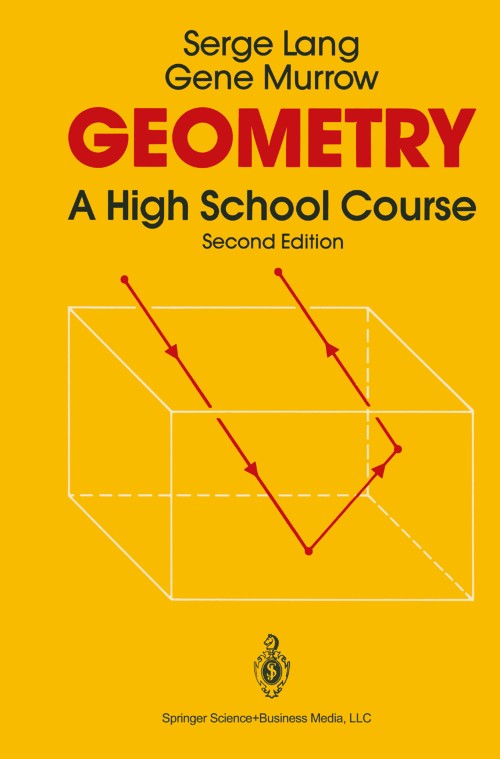
Geometry [electronic resource] : A High School Course / by Serge Lang, Gene Murrow.
Erişim Adresi
ISBN
9781475720228
Dil Kodu
İngilizce
Yer Numarası
DK/14115
Yazar
Basım Bildirimi
2nd ed. 1988.
Yayın Bilgisi
New York, NY : Springer New York : Imprint: Springer, 1988.
Fiziksel Niteleme
XII, 394 p. online resource.
İçindekiler Notu
1 Distance and Angles -- 2 Coordinates -- 3 Area and the Pythagoras Theorem -- 4 The Distance Formula -- 5 Some Applications of Right Triangles -- 6 Polygons -- 7 Congruent Triangles -- 8 Dilations and Similarities -- 9 Volumes -- 10 Vectors and Dot Product -- 11 Transformations -- 12 Isometries.
Özet, vb.
From the reviews: "A prominent research mathematician and a high school teacher have combined their efforts in order to produce a high school geometry course. The result is a challenging, vividly written volume which offers a broader treatment than the traditional Euclidean one, but which preserves its pedagogical virtues. The material included has been judiciously selected: some traditional items have been omitted, while emphasis has been laid on topics which relate the geometry course to the mathematics that precedes and follows. The exposition is clear and precise, while avoiding pedantry. There are many exercises, quite a number of them not routine. The exposition falls into twelve chapters: 1. Distance and Angles.- 2. Coordinates.- 3. Area and the Pythagoras Theorem.- 4. The Distance Formula.- 5. Some Applications of Right Triangles.- 6. Polygons.- 7. Congruent Triangles.- 8. Dilatations and Similarities.- 9. Volumes.- 10. Vectors and Dot Product.- 11. Transformations.- 12. Isometries.This excellent text, presenting elementary geometry in a manner fully corresponding to the requirements of modern mathematics, will certainly obtain well-merited popularity. Publicationes Mathematicae Debrecen#1.
Konu
Science __ History.
Geometry.
Mathematics.
History.
History of Science.
Geometry.
History of Mathematical Sciences.
Geometry.
Mathematics.
History.
History of Science.
Geometry.
History of Mathematical Sciences.
Diğer Yazarlar
Kurum Adı
