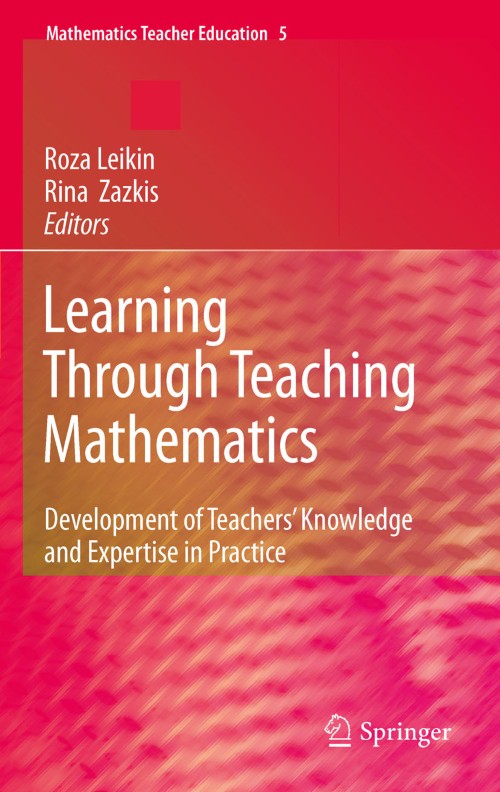
Learning Through Teaching Mathematics [electronic resource] : Development of Teachers' Knowledge and Expertise in Practice / edited by Roza Leikin, Rina Zazkis.
Erişim Adresi
ISBN
9789048139903
Dil Kodu
İngilizce
Yer Numarası
DK/14117
Basım Bildirimi
1st ed. 2010.
Yayın Bilgisi
Dordrecht : Springer Netherlands : Imprint: Springer, 2010.
Fiziksel Niteleme
XII, 300 p. 63 illus. online resource.
Dizi
Mathematics Teacher Education, 2543-0017 ; 5
İçindekiler Notu
Theoretical and Methodological Perspectives on Teachers’ Learning through Teaching -- Teachers’ Opportunities to Learn Mathematics Through Teaching -- Attention and Intention in Learning About Teaching Through Teaching -- How and What Might Teachers Learn Through Teaching Mathematics: Contributions to Closing an Unspoken Gap -- Learning Through Teaching Through the Lens of Multiple Solution Tasks -- Examples of Learning through teaching: Pedagogical mathematics -- What Have I Learned: Mathematical Insights and Pedagogical Implications -- Dialogical Education and Learning Mathematics Online from Teachers -- Role of Task and Technology in Provoking Teacher Change: A Case of Proofs and Proving in High School Algebra -- Learning Through Teaching, When Teaching Machines: Discursive Interaction Design in Sketchpad -- What Experienced Teachers Have Learned from Helping Students Think About Solving Equations in the One-Variable-First Algebra Curriculum -- Examples of Learning through teaching: Mathematical pedagogy -- Exploring Reform Ideas for Teaching Algebra: Analysis of Videotaped Episodes and of Conversations About Them -- On Rapid Professional Growth: Cases of Learning Through Teaching -- Interactions Between Teaching and Research: Developing Pedagogical Content Knowledge for Real Analysis -- Teachers Learning from Their Teaching: The Case of Communicative Practices -- Feedback: Expanding a Repertoire and Making Choices.
Özet, vb.
This volume explores how and when teachers' knowledge develops through teaching. The book presents international views on teachers' learning from their practice; the chapters are written by mathematicians or mathematics educators from Brazil, Canada, Israel, Mexico, UK, and USA. They address diverse content – numerical literacy, geometry, algebra, and real analysis – and a variety of levels – elementary school, secondary school, undergraduate mathematics, and teacher education courses. The authors employ different methodological tools and different theoretical perspectives as they consider teaching in different learning environments: lecturing, small group work on problems and tasks, mathematical explorations with the support of technological software, or e-learning. Despite these differences, the authors exemplify and analyze teachers’ learning that occurred and address the question: "What kinds of knowledge are developed as a result of teaching mathematics and what are the factors that support or impede such development?" Further, the chapters explore interactions and interrelationships between the enhancement of mathematical and pedagogical knowledge. The important and original contribution of this book is that it ties together the notions of teachers’ knowledge and complexity of teacher’s work, while presenting them from a relatively unexplored perspective – learning through teaching mathematics.
Konu
Science __ Study and teaching.
Mathematics __ Study and teaching .
Teachers __ Training of.
Learning, Psychology of.
Educational psychology.
Science Education.
Mathematics Education.
Teaching and Teacher Education.
Instructional Psychology.
Educational Psychology.
Mathematics __ Study and teaching .
Teachers __ Training of.
Learning, Psychology of.
Educational psychology.
Science Education.
Mathematics Education.
Teaching and Teacher Education.
Instructional Psychology.
Educational Psychology.
Diğer Yazarlar
Kurum Adı

Eseri Alıntıla
Referansları kullanmadan önce gözden geçirmeniz ve varsa gerekli düzeltmeleri yapmanız önerilir.
Dijital Kaynak
MARC Görünümü
LEADER 05088nam a22006015i 4500
001 812872
003 TR_AnAIT
005 20260130232606
007 cr nn 008mamaa
008 100427s2010 ne | s |||| 0|eng d
020 |a9789048139903|9978-90-481-3990-3
024 7 |a10.1007/978-90-481-3990-3|2doi
041 |aeng
049 |aTürk Tarih Kurumu Kütüphanesi
050 4|aQ181-183.4
072 7|aJNU|2bicssc
072 7|aPD|2bicssc
072 7|aSCI063000|2bisacsh
072 7|aJNU|2thema
072 7|aPD|2thema
082 04|a507.1|223
090 |aDK/14117
245 10|aLearning Through Teaching Mathematics|h[electronic resource] :|bDevelopment of Teachers' Knowledge and Expertise in Practice /|cedited by Roza Leikin, Rina Zazkis.
250 |a1st ed. 2010.
264 1|aDordrecht :|bSpringer Netherlands :|bImprint: Springer,|c2010.
300 |aXII, 300 p. 63 illus.|bonline resource.
336 |atext|btxt|2rdacontent
337 |acomputer|bc|2rdamedia
338 |aonline resource|bcr|2rdacarrier
347 |atext file|bPDF|2rda
490 1 |aMathematics Teacher Education,|x2543-0017 ;|v5
505 0 |aTheoretical and Methodological Perspectives on Teachers’ Learning through Teaching -- Teachers’ Opportunities to Learn Mathematics Through Teaching -- Attention and Intention in Learning About Teaching Through Teaching -- How and What Might Teachers Learn Through Teaching Mathematics: Contributions to Closing an Unspoken Gap -- Learning Through Teaching Through the Lens of Multiple Solution Tasks -- Examples of Learning through teaching: Pedagogical mathematics -- What Have I Learned: Mathematical Insights and Pedagogical Implications -- Dialogical Education and Learning Mathematics Online from Teachers -- Role of Task and Technology in Provoking Teacher Change: A Case of Proofs and Proving in High School Algebra -- Learning Through Teaching, When Teaching Machines: Discursive Interaction Design in Sketchpad -- What Experienced Teachers Have Learned from Helping Students Think About Solving Equations in the One-Variable-First Algebra Curriculum -- Examples of Learning through teaching: Mathematical pedagogy -- Exploring Reform Ideas for Teaching Algebra: Analysis of Videotaped Episodes and of Conversations About Them -- On Rapid Professional Growth: Cases of Learning Through Teaching -- Interactions Between Teaching and Research: Developing Pedagogical Content Knowledge for Real Analysis -- Teachers Learning from Their Teaching: The Case of Communicative Practices -- Feedback: Expanding a Repertoire and Making Choices.
520 |aThis volume explores how and when teachers' knowledge develops through teaching. The book presents international views on teachers' learning from their practice; the chapters are written by mathematicians or mathematics educators from Brazil, Canada, Israel, Mexico, UK, and USA. They address diverse content – numerical literacy, geometry, algebra, and real analysis – and a variety of levels – elementary school, secondary school, undergraduate mathematics, and teacher education courses. The authors employ different methodological tools and different theoretical perspectives as they consider teaching in different learning environments: lecturing, small group work on problems and tasks, mathematical explorations with the support of technological software, or e-learning. Despite these differences, the authors exemplify and analyze teachers’ learning that occurred and address the question: "What kinds of knowledge are developed as a result of teaching mathematics and what are the factors that support or impede such development?" Further, the chapters explore interactions and interrelationships between the enhancement of mathematical and pedagogical knowledge. The important and original contribution of this book is that it ties together the notions of teachers’ knowledge and complexity of teacher’s work, while presenting them from a relatively unexplored perspective – learning through teaching mathematics.
650 0|aScience|xStudy and teaching.
650 0|aMathematics|xStudy and teaching .
650 0|aTeachers|xTraining of.
650 0|aLearning, Psychology of.
650 0|aEducational psychology.
650 14|aScience Education.
650 24|aMathematics Education.
650 24|aTeaching and Teacher Education.
650 24|aInstructional Psychology.
650 24|aEducational Psychology.
700 1 |aLeikin, Roza.|eeditor.|4edt|4http://id.loc.gov/vocabulary/relators/edt
700 1 |aZazkis, Rina.|eeditor.|4edt|4http://id.loc.gov/vocabulary/relators/edt
710 2 |aSpringerLink (Online service)
773 0 |tSpringer Nature eBook
776 08|iPrinted edition:|z9789048139897
776 08|iPrinted edition:|z9789048139910
776 08|iPrinted edition:|z9789400732469
830 0|aMathematics Teacher Education,|x2543-0017 ;|v5
856 40|uhttps://doi.org/10.1007/978-90-481-3990-3
912 |aZDB-2-SHU
912 |aZDB-2-SXED
950 |aHumanities, Social Sciences and Law (SpringerNature-11648)
950 |aEducation (R0) (SpringerNature-43721)
001 812872
003 TR_AnAIT
005 20260130232606
007 cr nn 008mamaa
008 100427s2010 ne | s |||| 0|eng d
020 |a9789048139903|9978-90-481-3990-3
024 7 |a10.1007/978-90-481-3990-3|2doi
041 |aeng
049 |aTürk Tarih Kurumu Kütüphanesi
050 4|aQ181-183.4
072 7|aJNU|2bicssc
072 7|aPD|2bicssc
072 7|aSCI063000|2bisacsh
072 7|aJNU|2thema
072 7|aPD|2thema
082 04|a507.1|223
090 |aDK/14117
245 10|aLearning Through Teaching Mathematics|h[electronic resource] :|bDevelopment of Teachers' Knowledge and Expertise in Practice /|cedited by Roza Leikin, Rina Zazkis.
250 |a1st ed. 2010.
264 1|aDordrecht :|bSpringer Netherlands :|bImprint: Springer,|c2010.
300 |aXII, 300 p. 63 illus.|bonline resource.
336 |atext|btxt|2rdacontent
337 |acomputer|bc|2rdamedia
338 |aonline resource|bcr|2rdacarrier
347 |atext file|bPDF|2rda
490 1 |aMathematics Teacher Education,|x2543-0017 ;|v5
505 0 |aTheoretical and Methodological Perspectives on Teachers’ Learning through Teaching -- Teachers’ Opportunities to Learn Mathematics Through Teaching -- Attention and Intention in Learning About Teaching Through Teaching -- How and What Might Teachers Learn Through Teaching Mathematics: Contributions to Closing an Unspoken Gap -- Learning Through Teaching Through the Lens of Multiple Solution Tasks -- Examples of Learning through teaching: Pedagogical mathematics -- What Have I Learned: Mathematical Insights and Pedagogical Implications -- Dialogical Education and Learning Mathematics Online from Teachers -- Role of Task and Technology in Provoking Teacher Change: A Case of Proofs and Proving in High School Algebra -- Learning Through Teaching, When Teaching Machines: Discursive Interaction Design in Sketchpad -- What Experienced Teachers Have Learned from Helping Students Think About Solving Equations in the One-Variable-First Algebra Curriculum -- Examples of Learning through teaching: Mathematical pedagogy -- Exploring Reform Ideas for Teaching Algebra: Analysis of Videotaped Episodes and of Conversations About Them -- On Rapid Professional Growth: Cases of Learning Through Teaching -- Interactions Between Teaching and Research: Developing Pedagogical Content Knowledge for Real Analysis -- Teachers Learning from Their Teaching: The Case of Communicative Practices -- Feedback: Expanding a Repertoire and Making Choices.
520 |aThis volume explores how and when teachers' knowledge develops through teaching. The book presents international views on teachers' learning from their practice; the chapters are written by mathematicians or mathematics educators from Brazil, Canada, Israel, Mexico, UK, and USA. They address diverse content – numerical literacy, geometry, algebra, and real analysis – and a variety of levels – elementary school, secondary school, undergraduate mathematics, and teacher education courses. The authors employ different methodological tools and different theoretical perspectives as they consider teaching in different learning environments: lecturing, small group work on problems and tasks, mathematical explorations with the support of technological software, or e-learning. Despite these differences, the authors exemplify and analyze teachers’ learning that occurred and address the question: "What kinds of knowledge are developed as a result of teaching mathematics and what are the factors that support or impede such development?" Further, the chapters explore interactions and interrelationships between the enhancement of mathematical and pedagogical knowledge. The important and original contribution of this book is that it ties together the notions of teachers’ knowledge and complexity of teacher’s work, while presenting them from a relatively unexplored perspective – learning through teaching mathematics.
650 0|aScience|xStudy and teaching.
650 0|aMathematics|xStudy and teaching .
650 0|aTeachers|xTraining of.
650 0|aLearning, Psychology of.
650 0|aEducational psychology.
650 14|aScience Education.
650 24|aMathematics Education.
650 24|aTeaching and Teacher Education.
650 24|aInstructional Psychology.
650 24|aEducational Psychology.
700 1 |aLeikin, Roza.|eeditor.|4edt|4http://id.loc.gov/vocabulary/relators/edt
700 1 |aZazkis, Rina.|eeditor.|4edt|4http://id.loc.gov/vocabulary/relators/edt
710 2 |aSpringerLink (Online service)
773 0 |tSpringer Nature eBook
776 08|iPrinted edition:|z9789048139897
776 08|iPrinted edition:|z9789048139910
776 08|iPrinted edition:|z9789400732469
830 0|aMathematics Teacher Education,|x2543-0017 ;|v5
856 40|uhttps://doi.org/10.1007/978-90-481-3990-3
912 |aZDB-2-SHU
912 |aZDB-2-SXED
950 |aHumanities, Social Sciences and Law (SpringerNature-11648)
950 |aEducation (R0) (SpringerNature-43721)
Materyaller
Depodan talep edilen materyal sadece kütüphane içerisinde kullanılmaktadır.
Materyal dışarıya ödünç verilmemektedir.
