

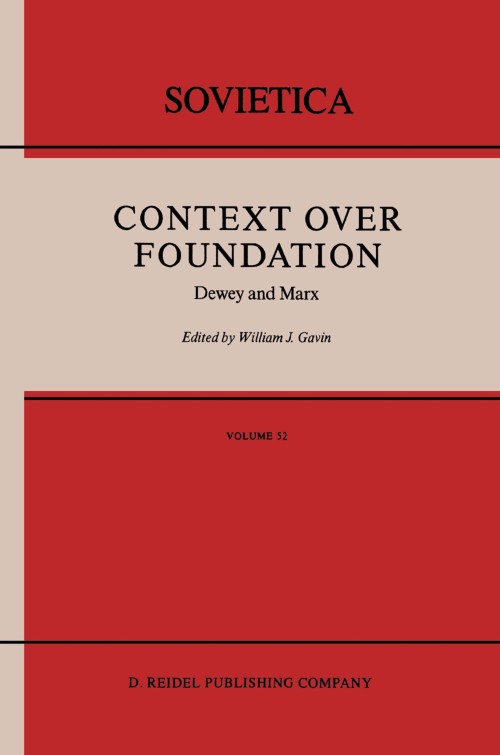
Context Over Foundation [electronic resource] : Dewey and Marx / edited by W.J. Gavin.
Erişim Adresi
ISBN
9789400929036
Dil Kodu
İngilizce
Yer Numarası
DK/14127
Basım Bildirimi
1st ed. 1988.
Yayın Bilgisi
Dordrecht : Springer Netherlands : Imprint: Springer, 1988.
Fiziksel Niteleme
V, 259 p. online resource.
Dizi
Sovietica ; 52
İçindekiler Notu
One The Human Context -- From ‘Individual’ to ‘Subject’: Marx and Dewey on the Person -- Science, Psychology, and Human Values in the Context of Dewey’s Critique of Marx -- Text, Context, and the Existential Limit: A Jamesian Strain in Marx and Dewey -- Two The Cultural/Political Context -- Politics, Culture and Society in Marx and Dewey -- Dewey’s Understanding of Marx and Marxism -- Philosophy and Politics: A Historical Approach to Marx and Dewey -- The Politics After Deconstruction: Rorty, Dewey, and Marx -- Three The Metaphysical Context -- Marx and Dewey on the Unity of Theory and Practice -- Naturalism, Dialectical Materialism, and an Ontology of Constitutive Relations.
Özet, vb.
"I should venture to assert that the most pervasive fallacy of philosophic thinking goes back to neglect of context. III John Dewey " . . . philosophers do not grow like mushrooms, out of the earth; they are the outgrowth of their period, their nation, whose most subtle, delicate and invisible juices abound in the philosophical ideas. ,,2 Karl Marx Few issues are more heatedly debated in contemporary philosophy circles than that of con textual ism vs. foundationalism. The genesis for the debate was the publication in 1979 of Richard Rorty's Philosophy and the Mirror of Nature, which announ~ed the death of traditional philosophy. By "traditional" here is meant the quest for a certain or apodictic bedrock upon which an overall general theory or schema might be erected. This approach, for Rorty, characterized most previous philosophy, but especially the era from Descartes to Kant. Further, the three major philosophic thinkers of the 20th century, Dewey, Heidegger, and Wittgenstein, each initially tried to construct a foundational philosophy but each of the three, in his later work, broke free of the Kantian conception of philosophy as foundational, and spent his time warning us against those very temptations to which he himself had once succumbed. Thus their later work is therapeutic rather than constructive, edifying rather than systematic, designed to make the reader question his own motives for philosophizing rather than to 3 supply him with a new philosophical program.
Konu
Philosophy, Modern.
Early Modern Philosophy.
Early Modern Philosophy.
Diğer Yazarlar
Kurum Adı
Eseri Alıntıla
Referansları kullanmadan önce gözden geçirmeniz ve varsa gerekli düzeltmeleri yapmanız önerilir.
Dijital Kaynak
MARC Görünümü
LEADER 04565nam a22005295i 4500
001 812882
003 TR_AnAIT
005 20260130232552
007 cr nn 008mamaa
008 121227s1988 ne | s |||| 0|eng d
020 |a9789400929036|9978-94-009-2903-6
024 7 |a10.1007/978-94-009-2903-6|2doi
041 |aeng
049 |aTürk Tarih Kurumu Kütüphanesi
050 4|aB800.2-804
072 7|aHPCD|2bicssc
072 7|aPHI016000|2bisacsh
072 7|aQDH|2thema
082 04|a190.903|223
090 |aDK/14127
245 10|aContext Over Foundation|h[electronic resource] :|bDewey and Marx /|cedited by W.J. Gavin.
250 |a1st ed. 1988.
264 1|aDordrecht :|bSpringer Netherlands :|bImprint: Springer,|c1988.
300 |aV, 259 p.|bonline resource.
336 |atext|btxt|2rdacontent
337 |acomputer|bc|2rdamedia
338 |aonline resource|bcr|2rdacarrier
347 |atext file|bPDF|2rda
490 1 |aSovietica ;|v52
505 0 |aOne The Human Context -- From ‘Individual’ to ‘Subject’: Marx and Dewey on the Person -- Science, Psychology, and Human Values in the Context of Dewey’s Critique of Marx -- Text, Context, and the Existential Limit: A Jamesian Strain in Marx and Dewey -- Two The Cultural/Political Context -- Politics, Culture and Society in Marx and Dewey -- Dewey’s Understanding of Marx and Marxism -- Philosophy and Politics: A Historical Approach to Marx and Dewey -- The Politics After Deconstruction: Rorty, Dewey, and Marx -- Three The Metaphysical Context -- Marx and Dewey on the Unity of Theory and Practice -- Naturalism, Dialectical Materialism, and an Ontology of Constitutive Relations.
520 |a"I should venture to assert that the most pervasive fallacy of philosophic thinking goes back to neglect of context. III John Dewey " . . . philosophers do not grow like mushrooms, out of the earth; they are the outgrowth of their period, their nation, whose most subtle, delicate and invisible juices abound in the philosophical ideas. ,,2 Karl Marx Few issues are more heatedly debated in contemporary philosophy circles than that of con textual ism vs. foundationalism. The genesis for the debate was the publication in 1979 of Richard Rorty's Philosophy and the Mirror of Nature, which announ~ed the death of traditional philosophy. By "traditional" here is meant the quest for a certain or apodictic bedrock upon which an overall general theory or schema might be erected. This approach, for Rorty, characterized most previous philosophy, but especially the era from Descartes to Kant. Further, the three major philosophic thinkers of the 20th century, Dewey, Heidegger, and Wittgenstein, each initially tried to construct a foundational philosophy but each of the three, in his later work, broke free of the Kantian conception of philosophy as foundational, and spent his time warning us against those very temptations to which he himself had once succumbed. Thus their later work is therapeutic rather than constructive, edifying rather than systematic, designed to make the reader question his own motives for philosophizing rather than to 3 supply him with a new philosophical program.
532 8 |aAccessibility summary: This PDF is not accessible. It is based on scanned pages and does not support features such as screen reader compatibility or described non-text content (images, graphs etc). However, it likely supports searchable and selectable text based on OCR (Optical Character Recognition). Users with accessibility needs may not be able to use this content effectively. Please contact us at accessibilitysupport@springernature.com if you require assistance or an alternative format.
532 8 |aInaccessible, or known limited accessibility
532 8 |aNo reading system accessibility options actively disabled
532 8 |aPublisher contact for further accessibility information: accessibilitysupport@springernature.com
650 0|aPhilosophy, Modern.
650 14|aEarly Modern Philosophy.
700 1 |aGavin, W.J.|eeditor.|4edt|4http://id.loc.gov/vocabulary/relators/edt
710 2 |aSpringerLink (Online service)
773 0 |tSpringer Nature eBook
776 08|iPrinted edition:|z9789027726704
776 08|iPrinted edition:|z9789400929043
776 08|iPrinted edition:|z9789401078085
830 0|aSovietica ;|v52
856 40|uhttps://doi.org/10.1007/978-94-009-2903-6
912 |aZDB-2-SHU
912 |aZDB-2-SXPR
912 |aZDB-2-BAE
950 |aHumanities, Social Sciences and Law (SpringerNature-11648)
950 |aPhilosophy and Religion (R0) (SpringerNature-43725)
001 812882
003 TR_AnAIT
005 20260130232552
007 cr nn 008mamaa
008 121227s1988 ne | s |||| 0|eng d
020 |a9789400929036|9978-94-009-2903-6
024 7 |a10.1007/978-94-009-2903-6|2doi
041 |aeng
049 |aTürk Tarih Kurumu Kütüphanesi
050 4|aB800.2-804
072 7|aHPCD|2bicssc
072 7|aPHI016000|2bisacsh
072 7|aQDH|2thema
082 04|a190.903|223
090 |aDK/14127
245 10|aContext Over Foundation|h[electronic resource] :|bDewey and Marx /|cedited by W.J. Gavin.
250 |a1st ed. 1988.
264 1|aDordrecht :|bSpringer Netherlands :|bImprint: Springer,|c1988.
300 |aV, 259 p.|bonline resource.
336 |atext|btxt|2rdacontent
337 |acomputer|bc|2rdamedia
338 |aonline resource|bcr|2rdacarrier
347 |atext file|bPDF|2rda
490 1 |aSovietica ;|v52
505 0 |aOne The Human Context -- From ‘Individual’ to ‘Subject’: Marx and Dewey on the Person -- Science, Psychology, and Human Values in the Context of Dewey’s Critique of Marx -- Text, Context, and the Existential Limit: A Jamesian Strain in Marx and Dewey -- Two The Cultural/Political Context -- Politics, Culture and Society in Marx and Dewey -- Dewey’s Understanding of Marx and Marxism -- Philosophy and Politics: A Historical Approach to Marx and Dewey -- The Politics After Deconstruction: Rorty, Dewey, and Marx -- Three The Metaphysical Context -- Marx and Dewey on the Unity of Theory and Practice -- Naturalism, Dialectical Materialism, and an Ontology of Constitutive Relations.
520 |a"I should venture to assert that the most pervasive fallacy of philosophic thinking goes back to neglect of context. III John Dewey " . . . philosophers do not grow like mushrooms, out of the earth; they are the outgrowth of their period, their nation, whose most subtle, delicate and invisible juices abound in the philosophical ideas. ,,2 Karl Marx Few issues are more heatedly debated in contemporary philosophy circles than that of con textual ism vs. foundationalism. The genesis for the debate was the publication in 1979 of Richard Rorty's Philosophy and the Mirror of Nature, which announ~ed the death of traditional philosophy. By "traditional" here is meant the quest for a certain or apodictic bedrock upon which an overall general theory or schema might be erected. This approach, for Rorty, characterized most previous philosophy, but especially the era from Descartes to Kant. Further, the three major philosophic thinkers of the 20th century, Dewey, Heidegger, and Wittgenstein, each initially tried to construct a foundational philosophy but each of the three, in his later work, broke free of the Kantian conception of philosophy as foundational, and spent his time warning us against those very temptations to which he himself had once succumbed. Thus their later work is therapeutic rather than constructive, edifying rather than systematic, designed to make the reader question his own motives for philosophizing rather than to 3 supply him with a new philosophical program.
532 8 |aAccessibility summary: This PDF is not accessible. It is based on scanned pages and does not support features such as screen reader compatibility or described non-text content (images, graphs etc). However, it likely supports searchable and selectable text based on OCR (Optical Character Recognition). Users with accessibility needs may not be able to use this content effectively. Please contact us at accessibilitysupport@springernature.com if you require assistance or an alternative format.
532 8 |aInaccessible, or known limited accessibility
532 8 |aNo reading system accessibility options actively disabled
532 8 |aPublisher contact for further accessibility information: accessibilitysupport@springernature.com
650 0|aPhilosophy, Modern.
650 14|aEarly Modern Philosophy.
700 1 |aGavin, W.J.|eeditor.|4edt|4http://id.loc.gov/vocabulary/relators/edt
710 2 |aSpringerLink (Online service)
773 0 |tSpringer Nature eBook
776 08|iPrinted edition:|z9789027726704
776 08|iPrinted edition:|z9789400929043
776 08|iPrinted edition:|z9789401078085
830 0|aSovietica ;|v52
856 40|uhttps://doi.org/10.1007/978-94-009-2903-6
912 |aZDB-2-SHU
912 |aZDB-2-SXPR
912 |aZDB-2-BAE
950 |aHumanities, Social Sciences and Law (SpringerNature-11648)
950 |aPhilosophy and Religion (R0) (SpringerNature-43725)
Materyaller
Depodan talep edilen materyal sadece kütüphane içerisinde kullanılmaktadır.
Materyal dışarıya ödünç verilmemektedir.
Materyal dışarıya ödünç verilmemektedir.
