

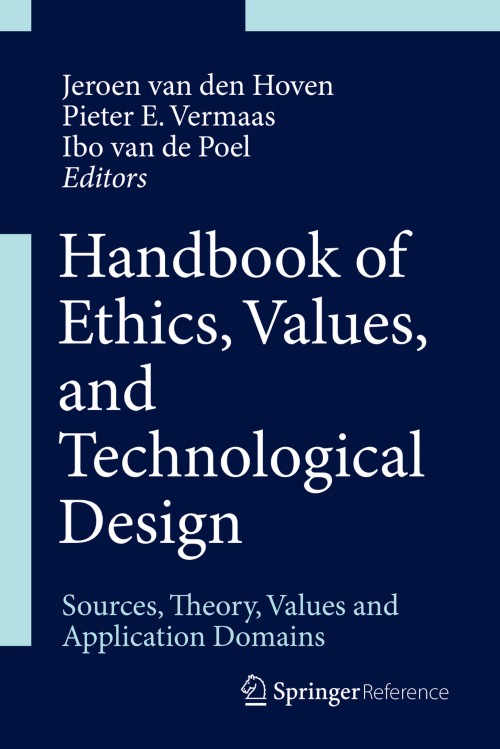
Handbook of Ethics, Values, and Technological Design [electronic resource] : Sources, Theory, Values and Application Domains / edited by Jeroen van den Hoven, Pieter E. Vermaas, Ibo van de Poel.
Erişim Adresi
ISBN
9789400769700
Dil Kodu
İngilizce
Yer Numarası
DK/14138
Basım Bildirimi
1st ed. 2015.
Yayın Bilgisi
Dordrecht : Springer Netherlands : Imprint: Springer, 2015.
Fiziksel Niteleme
89 illus., 44 illus. in color. eReference. online resource.
İçindekiler Notu
Chapter 1. General Introduction -- Part I. Sources -- Chapter 2. General overview; Jeroen van den Hoven and Noëmi Manders-Huits -- Chapter 3. Value Sensitive Design; Janet Davis and Lisa Nathan -- Chapter 4. Technology Assessment; Armin Grunwald -- Part II. Theory -- Chapter 5. Part introduction; editors -- Chapter 6. Design and conflicting values; Ibo van de Poel -- Chapter 7. Design and emotions; Pieter Desmet and Sabine Roeser -- Chapter 8. Design for human capabilities; Ilse Oosterlaken -- Chapter 9. Design for values and system roles; Maarten Franssen -- Chapter 10. Design for mediation; Peter-Paul Verbeek -- Chapter 11. Design methods for values; P. Vermaas, P. Hekkert, N. Manders-Huits and N. Tromp -- Chapter 12. Operationalization of values; Peter Kroes and Ibo van de Poel -- Chapter 13. Values and modeling in design; Sven Diekmann and Sjoerd Zwart.- Part III. Values -- Chapter 14. Part introduction; editors -- Chapter 15. Accountability and transparency; Joris Hulstijn and Brigitte Burgemeestre -- Chapter 16. Democracy and Justice; tbd -- Chapter 17. Human well being/good life; Philip Brey -- Chapter 18. Inclusive/universal design; Simeon Keates -- Chapter 19. Presence and Participation; Carline Nevejan -- Chapter 20. Privacy; Martijn Warnier, Francien Dechesne and Frances Brazier -- Chapter 21. Responsibility; Jessica Nihlén Fahlquist, Neelke Doorn and Ibo van de Poel -- Chapter 22. Risk and safety; Neelke Doorn and Sven Ove Hansson -- Chapter 23. Sustainability; Bhamra, Mawle and Hernandez-Pardo -- Chapter 24. Trust; Philip Nickel.- Part IV. Application Domains -- Chapter 25. Part introduction; editors.- Chapter 26. Architecture; Christian Illies -- Chapter 27. Biotechnology; Henk van den Belt -- Chapter 28. Complex Systems; Paulien Herder and Eswaran Subrahmanian -- Chapter 29. Economics; John Groenewegen -- Chapter 30. Engineering; Ibo van de Poel -- Chapter 31. ICT; Huib Aldewereld, Virginia Dignum and Yao-Hua Tan -- Chapter 32. Institutions and Policy; Seamus Miller and David Koepsell -- Chapter 33. Military technology; Lambér Royakkers and Sjef Orbons -- Chapter 34. Nanotechnology; Johannes F. Jacobs and Marc J. de Vries -- Chapter 35. Nuclear technology; Behnam Taebi and Jan Leen Kloosterman -- Chapter 36. Water Management; Wim Ravesteijn and Otto Kroesen -- Chapter 37. Outlook.
Özet, vb.
This handbook enumerates every aspect of incorporating moral and societal values into technology design, reflects the fact that the latter has moved on from strict functionality to become sensitive to moral and social values such as sustainability and accountability. Aimed at a broad readership that includes ethicists, policy makers and designers themselves, it proffers a detailed survey of how technological, and institutional, design must now reflect awareness of ethical factors such as sustainability, human well-being, privacy, democracy and justice, inclusivity, trust, accountability, and responsibility (both social and environmental). Edited by a trio of highly experienced academic philosophers with a specialized interest in the ethical dimensions of technology and human creativity, this syncretic handbook collates an array of published material and offers a studied, practical introduction to the field. The volume addresses myriad aspects at the intersection of technology design and ethics, enabling designers to adopt a constructive approach in anticipating, preventing, and resolving societal and ethical issues affecting their work. It covers underlying theory; discrete values such as democracy, human well-being, sustainability and justice; and application domains themselves, which include architecture, bio- and nanotechnology, and military hardware. As the first exhaustive survey of a field whose importance is characterized by almost exponential growth, it represents a compelling addition to a formerly atomized literature.
Konu
Technology __ Philosophy.
Design.
Economic development.
Philosophy of Technology.
Design.
Economic Development, Innovation and Growth.
Design.
Economic development.
Philosophy of Technology.
Design.
Economic Development, Innovation and Growth.
Diğer Yazarlar
Kurum Adı
Eseri Alıntıla
Referansları kullanmadan önce gözden geçirmeniz ve varsa gerekli düzeltmeleri yapmanız önerilir.
Dijital Kaynak
MARC Görünümü
LEADER 06048nam a22005535i 4500
001 812893
003 TR_AnAIT
005 20260130232539
007 cr nn 008mamaa
008 150527s2015 ne | s |||| 0|eng d
020 |a9789400769700|9978-94-007-6970-0
024 7 |a10.1007/978-94-007-6970-0|2doi
041 |aeng
049 |aTürk Tarih Kurumu Kütüphanesi
050 4|aT14
072 7|aHP|2bicssc
072 7|aTB|2bicssc
072 7|aSCI075000|2bisacsh
072 7|aQD|2thema
072 7|aTB|2thema
082 04|a601|223
090 |aDK/14138
245 10|aHandbook of Ethics, Values, and Technological Design|h[electronic resource] :|bSources, Theory, Values and Application Domains /|cedited by Jeroen van den Hoven, Pieter E. Vermaas, Ibo van de Poel.
250 |a1st ed. 2015.
264 1|aDordrecht :|bSpringer Netherlands :|bImprint: Springer,|c2015.
300 |a89 illus., 44 illus. in color. eReference.|bonline resource.
336 |atext|btxt|2rdacontent
337 |acomputer|bc|2rdamedia
338 |aonline resource|bcr|2rdacarrier
347 |atext file|bPDF|2rda
505 0 |aChapter 1. General Introduction -- Part I. Sources -- Chapter 2. General overview; Jeroen van den Hoven and Noëmi Manders-Huits -- Chapter 3. Value Sensitive Design; Janet Davis and Lisa Nathan -- Chapter 4. Technology Assessment; Armin Grunwald -- Part II. Theory -- Chapter 5. Part introduction; editors -- Chapter 6. Design and conflicting values; Ibo van de Poel -- Chapter 7. Design and emotions; Pieter Desmet and Sabine Roeser -- Chapter 8. Design for human capabilities; Ilse Oosterlaken -- Chapter 9. Design for values and system roles; Maarten Franssen -- Chapter 10. Design for mediation; Peter-Paul Verbeek -- Chapter 11. Design methods for values; P. Vermaas, P. Hekkert, N. Manders-Huits and N. Tromp -- Chapter 12. Operationalization of values; Peter Kroes and Ibo van de Poel -- Chapter 13. Values and modeling in design; Sven Diekmann and Sjoerd Zwart.- Part III. Values -- Chapter 14. Part introduction; editors -- Chapter 15. Accountability and transparency; Joris Hulstijn and Brigitte Burgemeestre -- Chapter 16. Democracy and Justice; tbd -- Chapter 17. Human well being/good life; Philip Brey -- Chapter 18. Inclusive/universal design; Simeon Keates -- Chapter 19. Presence and Participation; Carline Nevejan -- Chapter 20. Privacy; Martijn Warnier, Francien Dechesne and Frances Brazier -- Chapter 21. Responsibility; Jessica Nihlén Fahlquist, Neelke Doorn and Ibo van de Poel -- Chapter 22. Risk and safety; Neelke Doorn and Sven Ove Hansson -- Chapter 23. Sustainability; Bhamra, Mawle and Hernandez-Pardo -- Chapter 24. Trust; Philip Nickel.- Part IV. Application Domains -- Chapter 25. Part introduction; editors.- Chapter 26. Architecture; Christian Illies -- Chapter 27. Biotechnology; Henk van den Belt -- Chapter 28. Complex Systems; Paulien Herder and Eswaran Subrahmanian -- Chapter 29. Economics; John Groenewegen -- Chapter 30. Engineering; Ibo van de Poel -- Chapter 31. ICT; Huib Aldewereld, Virginia Dignum and Yao-Hua Tan -- Chapter 32. Institutions and Policy; Seamus Miller and David Koepsell -- Chapter 33. Military technology; Lambér Royakkers and Sjef Orbons -- Chapter 34. Nanotechnology; Johannes F. Jacobs and Marc J. de Vries -- Chapter 35. Nuclear technology; Behnam Taebi and Jan Leen Kloosterman -- Chapter 36. Water Management; Wim Ravesteijn and Otto Kroesen -- Chapter 37. Outlook.
520 |aThis handbook enumerates every aspect of incorporating moral and societal values into technology design, reflects the fact that the latter has moved on from strict functionality to become sensitive to moral and social values such as sustainability and accountability. Aimed at a broad readership that includes ethicists, policy makers and designers themselves, it proffers a detailed survey of how technological, and institutional, design must now reflect awareness of ethical factors such as sustainability, human well-being, privacy, democracy and justice, inclusivity, trust, accountability, and responsibility (both social and environmental). Edited by a trio of highly experienced academic philosophers with a specialized interest in the ethical dimensions of technology and human creativity, this syncretic handbook collates an array of published material and offers a studied, practical introduction to the field. The volume addresses myriad aspects at the intersection of technology design and ethics, enabling designers to adopt a constructive approach in anticipating, preventing, and resolving societal and ethical issues affecting their work. It covers underlying theory; discrete values such as democracy, human well-being, sustainability and justice; and application domains themselves, which include architecture, bio- and nanotechnology, and military hardware. As the first exhaustive survey of a field whose importance is characterized by almost exponential growth, it represents a compelling addition to a formerly atomized literature.
650 0|aTechnology|xPhilosophy.
650 0|aDesign.
650 0|aEconomic development.
650 14|aPhilosophy of Technology.
650 24|aDesign.
650 24|aEconomic Development, Innovation and Growth.
700 1 |avan den Hoven, Jeroen.|eeditor.|4edt|4http://id.loc.gov/vocabulary/relators/edt
700 1 |aVermaas, Pieter E.|eeditor.|4edt|4http://id.loc.gov/vocabulary/relators/edt
700 1 |avan de Poel, Ibo.|eeditor.|4edt|4http://id.loc.gov/vocabulary/relators/edt
710 2 |aSpringerLink (Online service)
773 0 |tSpringer Nature eReference
776 08|iPrinted edition:|z9789400769694
776 08|iPrinted edition:|z9789400769717
856 40|uhttps://doi.org/10.1007/978-94-007-6970-0
912 |aZDB-2-SHU
912 |aZDB-2-SXRH
912 |aZDB-2-SXMH
950 |aHumanities, Social Sciences and Law (SpringerNature-11648)
950 |aReference Module Humanities and Social Sciences (SpringerNature-43749)
950 |aReference Module Humanities (SpringerNature-85197)
001 812893
003 TR_AnAIT
005 20260130232539
007 cr nn 008mamaa
008 150527s2015 ne | s |||| 0|eng d
020 |a9789400769700|9978-94-007-6970-0
024 7 |a10.1007/978-94-007-6970-0|2doi
041 |aeng
049 |aTürk Tarih Kurumu Kütüphanesi
050 4|aT14
072 7|aHP|2bicssc
072 7|aTB|2bicssc
072 7|aSCI075000|2bisacsh
072 7|aQD|2thema
072 7|aTB|2thema
082 04|a601|223
090 |aDK/14138
245 10|aHandbook of Ethics, Values, and Technological Design|h[electronic resource] :|bSources, Theory, Values and Application Domains /|cedited by Jeroen van den Hoven, Pieter E. Vermaas, Ibo van de Poel.
250 |a1st ed. 2015.
264 1|aDordrecht :|bSpringer Netherlands :|bImprint: Springer,|c2015.
300 |a89 illus., 44 illus. in color. eReference.|bonline resource.
336 |atext|btxt|2rdacontent
337 |acomputer|bc|2rdamedia
338 |aonline resource|bcr|2rdacarrier
347 |atext file|bPDF|2rda
505 0 |aChapter 1. General Introduction -- Part I. Sources -- Chapter 2. General overview; Jeroen van den Hoven and Noëmi Manders-Huits -- Chapter 3. Value Sensitive Design; Janet Davis and Lisa Nathan -- Chapter 4. Technology Assessment; Armin Grunwald -- Part II. Theory -- Chapter 5. Part introduction; editors -- Chapter 6. Design and conflicting values; Ibo van de Poel -- Chapter 7. Design and emotions; Pieter Desmet and Sabine Roeser -- Chapter 8. Design for human capabilities; Ilse Oosterlaken -- Chapter 9. Design for values and system roles; Maarten Franssen -- Chapter 10. Design for mediation; Peter-Paul Verbeek -- Chapter 11. Design methods for values; P. Vermaas, P. Hekkert, N. Manders-Huits and N. Tromp -- Chapter 12. Operationalization of values; Peter Kroes and Ibo van de Poel -- Chapter 13. Values and modeling in design; Sven Diekmann and Sjoerd Zwart.- Part III. Values -- Chapter 14. Part introduction; editors -- Chapter 15. Accountability and transparency; Joris Hulstijn and Brigitte Burgemeestre -- Chapter 16. Democracy and Justice; tbd -- Chapter 17. Human well being/good life; Philip Brey -- Chapter 18. Inclusive/universal design; Simeon Keates -- Chapter 19. Presence and Participation; Carline Nevejan -- Chapter 20. Privacy; Martijn Warnier, Francien Dechesne and Frances Brazier -- Chapter 21. Responsibility; Jessica Nihlén Fahlquist, Neelke Doorn and Ibo van de Poel -- Chapter 22. Risk and safety; Neelke Doorn and Sven Ove Hansson -- Chapter 23. Sustainability; Bhamra, Mawle and Hernandez-Pardo -- Chapter 24. Trust; Philip Nickel.- Part IV. Application Domains -- Chapter 25. Part introduction; editors.- Chapter 26. Architecture; Christian Illies -- Chapter 27. Biotechnology; Henk van den Belt -- Chapter 28. Complex Systems; Paulien Herder and Eswaran Subrahmanian -- Chapter 29. Economics; John Groenewegen -- Chapter 30. Engineering; Ibo van de Poel -- Chapter 31. ICT; Huib Aldewereld, Virginia Dignum and Yao-Hua Tan -- Chapter 32. Institutions and Policy; Seamus Miller and David Koepsell -- Chapter 33. Military technology; Lambér Royakkers and Sjef Orbons -- Chapter 34. Nanotechnology; Johannes F. Jacobs and Marc J. de Vries -- Chapter 35. Nuclear technology; Behnam Taebi and Jan Leen Kloosterman -- Chapter 36. Water Management; Wim Ravesteijn and Otto Kroesen -- Chapter 37. Outlook.
520 |aThis handbook enumerates every aspect of incorporating moral and societal values into technology design, reflects the fact that the latter has moved on from strict functionality to become sensitive to moral and social values such as sustainability and accountability. Aimed at a broad readership that includes ethicists, policy makers and designers themselves, it proffers a detailed survey of how technological, and institutional, design must now reflect awareness of ethical factors such as sustainability, human well-being, privacy, democracy and justice, inclusivity, trust, accountability, and responsibility (both social and environmental). Edited by a trio of highly experienced academic philosophers with a specialized interest in the ethical dimensions of technology and human creativity, this syncretic handbook collates an array of published material and offers a studied, practical introduction to the field. The volume addresses myriad aspects at the intersection of technology design and ethics, enabling designers to adopt a constructive approach in anticipating, preventing, and resolving societal and ethical issues affecting their work. It covers underlying theory; discrete values such as democracy, human well-being, sustainability and justice; and application domains themselves, which include architecture, bio- and nanotechnology, and military hardware. As the first exhaustive survey of a field whose importance is characterized by almost exponential growth, it represents a compelling addition to a formerly atomized literature.
650 0|aTechnology|xPhilosophy.
650 0|aDesign.
650 0|aEconomic development.
650 14|aPhilosophy of Technology.
650 24|aDesign.
650 24|aEconomic Development, Innovation and Growth.
700 1 |avan den Hoven, Jeroen.|eeditor.|4edt|4http://id.loc.gov/vocabulary/relators/edt
700 1 |aVermaas, Pieter E.|eeditor.|4edt|4http://id.loc.gov/vocabulary/relators/edt
700 1 |avan de Poel, Ibo.|eeditor.|4edt|4http://id.loc.gov/vocabulary/relators/edt
710 2 |aSpringerLink (Online service)
773 0 |tSpringer Nature eReference
776 08|iPrinted edition:|z9789400769694
776 08|iPrinted edition:|z9789400769717
856 40|uhttps://doi.org/10.1007/978-94-007-6970-0
912 |aZDB-2-SHU
912 |aZDB-2-SXRH
912 |aZDB-2-SXMH
950 |aHumanities, Social Sciences and Law (SpringerNature-11648)
950 |aReference Module Humanities and Social Sciences (SpringerNature-43749)
950 |aReference Module Humanities (SpringerNature-85197)
Materyaller
Depodan talep edilen materyal sadece kütüphane içerisinde kullanılmaktadır.
Materyal dışarıya ödünç verilmemektedir.
Materyal dışarıya ödünç verilmemektedir.
