

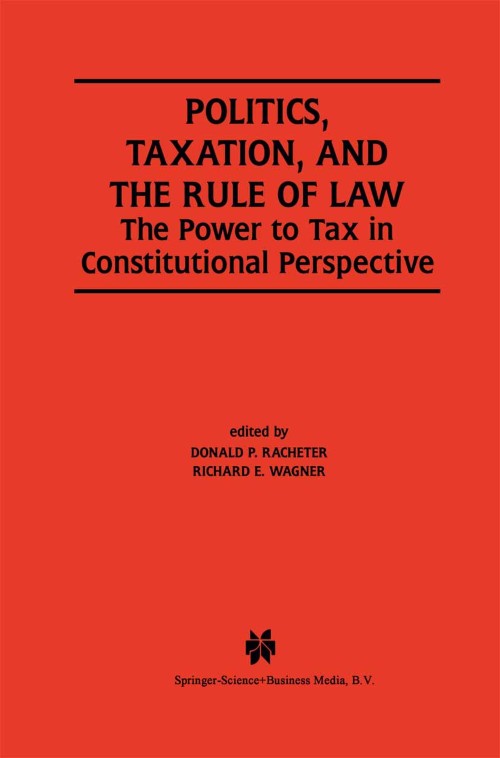
Politics, Taxation, and the Rule of Law [electronic resource] : The Power to Tax in Constitutional Perspective / edited by Donald P. Racheter, Richard E. Wagner.
Erişim Adresi
ISBN
9781461510697
Dil Kodu
İngilizce
Yer Numarası
DK/14140
Basım Bildirimi
1st ed. 2002.
Yayın Bilgisi
New York, NY : Springer US : Imprint: Springer, 2002.
Fiziksel Niteleme
XI, 272 p. online resource.
İçindekiler Notu
1. The Constitutional Framework for Democratic Taxation -- 2. Self-Ownership, Taxation, and Democracy: A Philosophical-Constitutional Perspective -- 3. Property, Taxation, and the Budgetary Commons -- 4. Taxpayers Rights and the Fiscal Constitution -- 5. Referendum, Redistribution, and Tax Exemption: A Rent-Seeking Theory of Direct Democracy -- 6. Public Choices and Fiscal Means: Analyzing Taxes as Collective Outcomes -- 7. Excise Taxation and Interest Group Politics -- 8. Taxation through Litigation -- 9. Explaining the Persistent Growth in Tax Complexity -- 10. Site-Value Taxation and the Rule of Law -- 11. Zoning, Smart Growth, and Regulatory Taxation -- 12. Emerging Property Rights, Command-and-Control Regulation, And the Disinterest in Environmental Taxation.
Özet, vb.
Public Interest Institute began operations in 1992 as Iowa's only state-level, independent, research organization. As a public-policy research organization, our four principal goals are to become an information and analysis resource for all Iowans; provide local, state, and national policy-makers with a rigorous, objective, and understandable analysis of specific policy initiatives; identify practical alternatives for action on critical issues; and provide a forum for policy-makers and individuals to share ideas and concerns. The Institute promotes the importance of a free-enterprise economic system and its relationship to a free and democratic society. It seeks to support the proper role of a limited government in a society based upon individual freedom and liberty. Concerned citizens are challenged to become better informed about public issues, for ideas have consequences, and involved individuals can make a difference. Following the general treatment of how to achieve these ideals contained in LIMITING LEVIATHAN, we have continued our series of books designed to examine the topics raised there in greater depth. In FEDERALIST GOVERNMENT IN PRINCIPLE AND PRACTICE we developed the ways in which dividing governmental power between levels such as national and state can help citizens preserve their freedoms. In this volume we develop the ways in which property rights do the same.
Konu
Political science.
Business enterprises __ Taxation.
Business tax __ Law and legislation.
Economic policy.
Finance, Public.
Political Science.
Business Taxation and Tax Law.
Economic Policy.
Public Economics.
Business enterprises __ Taxation.
Business tax __ Law and legislation.
Economic policy.
Finance, Public.
Political Science.
Business Taxation and Tax Law.
Economic Policy.
Public Economics.
Diğer Yazarlar
Kurum Adı
Eseri Alıntıla
Referansları kullanmadan önce gözden geçirmeniz ve varsa gerekli düzeltmeleri yapmanız önerilir.
Dijital Kaynak
MARC Görünümü
LEADER 04937nam a22006015i 4500
001 812895
003 TR_AnAIT
005 20260130232537
007 cr nn 008mamaa
008 121227s2002 xxu| s |||| 0|eng d
020 |a9781461510697|9978-1-4615-1069-7
024 7 |a10.1007/978-1-4615-1069-7|2doi
041 |aeng
049 |aTürk Tarih Kurumu Kütüphanesi
050 4|aJA1-92
072 7|aJPA|2bicssc
072 7|aPOL000000|2bisacsh
072 7|aJPA|2thema
082 04|a320|223
090 |aDK/14140
245 10|aPolitics, Taxation, and the Rule of Law|h[electronic resource] :|bThe Power to Tax in Constitutional Perspective /|cedited by Donald P. Racheter, Richard E. Wagner.
250 |a1st ed. 2002.
264 1|aNew York, NY :|bSpringer US :|bImprint: Springer,|c2002.
300 |aXI, 272 p.|bonline resource.
336 |atext|btxt|2rdacontent
337 |acomputer|bc|2rdamedia
338 |aonline resource|bcr|2rdacarrier
347 |atext file|bPDF|2rda
505 0 |a1. The Constitutional Framework for Democratic Taxation -- 2. Self-Ownership, Taxation, and Democracy: A Philosophical-Constitutional Perspective -- 3. Property, Taxation, and the Budgetary Commons -- 4. Taxpayers Rights and the Fiscal Constitution -- 5. Referendum, Redistribution, and Tax Exemption: A Rent-Seeking Theory of Direct Democracy -- 6. Public Choices and Fiscal Means: Analyzing Taxes as Collective Outcomes -- 7. Excise Taxation and Interest Group Politics -- 8. Taxation through Litigation -- 9. Explaining the Persistent Growth in Tax Complexity -- 10. Site-Value Taxation and the Rule of Law -- 11. Zoning, Smart Growth, and Regulatory Taxation -- 12. Emerging Property Rights, Command-and-Control Regulation, And the Disinterest in Environmental Taxation.
520 |aPublic Interest Institute began operations in 1992 as Iowa's only state-level, independent, research organization. As a public-policy research organization, our four principal goals are to become an information and analysis resource for all Iowans; provide local, state, and national policy-makers with a rigorous, objective, and understandable analysis of specific policy initiatives; identify practical alternatives for action on critical issues; and provide a forum for policy-makers and individuals to share ideas and concerns. The Institute promotes the importance of a free-enterprise economic system and its relationship to a free and democratic society. It seeks to support the proper role of a limited government in a society based upon individual freedom and liberty. Concerned citizens are challenged to become better informed about public issues, for ideas have consequences, and involved individuals can make a difference. Following the general treatment of how to achieve these ideals contained in LIMITING LEVIATHAN, we have continued our series of books designed to examine the topics raised there in greater depth. In FEDERALIST GOVERNMENT IN PRINCIPLE AND PRACTICE we developed the ways in which dividing governmental power between levels such as national and state can help citizens preserve their freedoms. In this volume we develop the ways in which property rights do the same.
532 8 |aAccessibility summary: This PDF is not accessible. It is based on scanned pages and does not support features such as screen reader compatibility or described non-text content (images, graphs etc). However, it likely supports searchable and selectable text based on OCR (Optical Character Recognition). Users with accessibility needs may not be able to use this content effectively. Please contact us at accessibilitysupport@springernature.com if you require assistance or an alternative format.
532 8 |aInaccessible, or known limited accessibility
532 8 |aNo reading system accessibility options actively disabled
532 8 |aPublisher contact for further accessibility information: accessibilitysupport@springernature.com
650 0|aPolitical science.
650 0|aBusiness enterprises|xTaxation.
650 0|aBusiness tax|xLaw and legislation.
650 0|aEconomic policy.
650 0|aFinance, Public.
650 14|aPolitical Science.
650 24|aBusiness Taxation and Tax Law.
650 24|aEconomic Policy.
650 24|aPublic Economics.
700 1 |aRacheter, Donald P.|eeditor.|4edt|4http://id.loc.gov/vocabulary/relators/edt
700 1 |aWagner, Richard E.|eeditor.|4edt|4http://id.loc.gov/vocabulary/relators/edt
710 2 |aSpringerLink (Online service)
773 0 |tSpringer Nature eBook
776 08|iPrinted edition:|z9781402071546
776 08|iPrinted edition:|z9781461510703
776 08|iPrinted edition:|z9781461353799
856 40|uhttps://doi.org/10.1007/978-1-4615-1069-7
912 |aZDB-2-SHU
912 |aZDB-2-SXPI
912 |aZDB-2-BAE
950 |aHumanities, Social Sciences and Law (SpringerNature-11648)
950 |aPolitical Science and International Studies (R0) (SpringerNature-43724)
001 812895
003 TR_AnAIT
005 20260130232537
007 cr nn 008mamaa
008 121227s2002 xxu| s |||| 0|eng d
020 |a9781461510697|9978-1-4615-1069-7
024 7 |a10.1007/978-1-4615-1069-7|2doi
041 |aeng
049 |aTürk Tarih Kurumu Kütüphanesi
050 4|aJA1-92
072 7|aJPA|2bicssc
072 7|aPOL000000|2bisacsh
072 7|aJPA|2thema
082 04|a320|223
090 |aDK/14140
245 10|aPolitics, Taxation, and the Rule of Law|h[electronic resource] :|bThe Power to Tax in Constitutional Perspective /|cedited by Donald P. Racheter, Richard E. Wagner.
250 |a1st ed. 2002.
264 1|aNew York, NY :|bSpringer US :|bImprint: Springer,|c2002.
300 |aXI, 272 p.|bonline resource.
336 |atext|btxt|2rdacontent
337 |acomputer|bc|2rdamedia
338 |aonline resource|bcr|2rdacarrier
347 |atext file|bPDF|2rda
505 0 |a1. The Constitutional Framework for Democratic Taxation -- 2. Self-Ownership, Taxation, and Democracy: A Philosophical-Constitutional Perspective -- 3. Property, Taxation, and the Budgetary Commons -- 4. Taxpayers Rights and the Fiscal Constitution -- 5. Referendum, Redistribution, and Tax Exemption: A Rent-Seeking Theory of Direct Democracy -- 6. Public Choices and Fiscal Means: Analyzing Taxes as Collective Outcomes -- 7. Excise Taxation and Interest Group Politics -- 8. Taxation through Litigation -- 9. Explaining the Persistent Growth in Tax Complexity -- 10. Site-Value Taxation and the Rule of Law -- 11. Zoning, Smart Growth, and Regulatory Taxation -- 12. Emerging Property Rights, Command-and-Control Regulation, And the Disinterest in Environmental Taxation.
520 |aPublic Interest Institute began operations in 1992 as Iowa's only state-level, independent, research organization. As a public-policy research organization, our four principal goals are to become an information and analysis resource for all Iowans; provide local, state, and national policy-makers with a rigorous, objective, and understandable analysis of specific policy initiatives; identify practical alternatives for action on critical issues; and provide a forum for policy-makers and individuals to share ideas and concerns. The Institute promotes the importance of a free-enterprise economic system and its relationship to a free and democratic society. It seeks to support the proper role of a limited government in a society based upon individual freedom and liberty. Concerned citizens are challenged to become better informed about public issues, for ideas have consequences, and involved individuals can make a difference. Following the general treatment of how to achieve these ideals contained in LIMITING LEVIATHAN, we have continued our series of books designed to examine the topics raised there in greater depth. In FEDERALIST GOVERNMENT IN PRINCIPLE AND PRACTICE we developed the ways in which dividing governmental power between levels such as national and state can help citizens preserve their freedoms. In this volume we develop the ways in which property rights do the same.
532 8 |aAccessibility summary: This PDF is not accessible. It is based on scanned pages and does not support features such as screen reader compatibility or described non-text content (images, graphs etc). However, it likely supports searchable and selectable text based on OCR (Optical Character Recognition). Users with accessibility needs may not be able to use this content effectively. Please contact us at accessibilitysupport@springernature.com if you require assistance or an alternative format.
532 8 |aInaccessible, or known limited accessibility
532 8 |aNo reading system accessibility options actively disabled
532 8 |aPublisher contact for further accessibility information: accessibilitysupport@springernature.com
650 0|aPolitical science.
650 0|aBusiness enterprises|xTaxation.
650 0|aBusiness tax|xLaw and legislation.
650 0|aEconomic policy.
650 0|aFinance, Public.
650 14|aPolitical Science.
650 24|aBusiness Taxation and Tax Law.
650 24|aEconomic Policy.
650 24|aPublic Economics.
700 1 |aRacheter, Donald P.|eeditor.|4edt|4http://id.loc.gov/vocabulary/relators/edt
700 1 |aWagner, Richard E.|eeditor.|4edt|4http://id.loc.gov/vocabulary/relators/edt
710 2 |aSpringerLink (Online service)
773 0 |tSpringer Nature eBook
776 08|iPrinted edition:|z9781402071546
776 08|iPrinted edition:|z9781461510703
776 08|iPrinted edition:|z9781461353799
856 40|uhttps://doi.org/10.1007/978-1-4615-1069-7
912 |aZDB-2-SHU
912 |aZDB-2-SXPI
912 |aZDB-2-BAE
950 |aHumanities, Social Sciences and Law (SpringerNature-11648)
950 |aPolitical Science and International Studies (R0) (SpringerNature-43724)
Materyaller
Depodan talep edilen materyal sadece kütüphane içerisinde kullanılmaktadır.
Materyal dışarıya ödünç verilmemektedir.
Materyal dışarıya ödünç verilmemektedir.
