

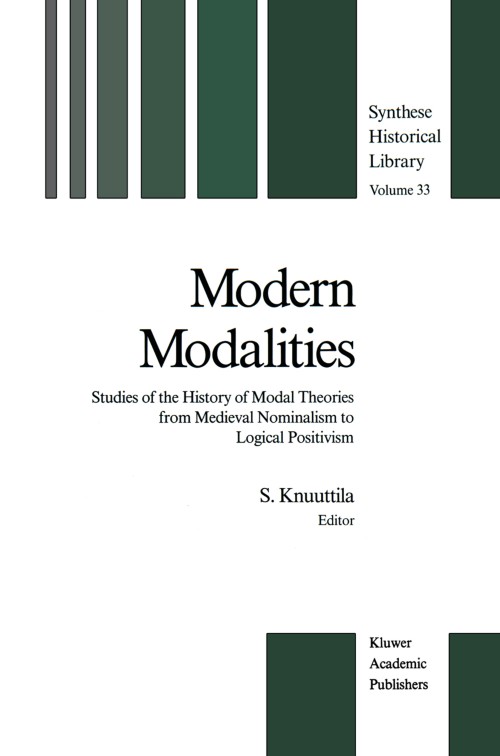
Modern Modalities [electronic resource] : Studies of the History of Modal Theories from Medieval Nominalism to Logical Positivism / edited by Simo Knuuttila.
Erişim Adresi
ISBN
9789400929159
Dil Kodu
İngilizce
Yer Numarası
DK/14153
Basım Bildirimi
1st ed. 1988.
Yayın Bilgisi
Dordrecht : Springer Netherlands : Imprint: Springer, 1988.
Fiziksel Niteleme
XIV, 346 p. online resource.
Dizi
Synthese Historical Library ; 33
İçindekiler Notu
The Foundations of Modality and Conceivability in Descartes and his Predecessors -- Hobbes’s System of Modalities -- Was Leibniz’s Deity an Akrates? -- Hegel on Modalities and Monadology -- Plenitude and Contingency: Modal Concepts in Nineteenth Century French Philosophy -- Frege and his German Contemporaries on Alethic Modalities -- From Possibility to Probability: British Discussions on Modality in the Nineteenth Century -- The Failure of Logical Positivism to Cope with Problems of Modal Theory -- Index of Names -- Index of Subjects.
Özet, vb.
The word "modem" in the title of this book refers primarily to post-medieval discussions, but it also hints at those medieval mo dal theories which were considered modem in contradistinction to ancient conceptions and which in different ways influenced philosophical discussions during the early modem period. The me dieval developments are investigated in the opening paper, 'The Foundations of Modality and Conceivability in Descartes and His Predecessors', by Lilli Alanen and Simo Knuuttila. Boethius's works from the early sixth century belonged to the sources from which early medieval thinkers obtained their knowledge of ancient thought. They offered extensive discus sions of traditional modal conceptions the basic forms of which were: (1) the paradigm of possibility as a potency striving to realize itself; (2) the "statistical" interpretation of modal no tions where necessity means actuality in all relevant cases or omnitemporal actuality, possibility means actuality in some rel evant cases or sometimes, and impossibility means omnitemporal non-actuality; and (3) the "logical" definition of possibility as something which, being assumed, results in nothing contradic tory. Boethius accepted the Aristotelian view according to which total possibilities in the first sense must prove their met tle through actualization and possibilities in the third sense are assumed to be realized in our actual history. On these presump tions, all of the above-mentioned ancient paradigms imply the Principle of Plenitude according to which no genuine possibility remains unrealized.
Konu
Philosophy, Modern.
Early Modern Philosophy.
Early Modern Philosophy.
Diğer Yazarlar
Kurum Adı
Eseri Alıntıla
Referansları kullanmadan önce gözden geçirmeniz ve varsa gerekli düzeltmeleri yapmanız önerilir.
Dijital Kaynak
MARC Görünümü
LEADER 04636nam a22005295i 4500
001 812908
003 TR_AnAIT
005 20260130232507
007 cr nn 008mamaa
008 121227s1988 ne | s |||| 0|eng d
020 |a9789400929159|9978-94-009-2915-9
024 7 |a10.1007/978-94-009-2915-9|2doi
041 |aeng
049 |aTürk Tarih Kurumu Kütüphanesi
050 4|aB800.2-804
072 7|aHPCD|2bicssc
072 7|aPHI016000|2bisacsh
072 7|aQDH|2thema
082 04|a190.903|223
090 |aDK/14153
245 10|aModern Modalities|h[electronic resource] :|bStudies of the History of Modal Theories from Medieval Nominalism to Logical Positivism /|cedited by Simo Knuuttila.
250 |a1st ed. 1988.
264 1|aDordrecht :|bSpringer Netherlands :|bImprint: Springer,|c1988.
300 |aXIV, 346 p.|bonline resource.
336 |atext|btxt|2rdacontent
337 |acomputer|bc|2rdamedia
338 |aonline resource|bcr|2rdacarrier
347 |atext file|bPDF|2rda
490 1 |aSynthese Historical Library ;|v33
505 0 |aThe Foundations of Modality and Conceivability in Descartes and his Predecessors -- Hobbes’s System of Modalities -- Was Leibniz’s Deity an Akrates? -- Hegel on Modalities and Monadology -- Plenitude and Contingency: Modal Concepts in Nineteenth Century French Philosophy -- Frege and his German Contemporaries on Alethic Modalities -- From Possibility to Probability: British Discussions on Modality in the Nineteenth Century -- The Failure of Logical Positivism to Cope with Problems of Modal Theory -- Index of Names -- Index of Subjects.
520 |aThe word "modem" in the title of this book refers primarily to post-medieval discussions, but it also hints at those medieval mo dal theories which were considered modem in contradistinction to ancient conceptions and which in different ways influenced philosophical discussions during the early modem period. The me dieval developments are investigated in the opening paper, 'The Foundations of Modality and Conceivability in Descartes and His Predecessors', by Lilli Alanen and Simo Knuuttila. Boethius's works from the early sixth century belonged to the sources from which early medieval thinkers obtained their knowledge of ancient thought. They offered extensive discus sions of traditional modal conceptions the basic forms of which were: (1) the paradigm of possibility as a potency striving to realize itself; (2) the "statistical" interpretation of modal no tions where necessity means actuality in all relevant cases or omnitemporal actuality, possibility means actuality in some rel evant cases or sometimes, and impossibility means omnitemporal non-actuality; and (3) the "logical" definition of possibility as something which, being assumed, results in nothing contradic tory. Boethius accepted the Aristotelian view according to which total possibilities in the first sense must prove their met tle through actualization and possibilities in the third sense are assumed to be realized in our actual history. On these presump tions, all of the above-mentioned ancient paradigms imply the Principle of Plenitude according to which no genuine possibility remains unrealized.
532 8 |aAccessibility summary: This PDF is not accessible. It is based on scanned pages and does not support features such as screen reader compatibility or described non-text content (images, graphs etc). However, it likely supports searchable and selectable text based on OCR (Optical Character Recognition). Users with accessibility needs may not be able to use this content effectively. Please contact us at accessibilitysupport@springernature.com if you require assistance or an alternative format.
532 8 |aInaccessible, or known limited accessibility
532 8 |aNo reading system accessibility options actively disabled
532 8 |aPublisher contact for further accessibility information: accessibilitysupport@springernature.com
650 0|aPhilosophy, Modern.
650 14|aEarly Modern Philosophy.
700 1 |aKnuuttila, Simo.|eeditor.|4edt|4http://id.loc.gov/vocabulary/relators/edt
710 2 |aSpringerLink (Online service)
773 0 |tSpringer Nature eBook
776 08|iPrinted edition:|z9789027726780
776 08|iPrinted edition:|z9789400929166
776 08|iPrinted edition:|z9789401078122
830 0|aSynthese Historical Library ;|v33
856 40|uhttps://doi.org/10.1007/978-94-009-2915-9
912 |aZDB-2-SHU
912 |aZDB-2-SXPR
912 |aZDB-2-BAE
950 |aHumanities, Social Sciences and Law (SpringerNature-11648)
950 |aPhilosophy and Religion (R0) (SpringerNature-43725)
001 812908
003 TR_AnAIT
005 20260130232507
007 cr nn 008mamaa
008 121227s1988 ne | s |||| 0|eng d
020 |a9789400929159|9978-94-009-2915-9
024 7 |a10.1007/978-94-009-2915-9|2doi
041 |aeng
049 |aTürk Tarih Kurumu Kütüphanesi
050 4|aB800.2-804
072 7|aHPCD|2bicssc
072 7|aPHI016000|2bisacsh
072 7|aQDH|2thema
082 04|a190.903|223
090 |aDK/14153
245 10|aModern Modalities|h[electronic resource] :|bStudies of the History of Modal Theories from Medieval Nominalism to Logical Positivism /|cedited by Simo Knuuttila.
250 |a1st ed. 1988.
264 1|aDordrecht :|bSpringer Netherlands :|bImprint: Springer,|c1988.
300 |aXIV, 346 p.|bonline resource.
336 |atext|btxt|2rdacontent
337 |acomputer|bc|2rdamedia
338 |aonline resource|bcr|2rdacarrier
347 |atext file|bPDF|2rda
490 1 |aSynthese Historical Library ;|v33
505 0 |aThe Foundations of Modality and Conceivability in Descartes and his Predecessors -- Hobbes’s System of Modalities -- Was Leibniz’s Deity an Akrates? -- Hegel on Modalities and Monadology -- Plenitude and Contingency: Modal Concepts in Nineteenth Century French Philosophy -- Frege and his German Contemporaries on Alethic Modalities -- From Possibility to Probability: British Discussions on Modality in the Nineteenth Century -- The Failure of Logical Positivism to Cope with Problems of Modal Theory -- Index of Names -- Index of Subjects.
520 |aThe word "modem" in the title of this book refers primarily to post-medieval discussions, but it also hints at those medieval mo dal theories which were considered modem in contradistinction to ancient conceptions and which in different ways influenced philosophical discussions during the early modem period. The me dieval developments are investigated in the opening paper, 'The Foundations of Modality and Conceivability in Descartes and His Predecessors', by Lilli Alanen and Simo Knuuttila. Boethius's works from the early sixth century belonged to the sources from which early medieval thinkers obtained their knowledge of ancient thought. They offered extensive discus sions of traditional modal conceptions the basic forms of which were: (1) the paradigm of possibility as a potency striving to realize itself; (2) the "statistical" interpretation of modal no tions where necessity means actuality in all relevant cases or omnitemporal actuality, possibility means actuality in some rel evant cases or sometimes, and impossibility means omnitemporal non-actuality; and (3) the "logical" definition of possibility as something which, being assumed, results in nothing contradic tory. Boethius accepted the Aristotelian view according to which total possibilities in the first sense must prove their met tle through actualization and possibilities in the third sense are assumed to be realized in our actual history. On these presump tions, all of the above-mentioned ancient paradigms imply the Principle of Plenitude according to which no genuine possibility remains unrealized.
532 8 |aAccessibility summary: This PDF is not accessible. It is based on scanned pages and does not support features such as screen reader compatibility or described non-text content (images, graphs etc). However, it likely supports searchable and selectable text based on OCR (Optical Character Recognition). Users with accessibility needs may not be able to use this content effectively. Please contact us at accessibilitysupport@springernature.com if you require assistance or an alternative format.
532 8 |aInaccessible, or known limited accessibility
532 8 |aNo reading system accessibility options actively disabled
532 8 |aPublisher contact for further accessibility information: accessibilitysupport@springernature.com
650 0|aPhilosophy, Modern.
650 14|aEarly Modern Philosophy.
700 1 |aKnuuttila, Simo.|eeditor.|4edt|4http://id.loc.gov/vocabulary/relators/edt
710 2 |aSpringerLink (Online service)
773 0 |tSpringer Nature eBook
776 08|iPrinted edition:|z9789027726780
776 08|iPrinted edition:|z9789400929166
776 08|iPrinted edition:|z9789401078122
830 0|aSynthese Historical Library ;|v33
856 40|uhttps://doi.org/10.1007/978-94-009-2915-9
912 |aZDB-2-SHU
912 |aZDB-2-SXPR
912 |aZDB-2-BAE
950 |aHumanities, Social Sciences and Law (SpringerNature-11648)
950 |aPhilosophy and Religion (R0) (SpringerNature-43725)
Materyaller
Depodan talep edilen materyal sadece kütüphane içerisinde kullanılmaktadır.
Materyal dışarıya ödünç verilmemektedir.
Materyal dışarıya ödünç verilmemektedir.
