

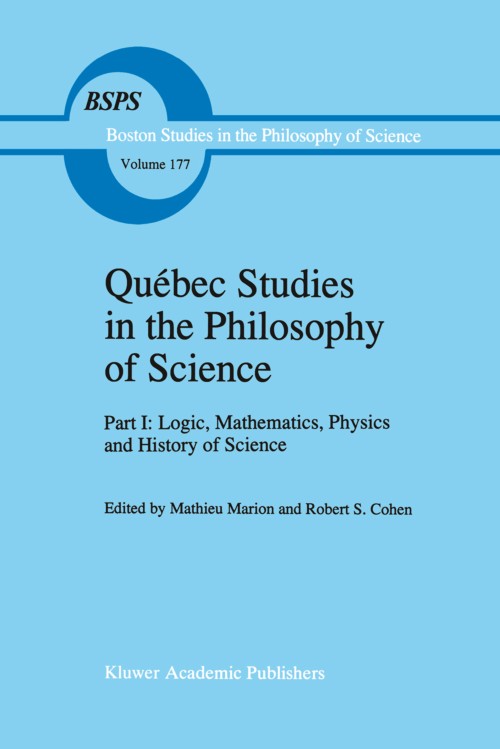
Québec Studies in the Philosophy of Science [electronic resource] : Part I: Logic, Mathematics, Physics and History of Science / edited by Mathieu Marion, Robert S. Cohen.
Erişim Adresi
ISBN
9789400915756
Dil Kodu
İngilizce
Yer Numarası
DK/14191
Basım Bildirimi
1st ed. 1995.
Yayın Bilgisi
Dordrecht : Springer Netherlands : Imprint: Springer, 1995.
Fiziksel Niteleme
XII, 332 p. online resource.
Dizi
Boston Studies in the Philosophy and History of Science, 2214-7942 ; 177
İçindekiler Notu
Logic -- On Axiomatizing Free Logic — And Inclusive Logic in the Bargain -- Partial Propositional Logic -- Generalized Quantifiers and Inferences -- A Category-Theoretic Approach to Aristotle’s Term Logic, with Special Reference to Syllogisms -- On the Nominalistic Interpretation of Natural Languages -- If Not-True and Not Being True Are Not Identical, Which One Is False? -- A New Formulation of the Logic of Propositions -- Internal Logic. A Radically Constructive Logic for Mathematics and Physics -- A Reconstruction of Russell’s Substitution Theory -- Philosophy of Mathematics -- Hilbert and Logic -- Kronecker’s ‘Safe Haven of Real Mathematics’ -- Philosophy of Physics -- Hidden Variables, Separability, and Realism -- A Branched Interpretation of Quantum Mechanics Which Differs from Everett’s -- ... and Chaos Shall Set You Free -- History and Philosophy of Science -- Other Things Equal, The Chances Improve -- The Model-Theoretic Argument Unlocked -- Helmholtz and Modern Empiricism -- Technology and the Rise of the Mechanical Philosophy -- Notes on the Authors -- Name Index.
Özet, vb.
By North-American standards, philosophy is not new in Quebec: the first men tion of philosophy lectures given by a Jesuit in the College de Quebec (founded 1635) dates from 1665, and the oldest logic manuscript dates from 1679. In English-speaking universities such as McGill (founded 1829), philosophy began to be taught later, during the second half of the 19th century. The major influence on English-speaking philosophers was, at least initially, that of Scottish Empiricism. On the other hand, the strong influence of the Catholic Church on French-Canadian society meant that the staff of the facultes of the French-speaking universities consisted, until recently, almost entirely of Thomist philosophers. There was accordingly little or no work in modem Formal Logic and Philosophy of Science and precious few contacts between the philosophical communities. In the late forties, Hugues Leblanc was a young student wanting to learn Formal Logic. He could not find anyone in Quebec to teach him and he went to study at Harvard University under the supervision of W. V. Quine. His best friend Maurice L' Abbe had left, a year earlier, for Princeton to study with Alonzo Church. After receiving his Ph. D from Harvard in 1948, Leblanc started his profes sional career at Bryn Mawr College, where he stayed until 1967. He then went to Temple University, where he taught until his retirement in 1992, serving as Chair of the Department of Philosophy from 1973 until 1979.
Konu
Science __ Philosophy.
Mathematical logic.
History.
Logic.
Knowledge, Theory of.
Philosophy of Science.
Mathematical Logic and Foundations.
History.
Logic.
Epistemology.
Mathematical logic.
History.
Logic.
Knowledge, Theory of.
Philosophy of Science.
Mathematical Logic and Foundations.
History.
Logic.
Epistemology.
Diğer Yazarlar
Kurum Adı
Eseri Alıntıla
Referansları kullanmadan önce gözden geçirmeniz ve varsa gerekli düzeltmeleri yapmanız önerilir.
Dijital Kaynak
MARC Görünümü
LEADER 05522nam a22006495i 4500
001 812946
003 TR_AnAIT
005 20260130232406
007 cr nn 008mamaa
008 121227s1995 ne | s |||| 0|eng d
020 |a9789400915756|9978-94-009-1575-6
024 7 |a10.1007/978-94-009-1575-6|2doi
041 |aeng
049 |aTürk Tarih Kurumu Kütüphanesi
050 4|aQ174-175.3
050 4|aB67
072 7|aPDA|2bicssc
072 7|aSCI075000|2bisacsh
072 7|aPDA|2thema
082 04|a501|223
090 |aDK/14191
245 10|aQuébec Studies in the Philosophy of Science|h[electronic resource] :|bPart I: Logic, Mathematics, Physics and History of Science /|cedited by Mathieu Marion, Robert S. Cohen.
250 |a1st ed. 1995.
264 1|aDordrecht :|bSpringer Netherlands :|bImprint: Springer,|c1995.
300 |aXII, 332 p.|bonline resource.
336 |atext|btxt|2rdacontent
337 |acomputer|bc|2rdamedia
338 |aonline resource|bcr|2rdacarrier
347 |atext file|bPDF|2rda
490 1 |aBoston Studies in the Philosophy and History of Science,|x2214-7942 ;|v177
505 0 |aLogic -- On Axiomatizing Free Logic — And Inclusive Logic in the Bargain -- Partial Propositional Logic -- Generalized Quantifiers and Inferences -- A Category-Theoretic Approach to Aristotle’s Term Logic, with Special Reference to Syllogisms -- On the Nominalistic Interpretation of Natural Languages -- If Not-True and Not Being True Are Not Identical, Which One Is False? -- A New Formulation of the Logic of Propositions -- Internal Logic. A Radically Constructive Logic for Mathematics and Physics -- A Reconstruction of Russell’s Substitution Theory -- Philosophy of Mathematics -- Hilbert and Logic -- Kronecker’s ‘Safe Haven of Real Mathematics’ -- Philosophy of Physics -- Hidden Variables, Separability, and Realism -- A Branched Interpretation of Quantum Mechanics Which Differs from Everett’s -- ... and Chaos Shall Set You Free -- History and Philosophy of Science -- Other Things Equal, The Chances Improve -- The Model-Theoretic Argument Unlocked -- Helmholtz and Modern Empiricism -- Technology and the Rise of the Mechanical Philosophy -- Notes on the Authors -- Name Index.
520 |aBy North-American standards, philosophy is not new in Quebec: the first men tion of philosophy lectures given by a Jesuit in the College de Quebec (founded 1635) dates from 1665, and the oldest logic manuscript dates from 1679. In English-speaking universities such as McGill (founded 1829), philosophy began to be taught later, during the second half of the 19th century. The major influence on English-speaking philosophers was, at least initially, that of Scottish Empiricism. On the other hand, the strong influence of the Catholic Church on French-Canadian society meant that the staff of the facultes of the French-speaking universities consisted, until recently, almost entirely of Thomist philosophers. There was accordingly little or no work in modem Formal Logic and Philosophy of Science and precious few contacts between the philosophical communities. In the late forties, Hugues Leblanc was a young student wanting to learn Formal Logic. He could not find anyone in Quebec to teach him and he went to study at Harvard University under the supervision of W. V. Quine. His best friend Maurice L' Abbe had left, a year earlier, for Princeton to study with Alonzo Church. After receiving his Ph. D from Harvard in 1948, Leblanc started his profes sional career at Bryn Mawr College, where he stayed until 1967. He then went to Temple University, where he taught until his retirement in 1992, serving as Chair of the Department of Philosophy from 1973 until 1979.
532 8 |aAccessibility summary: This PDF is not accessible. It is based on scanned pages and does not support features such as screen reader compatibility or described non-text content (images, graphs etc). However, it likely supports searchable and selectable text based on OCR (Optical Character Recognition). Users with accessibility needs may not be able to use this content effectively. Please contact us at accessibilitysupport@springernature.com if you require assistance or an alternative format.
532 8 |aInaccessible, or known limited accessibility
532 8 |aNo reading system accessibility options actively disabled
532 8 |aPublisher contact for further accessibility information: accessibilitysupport@springernature.com
650 0|aScience|xPhilosophy.
650 0|aMathematical logic.
650 0|aHistory.
650 0|aLogic.
650 0|aKnowledge, Theory of.
650 14|aPhilosophy of Science.
650 24|aMathematical Logic and Foundations.
650 24|aHistory.
650 24|aLogic.
650 24|aEpistemology.
700 1 |aMarion, Mathieu.|eeditor.|4edt|4http://id.loc.gov/vocabulary/relators/edt
700 1 |aCohen, Robert S.|eeditor.|4edt|4http://id.loc.gov/vocabulary/relators/edt
710 2 |aSpringerLink (Online service)
773 0 |tSpringer Nature eBook
776 08|iPrinted edition:|z9780792335597
776 08|iPrinted edition:|z9789400915763
776 08|iPrinted edition:|z9789401072045
830 0|aBoston Studies in the Philosophy and History of Science,|x2214-7942 ;|v177
856 40|uhttps://doi.org/10.1007/978-94-009-1575-6
912 |aZDB-2-SHU
912 |aZDB-2-SXPR
912 |aZDB-2-BAE
950 |aHumanities, Social Sciences and Law (SpringerNature-11648)
950 |aPhilosophy and Religion (R0) (SpringerNature-43725)
001 812946
003 TR_AnAIT
005 20260130232406
007 cr nn 008mamaa
008 121227s1995 ne | s |||| 0|eng d
020 |a9789400915756|9978-94-009-1575-6
024 7 |a10.1007/978-94-009-1575-6|2doi
041 |aeng
049 |aTürk Tarih Kurumu Kütüphanesi
050 4|aQ174-175.3
050 4|aB67
072 7|aPDA|2bicssc
072 7|aSCI075000|2bisacsh
072 7|aPDA|2thema
082 04|a501|223
090 |aDK/14191
245 10|aQuébec Studies in the Philosophy of Science|h[electronic resource] :|bPart I: Logic, Mathematics, Physics and History of Science /|cedited by Mathieu Marion, Robert S. Cohen.
250 |a1st ed. 1995.
264 1|aDordrecht :|bSpringer Netherlands :|bImprint: Springer,|c1995.
300 |aXII, 332 p.|bonline resource.
336 |atext|btxt|2rdacontent
337 |acomputer|bc|2rdamedia
338 |aonline resource|bcr|2rdacarrier
347 |atext file|bPDF|2rda
490 1 |aBoston Studies in the Philosophy and History of Science,|x2214-7942 ;|v177
505 0 |aLogic -- On Axiomatizing Free Logic — And Inclusive Logic in the Bargain -- Partial Propositional Logic -- Generalized Quantifiers and Inferences -- A Category-Theoretic Approach to Aristotle’s Term Logic, with Special Reference to Syllogisms -- On the Nominalistic Interpretation of Natural Languages -- If Not-True and Not Being True Are Not Identical, Which One Is False? -- A New Formulation of the Logic of Propositions -- Internal Logic. A Radically Constructive Logic for Mathematics and Physics -- A Reconstruction of Russell’s Substitution Theory -- Philosophy of Mathematics -- Hilbert and Logic -- Kronecker’s ‘Safe Haven of Real Mathematics’ -- Philosophy of Physics -- Hidden Variables, Separability, and Realism -- A Branched Interpretation of Quantum Mechanics Which Differs from Everett’s -- ... and Chaos Shall Set You Free -- History and Philosophy of Science -- Other Things Equal, The Chances Improve -- The Model-Theoretic Argument Unlocked -- Helmholtz and Modern Empiricism -- Technology and the Rise of the Mechanical Philosophy -- Notes on the Authors -- Name Index.
520 |aBy North-American standards, philosophy is not new in Quebec: the first men tion of philosophy lectures given by a Jesuit in the College de Quebec (founded 1635) dates from 1665, and the oldest logic manuscript dates from 1679. In English-speaking universities such as McGill (founded 1829), philosophy began to be taught later, during the second half of the 19th century. The major influence on English-speaking philosophers was, at least initially, that of Scottish Empiricism. On the other hand, the strong influence of the Catholic Church on French-Canadian society meant that the staff of the facultes of the French-speaking universities consisted, until recently, almost entirely of Thomist philosophers. There was accordingly little or no work in modem Formal Logic and Philosophy of Science and precious few contacts between the philosophical communities. In the late forties, Hugues Leblanc was a young student wanting to learn Formal Logic. He could not find anyone in Quebec to teach him and he went to study at Harvard University under the supervision of W. V. Quine. His best friend Maurice L' Abbe had left, a year earlier, for Princeton to study with Alonzo Church. After receiving his Ph. D from Harvard in 1948, Leblanc started his profes sional career at Bryn Mawr College, where he stayed until 1967. He then went to Temple University, where he taught until his retirement in 1992, serving as Chair of the Department of Philosophy from 1973 until 1979.
532 8 |aAccessibility summary: This PDF is not accessible. It is based on scanned pages and does not support features such as screen reader compatibility or described non-text content (images, graphs etc). However, it likely supports searchable and selectable text based on OCR (Optical Character Recognition). Users with accessibility needs may not be able to use this content effectively. Please contact us at accessibilitysupport@springernature.com if you require assistance or an alternative format.
532 8 |aInaccessible, or known limited accessibility
532 8 |aNo reading system accessibility options actively disabled
532 8 |aPublisher contact for further accessibility information: accessibilitysupport@springernature.com
650 0|aScience|xPhilosophy.
650 0|aMathematical logic.
650 0|aHistory.
650 0|aLogic.
650 0|aKnowledge, Theory of.
650 14|aPhilosophy of Science.
650 24|aMathematical Logic and Foundations.
650 24|aHistory.
650 24|aLogic.
650 24|aEpistemology.
700 1 |aMarion, Mathieu.|eeditor.|4edt|4http://id.loc.gov/vocabulary/relators/edt
700 1 |aCohen, Robert S.|eeditor.|4edt|4http://id.loc.gov/vocabulary/relators/edt
710 2 |aSpringerLink (Online service)
773 0 |tSpringer Nature eBook
776 08|iPrinted edition:|z9780792335597
776 08|iPrinted edition:|z9789400915763
776 08|iPrinted edition:|z9789401072045
830 0|aBoston Studies in the Philosophy and History of Science,|x2214-7942 ;|v177
856 40|uhttps://doi.org/10.1007/978-94-009-1575-6
912 |aZDB-2-SHU
912 |aZDB-2-SXPR
912 |aZDB-2-BAE
950 |aHumanities, Social Sciences and Law (SpringerNature-11648)
950 |aPhilosophy and Religion (R0) (SpringerNature-43725)
Materyaller
Depodan talep edilen materyal sadece kütüphane içerisinde kullanılmaktadır.
Materyal dışarıya ödünç verilmemektedir.
Materyal dışarıya ödünç verilmemektedir.
