LEADER 03391nam a22005175i 4500
001 812962
003 TR_AnAIT
005 20260130232340
007 cr nn 008mamaa
008 100301s2005 gw | s |||| 0|eng d
020 |a9783540288862|9978-3-540-28886-2
024 7 |a10.1007/3-540-28886-4|2doi
041 |aeng
049 |aTürk Tarih Kurumu Kütüphanesi
050 4|aK201-487
072 7|aLA|2bicssc
072 7|aLAW000000|2bisacsh
072 7|aLA|2thema
082 04|a340.1|223
090 |aDK/14207
100 1 |aNowotny, Helga.|eauthor.|4aut|4http://id.loc.gov/vocabulary/relators/aut
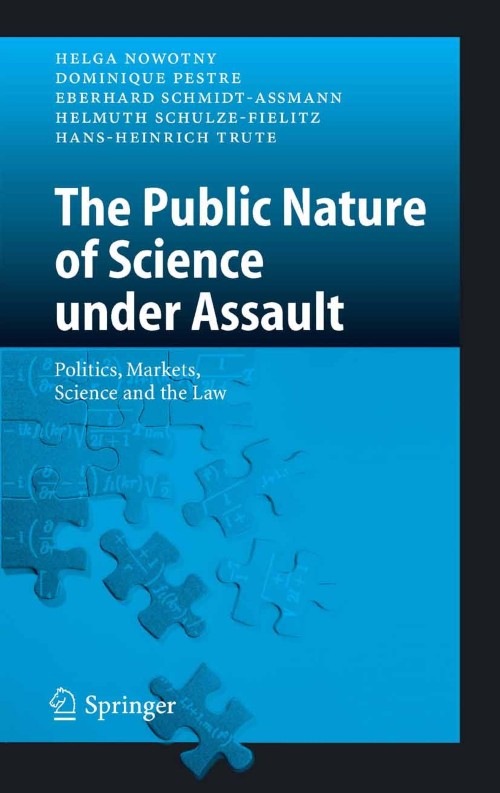
245 14|aThe Public Nature of Science under Assault|h[electronic resource] :|bPolitics, Markets, Science and the Law /|cby Helga Nowotny, Dominique Pestre, Eberhard Schmidt-Aßmann, Helmuth Schulze-Fielitz, Hans-Heinrich Trute.
250 |a1st ed. 2005.
264 1|aBerlin, Heidelberg :|bSpringer Berlin Heidelberg :|bImprint: Springer,|c2005.
300 |aVIII, 148 p.|bonline resource.
336 |atext|btxt|2rdacontent
337 |acomputer|bc|2rdamedia
338 |aonline resource|bcr|2rdacarrier
347 |atext file|bPDF|2rda
505 0 |aThe Changing Nature of Public Science -- The Technosciences between Markets, Social Worries and the Political: How to Imagine a Better Future? -- Comment from a Legal Perspective -- Responses of the Legal Order to the Loss of Trust in Science -- Democratizing Science: Expertise and Participation in Administrative Decision-Making -- Free Access to Research Findings and Its Limitations -- The Response of the Legal Order: Final Commentary from a Social Studies of Science Perspective.
520 |aScience has development from a self-evident public good to being highly valued in other contexts for different reasons: strengthening the economic competitiveness and, especially in high-tech fields, as a financial investment for future gains. This has been accompanied by a shift from public to private funding with intellectual property rights gaining importance. But in contemporary democracies citizens have also begun to voice their concerns about science and technology related risks, demanding greater participation in decision-making and in the setting of research priorities. The book examines the legal issues and responses vis-à-vis these transformations of the nature of public science. It discusses their normative content as well as the inherent limitations of the law in meeting these challenges.
650 0|aLaw.
650 0|aScience|xHistory.
650 14|aFundamentals of Law.
650 24|aHistory of Science.
700 1 |aPestre, Dominique.|eauthor.|4aut|4http://id.loc.gov/vocabulary/relators/aut
700 1 |aSchmidt-Aßmann, Eberhard.|eauthor.|4aut|4http://id.loc.gov/vocabulary/relators/aut
700 1 |aSchulze-Fielitz, Helmuth.|eauthor.|4aut|4http://id.loc.gov/vocabulary/relators/aut
700 1 |aTrute, Hans-Heinrich.|eauthor.|4aut|4http://id.loc.gov/vocabulary/relators/aut
710 2 |aSpringerLink (Online service)
773 0 |tSpringer Nature eBook
776 08|iPrinted edition:|z9783540257912
776 08|iPrinted edition:|z9783540810438
776 08|iPrinted edition:|z9783642065170
856 40|uhttps://doi.org/10.1007/3-540-28886-4
912 |aZDB-2-SHU
912 |aZDB-2-SXLC
950 |aHumanities, Social Sciences and Law (SpringerNature-11648)
950 |aLaw and Criminology (R0) (SpringerNature-43727)