

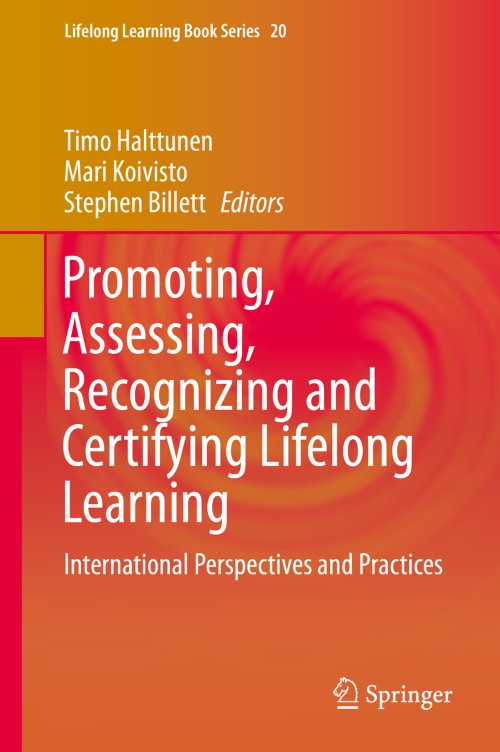
Promoting, Assessing, Recognizing and Certifying Lifelong Learning [electronic resource] : International Perspectives and Practices / edited by Timo Halttunen, Mari Koivisto, Stephen Billett.
Erişim Adresi
ISBN
9789401786942
Dil Kodu
İngilizce
Yer Numarası
DK/14244
Basım Bildirimi
1st ed. 2014.
Yayın Bilgisi
Dordrecht : Springer Netherlands : Imprint: Springer, 2014.
Fiziksel Niteleme
XIV, 302 p. 9 illus. online resource.
Dizi
Lifelong Learning Book Series, 2730-5325 ; 20
İçindekiler Notu
Preface -- Acknowledgements -- Section 1: Promoting and recognising lifelong learning: Key concepts, practices and emerging and perennial problems -- Chapter 1: Promoting and recognising lifelong learning: Introduction; Timo Halttunen and Mari Koivisto (University of Turku, Finland), and Stephen Billett (Griffith University, Australia) -- Chapter 2 : Conceptualising lifelong learning and its recognition in contemporary times; Stephen Billett (Griffith University, Australia -- Chapter 3: New skills for new jobs: Work agency as a necessary condition for successful lifelong learning; Christian Harteis and Michael Goller (University of Paderborn, Germany) -- Section 2: Promoting lifelong learning for economic, social and cultural purposes -- Chapter 4: Evaluating informal learning in the workplace; Karen E. Watkins (The University of Georgia, USA), Victoria J. Marsick (Columbia University, USA) and Miren Fernández de Álava (Autonomous University of Barcelona, Spain) -- Chapter 5: Recognising learning and development in the transaction of personal work practices; Raymond Smith (Griffith University, Australia) -- Chapter 6: Understanding work-related learning: The role of job characteristics and the use of different sources of learning; David Gijbels, Vincent Donche and Piet Van den Bossche (University of Antwerp, Belgium), and Ingrid Ilsbroux and Eva Sammels (University of Leuven, Belgium) -- Chapter 7: Experiential learning: A new higher education requiring new pedagogic skills; Anita Walsh (University of London, UK) -- Chapter 8: How expertise is created in emerging professional fields: Tuire Palonen and Erno Lehtinen (University of Turku, Finland), and Henny P. A. Boshuizen (Open Universiteit in the Netherlands) -- Chapter 9: Continuing education and training at work; Sarojni Choy, Ray Smith and Ann Kelly (Griffith University, Australia) -- Chapter 10: Lifelong learning policies and practices in Singapore:Tensions and challenges; Helen Bound, Magdalene Lin and Peter Rushbrook (Institute for Adult Learning, Singapore) -- Section 3: Recognising and certifying lifelong learning: Policies and practices -- Chapter 11: Professionalisation of supervisors and RPL; Timo Halttunen and Mari Koivisto (University of Turku, Finland) -- Chapter 12: Securing assessors’ professionalism: Meeting assessor requirements for the purpose of performing high-quality (RPL) assessments; Antoinette van Berkel (Amsterdam University of Applied Sciences, the Netherlands) -- Chapter 13: Problems and possibilities in recognition of prior learning: A critical social theory perspective; Fredrik Sandberg (Linköping University, Sweden) -- Chapter 14: Changing RPL & HRD discourses: practitioner perspectives; Anne Murphy (Dublin Institute of Technology, Ireland), Oran Doherty (Letterkenny Institute of Technology, Ireland), and Kate Collins (University College Dublin, Ireland) -- Chapter 15: French approaches to Accreditation of Prior Learning: practices and research; Vanessa Remery (University of Geneva, Switzerland) and Vincent Merle (Conservatoire national des arts et métiers, CNAM, France) -- Chapter 16: Recognising and certifying workers’ knowledge: Policies, frameworks and practices in prospect: Perspectives from two countries; Stephen Billett (Griffith University, Australia) and Helen Bound and Magdalene Lin (Institute for Adult Learning, Singapore) -- Index.
Özet, vb.
This book offers an international perspective on the growing interest worldwide in lifelong learning, particularly as it relates to learning beyond compulsory education and initial occupational preparation: across working life. Much of this interest is driven by key social and economic imperatives associated with the changing requirements of work and working life, the transformation of many occupations and lengthening working lives. The concerns in lifelong learning are also associated with individuals being able to engage in learning about cultural and social topics and practices that they had not so far. It is important to understand how this learning can be assessed, recognized and certified. Many in workforces across the world learn much of the knowledge that is required to maintain their employability through that work. Yet, that learning and that competency remains without recognition and certification while this could be particularly helpful for individuals seeking to sustain their employability or to extend their work into new occupations or workplaces. The first section of this book sets out the overall project and outlines the key concepts and issues. It illustrates why there is a need for promoting and recognizing lifelong learning and explains some of the terminology, concepts and key considerations. The second section informs about a range of policies and practices that are currently being deployed or have been deployed across a range of countries within Europe, Scandinavia and Asia. The last section comprises of contributions emphasizing the ways in which the assessment of workers learning takes place in different occupational contexts and different cultural contexts. The final chapter outlines how a systemic approach to recognizing lifelong learning might progress for a country which is promoting a continuing education and training system largely outside of tertiary education institutions.
Konu
Continuing education.
Professional education.
Vocational education.
Educational tests and measurements.
Education and state.
Lifelong Learning.
Professional and Vocational Education.
Assessment and Testing.
Educational Policy and Politics.
Professional education.
Vocational education.
Educational tests and measurements.
Education and state.
Lifelong Learning.
Professional and Vocational Education.
Assessment and Testing.
Educational Policy and Politics.
Diğer Yazarlar
Kurum Adı
Eseri Alıntıla
Referansları kullanmadan önce gözden geçirmeniz ve varsa gerekli düzeltmeleri yapmanız önerilir.
Dijital Kaynak
MARC Görünümü
LEADER 07576nam a22005775i 4500
001 812999
003 TR_AnAIT
005 20260130232216
007 cr nn 008mamaa
008 140311s2014 ne | s |||| 0|eng d
020 |a9789401786942|9978-94-017-8694-2
024 7 |a10.1007/978-94-017-8694-2|2doi
041 |aeng
049 |aTürk Tarih Kurumu Kütüphanesi
050 4|aLC5201-6660.4
072 7|aJNP|2bicssc
072 7|aEDU002000|2bisacsh
072 7|aJNP|2thema
082 04|a374|223
090 |aDK/14244
245 10|aPromoting, Assessing, Recognizing and Certifying Lifelong Learning|h[electronic resource] :|bInternational Perspectives and Practices /|cedited by Timo Halttunen, Mari Koivisto, Stephen Billett.
250 |a1st ed. 2014.
264 1|aDordrecht :|bSpringer Netherlands :|bImprint: Springer,|c2014.
300 |aXIV, 302 p. 9 illus.|bonline resource.
336 |atext|btxt|2rdacontent
337 |acomputer|bc|2rdamedia
338 |aonline resource|bcr|2rdacarrier
347 |atext file|bPDF|2rda
490 1 |aLifelong Learning Book Series,|x2730-5325 ;|v20
505 0 |aPreface -- Acknowledgements -- Section 1: Promoting and recognising lifelong learning: Key concepts, practices and emerging and perennial problems -- Chapter 1: Promoting and recognising lifelong learning: Introduction; Timo Halttunen and Mari Koivisto (University of Turku, Finland), and Stephen Billett (Griffith University, Australia) -- Chapter 2 : Conceptualising lifelong learning and its recognition in contemporary times; Stephen Billett (Griffith University, Australia -- Chapter 3: New skills for new jobs: Work agency as a necessary condition for successful lifelong learning; Christian Harteis and Michael Goller (University of Paderborn, Germany) -- Section 2: Promoting lifelong learning for economic, social and cultural purposes -- Chapter 4: Evaluating informal learning in the workplace; Karen E. Watkins (The University of Georgia, USA), Victoria J. Marsick (Columbia University, USA) and Miren Fernández de Álava (Autonomous University of Barcelona, Spain) -- Chapter 5: Recognising learning and development in the transaction of personal work practices; Raymond Smith (Griffith University, Australia) -- Chapter 6: Understanding work-related learning: The role of job characteristics and the use of different sources of learning; David Gijbels, Vincent Donche and Piet Van den Bossche (University of Antwerp, Belgium), and Ingrid Ilsbroux and Eva Sammels (University of Leuven, Belgium) -- Chapter 7: Experiential learning: A new higher education requiring new pedagogic skills; Anita Walsh (University of London, UK) -- Chapter 8: How expertise is created in emerging professional fields: Tuire Palonen and Erno Lehtinen (University of Turku, Finland), and Henny P. A. Boshuizen (Open Universiteit in the Netherlands) -- Chapter 9: Continuing education and training at work; Sarojni Choy, Ray Smith and Ann Kelly (Griffith University, Australia) -- Chapter 10: Lifelong learning policies and practices in Singapore:Tensions and challenges; Helen Bound, Magdalene Lin and Peter Rushbrook (Institute for Adult Learning, Singapore) -- Section 3: Recognising and certifying lifelong learning: Policies and practices -- Chapter 11: Professionalisation of supervisors and RPL; Timo Halttunen and Mari Koivisto (University of Turku, Finland) -- Chapter 12: Securing assessors’ professionalism: Meeting assessor requirements for the purpose of performing high-quality (RPL) assessments; Antoinette van Berkel (Amsterdam University of Applied Sciences, the Netherlands) -- Chapter 13: Problems and possibilities in recognition of prior learning: A critical social theory perspective; Fredrik Sandberg (Linköping University, Sweden) -- Chapter 14: Changing RPL & HRD discourses: practitioner perspectives; Anne Murphy (Dublin Institute of Technology, Ireland), Oran Doherty (Letterkenny Institute of Technology, Ireland), and Kate Collins (University College Dublin, Ireland) -- Chapter 15: French approaches to Accreditation of Prior Learning: practices and research; Vanessa Remery (University of Geneva, Switzerland) and Vincent Merle (Conservatoire national des arts et métiers, CNAM, France) -- Chapter 16: Recognising and certifying workers’ knowledge: Policies, frameworks and practices in prospect: Perspectives from two countries; Stephen Billett (Griffith University, Australia) and Helen Bound and Magdalene Lin (Institute for Adult Learning, Singapore) -- Index.
520 |aThis book offers an international perspective on the growing interest worldwide in lifelong learning, particularly as it relates to learning beyond compulsory education and initial occupational preparation: across working life. Much of this interest is driven by key social and economic imperatives associated with the changing requirements of work and working life, the transformation of many occupations and lengthening working lives. The concerns in lifelong learning are also associated with individuals being able to engage in learning about cultural and social topics and practices that they had not so far. It is important to understand how this learning can be assessed, recognized and certified. Many in workforces across the world learn much of the knowledge that is required to maintain their employability through that work. Yet, that learning and that competency remains without recognition and certification while this could be particularly helpful for individuals seeking to sustain their employability or to extend their work into new occupations or workplaces. The first section of this book sets out the overall project and outlines the key concepts and issues. It illustrates why there is a need for promoting and recognizing lifelong learning and explains some of the terminology, concepts and key considerations. The second section informs about a range of policies and practices that are currently being deployed or have been deployed across a range of countries within Europe, Scandinavia and Asia. The last section comprises of contributions emphasizing the ways in which the assessment of workers learning takes place in different occupational contexts and different cultural contexts. The final chapter outlines how a systemic approach to recognizing lifelong learning might progress for a country which is promoting a continuing education and training system largely outside of tertiary education institutions.
650 0|aContinuing education.
650 0|aProfessional education.
650 0|aVocational education.
650 0|aEducational tests and measurements.
650 0|aEducation and state.
650 14|aLifelong Learning.
650 24|aProfessional and Vocational Education.
650 24|aAssessment and Testing.
650 24|aEducational Policy and Politics.
700 1 |aHalttunen, Timo.|eeditor.|4edt|4http://id.loc.gov/vocabulary/relators/edt
700 1 |aKoivisto, Mari.|eeditor.|4edt|4http://id.loc.gov/vocabulary/relators/edt
700 1 |aBillett, Stephen.|eeditor.|4edt|4http://id.loc.gov/vocabulary/relators/edt
710 2 |aSpringerLink (Online service)
773 0 |tSpringer Nature eBook
776 08|iPrinted edition:|z9789401786935
776 08|iPrinted edition:|z9789401786959
776 08|iPrinted edition:|z9789402401592
830 0|aLifelong Learning Book Series,|x2730-5325 ;|v20
856 40|uhttps://doi.org/10.1007/978-94-017-8694-2
912 |aZDB-2-SHU
912 |aZDB-2-SXED
950 |aHumanities, Social Sciences and Law (SpringerNature-11648)
950 |aEducation (R0) (SpringerNature-43721)
001 812999
003 TR_AnAIT
005 20260130232216
007 cr nn 008mamaa
008 140311s2014 ne | s |||| 0|eng d
020 |a9789401786942|9978-94-017-8694-2
024 7 |a10.1007/978-94-017-8694-2|2doi
041 |aeng
049 |aTürk Tarih Kurumu Kütüphanesi
050 4|aLC5201-6660.4
072 7|aJNP|2bicssc
072 7|aEDU002000|2bisacsh
072 7|aJNP|2thema
082 04|a374|223
090 |aDK/14244
245 10|aPromoting, Assessing, Recognizing and Certifying Lifelong Learning|h[electronic resource] :|bInternational Perspectives and Practices /|cedited by Timo Halttunen, Mari Koivisto, Stephen Billett.
250 |a1st ed. 2014.
264 1|aDordrecht :|bSpringer Netherlands :|bImprint: Springer,|c2014.
300 |aXIV, 302 p. 9 illus.|bonline resource.
336 |atext|btxt|2rdacontent
337 |acomputer|bc|2rdamedia
338 |aonline resource|bcr|2rdacarrier
347 |atext file|bPDF|2rda
490 1 |aLifelong Learning Book Series,|x2730-5325 ;|v20
505 0 |aPreface -- Acknowledgements -- Section 1: Promoting and recognising lifelong learning: Key concepts, practices and emerging and perennial problems -- Chapter 1: Promoting and recognising lifelong learning: Introduction; Timo Halttunen and Mari Koivisto (University of Turku, Finland), and Stephen Billett (Griffith University, Australia) -- Chapter 2 : Conceptualising lifelong learning and its recognition in contemporary times; Stephen Billett (Griffith University, Australia -- Chapter 3: New skills for new jobs: Work agency as a necessary condition for successful lifelong learning; Christian Harteis and Michael Goller (University of Paderborn, Germany) -- Section 2: Promoting lifelong learning for economic, social and cultural purposes -- Chapter 4: Evaluating informal learning in the workplace; Karen E. Watkins (The University of Georgia, USA), Victoria J. Marsick (Columbia University, USA) and Miren Fernández de Álava (Autonomous University of Barcelona, Spain) -- Chapter 5: Recognising learning and development in the transaction of personal work practices; Raymond Smith (Griffith University, Australia) -- Chapter 6: Understanding work-related learning: The role of job characteristics and the use of different sources of learning; David Gijbels, Vincent Donche and Piet Van den Bossche (University of Antwerp, Belgium), and Ingrid Ilsbroux and Eva Sammels (University of Leuven, Belgium) -- Chapter 7: Experiential learning: A new higher education requiring new pedagogic skills; Anita Walsh (University of London, UK) -- Chapter 8: How expertise is created in emerging professional fields: Tuire Palonen and Erno Lehtinen (University of Turku, Finland), and Henny P. A. Boshuizen (Open Universiteit in the Netherlands) -- Chapter 9: Continuing education and training at work; Sarojni Choy, Ray Smith and Ann Kelly (Griffith University, Australia) -- Chapter 10: Lifelong learning policies and practices in Singapore:Tensions and challenges; Helen Bound, Magdalene Lin and Peter Rushbrook (Institute for Adult Learning, Singapore) -- Section 3: Recognising and certifying lifelong learning: Policies and practices -- Chapter 11: Professionalisation of supervisors and RPL; Timo Halttunen and Mari Koivisto (University of Turku, Finland) -- Chapter 12: Securing assessors’ professionalism: Meeting assessor requirements for the purpose of performing high-quality (RPL) assessments; Antoinette van Berkel (Amsterdam University of Applied Sciences, the Netherlands) -- Chapter 13: Problems and possibilities in recognition of prior learning: A critical social theory perspective; Fredrik Sandberg (Linköping University, Sweden) -- Chapter 14: Changing RPL & HRD discourses: practitioner perspectives; Anne Murphy (Dublin Institute of Technology, Ireland), Oran Doherty (Letterkenny Institute of Technology, Ireland), and Kate Collins (University College Dublin, Ireland) -- Chapter 15: French approaches to Accreditation of Prior Learning: practices and research; Vanessa Remery (University of Geneva, Switzerland) and Vincent Merle (Conservatoire national des arts et métiers, CNAM, France) -- Chapter 16: Recognising and certifying workers’ knowledge: Policies, frameworks and practices in prospect: Perspectives from two countries; Stephen Billett (Griffith University, Australia) and Helen Bound and Magdalene Lin (Institute for Adult Learning, Singapore) -- Index.
520 |aThis book offers an international perspective on the growing interest worldwide in lifelong learning, particularly as it relates to learning beyond compulsory education and initial occupational preparation: across working life. Much of this interest is driven by key social and economic imperatives associated with the changing requirements of work and working life, the transformation of many occupations and lengthening working lives. The concerns in lifelong learning are also associated with individuals being able to engage in learning about cultural and social topics and practices that they had not so far. It is important to understand how this learning can be assessed, recognized and certified. Many in workforces across the world learn much of the knowledge that is required to maintain their employability through that work. Yet, that learning and that competency remains without recognition and certification while this could be particularly helpful for individuals seeking to sustain their employability or to extend their work into new occupations or workplaces. The first section of this book sets out the overall project and outlines the key concepts and issues. It illustrates why there is a need for promoting and recognizing lifelong learning and explains some of the terminology, concepts and key considerations. The second section informs about a range of policies and practices that are currently being deployed or have been deployed across a range of countries within Europe, Scandinavia and Asia. The last section comprises of contributions emphasizing the ways in which the assessment of workers learning takes place in different occupational contexts and different cultural contexts. The final chapter outlines how a systemic approach to recognizing lifelong learning might progress for a country which is promoting a continuing education and training system largely outside of tertiary education institutions.
650 0|aContinuing education.
650 0|aProfessional education.
650 0|aVocational education.
650 0|aEducational tests and measurements.
650 0|aEducation and state.
650 14|aLifelong Learning.
650 24|aProfessional and Vocational Education.
650 24|aAssessment and Testing.
650 24|aEducational Policy and Politics.
700 1 |aHalttunen, Timo.|eeditor.|4edt|4http://id.loc.gov/vocabulary/relators/edt
700 1 |aKoivisto, Mari.|eeditor.|4edt|4http://id.loc.gov/vocabulary/relators/edt
700 1 |aBillett, Stephen.|eeditor.|4edt|4http://id.loc.gov/vocabulary/relators/edt
710 2 |aSpringerLink (Online service)
773 0 |tSpringer Nature eBook
776 08|iPrinted edition:|z9789401786935
776 08|iPrinted edition:|z9789401786959
776 08|iPrinted edition:|z9789402401592
830 0|aLifelong Learning Book Series,|x2730-5325 ;|v20
856 40|uhttps://doi.org/10.1007/978-94-017-8694-2
912 |aZDB-2-SHU
912 |aZDB-2-SXED
950 |aHumanities, Social Sciences and Law (SpringerNature-11648)
950 |aEducation (R0) (SpringerNature-43721)
Materyaller
Depodan talep edilen materyal sadece kütüphane içerisinde kullanılmaktadır.
Materyal dışarıya ödünç verilmemektedir.
Materyal dışarıya ödünç verilmemektedir.
