

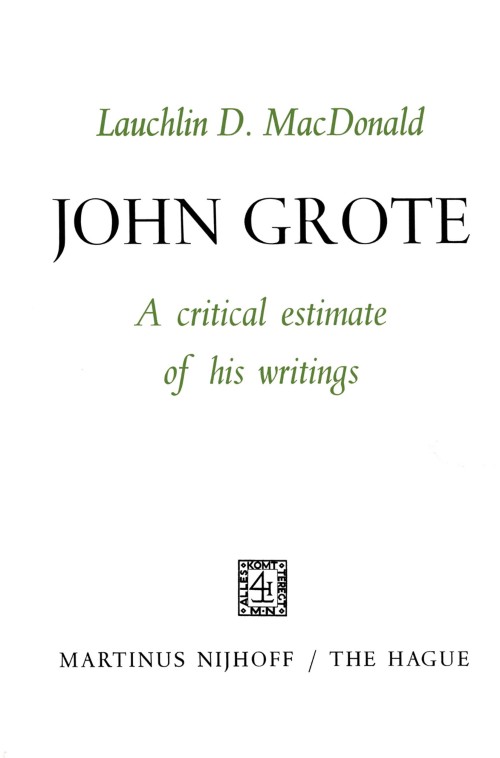
John Grote [electronic resource] : A Critical Estimate of his Writings / by Lauchlin D. MacDonald.
Erişim Adresi
ISBN
9789401192392
Dil Kodu
İngilizce
Yer Numarası
DK/14262
Yazar
Basım Bildirimi
1st ed. 1966.
Yayın Bilgisi
Dordrecht : Springer Netherlands : Imprint: Springer, 1966.
Fiziksel Niteleme
XXI, 284 p. 1 illus. online resource.
İçindekiler Notu
I. Introduction -- 1. John Grote’s Life -- 2. Writings -- 3. Statement, and Division, of the Problem -- 4. Survey of Sources and of Previous Work on the Problem -- 5. Transition to Next Chapter -- II. Grote’s View of Phenomenalism -- I. Distinction of Terms: ‘Noumenon,’ ‘Phenomenon,’ and ‘Thing in Itself’ -- 2. What Phenomenalism Means -- 3. Phenomenal Reality -- 4. Two Tests of Phenomenalism -- 5. The Phenomenalist Spirit or Mind -- 6. Summary and Foreword to Next Chapter -- III. Grote’s Interpretation of the Relation of Phenomenalism to Philosophy -- 1. Each is Necessary to the Other -- 2. Consciousness as Active and Passive -- 3. Analysis of Sensation -- 4. Time and Space -- 5. The Relationship of Phenomenalism to Philosophy Further Illustrated -- 6. Relationship Through Contrast -- 7. Mind Provides Unity -- 8. Grote Avoids A Basic Blunder in Behaviorism -- 9. Kant’s Abstraction of Phenomenal Reality from Reason -- 10. Abstracting of Consciousness from Phenomena is Unwarranted -- 11. Historical Recapitulation -- 12. Main Contribution of the Chapter, with Comment -- 13. Transition to Next Chapter -- IV. Philosophy As Consciousness and the Ego -- 1. Introduction -- 2. Ferrier’s Treatment of Philosophy and Phenomenalism -- 3. Criticism of Grote and Ferrier on the Basis of Lotze’s Position -- 4. Meaning of ‘Know,’ and ‘Know About,’ in Reference to Phenomenal Reality -- 5. Relativity of Knowledge -- 6. Summary of Main Issues -- V. ‘Philosophy’ and the Scale of Sensation -- 1. Introduction -- 2. Importance of the Scale of Sensation -- 3. Two Kinds of Knowledge — ‘Higher’ and ‘Lower’ -- 4. Hamilton, Mill and Reid Compared -- 5. Descartes and Hamilton -- 6. Proper Use of Certain Terms in Relation to the Scale of Sensation -- 7. Critical Reflection on the ForegoingChapter -- VI. Phenomenalist Logic and Knowledge -- 1. Introductory -- 2. Grote’s Own Position Revealed Through Criticism of Hamilton and Mill -- 3. Phenomenalism Inadequate For A Perfect Scheme of Knowledge -- 4. Critical Observations and Analyses -- VII. The Introspective Method in Knowledge -- 1. Introduction -- 2. Locke’s Psychology -- 3. Hume’s Rationalism -- 4. Berkeley’s Subjectivism -- 5. Spencer’s and Morell’s Evolutionism -- 6. Retrospect and Prospect -- VIII. Immediateness and Reflection -- 1. Introduction -- 2. Purpose of the Chapter in Introducing These Terms -- 3. Meaning of Immediateness and Reflection -- 4. Significance of Immediateness and Reflection in Grote’s Philosophy -- 5. Critical Comment -- 6. Relation to the Following Chapter -- IX. Personalism in Grote’s Writings -- 1. Introduction -- 2. Epistemological Monism -- 3. Monistic, Pluralistic, and Theistic Personalism -- 4. Critique of Materialism -- 5. Critical Comment -- 6. Summary and Transition to Next Chapter -- X. Grote’s Idealism -- 1. Introduction -- 2. Grote’s Platonism -- 3. Critique of Utilitarianism -- 4. A Critique of Moral Ideals -- 5. Critical Remarks -- 6. Concluding Note to this Chapter -- Conclusion -- 1. Grote’s Position in the History of Philosophy -- 2. Further Critical Comment -- Appendix: An Exposition of the Miscellaneous Writings of John Grote -- I. “On A Furture State” -- 1. Glorification of body and mind -- 2. Simplicity of style and thought in this article -- 3. Effect of present life on the future -- 4. Manner of individual appearance in a future life is unimportant -- 5. Stress on the importance of both present and future life -- 6. Comment -- II. “On Glossology” -- 1. Concerning terminology -- i. Break in Grote’s projected work on glossology -- ii.’ Phone’ and ‘noem’.-iii.’ Phonism’ and ‘noematism’ -- iv. Ideas of physical ‘things’ -- v. Stomatism -- vi. ‘Hypophonism’ -- 2. The philosophy of language -- i. Four divisions -- ii. ‘Noematism’ -- iii. ‘Noematoschematism’ -- iv.’ Phonarium’ -- v. ‘Dianoematism’ -- vi. In extreme cases the modification in noematism is very great -- 3. Criticism of Tooke -- 4. Criticism of Trench -- 5. Comment -- III. “Thought vs. Learning” -- 1. A contrast -- 2. Use of one’s own mind is of chief importance -- 3. Thought and learning stagnation -- 4. Comment -- IV. “Pascal and Montaigne” -- 1. A brief comparison -- 2. Pascal’s devotion to religion -- 3. Montaigne’s neopaganism -- 4. Pascal on happiness -- 5. Comment -- V. “On the Dating of Ancient History” -- 1. Dating of events by two methods — epochal and eponymous -- 2. Dynastical reckoning -- 3. Olympiadic dating -- 4. Dating by lunar months -- 5. Dating originating in Christendom -- 6. Other methods of dating -- 7. Present and future methods of dating -- VI. “Origin and Meaning of Roman Names” -- 1. Significance of ‘nomen,’ ‘praenomen,’ and ‘cognomen’ -- 2. Criticism of Plutarch -- 3. Change in a Roman name -- 4. Criticism of Varro’s view -- 5. Present-day names based on Roman rather than on Greek -- VII. Conclusion to Miscellaneous Writings -- Chronological Bibliography of the Writings of John Grote -- General Bibliography.
Özet, vb.
An objective of this book is to discuss some of the contributions made by John Grote to philosophy. This work is an extension of a dissertation written for the doctorate at Boston University. The author wishes to acknowledge the invaluable assistance in many places to Professor Peter A. Bertocci and the late Professor Edgar S. Brightman both of whom read the entire manuscript in its original form. Also, the author acknowledges the encouraging interest and support of his wife, Helen, whose many suggestions have improved the writing and without whose assistance this work would not have been accomplished. The author assumes complete responsibility for whatever errors or deficiencies appear in the book. All known writings of Grote are listed and the more important ones analyzed. LAUCHLIN D. MACDONALD CHAPTER I INTRODUCTION 1. JOHN GROTE'S LIFE i. Sketch of his life John Grote will remain best known by reason of the thought formu lated in the Exploratio Philosophica, or Rough Notes on Modern I ntellectu al Science. To the philosophical world of his own time he was well known as the teacher who ably held the chair of Moral Philosophy in the University of Cambridge from r855 until the year of his death, r866, to the Knightbridge Professor, William Whewell whose in succession Philosophy of Science is the subject of at least one chapter of the Exploratio Philosophica. Grote's birthplace was Beckenham in Kent, and the date, May 5, r8r3.
Konu
Philosophy, Modern.
Religion and sociology.
Communication.
Early Modern Philosophy.
Sociology of Religion.
Media and Communication.
Religion and sociology.
Communication.
Early Modern Philosophy.
Sociology of Religion.
Media and Communication.
Kurum Adı
Eseri Alıntıla
Referansları kullanmadan önce gözden geçirmeniz ve varsa gerekli düzeltmeleri yapmanız önerilir.
Dijital Kaynak
MARC Görünümü
LEADER 09011nam a22005415i 4500
001 813017
003 TR_AnAIT
005 20260130232147
007 cr nn 008mamaa
008 121227s1966 ne | s |||| 0|eng d
020 |a9789401192392|9978-94-011-9239-2
024 7 |a10.1007/978-94-011-9239-2|2doi
041 |aeng
049 |aTürk Tarih Kurumu Kütüphanesi
050 4|aB800.2-804
072 7|aHPCD|2bicssc
072 7|aPHI016000|2bisacsh
072 7|aQDH|2thema
082 04|a190.903|223
090 |aDK/14262
100 1 |aMacDonald, Lauchlin D.|eauthor.|4aut|4http://id.loc.gov/vocabulary/relators/aut
245 10|aJohn Grote|h[electronic resource] :|bA Critical Estimate of his Writings /|cby Lauchlin D. MacDonald.
250 |a1st ed. 1966.
264 1|aDordrecht :|bSpringer Netherlands :|bImprint: Springer,|c1966.
300 |aXXI, 284 p. 1 illus.|bonline resource.
336 |atext|btxt|2rdacontent
337 |acomputer|bc|2rdamedia
338 |aonline resource|bcr|2rdacarrier
347 |atext file|bPDF|2rda
505 0 |aI. Introduction -- 1. John Grote’s Life -- 2. Writings -- 3. Statement, and Division, of the Problem -- 4. Survey of Sources and of Previous Work on the Problem -- 5. Transition to Next Chapter -- II. Grote’s View of Phenomenalism -- I. Distinction of Terms: ‘Noumenon,’ ‘Phenomenon,’ and ‘Thing in Itself’ -- 2. What Phenomenalism Means -- 3. Phenomenal Reality -- 4. Two Tests of Phenomenalism -- 5. The Phenomenalist Spirit or Mind -- 6. Summary and Foreword to Next Chapter -- III. Grote’s Interpretation of the Relation of Phenomenalism to Philosophy -- 1. Each is Necessary to the Other -- 2. Consciousness as Active and Passive -- 3. Analysis of Sensation -- 4. Time and Space -- 5. The Relationship of Phenomenalism to Philosophy Further Illustrated -- 6. Relationship Through Contrast -- 7. Mind Provides Unity -- 8. Grote Avoids A Basic Blunder in Behaviorism -- 9. Kant’s Abstraction of Phenomenal Reality from Reason -- 10. Abstracting of Consciousness from Phenomena is Unwarranted -- 11. Historical Recapitulation -- 12. Main Contribution of the Chapter, with Comment -- 13. Transition to Next Chapter -- IV. Philosophy As Consciousness and the Ego -- 1. Introduction -- 2. Ferrier’s Treatment of Philosophy and Phenomenalism -- 3. Criticism of Grote and Ferrier on the Basis of Lotze’s Position -- 4. Meaning of ‘Know,’ and ‘Know About,’ in Reference to Phenomenal Reality -- 5. Relativity of Knowledge -- 6. Summary of Main Issues -- V. ‘Philosophy’ and the Scale of Sensation -- 1. Introduction -- 2. Importance of the Scale of Sensation -- 3. Two Kinds of Knowledge — ‘Higher’ and ‘Lower’ -- 4. Hamilton, Mill and Reid Compared -- 5. Descartes and Hamilton -- 6. Proper Use of Certain Terms in Relation to the Scale of Sensation -- 7. Critical Reflection on the ForegoingChapter -- VI. Phenomenalist Logic and Knowledge -- 1. Introductory -- 2. Grote’s Own Position Revealed Through Criticism of Hamilton and Mill -- 3. Phenomenalism Inadequate For A Perfect Scheme of Knowledge -- 4. Critical Observations and Analyses -- VII. The Introspective Method in Knowledge -- 1. Introduction -- 2. Locke’s Psychology -- 3. Hume’s Rationalism -- 4. Berkeley’s Subjectivism -- 5. Spencer’s and Morell’s Evolutionism -- 6. Retrospect and Prospect -- VIII. Immediateness and Reflection -- 1. Introduction -- 2. Purpose of the Chapter in Introducing These Terms -- 3. Meaning of Immediateness and Reflection -- 4. Significance of Immediateness and Reflection in Grote’s Philosophy -- 5. Critical Comment -- 6. Relation to the Following Chapter -- IX. Personalism in Grote’s Writings -- 1. Introduction -- 2. Epistemological Monism -- 3. Monistic, Pluralistic, and Theistic Personalism -- 4. Critique of Materialism -- 5. Critical Comment -- 6. Summary and Transition to Next Chapter -- X. Grote’s Idealism -- 1. Introduction -- 2. Grote’s Platonism -- 3. Critique of Utilitarianism -- 4. A Critique of Moral Ideals -- 5. Critical Remarks -- 6. Concluding Note to this Chapter -- Conclusion -- 1. Grote’s Position in the History of Philosophy -- 2. Further Critical Comment -- Appendix: An Exposition of the Miscellaneous Writings of John Grote -- I. “On A Furture State” -- 1. Glorification of body and mind -- 2. Simplicity of style and thought in this article -- 3. Effect of present life on the future -- 4. Manner of individual appearance in a future life is unimportant -- 5. Stress on the importance of both present and future life -- 6. Comment -- II. “On Glossology” -- 1. Concerning terminology -- i. Break in Grote’s projected work on glossology -- ii.’ Phone’ and ‘noem’.-iii.’ Phonism’ and ‘noematism’ -- iv. Ideas of physical ‘things’ -- v. Stomatism -- vi. ‘Hypophonism’ -- 2. The philosophy of language -- i. Four divisions -- ii. ‘Noematism’ -- iii. ‘Noematoschematism’ -- iv.’ Phonarium’ -- v. ‘Dianoematism’ -- vi. In extreme cases the modification in noematism is very great -- 3. Criticism of Tooke -- 4. Criticism of Trench -- 5. Comment -- III. “Thought vs. Learning” -- 1. A contrast -- 2. Use of one’s own mind is of chief importance -- 3. Thought and learning stagnation -- 4. Comment -- IV. “Pascal and Montaigne” -- 1. A brief comparison -- 2. Pascal’s devotion to religion -- 3. Montaigne’s neopaganism -- 4. Pascal on happiness -- 5. Comment -- V. “On the Dating of Ancient History” -- 1. Dating of events by two methods — epochal and eponymous -- 2. Dynastical reckoning -- 3. Olympiadic dating -- 4. Dating by lunar months -- 5. Dating originating in Christendom -- 6. Other methods of dating -- 7. Present and future methods of dating -- VI. “Origin and Meaning of Roman Names” -- 1. Significance of ‘nomen,’ ‘praenomen,’ and ‘cognomen’ -- 2. Criticism of Plutarch -- 3. Change in a Roman name -- 4. Criticism of Varro’s view -- 5. Present-day names based on Roman rather than on Greek -- VII. Conclusion to Miscellaneous Writings -- Chronological Bibliography of the Writings of John Grote -- General Bibliography.
520 |aAn objective of this book is to discuss some of the contributions made by John Grote to philosophy. This work is an extension of a dissertation written for the doctorate at Boston University. The author wishes to acknowledge the invaluable assistance in many places to Professor Peter A. Bertocci and the late Professor Edgar S. Brightman both of whom read the entire manuscript in its original form. Also, the author acknowledges the encouraging interest and support of his wife, Helen, whose many suggestions have improved the writing and without whose assistance this work would not have been accomplished. The author assumes complete responsibility for whatever errors or deficiencies appear in the book. All known writings of Grote are listed and the more important ones analyzed. LAUCHLIN D. MACDONALD CHAPTER I INTRODUCTION 1. JOHN GROTE'S LIFE i. Sketch of his life John Grote will remain best known by reason of the thought formu lated in the Exploratio Philosophica, or Rough Notes on Modern I ntellectu al Science. To the philosophical world of his own time he was well known as the teacher who ably held the chair of Moral Philosophy in the University of Cambridge from r855 until the year of his death, r866, to the Knightbridge Professor, William Whewell whose in succession Philosophy of Science is the subject of at least one chapter of the Exploratio Philosophica. Grote's birthplace was Beckenham in Kent, and the date, May 5, r8r3.
532 8 |aAccessibility summary: This PDF is not accessible. It is based on scanned pages and does not support features such as screen reader compatibility or described non-text content (images, graphs etc). However, it likely supports searchable and selectable text based on OCR (Optical Character Recognition). Users with accessibility needs may not be able to use this content effectively. Please contact us at accessibilitysupport@springernature.com if you require assistance or an alternative format.
532 8 |aInaccessible, or known limited accessibility
532 8 |aNo reading system accessibility options actively disabled
532 8 |aPublisher contact for further accessibility information: accessibilitysupport@springernature.com
650 0|aPhilosophy, Modern.
650 0|aReligion and sociology.
650 0|aCommunication.
650 14|aEarly Modern Philosophy.
650 24|aSociology of Religion.
650 24|aMedia and Communication.
710 2 |aSpringerLink (Online service)
773 0 |tSpringer Nature eBook
776 08|iPrinted edition:|z9789401185042
776 08|iPrinted edition:|z9789401192408
856 40|uhttps://doi.org/10.1007/978-94-011-9239-2
912 |aZDB-2-SHU
912 |aZDB-2-SXPR
912 |aZDB-2-BAE
950 |aHumanities, Social Sciences and Law (SpringerNature-11648)
950 |aPhilosophy and Religion (R0) (SpringerNature-43725)
001 813017
003 TR_AnAIT
005 20260130232147
007 cr nn 008mamaa
008 121227s1966 ne | s |||| 0|eng d
020 |a9789401192392|9978-94-011-9239-2
024 7 |a10.1007/978-94-011-9239-2|2doi
041 |aeng
049 |aTürk Tarih Kurumu Kütüphanesi
050 4|aB800.2-804
072 7|aHPCD|2bicssc
072 7|aPHI016000|2bisacsh
072 7|aQDH|2thema
082 04|a190.903|223
090 |aDK/14262
100 1 |aMacDonald, Lauchlin D.|eauthor.|4aut|4http://id.loc.gov/vocabulary/relators/aut
245 10|aJohn Grote|h[electronic resource] :|bA Critical Estimate of his Writings /|cby Lauchlin D. MacDonald.
250 |a1st ed. 1966.
264 1|aDordrecht :|bSpringer Netherlands :|bImprint: Springer,|c1966.
300 |aXXI, 284 p. 1 illus.|bonline resource.
336 |atext|btxt|2rdacontent
337 |acomputer|bc|2rdamedia
338 |aonline resource|bcr|2rdacarrier
347 |atext file|bPDF|2rda
505 0 |aI. Introduction -- 1. John Grote’s Life -- 2. Writings -- 3. Statement, and Division, of the Problem -- 4. Survey of Sources and of Previous Work on the Problem -- 5. Transition to Next Chapter -- II. Grote’s View of Phenomenalism -- I. Distinction of Terms: ‘Noumenon,’ ‘Phenomenon,’ and ‘Thing in Itself’ -- 2. What Phenomenalism Means -- 3. Phenomenal Reality -- 4. Two Tests of Phenomenalism -- 5. The Phenomenalist Spirit or Mind -- 6. Summary and Foreword to Next Chapter -- III. Grote’s Interpretation of the Relation of Phenomenalism to Philosophy -- 1. Each is Necessary to the Other -- 2. Consciousness as Active and Passive -- 3. Analysis of Sensation -- 4. Time and Space -- 5. The Relationship of Phenomenalism to Philosophy Further Illustrated -- 6. Relationship Through Contrast -- 7. Mind Provides Unity -- 8. Grote Avoids A Basic Blunder in Behaviorism -- 9. Kant’s Abstraction of Phenomenal Reality from Reason -- 10. Abstracting of Consciousness from Phenomena is Unwarranted -- 11. Historical Recapitulation -- 12. Main Contribution of the Chapter, with Comment -- 13. Transition to Next Chapter -- IV. Philosophy As Consciousness and the Ego -- 1. Introduction -- 2. Ferrier’s Treatment of Philosophy and Phenomenalism -- 3. Criticism of Grote and Ferrier on the Basis of Lotze’s Position -- 4. Meaning of ‘Know,’ and ‘Know About,’ in Reference to Phenomenal Reality -- 5. Relativity of Knowledge -- 6. Summary of Main Issues -- V. ‘Philosophy’ and the Scale of Sensation -- 1. Introduction -- 2. Importance of the Scale of Sensation -- 3. Two Kinds of Knowledge — ‘Higher’ and ‘Lower’ -- 4. Hamilton, Mill and Reid Compared -- 5. Descartes and Hamilton -- 6. Proper Use of Certain Terms in Relation to the Scale of Sensation -- 7. Critical Reflection on the ForegoingChapter -- VI. Phenomenalist Logic and Knowledge -- 1. Introductory -- 2. Grote’s Own Position Revealed Through Criticism of Hamilton and Mill -- 3. Phenomenalism Inadequate For A Perfect Scheme of Knowledge -- 4. Critical Observations and Analyses -- VII. The Introspective Method in Knowledge -- 1. Introduction -- 2. Locke’s Psychology -- 3. Hume’s Rationalism -- 4. Berkeley’s Subjectivism -- 5. Spencer’s and Morell’s Evolutionism -- 6. Retrospect and Prospect -- VIII. Immediateness and Reflection -- 1. Introduction -- 2. Purpose of the Chapter in Introducing These Terms -- 3. Meaning of Immediateness and Reflection -- 4. Significance of Immediateness and Reflection in Grote’s Philosophy -- 5. Critical Comment -- 6. Relation to the Following Chapter -- IX. Personalism in Grote’s Writings -- 1. Introduction -- 2. Epistemological Monism -- 3. Monistic, Pluralistic, and Theistic Personalism -- 4. Critique of Materialism -- 5. Critical Comment -- 6. Summary and Transition to Next Chapter -- X. Grote’s Idealism -- 1. Introduction -- 2. Grote’s Platonism -- 3. Critique of Utilitarianism -- 4. A Critique of Moral Ideals -- 5. Critical Remarks -- 6. Concluding Note to this Chapter -- Conclusion -- 1. Grote’s Position in the History of Philosophy -- 2. Further Critical Comment -- Appendix: An Exposition of the Miscellaneous Writings of John Grote -- I. “On A Furture State” -- 1. Glorification of body and mind -- 2. Simplicity of style and thought in this article -- 3. Effect of present life on the future -- 4. Manner of individual appearance in a future life is unimportant -- 5. Stress on the importance of both present and future life -- 6. Comment -- II. “On Glossology” -- 1. Concerning terminology -- i. Break in Grote’s projected work on glossology -- ii.’ Phone’ and ‘noem’.-iii.’ Phonism’ and ‘noematism’ -- iv. Ideas of physical ‘things’ -- v. Stomatism -- vi. ‘Hypophonism’ -- 2. The philosophy of language -- i. Four divisions -- ii. ‘Noematism’ -- iii. ‘Noematoschematism’ -- iv.’ Phonarium’ -- v. ‘Dianoematism’ -- vi. In extreme cases the modification in noematism is very great -- 3. Criticism of Tooke -- 4. Criticism of Trench -- 5. Comment -- III. “Thought vs. Learning” -- 1. A contrast -- 2. Use of one’s own mind is of chief importance -- 3. Thought and learning stagnation -- 4. Comment -- IV. “Pascal and Montaigne” -- 1. A brief comparison -- 2. Pascal’s devotion to religion -- 3. Montaigne’s neopaganism -- 4. Pascal on happiness -- 5. Comment -- V. “On the Dating of Ancient History” -- 1. Dating of events by two methods — epochal and eponymous -- 2. Dynastical reckoning -- 3. Olympiadic dating -- 4. Dating by lunar months -- 5. Dating originating in Christendom -- 6. Other methods of dating -- 7. Present and future methods of dating -- VI. “Origin and Meaning of Roman Names” -- 1. Significance of ‘nomen,’ ‘praenomen,’ and ‘cognomen’ -- 2. Criticism of Plutarch -- 3. Change in a Roman name -- 4. Criticism of Varro’s view -- 5. Present-day names based on Roman rather than on Greek -- VII. Conclusion to Miscellaneous Writings -- Chronological Bibliography of the Writings of John Grote -- General Bibliography.
520 |aAn objective of this book is to discuss some of the contributions made by John Grote to philosophy. This work is an extension of a dissertation written for the doctorate at Boston University. The author wishes to acknowledge the invaluable assistance in many places to Professor Peter A. Bertocci and the late Professor Edgar S. Brightman both of whom read the entire manuscript in its original form. Also, the author acknowledges the encouraging interest and support of his wife, Helen, whose many suggestions have improved the writing and without whose assistance this work would not have been accomplished. The author assumes complete responsibility for whatever errors or deficiencies appear in the book. All known writings of Grote are listed and the more important ones analyzed. LAUCHLIN D. MACDONALD CHAPTER I INTRODUCTION 1. JOHN GROTE'S LIFE i. Sketch of his life John Grote will remain best known by reason of the thought formu lated in the Exploratio Philosophica, or Rough Notes on Modern I ntellectu al Science. To the philosophical world of his own time he was well known as the teacher who ably held the chair of Moral Philosophy in the University of Cambridge from r855 until the year of his death, r866, to the Knightbridge Professor, William Whewell whose in succession Philosophy of Science is the subject of at least one chapter of the Exploratio Philosophica. Grote's birthplace was Beckenham in Kent, and the date, May 5, r8r3.
532 8 |aAccessibility summary: This PDF is not accessible. It is based on scanned pages and does not support features such as screen reader compatibility or described non-text content (images, graphs etc). However, it likely supports searchable and selectable text based on OCR (Optical Character Recognition). Users with accessibility needs may not be able to use this content effectively. Please contact us at accessibilitysupport@springernature.com if you require assistance or an alternative format.
532 8 |aInaccessible, or known limited accessibility
532 8 |aNo reading system accessibility options actively disabled
532 8 |aPublisher contact for further accessibility information: accessibilitysupport@springernature.com
650 0|aPhilosophy, Modern.
650 0|aReligion and sociology.
650 0|aCommunication.
650 14|aEarly Modern Philosophy.
650 24|aSociology of Religion.
650 24|aMedia and Communication.
710 2 |aSpringerLink (Online service)
773 0 |tSpringer Nature eBook
776 08|iPrinted edition:|z9789401185042
776 08|iPrinted edition:|z9789401192408
856 40|uhttps://doi.org/10.1007/978-94-011-9239-2
912 |aZDB-2-SHU
912 |aZDB-2-SXPR
912 |aZDB-2-BAE
950 |aHumanities, Social Sciences and Law (SpringerNature-11648)
950 |aPhilosophy and Religion (R0) (SpringerNature-43725)
Materyaller
Depodan talep edilen materyal sadece kütüphane içerisinde kullanılmaktadır.
Materyal dışarıya ödünç verilmemektedir.
Materyal dışarıya ödünç verilmemektedir.
