

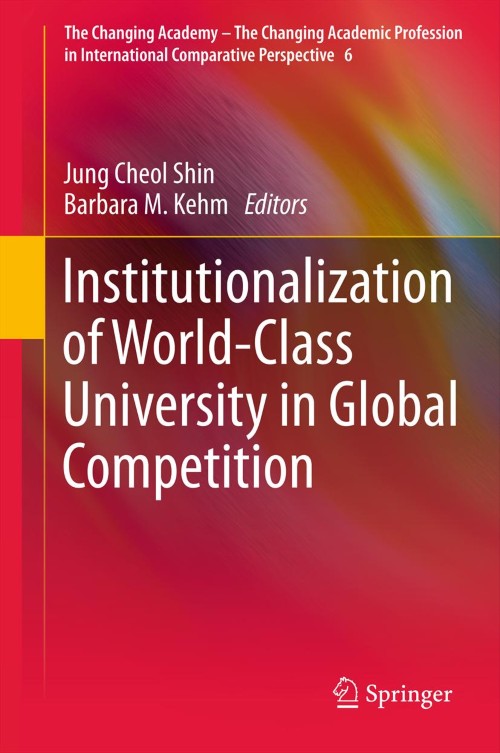
Institutionalization of World-Class University in Global Competition [electronic resource] / edited by Jung Cheol Shin, Barbara M. Kehm.
Erişim Adresi
ISBN
9789400749757
Dil Kodu
İngilizce
Yer Numarası
DK/14323
Basım Bildirimi
1st ed. 2013.
Yayın Bilgisi
Dordrecht : Springer Netherlands : Imprint: Springer, 2013.
Fiziksel Niteleme
XII, 304 p. online resource.
Dizi
The Changing Academy – The Changing Academic Profession in International Comparative Perspective, 2543-0378 ; 6
İçindekiler Notu
1. The World-class University in Different Systems and Contexts; J.C. Shin and B.M. Kehm -- Part A. Background of WCU Worldwide -- 2. The World-class University: Concept and Policy Initiatives; J. C. Shin -- 3. The Global Research and the ‘World-class’ Universities; W. Ma -- 4. World-class Universities: The Sector Requirements; S. Heyneman and J. Lee -- 5. Nation-states, Educational Traditions and the WCU Project; S. Marginson -- Part B. WCUs in non-English Speaking Advanced Systems -- 6. To Be or Not to Be? The Impacts of the Excellence Initiative on the German System of Higher Education; B.M. Kehm -- 7. Reconciling Republican ‘Egalité’ and Global Excellence Values in French Higher Education; L. Cremonini, P. Benneworth, F. Westerheijden and H. Dauncey -- 8. Challenges for Top Japanese Universities when Establishing a New Global Identity: Seeking a New Paradigm after “World Class”; A. Yonezawa -- Part C. WCUs in non-English Speaking Developing Systems -- 9. World-class University in Korea: Proactive Government, Responsive University, and Procrastinating Academics; J.C. Shin and Y.S. Jang -- 10. Building a World-class University in China; Y. Luo -- 11. The Challenges for Establishing World-class Universities in Taiwan; D. Chang -- Part D. WCUs in English Speaking Developing Systems -- 12. Malaysia’s World-class University Ambition: An Assessment; M. Sirat -- 13. Peering through the dust of construction: Singapore’s efforts to build WCUs; K.C. Ho -- 14. Frameworks for Creating Research Universities: The Hong Kong Case; G. Postiglione and J. Jung -- Conclusion -- 15. Universalizing the University in a World Society; F.O. Ramirez and J.W. Meyer -- 16. World-class University across Higher Education systems: Similarities, Differences, and Challenges; J.C. Shin and B.M. Kehm. - Index.
Özet, vb.
Moving the academic debate on from its current focus on development to a more nuanced sociological perspective, this fresh research is a collaboration between academics in Asia and Europe that assesses the factors shaping world-class universities as institutional social systems as well as national cultural treasures. The work explores in detail how WCUs have moved to a central position in policy circles, and how these often ambitious government policies on WCUs have been interpreted and adopted by university administrators and individual professors. The authors provide a wealth of empirical data on universities, both world-class and aiming for WCU status, in a range of politics and continents. They compare strategies for developing WCUs in countries of the East and the West, both developing and developed. Nations featured in the statistical purview include nine countries (Germany, France, Japan, South Korea, China, Taiwan, Malaysia, Singapore and Hong Kong SAR). The volume goes further than merely taking a snapshot of the current situation, offering detailed and considered strategies and rationales for institutionalizing and developing WCUs, particularly in Asian countries where Confucian cultural influences accord education the highest priority.
Konu
Education, Higher.
International education .
Comparative education.
Education and state.
Higher Education.
International and Comparative Education.
Educational Policy and Politics.
International education .
Comparative education.
Education and state.
Higher Education.
International and Comparative Education.
Educational Policy and Politics.
Diğer Yazarlar
Kurum Adı
Eseri Alıntıla
Referansları kullanmadan önce gözden geçirmeniz ve varsa gerekli düzeltmeleri yapmanız önerilir.
Dijital Kaynak
MARC Görünümü
LEADER 05236nam a22005415i 4500
001 813078
003 TR_AnAIT
005 20260130231850
007 cr nn 008mamaa
008 121204s2013 ne | s |||| 0|eng d
020 |a9789400749757|9978-94-007-4975-7
024 7 |a10.1007/978-94-007-4975-7|2doi
041 |aeng
049 |aTürk Tarih Kurumu Kütüphanesi
050 4|aLB2300-2799.3
072 7|aJNM|2bicssc
072 7|aEDU015000|2bisacsh
072 7|aJNM|2thema
082 04|a378|223
090 |aDK/14323
245 10|aInstitutionalization of World-Class University in Global Competition|h[electronic resource] /|cedited by Jung Cheol Shin, Barbara M. Kehm.
250 |a1st ed. 2013.
264 1|aDordrecht :|bSpringer Netherlands :|bImprint: Springer,|c2013.
300 |aXII, 304 p.|bonline resource.
336 |atext|btxt|2rdacontent
337 |acomputer|bc|2rdamedia
338 |aonline resource|bcr|2rdacarrier
347 |atext file|bPDF|2rda
490 1 |aThe Changing Academy – The Changing Academic Profession in International Comparative Perspective,|x2543-0378 ;|v6
505 0 |a1. The World-class University in Different Systems and Contexts; J.C. Shin and B.M. Kehm -- Part A. Background of WCU Worldwide -- 2. The World-class University: Concept and Policy Initiatives; J. C. Shin -- 3. The Global Research and the ‘World-class’ Universities; W. Ma -- 4. World-class Universities: The Sector Requirements; S. Heyneman and J. Lee -- 5. Nation-states, Educational Traditions and the WCU Project; S. Marginson -- Part B. WCUs in non-English Speaking Advanced Systems -- 6. To Be or Not to Be? The Impacts of the Excellence Initiative on the German System of Higher Education; B.M. Kehm -- 7. Reconciling Republican ‘Egalité’ and Global Excellence Values in French Higher Education; L. Cremonini, P. Benneworth, F. Westerheijden and H. Dauncey -- 8. Challenges for Top Japanese Universities when Establishing a New Global Identity: Seeking a New Paradigm after “World Class”; A. Yonezawa -- Part C. WCUs in non-English Speaking Developing Systems -- 9. World-class University in Korea: Proactive Government, Responsive University, and Procrastinating Academics; J.C. Shin and Y.S. Jang -- 10. Building a World-class University in China; Y. Luo -- 11. The Challenges for Establishing World-class Universities in Taiwan; D. Chang -- Part D. WCUs in English Speaking Developing Systems -- 12. Malaysia’s World-class University Ambition: An Assessment; M. Sirat -- 13. Peering through the dust of construction: Singapore’s efforts to build WCUs; K.C. Ho -- 14. Frameworks for Creating Research Universities: The Hong Kong Case; G. Postiglione and J. Jung -- Conclusion -- 15. Universalizing the University in a World Society; F.O. Ramirez and J.W. Meyer -- 16. World-class University across Higher Education systems: Similarities, Differences, and Challenges; J.C. Shin and B.M. Kehm. - Index.
520 |aMoving the academic debate on from its current focus on development to a more nuanced sociological perspective, this fresh research is a collaboration between academics in Asia and Europe that assesses the factors shaping world-class universities as institutional social systems as well as national cultural treasures. The work explores in detail how WCUs have moved to a central position in policy circles, and how these often ambitious government policies on WCUs have been interpreted and adopted by university administrators and individual professors. The authors provide a wealth of empirical data on universities, both world-class and aiming for WCU status, in a range of politics and continents. They compare strategies for developing WCUs in countries of the East and the West, both developing and developed. Nations featured in the statistical purview include nine countries (Germany, France, Japan, South Korea, China, Taiwan, Malaysia, Singapore and Hong Kong SAR). The volume goes further than merely taking a snapshot of the current situation, offering detailed and considered strategies and rationales for institutionalizing and developing WCUs, particularly in Asian countries where Confucian cultural influences accord education the highest priority.
650 0|aEducation, Higher.
650 0|aInternational education .
650 0|aComparative education.
650 0|aEducation and state.
650 14|aHigher Education.
650 24|aInternational and Comparative Education.
650 24|aEducational Policy and Politics.
700 1 |aShin, Jung Cheol.|eeditor.|4edt|4http://id.loc.gov/vocabulary/relators/edt
700 1 |aKehm, Barbara M.|eeditor.|4edt|4http://id.loc.gov/vocabulary/relators/edt
710 2 |aSpringerLink (Online service)
773 0 |tSpringer Nature eBook
776 08|iPrinted edition:|z9789400749740
776 08|iPrinted edition:|z9789400749764
776 08|iPrinted edition:|z9789401780575
830 0|aThe Changing Academy – The Changing Academic Profession in International Comparative Perspective,|x2543-0378 ;|v6
856 40|uhttps://doi.org/10.1007/978-94-007-4975-7
912 |aZDB-2-SHU
912 |aZDB-2-SXED
950 |aHumanities, Social Sciences and Law (SpringerNature-11648)
950 |aEducation (R0) (SpringerNature-43721)
001 813078
003 TR_AnAIT
005 20260130231850
007 cr nn 008mamaa
008 121204s2013 ne | s |||| 0|eng d
020 |a9789400749757|9978-94-007-4975-7
024 7 |a10.1007/978-94-007-4975-7|2doi
041 |aeng
049 |aTürk Tarih Kurumu Kütüphanesi
050 4|aLB2300-2799.3
072 7|aJNM|2bicssc
072 7|aEDU015000|2bisacsh
072 7|aJNM|2thema
082 04|a378|223
090 |aDK/14323
245 10|aInstitutionalization of World-Class University in Global Competition|h[electronic resource] /|cedited by Jung Cheol Shin, Barbara M. Kehm.
250 |a1st ed. 2013.
264 1|aDordrecht :|bSpringer Netherlands :|bImprint: Springer,|c2013.
300 |aXII, 304 p.|bonline resource.
336 |atext|btxt|2rdacontent
337 |acomputer|bc|2rdamedia
338 |aonline resource|bcr|2rdacarrier
347 |atext file|bPDF|2rda
490 1 |aThe Changing Academy – The Changing Academic Profession in International Comparative Perspective,|x2543-0378 ;|v6
505 0 |a1. The World-class University in Different Systems and Contexts; J.C. Shin and B.M. Kehm -- Part A. Background of WCU Worldwide -- 2. The World-class University: Concept and Policy Initiatives; J. C. Shin -- 3. The Global Research and the ‘World-class’ Universities; W. Ma -- 4. World-class Universities: The Sector Requirements; S. Heyneman and J. Lee -- 5. Nation-states, Educational Traditions and the WCU Project; S. Marginson -- Part B. WCUs in non-English Speaking Advanced Systems -- 6. To Be or Not to Be? The Impacts of the Excellence Initiative on the German System of Higher Education; B.M. Kehm -- 7. Reconciling Republican ‘Egalité’ and Global Excellence Values in French Higher Education; L. Cremonini, P. Benneworth, F. Westerheijden and H. Dauncey -- 8. Challenges for Top Japanese Universities when Establishing a New Global Identity: Seeking a New Paradigm after “World Class”; A. Yonezawa -- Part C. WCUs in non-English Speaking Developing Systems -- 9. World-class University in Korea: Proactive Government, Responsive University, and Procrastinating Academics; J.C. Shin and Y.S. Jang -- 10. Building a World-class University in China; Y. Luo -- 11. The Challenges for Establishing World-class Universities in Taiwan; D. Chang -- Part D. WCUs in English Speaking Developing Systems -- 12. Malaysia’s World-class University Ambition: An Assessment; M. Sirat -- 13. Peering through the dust of construction: Singapore’s efforts to build WCUs; K.C. Ho -- 14. Frameworks for Creating Research Universities: The Hong Kong Case; G. Postiglione and J. Jung -- Conclusion -- 15. Universalizing the University in a World Society; F.O. Ramirez and J.W. Meyer -- 16. World-class University across Higher Education systems: Similarities, Differences, and Challenges; J.C. Shin and B.M. Kehm. - Index.
520 |aMoving the academic debate on from its current focus on development to a more nuanced sociological perspective, this fresh research is a collaboration between academics in Asia and Europe that assesses the factors shaping world-class universities as institutional social systems as well as national cultural treasures. The work explores in detail how WCUs have moved to a central position in policy circles, and how these often ambitious government policies on WCUs have been interpreted and adopted by university administrators and individual professors. The authors provide a wealth of empirical data on universities, both world-class and aiming for WCU status, in a range of politics and continents. They compare strategies for developing WCUs in countries of the East and the West, both developing and developed. Nations featured in the statistical purview include nine countries (Germany, France, Japan, South Korea, China, Taiwan, Malaysia, Singapore and Hong Kong SAR). The volume goes further than merely taking a snapshot of the current situation, offering detailed and considered strategies and rationales for institutionalizing and developing WCUs, particularly in Asian countries where Confucian cultural influences accord education the highest priority.
650 0|aEducation, Higher.
650 0|aInternational education .
650 0|aComparative education.
650 0|aEducation and state.
650 14|aHigher Education.
650 24|aInternational and Comparative Education.
650 24|aEducational Policy and Politics.
700 1 |aShin, Jung Cheol.|eeditor.|4edt|4http://id.loc.gov/vocabulary/relators/edt
700 1 |aKehm, Barbara M.|eeditor.|4edt|4http://id.loc.gov/vocabulary/relators/edt
710 2 |aSpringerLink (Online service)
773 0 |tSpringer Nature eBook
776 08|iPrinted edition:|z9789400749740
776 08|iPrinted edition:|z9789400749764
776 08|iPrinted edition:|z9789401780575
830 0|aThe Changing Academy – The Changing Academic Profession in International Comparative Perspective,|x2543-0378 ;|v6
856 40|uhttps://doi.org/10.1007/978-94-007-4975-7
912 |aZDB-2-SHU
912 |aZDB-2-SXED
950 |aHumanities, Social Sciences and Law (SpringerNature-11648)
950 |aEducation (R0) (SpringerNature-43721)
Materyaller
Depodan talep edilen materyal sadece kütüphane içerisinde kullanılmaktadır.
Materyal dışarıya ödünç verilmemektedir.
Materyal dışarıya ödünç verilmemektedir.
