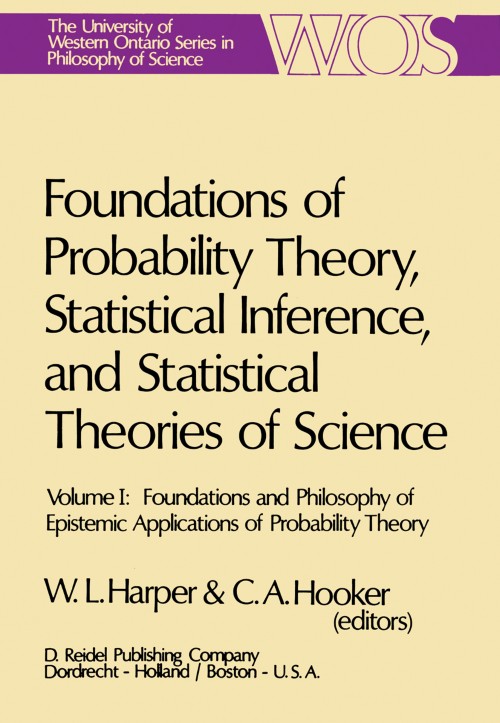
Foundations of Probability Theory, Statistical Inference, and Statistical Theories of Science [electronic resource] : Volume I Foundations and Philosophy of Epistemic Applications of Probability Theory / edited by W.L. Harper, C.A. Hooker.
Erişim Adresi
ISBN
9789401018531
Dil Kodu
İngilizce
Yer Numarası
DK/14381
Basım Bildirimi
1st ed. 1976.
Yayın Bilgisi
Dordrecht : Springer Netherlands : Imprint: Springer, 1976.
Fiziksel Niteleme
XI, 309 p. online resource.
Dizi
The Western Ontario Series in Philosophy of Science, A Series of Books in Philosophy of Science, Methodology, Epistemology, Logic, History of Science, and Related Fields, 2215-1974 ; 6a
İçindekiler Notu
Prior Probabilities and Counterfactual Conditionals -- Incomplete Descriptions in the Language of Probability Theory -- A Computational Complexity Viewpoint on the Stability of Relative Frequency and on Stochastic Independence -- A Logic for Subjective Belief -- Discussion -- Rational Belief Change, Popper Functions and Counterfactuals -- Letter by Robert Stalnaker to W. L. Harper -- Ramsey Test Conditionals and Iterated Belief Change (A Response to Stalnaker) -- Toward an Optimization Procedure for Applying Minimum Change Principles in Probability Kinematics -- Simplicity -- Discussion -- Conditionalization, Observation, and Change of Preference -- Discussion -- Probabilities of Conditionals -- Discussion -- Letter by Stalnaker to Van Fraassen -- Letter by Van Fraassen to Stalnaker.
Özet, vb.
In May of 1973 we organized an international research colloquium on foundations of probability, statistics, and statistical theories of science at the University of Western Ontario. During the past four decades there have been striking formal advances in our understanding of logic, semantics and algebraic structure in probabilistic and statistical theories. These advances, which include the development of the relations between semantics and metamathematics, between logics and algebras and the algebraic-geometrical foundations of statistical theories (especially in the sciences), have led to striking new insights into the formal and conceptual structure of probability and statistical theory and their scientific applications in the form of scientific theory. The foundations of statistics are in a state of profound conflict. Fisher's objections to some aspects of Neyman-Pearson statistics have long been well known. More recently the emergence of Baysian statistics as a radical alternative to standard views has made the conflict especially acute. In recent years the response of many practising statisticians to the conflict has been an eclectic approach to statistical inference. Many good statisticians have developed a kind of wisdom which enables them to know which problems are most appropriately handled by each of the methods available. The search for principles which would explain why each of the methods works where it does and fails where it does offers a fruitful approach to the controversy over foundations.
Konu
Science __ Philosophy.
Philosophy of Science.
Diğer Yazarlar
Kurum Adı

Eseri Alıntıla
Referansları kullanmadan önce gözden geçirmeniz ve varsa gerekli düzeltmeleri yapmanız önerilir.
Dijital Kaynak
MARC Görünümü
LEADER 05301nam a22005535i 4500
001 813136
003 TR_AnAIT
005 20260130231505
007 cr nn 008mamaa
008 121227s1976 ne | s |||| 0|eng d
020 |a9789401018531|9978-94-010-1853-1
024 7 |a10.1007/978-94-010-1853-1|2doi
041 |aeng
049 |aTürk Tarih Kurumu Kütüphanesi
050 4|aQ174-175.3
050 4|aB67
072 7|aPDA|2bicssc
072 7|aSCI075000|2bisacsh
072 7|aPDA|2thema
082 04|a501|223
090 |aDK/14381
245 10|aFoundations of Probability Theory, Statistical Inference, and Statistical Theories of Science|h[electronic resource] :|bVolume I Foundations and Philosophy of Epistemic Applications of Probability Theory /|cedited by W.L. Harper, C.A. Hooker.
250 |a1st ed. 1976.
264 1|aDordrecht :|bSpringer Netherlands :|bImprint: Springer,|c1976.
300 |aXI, 309 p.|bonline resource.
336 |atext|btxt|2rdacontent
337 |acomputer|bc|2rdamedia
338 |aonline resource|bcr|2rdacarrier
347 |atext file|bPDF|2rda
490 1 |aThe Western Ontario Series in Philosophy of Science, A Series of Books in Philosophy of Science, Methodology, Epistemology, Logic, History of Science, and Related Fields,|x2215-1974 ;|v6a
505 0 |aPrior Probabilities and Counterfactual Conditionals -- Incomplete Descriptions in the Language of Probability Theory -- A Computational Complexity Viewpoint on the Stability of Relative Frequency and on Stochastic Independence -- A Logic for Subjective Belief -- Discussion -- Rational Belief Change, Popper Functions and Counterfactuals -- Letter by Robert Stalnaker to W. L. Harper -- Ramsey Test Conditionals and Iterated Belief Change (A Response to Stalnaker) -- Toward an Optimization Procedure for Applying Minimum Change Principles in Probability Kinematics -- Simplicity -- Discussion -- Conditionalization, Observation, and Change of Preference -- Discussion -- Probabilities of Conditionals -- Discussion -- Letter by Stalnaker to Van Fraassen -- Letter by Van Fraassen to Stalnaker.
520 |aIn May of 1973 we organized an international research colloquium on foundations of probability, statistics, and statistical theories of science at the University of Western Ontario. During the past four decades there have been striking formal advances in our understanding of logic, semantics and algebraic structure in probabilistic and statistical theories. These advances, which include the development of the relations between semantics and metamathematics, between logics and algebras and the algebraic-geometrical foundations of statistical theories (especially in the sciences), have led to striking new insights into the formal and conceptual structure of probability and statistical theory and their scientific applications in the form of scientific theory. The foundations of statistics are in a state of profound conflict. Fisher's objections to some aspects of Neyman-Pearson statistics have long been well known. More recently the emergence of Baysian statistics as a radical alternative to standard views has made the conflict especially acute. In recent years the response of many practising statisticians to the conflict has been an eclectic approach to statistical inference. Many good statisticians have developed a kind of wisdom which enables them to know which problems are most appropriately handled by each of the methods available. The search for principles which would explain why each of the methods works where it does and fails where it does offers a fruitful approach to the controversy over foundations.
532 8 |aAccessibility summary: This PDF is not accessible. It is based on scanned pages and does not support features such as screen reader compatibility or described non-text content (images, graphs etc). However, it likely supports searchable and selectable text based on OCR (Optical Character Recognition). Users with accessibility needs may not be able to use this content effectively. Please contact us at accessibilitysupport@springernature.com if you require assistance or an alternative format.
532 8 |aInaccessible, or known limited accessibility
532 8 |aNo reading system accessibility options actively disabled
532 8 |aPublisher contact for further accessibility information: accessibilitysupport@springernature.com
650 0|aScience|xPhilosophy.
650 14|aPhilosophy of Science.
700 1 |aHarper, W.L.|eeditor.|4edt|4http://id.loc.gov/vocabulary/relators/edt
700 1 |aHooker, C.A.|eeditor.|4edt|4http://id.loc.gov/vocabulary/relators/edt
710 2 |aSpringerLink (Online service)
773 0 |tSpringer Nature eBook
776 08|iPrinted edition:|z9789027706164
776 08|iPrinted edition:|z9789027706171
776 08|iPrinted edition:|z9789401018548
830 0|aThe Western Ontario Series in Philosophy of Science, A Series of Books in Philosophy of Science, Methodology, Epistemology, Logic, History of Science, and Related Fields,|x2215-1974 ;|v6a
856 40|uhttps://doi.org/10.1007/978-94-010-1853-1
912 |aZDB-2-SHU
912 |aZDB-2-SXPR
912 |aZDB-2-BAE
950 |aHumanities, Social Sciences and Law (SpringerNature-11648)
950 |aPhilosophy and Religion (R0) (SpringerNature-43725)
001 813136
003 TR_AnAIT
005 20260130231505
007 cr nn 008mamaa
008 121227s1976 ne | s |||| 0|eng d
020 |a9789401018531|9978-94-010-1853-1
024 7 |a10.1007/978-94-010-1853-1|2doi
041 |aeng
049 |aTürk Tarih Kurumu Kütüphanesi
050 4|aQ174-175.3
050 4|aB67
072 7|aPDA|2bicssc
072 7|aSCI075000|2bisacsh
072 7|aPDA|2thema
082 04|a501|223
090 |aDK/14381
245 10|aFoundations of Probability Theory, Statistical Inference, and Statistical Theories of Science|h[electronic resource] :|bVolume I Foundations and Philosophy of Epistemic Applications of Probability Theory /|cedited by W.L. Harper, C.A. Hooker.
250 |a1st ed. 1976.
264 1|aDordrecht :|bSpringer Netherlands :|bImprint: Springer,|c1976.
300 |aXI, 309 p.|bonline resource.
336 |atext|btxt|2rdacontent
337 |acomputer|bc|2rdamedia
338 |aonline resource|bcr|2rdacarrier
347 |atext file|bPDF|2rda
490 1 |aThe Western Ontario Series in Philosophy of Science, A Series of Books in Philosophy of Science, Methodology, Epistemology, Logic, History of Science, and Related Fields,|x2215-1974 ;|v6a
505 0 |aPrior Probabilities and Counterfactual Conditionals -- Incomplete Descriptions in the Language of Probability Theory -- A Computational Complexity Viewpoint on the Stability of Relative Frequency and on Stochastic Independence -- A Logic for Subjective Belief -- Discussion -- Rational Belief Change, Popper Functions and Counterfactuals -- Letter by Robert Stalnaker to W. L. Harper -- Ramsey Test Conditionals and Iterated Belief Change (A Response to Stalnaker) -- Toward an Optimization Procedure for Applying Minimum Change Principles in Probability Kinematics -- Simplicity -- Discussion -- Conditionalization, Observation, and Change of Preference -- Discussion -- Probabilities of Conditionals -- Discussion -- Letter by Stalnaker to Van Fraassen -- Letter by Van Fraassen to Stalnaker.
520 |aIn May of 1973 we organized an international research colloquium on foundations of probability, statistics, and statistical theories of science at the University of Western Ontario. During the past four decades there have been striking formal advances in our understanding of logic, semantics and algebraic structure in probabilistic and statistical theories. These advances, which include the development of the relations between semantics and metamathematics, between logics and algebras and the algebraic-geometrical foundations of statistical theories (especially in the sciences), have led to striking new insights into the formal and conceptual structure of probability and statistical theory and their scientific applications in the form of scientific theory. The foundations of statistics are in a state of profound conflict. Fisher's objections to some aspects of Neyman-Pearson statistics have long been well known. More recently the emergence of Baysian statistics as a radical alternative to standard views has made the conflict especially acute. In recent years the response of many practising statisticians to the conflict has been an eclectic approach to statistical inference. Many good statisticians have developed a kind of wisdom which enables them to know which problems are most appropriately handled by each of the methods available. The search for principles which would explain why each of the methods works where it does and fails where it does offers a fruitful approach to the controversy over foundations.
532 8 |aAccessibility summary: This PDF is not accessible. It is based on scanned pages and does not support features such as screen reader compatibility or described non-text content (images, graphs etc). However, it likely supports searchable and selectable text based on OCR (Optical Character Recognition). Users with accessibility needs may not be able to use this content effectively. Please contact us at accessibilitysupport@springernature.com if you require assistance or an alternative format.
532 8 |aInaccessible, or known limited accessibility
532 8 |aNo reading system accessibility options actively disabled
532 8 |aPublisher contact for further accessibility information: accessibilitysupport@springernature.com
650 0|aScience|xPhilosophy.
650 14|aPhilosophy of Science.
700 1 |aHarper, W.L.|eeditor.|4edt|4http://id.loc.gov/vocabulary/relators/edt
700 1 |aHooker, C.A.|eeditor.|4edt|4http://id.loc.gov/vocabulary/relators/edt
710 2 |aSpringerLink (Online service)
773 0 |tSpringer Nature eBook
776 08|iPrinted edition:|z9789027706164
776 08|iPrinted edition:|z9789027706171
776 08|iPrinted edition:|z9789401018548
830 0|aThe Western Ontario Series in Philosophy of Science, A Series of Books in Philosophy of Science, Methodology, Epistemology, Logic, History of Science, and Related Fields,|x2215-1974 ;|v6a
856 40|uhttps://doi.org/10.1007/978-94-010-1853-1
912 |aZDB-2-SHU
912 |aZDB-2-SXPR
912 |aZDB-2-BAE
950 |aHumanities, Social Sciences and Law (SpringerNature-11648)
950 |aPhilosophy and Religion (R0) (SpringerNature-43725)
Materyaller
Depodan talep edilen materyal sadece kütüphane içerisinde kullanılmaktadır.
Materyal dışarıya ödünç verilmemektedir.
