

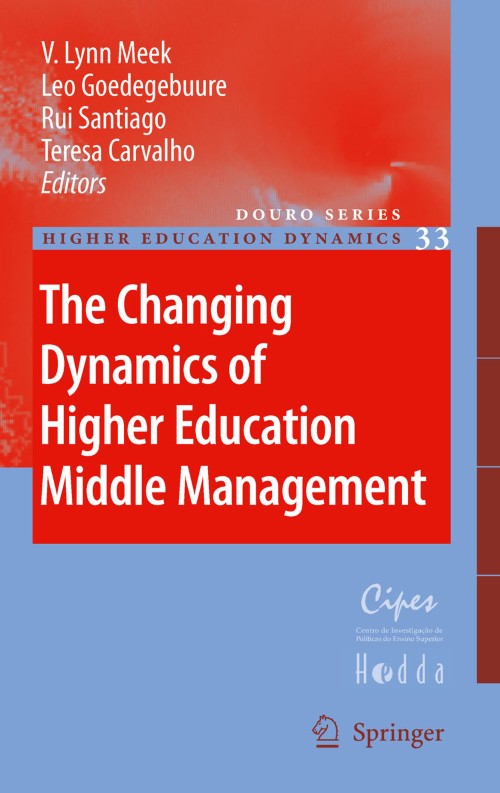
The Changing Dynamics of Higher Education Middle Management [electronic resource] / edited by V. Lynn Meek, Leo Goedegebuure, Rui Santiago, Teresa Carvalho.
Erişim Adresi
ISBN
9789048191635
Dil Kodu
İngilizce
Yer Numarası
DK/14397
Basım Bildirimi
1st ed. 2010.
Yayın Bilgisi
Dordrecht : Springer Netherlands : Imprint: Springer, 2010.
Fiziksel Niteleme
XIV, 252 p. online resource.
Dizi
Higher Education Dynamics, 2215-1923 ; 33
İçindekiler Notu
Academic Middle Managers Under the New Governance Regime at Austrian Universities -- The Changing Role of Academic Leadership in Australia and the Netherlands: Who Is the Modern Dean? -- Academic Middle Managers and Management in University Colleges and Universities in Belgium -- The Roles and Responsibilities of Middle Management (Chairs and Deans) in Canadian Universities -- Middle-Level University Managers in Italy: An Ambiguous Transition -- Presidents and Deans in French Universities: A Collective Approach to Academic Leadership -- From Democracy to Management-Oriented Leadership? The Manager-Academic in Norwegian Higher Education -- New Public Management and ‘Middle Management’: How Do Deans Influence Institutional Policies? -- UK Higher Education: Captured by New Managerialist Ideology? -- The New University: What It Portends for the Academic Profession and Their ‘Managers’ -- The Changing Nature of Academic Middle Management: A Framework for Analysis.
Özet, vb.
Known as either ‘soft’ or ‘hard’ ‘managerialism’, ‘new managerialism’ or ‘new public management’, this new narrative has, irrespective of moniker, permeated the institutions of higher education almost everywhere. Taking this as its context, this volume is founded on a comprehensive international comparative analysis of the evolving role of middle-level academic managers—deans, heads of department and their equivalents. The chapters address key questions that will determine the future of academe: have the imperatives of management theory caused a realignment of the values and expectations of middle-level academic managers? In what way do the new expectations placed on this group shape the academic profession as a whole? And, whose interests do middle-level academic managers represent? Based on material presented at one of the high-level Douro Seminars on research into tertiary education, this volume systematically combines theoretical views with empirical analysis. It argues that ‘managerialist’ pressure has resulted in changes in the way academic performance is measured. There has been a shift in criteria away from research reputation, teaching and scholarship to the measurement of performance based upon management capacities. This has given middle-level academic managers a pivotal role halfway between the predilections of high-level decision makers and the maintenance of academic values and control. The enhanced expectations and more defined functions of middle-level academic managers are in clear contrast to earlier times, when the position was considered a public-spirited rite of passage for career-minded academics. Despite this, the contributors to this book believe that the middle-level managers in the ten countries examined are neither corporate lackeys nor champions of academe. It is becoming increasingly clear that the ability of organisations to achieve their aims is largely dependent on the skill and dedication of middlemanagers. Past studies of organisational dynamics have been preoccupied with the executive level of management. This text, which will be of great interest to researchers and policy makers alike, attempts to redress the balance.
Konu
School management and organization.
School administration.
Social sciences.
Humanities.
Education, Higher.
Organization and Leadership.
Humanities and Social Sciences.
Higher Education.
School administration.
Social sciences.
Humanities.
Education, Higher.
Organization and Leadership.
Humanities and Social Sciences.
Higher Education.
Kurum Adı
Eseri Alıntıla
Referansları kullanmadan önce gözden geçirmeniz ve varsa gerekli düzeltmeleri yapmanız önerilir.
Dijital Kaynak
MARC Görünümü
LEADER 05409nam a22005775i 4500
001 813152
003 TR_AnAIT
005 20260130231407
007 cr nn 008mamaa
008 100716s2010 ne | s |||| 0|eng d
020 |a9789048191635|9978-90-481-9163-5
024 7 |a10.1007/978-90-481-9163-5|2doi
041 |aeng
049 |aTürk Tarih Kurumu Kütüphanesi
050 4|aLB2801-3095
072 7|aJNK|2bicssc
072 7|aEDU001000|2bisacsh
072 7|aJNK|2thema
082 04|a371.2|223
090 |aDK/14397
245 14|aThe Changing Dynamics of Higher Education Middle Management|h[electronic resource] /|cedited by V. Lynn Meek, Leo Goedegebuure, Rui Santiago, Teresa Carvalho.
250 |a1st ed. 2010.
264 1|aDordrecht :|bSpringer Netherlands :|bImprint: Springer,|c2010.
300 |aXIV, 252 p.|bonline resource.
336 |atext|btxt|2rdacontent
337 |acomputer|bc|2rdamedia
338 |aonline resource|bcr|2rdacarrier
347 |atext file|bPDF|2rda
490 1 |aHigher Education Dynamics,|x2215-1923 ;|v33
505 0 |aAcademic Middle Managers Under the New Governance Regime at Austrian Universities -- The Changing Role of Academic Leadership in Australia and the Netherlands: Who Is the Modern Dean? -- Academic Middle Managers and Management in University Colleges and Universities in Belgium -- The Roles and Responsibilities of Middle Management (Chairs and Deans) in Canadian Universities -- Middle-Level University Managers in Italy: An Ambiguous Transition -- Presidents and Deans in French Universities: A Collective Approach to Academic Leadership -- From Democracy to Management-Oriented Leadership? The Manager-Academic in Norwegian Higher Education -- New Public Management and ‘Middle Management’: How Do Deans Influence Institutional Policies? -- UK Higher Education: Captured by New Managerialist Ideology? -- The New University: What It Portends for the Academic Profession and Their ‘Managers’ -- The Changing Nature of Academic Middle Management: A Framework for Analysis.
520 |aKnown as either ‘soft’ or ‘hard’ ‘managerialism’, ‘new managerialism’ or ‘new public management’, this new narrative has, irrespective of moniker, permeated the institutions of higher education almost everywhere. Taking this as its context, this volume is founded on a comprehensive international comparative analysis of the evolving role of middle-level academic managers—deans, heads of department and their equivalents. The chapters address key questions that will determine the future of academe: have the imperatives of management theory caused a realignment of the values and expectations of middle-level academic managers? In what way do the new expectations placed on this group shape the academic profession as a whole? And, whose interests do middle-level academic managers represent? Based on material presented at one of the high-level Douro Seminars on research into tertiary education, this volume systematically combines theoretical views with empirical analysis. It argues that ‘managerialist’ pressure has resulted in changes in the way academic performance is measured. There has been a shift in criteria away from research reputation, teaching and scholarship to the measurement of performance based upon management capacities. This has given middle-level academic managers a pivotal role halfway between the predilections of high-level decision makers and the maintenance of academic values and control. The enhanced expectations and more defined functions of middle-level academic managers are in clear contrast to earlier times, when the position was considered a public-spirited rite of passage for career-minded academics. Despite this, the contributors to this book believe that the middle-level managers in the ten countries examined are neither corporate lackeys nor champions of academe. It is becoming increasingly clear that the ability of organisations to achieve their aims is largely dependent on the skill and dedication of middlemanagers. Past studies of organisational dynamics have been preoccupied with the executive level of management. This text, which will be of great interest to researchers and policy makers alike, attempts to redress the balance.
650 0|aSchool management and organization.
650 0|aSchool administration.
650 0|aSocial sciences.
650 0|aHumanities.
650 0|aEducation, Higher.
650 14|aOrganization and Leadership.
650 24|aHumanities and Social Sciences.
650 24|aHigher Education.
700 1 |aMeek, V. Lynn.|eeditor.|4edt|4http://id.loc.gov/vocabulary/relators/edt
700 1 |aGoedegebuure, Leo.|eeditor.|4edt|4http://id.loc.gov/vocabulary/relators/edt
700 1 |aSantiago, Rui.|eeditor.|4edt|4http://id.loc.gov/vocabulary/relators/edt
700 1 |aCarvalho, Teresa.|eeditor.|4edt|4http://id.loc.gov/vocabulary/relators/edt
710 2 |aSpringerLink (Online service)
773 0 |tSpringer Nature eBook
776 08|iPrinted edition:|z9789048191628
776 08|iPrinted edition:|z9789048191642
776 08|iPrinted edition:|z9789400732773
830 0|aHigher Education Dynamics,|x2215-1923 ;|v33
856 40|uhttps://doi.org/10.1007/978-90-481-9163-5
912 |aZDB-2-SHU
912 |aZDB-2-SXED
950 |aHumanities, Social Sciences and Law (SpringerNature-11648)
950 |aEducation (R0) (SpringerNature-43721)
001 813152
003 TR_AnAIT
005 20260130231407
007 cr nn 008mamaa
008 100716s2010 ne | s |||| 0|eng d
020 |a9789048191635|9978-90-481-9163-5
024 7 |a10.1007/978-90-481-9163-5|2doi
041 |aeng
049 |aTürk Tarih Kurumu Kütüphanesi
050 4|aLB2801-3095
072 7|aJNK|2bicssc
072 7|aEDU001000|2bisacsh
072 7|aJNK|2thema
082 04|a371.2|223
090 |aDK/14397
245 14|aThe Changing Dynamics of Higher Education Middle Management|h[electronic resource] /|cedited by V. Lynn Meek, Leo Goedegebuure, Rui Santiago, Teresa Carvalho.
250 |a1st ed. 2010.
264 1|aDordrecht :|bSpringer Netherlands :|bImprint: Springer,|c2010.
300 |aXIV, 252 p.|bonline resource.
336 |atext|btxt|2rdacontent
337 |acomputer|bc|2rdamedia
338 |aonline resource|bcr|2rdacarrier
347 |atext file|bPDF|2rda
490 1 |aHigher Education Dynamics,|x2215-1923 ;|v33
505 0 |aAcademic Middle Managers Under the New Governance Regime at Austrian Universities -- The Changing Role of Academic Leadership in Australia and the Netherlands: Who Is the Modern Dean? -- Academic Middle Managers and Management in University Colleges and Universities in Belgium -- The Roles and Responsibilities of Middle Management (Chairs and Deans) in Canadian Universities -- Middle-Level University Managers in Italy: An Ambiguous Transition -- Presidents and Deans in French Universities: A Collective Approach to Academic Leadership -- From Democracy to Management-Oriented Leadership? The Manager-Academic in Norwegian Higher Education -- New Public Management and ‘Middle Management’: How Do Deans Influence Institutional Policies? -- UK Higher Education: Captured by New Managerialist Ideology? -- The New University: What It Portends for the Academic Profession and Their ‘Managers’ -- The Changing Nature of Academic Middle Management: A Framework for Analysis.
520 |aKnown as either ‘soft’ or ‘hard’ ‘managerialism’, ‘new managerialism’ or ‘new public management’, this new narrative has, irrespective of moniker, permeated the institutions of higher education almost everywhere. Taking this as its context, this volume is founded on a comprehensive international comparative analysis of the evolving role of middle-level academic managers—deans, heads of department and their equivalents. The chapters address key questions that will determine the future of academe: have the imperatives of management theory caused a realignment of the values and expectations of middle-level academic managers? In what way do the new expectations placed on this group shape the academic profession as a whole? And, whose interests do middle-level academic managers represent? Based on material presented at one of the high-level Douro Seminars on research into tertiary education, this volume systematically combines theoretical views with empirical analysis. It argues that ‘managerialist’ pressure has resulted in changes in the way academic performance is measured. There has been a shift in criteria away from research reputation, teaching and scholarship to the measurement of performance based upon management capacities. This has given middle-level academic managers a pivotal role halfway between the predilections of high-level decision makers and the maintenance of academic values and control. The enhanced expectations and more defined functions of middle-level academic managers are in clear contrast to earlier times, when the position was considered a public-spirited rite of passage for career-minded academics. Despite this, the contributors to this book believe that the middle-level managers in the ten countries examined are neither corporate lackeys nor champions of academe. It is becoming increasingly clear that the ability of organisations to achieve their aims is largely dependent on the skill and dedication of middlemanagers. Past studies of organisational dynamics have been preoccupied with the executive level of management. This text, which will be of great interest to researchers and policy makers alike, attempts to redress the balance.
650 0|aSchool management and organization.
650 0|aSchool administration.
650 0|aSocial sciences.
650 0|aHumanities.
650 0|aEducation, Higher.
650 14|aOrganization and Leadership.
650 24|aHumanities and Social Sciences.
650 24|aHigher Education.
700 1 |aMeek, V. Lynn.|eeditor.|4edt|4http://id.loc.gov/vocabulary/relators/edt
700 1 |aGoedegebuure, Leo.|eeditor.|4edt|4http://id.loc.gov/vocabulary/relators/edt
700 1 |aSantiago, Rui.|eeditor.|4edt|4http://id.loc.gov/vocabulary/relators/edt
700 1 |aCarvalho, Teresa.|eeditor.|4edt|4http://id.loc.gov/vocabulary/relators/edt
710 2 |aSpringerLink (Online service)
773 0 |tSpringer Nature eBook
776 08|iPrinted edition:|z9789048191628
776 08|iPrinted edition:|z9789048191642
776 08|iPrinted edition:|z9789400732773
830 0|aHigher Education Dynamics,|x2215-1923 ;|v33
856 40|uhttps://doi.org/10.1007/978-90-481-9163-5
912 |aZDB-2-SHU
912 |aZDB-2-SXED
950 |aHumanities, Social Sciences and Law (SpringerNature-11648)
950 |aEducation (R0) (SpringerNature-43721)
Materyaller
Depodan talep edilen materyal sadece kütüphane içerisinde kullanılmaktadır.
Materyal dışarıya ödünç verilmemektedir.
Materyal dışarıya ödünç verilmemektedir.
