

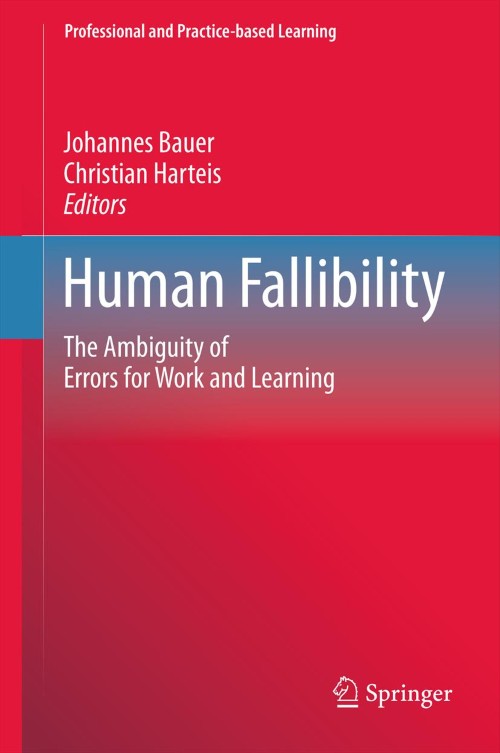
Human Fallibility [electronic resource] : The Ambiguity of Errors for Work and Learning / edited by Johannes Bauer, Christian Harteis.
Erişim Adresi
ISBN
9789048139415
Dil Kodu
İngilizce
Yer Numarası
DK/14413
Basım Bildirimi
1st ed. 2012.
Yayın Bilgisi
Dordrecht : Springer Netherlands : Imprint: Springer, 2012.
Fiziksel Niteleme
XIV, 282 p. online resource.
Dizi
Professional and Practice-based Learning, 2210-5557 ; 6
İçindekiler Notu
The Ambiguity of Errors for Work and Learning: Introduction to the Volume Johannes Bauer and Christian Harteis -- Part A: Errors, their Learning Potential, and the Processes of Learning from Errors -- Errors and Learning from Errors at Work Stephen Billett -- Tracing Outcomes of Learning from Errors on the Level of Knowledge Martin Gartmeier and Elke Schüttelkopf -- Towards a Theory of Negative Knowledge (NK): Almost-Mistakes as Drivers of Episodic Memory Amplification Fritz Oser, Catherine Näpflin, Christine Hofer, and Philipp Aerni -- Professional knowledge is (also) knowledge about errors Hans Gruber and Michael Mohe -- Part B: Methodological strategies -- Research on Errors and Learning from them: Methodological Perspectives Klaus Mehl and Theo Wehner -- Measuring Organizational Climate for Learning from Errors at Work Daniel Putz, Jan Schilling, and Annette Kluge -- Part C: Learning from Errors in the Professions -- Innovation by Learning from Mistakes: The Relationships between Team Characteristics, Error Orientation, and Team Innovation Marianne van Woerkom -- Error Orientation and Intuitive Decision Making: Results of an Exploratory Study in the Domain of Emergency Medicine Christian Harteis and Franziska Frost -- Learning from Errors in the Professions: Empirical Findings on Processes, Outcomes, and Supportive Conditions Johannes Bauer, Martin Gartmeier, and Christian Harteis -- Part D: Enabling Learning from Errors -- Dealing Effectively with Errors during Training Nina Keith -- Reflecting on Learning from Errors in School Instruction – Findings and Suggestions from a Swiss-German Video Study Inger Marie Dalehefte, Manfred Prenzel, and Tina Seidel.-Learning from Errors: The Role of After-Event Reviews Shmuel Ellis -- Incident Reporting Systems in Hospitals: How does Learning Occur Using this Organizational Instrument? Yvonne Pfeiffer and Theo Wehner -- Conclusion -- Research on Human Fallibility and Learning from Errors at Work: Challenges for Theory, Research, and Practice Christian Harteis, Johannes Bauer, and Helmut Heid.Part B: Methodological strategies -- Research on Errors and Learning from them: Methodological Perspectives Klaus Mehl and Theo Wehner -- Measuring Organizational Climate for Learning from Errors at Work Daniel Putz, Jan Schilling, and Annette Kluge -- Part C: Learning from Errors in the Professions -- Innovation by Learning from Mistakes: The Relationships between Team Characteristics, Error Orientation, and Team Innovation Marianne van Woerkom -- Error Orientation and Intuitive Decision Making: Results of an Exploratory Study in the Domain of Emergency Medicine Christian Harteis and Franziska Frost -- Learning from Errors in the Professions: Empirical Findings on Processes, Outcomes, and Supportive Conditions Johannes Bauer, Martin Gartmeier, and Christian Harteis -- Part D: Enabling Learning from Errors -- Dealing Effectively with Errors during Training Nina Keith -- Reflecting on Learning from Errors in School Instruction – Findings and Suggestions from a Swiss-German Video Study Inger Marie Dalehefte, Manfred Prenzel, and Tina Seidel -- Learning from Errors: The Role of After-Event Reviews Shmuel Ellis -- Incident Reporting Systems in Hospitals: How does Learning Occur Using this Organizational Instrument? Yvonne Pfeiffer and Theo Wehner -- Conclusion -- Research on Human Fallibility and Learning from Errors at Work: Challenges forTheory, Research, and Practice Christian Harteis, Johannes Bauer, and Helmut Heid.
Özet, vb.
A curious ambiguity surrounds errors in professional working contexts: they must be avoided in case they lead to adverse (and potentially disastrous) results, yet they also hold the key to improving our knowledge and procedures. In a further irony, it seems that a prerequisite for circumventing errors is our remaining open to their potential occurrence and learning from them when they do happen. This volume, the first to integrate interdisciplinary perspectives on learning from errors at work, presents theoretical concepts and empirical evidence in an attempt to establish under what conditions professionals deal with errors at work productively—in other words, learn the lessons they contain. By drawing upon and combining cognitive and action-oriented approaches to human error with theories of adult, professional, and workplace learning this book provides valuable insights which can be applied by workers and professionals. It includes systematic theoretical frameworks for explaining learning from errors in daily working life, methodologies and research instruments that facilitate the measurement of that learning, and empirical studies that investigate relevant determinants of learning from errors in different professions. Written by an international group of distinguished researchers from various disciplines, the chapters paint a comprehensive picture of the current state of the art in research on human fallibility and (learning from) errors at work.
Konu
Professional education.
Vocational education.
Learning, Psychology of.
Psychology, Industrial.
Professional and Vocational Education.
Instructional Psychology.
Work and Organizational Psychology.
Vocational education.
Learning, Psychology of.
Psychology, Industrial.
Professional and Vocational Education.
Instructional Psychology.
Work and Organizational Psychology.
Diğer Yazarlar
Kurum Adı
Eseri Alıntıla
Referansları kullanmadan önce gözden geçirmeniz ve varsa gerekli düzeltmeleri yapmanız önerilir.
Dijital Kaynak
MARC Görünümü
LEADER 07064nam a22005535i 4500
001 813168
003 TR_AnAIT
005 20260130231232
007 cr nn 008mamaa
008 120316s2012 ne | s |||| 0|eng d
020 |a9789048139415|9978-90-481-3941-5
024 7 |a10.1007/978-90-481-3941-5|2doi
041 |aeng
049 |aTürk Tarih Kurumu Kütüphanesi
050 4|aLC1051-1072
050 4|aLC1041-1048
072 7|aJNRV|2bicssc
072 7|aEDU046000|2bisacsh
072 7|aJNRV|2thema
082 04|a370.113|223
090 |aDK/14413
245 10|aHuman Fallibility|h[electronic resource] :|bThe Ambiguity of Errors for Work and Learning /|cedited by Johannes Bauer, Christian Harteis.
250 |a1st ed. 2012.
264 1|aDordrecht :|bSpringer Netherlands :|bImprint: Springer,|c2012.
300 |aXIV, 282 p.|bonline resource.
336 |atext|btxt|2rdacontent
337 |acomputer|bc|2rdamedia
338 |aonline resource|bcr|2rdacarrier
347 |atext file|bPDF|2rda
490 1 |aProfessional and Practice-based Learning,|x2210-5557 ;|v6
505 0 |aThe Ambiguity of Errors for Work and Learning: Introduction to the Volume Johannes Bauer and Christian Harteis -- Part A: Errors, their Learning Potential, and the Processes of Learning from Errors -- Errors and Learning from Errors at Work Stephen Billett -- Tracing Outcomes of Learning from Errors on the Level of Knowledge Martin Gartmeier and Elke Schüttelkopf -- Towards a Theory of Negative Knowledge (NK): Almost-Mistakes as Drivers of Episodic Memory Amplification Fritz Oser, Catherine Näpflin, Christine Hofer, and Philipp Aerni -- Professional knowledge is (also) knowledge about errors Hans Gruber and Michael Mohe -- Part B: Methodological strategies -- Research on Errors and Learning from them: Methodological Perspectives Klaus Mehl and Theo Wehner -- Measuring Organizational Climate for Learning from Errors at Work Daniel Putz, Jan Schilling, and Annette Kluge -- Part C: Learning from Errors in the Professions -- Innovation by Learning from Mistakes: The Relationships between Team Characteristics, Error Orientation, and Team Innovation Marianne van Woerkom -- Error Orientation and Intuitive Decision Making: Results of an Exploratory Study in the Domain of Emergency Medicine Christian Harteis and Franziska Frost -- Learning from Errors in the Professions: Empirical Findings on Processes, Outcomes, and Supportive Conditions Johannes Bauer, Martin Gartmeier, and Christian Harteis -- Part D: Enabling Learning from Errors -- Dealing Effectively with Errors during Training Nina Keith -- Reflecting on Learning from Errors in School Instruction – Findings and Suggestions from a Swiss-German Video Study Inger Marie Dalehefte, Manfred Prenzel, and Tina Seidel.-Learning from Errors: The Role of After-Event Reviews Shmuel Ellis -- Incident Reporting Systems in Hospitals: How does Learning Occur Using this Organizational Instrument? Yvonne Pfeiffer and Theo Wehner -- Conclusion -- Research on Human Fallibility and Learning from Errors at Work: Challenges for Theory, Research, and Practice Christian Harteis, Johannes Bauer, and Helmut Heid.Part B: Methodological strategies -- Research on Errors and Learning from them: Methodological Perspectives Klaus Mehl and Theo Wehner -- Measuring Organizational Climate for Learning from Errors at Work Daniel Putz, Jan Schilling, and Annette Kluge -- Part C: Learning from Errors in the Professions -- Innovation by Learning from Mistakes: The Relationships between Team Characteristics, Error Orientation, and Team Innovation Marianne van Woerkom -- Error Orientation and Intuitive Decision Making: Results of an Exploratory Study in the Domain of Emergency Medicine Christian Harteis and Franziska Frost -- Learning from Errors in the Professions: Empirical Findings on Processes, Outcomes, and Supportive Conditions Johannes Bauer, Martin Gartmeier, and Christian Harteis -- Part D: Enabling Learning from Errors -- Dealing Effectively with Errors during Training Nina Keith -- Reflecting on Learning from Errors in School Instruction – Findings and Suggestions from a Swiss-German Video Study Inger Marie Dalehefte, Manfred Prenzel, and Tina Seidel -- Learning from Errors: The Role of After-Event Reviews Shmuel Ellis -- Incident Reporting Systems in Hospitals: How does Learning Occur Using this Organizational Instrument? Yvonne Pfeiffer and Theo Wehner -- Conclusion -- Research on Human Fallibility and Learning from Errors at Work: Challenges forTheory, Research, and Practice Christian Harteis, Johannes Bauer, and Helmut Heid.
520 |aA curious ambiguity surrounds errors in professional working contexts: they must be avoided in case they lead to adverse (and potentially disastrous) results, yet they also hold the key to improving our knowledge and procedures. In a further irony, it seems that a prerequisite for circumventing errors is our remaining open to their potential occurrence and learning from them when they do happen. This volume, the first to integrate interdisciplinary perspectives on learning from errors at work, presents theoretical concepts and empirical evidence in an attempt to establish under what conditions professionals deal with errors at work productively—in other words, learn the lessons they contain. By drawing upon and combining cognitive and action-oriented approaches to human error with theories of adult, professional, and workplace learning this book provides valuable insights which can be applied by workers and professionals. It includes systematic theoretical frameworks for explaining learning from errors in daily working life, methodologies and research instruments that facilitate the measurement of that learning, and empirical studies that investigate relevant determinants of learning from errors in different professions. Written by an international group of distinguished researchers from various disciplines, the chapters paint a comprehensive picture of the current state of the art in research on human fallibility and (learning from) errors at work.
650 0|aProfessional education.
650 0|aVocational education.
650 0|aLearning, Psychology of.
650 0|aPsychology, Industrial.
650 14|aProfessional and Vocational Education.
650 24|aInstructional Psychology.
650 24|aWork and Organizational Psychology.
700 1 |aBauer, Johannes.|eeditor.|4edt|4http://id.loc.gov/vocabulary/relators/edt
700 1 |aHarteis, Christian.|eeditor.|4edt|4http://id.loc.gov/vocabulary/relators/edt
710 2 |aSpringerLink (Online service)
773 0 |tSpringer Nature eBook
776 08|iPrinted edition:|z9789048139408
776 08|iPrinted edition:|z9789048139606
776 08|iPrinted edition:|z9789400792449
830 0|aProfessional and Practice-based Learning,|x2210-5557 ;|v6
856 40|uhttps://doi.org/10.1007/978-90-481-3941-5
912 |aZDB-2-SHU
912 |aZDB-2-SXED
950 |aHumanities, Social Sciences and Law (SpringerNature-11648)
950 |aEducation (R0) (SpringerNature-43721)
001 813168
003 TR_AnAIT
005 20260130231232
007 cr nn 008mamaa
008 120316s2012 ne | s |||| 0|eng d
020 |a9789048139415|9978-90-481-3941-5
024 7 |a10.1007/978-90-481-3941-5|2doi
041 |aeng
049 |aTürk Tarih Kurumu Kütüphanesi
050 4|aLC1051-1072
050 4|aLC1041-1048
072 7|aJNRV|2bicssc
072 7|aEDU046000|2bisacsh
072 7|aJNRV|2thema
082 04|a370.113|223
090 |aDK/14413
245 10|aHuman Fallibility|h[electronic resource] :|bThe Ambiguity of Errors for Work and Learning /|cedited by Johannes Bauer, Christian Harteis.
250 |a1st ed. 2012.
264 1|aDordrecht :|bSpringer Netherlands :|bImprint: Springer,|c2012.
300 |aXIV, 282 p.|bonline resource.
336 |atext|btxt|2rdacontent
337 |acomputer|bc|2rdamedia
338 |aonline resource|bcr|2rdacarrier
347 |atext file|bPDF|2rda
490 1 |aProfessional and Practice-based Learning,|x2210-5557 ;|v6
505 0 |aThe Ambiguity of Errors for Work and Learning: Introduction to the Volume Johannes Bauer and Christian Harteis -- Part A: Errors, their Learning Potential, and the Processes of Learning from Errors -- Errors and Learning from Errors at Work Stephen Billett -- Tracing Outcomes of Learning from Errors on the Level of Knowledge Martin Gartmeier and Elke Schüttelkopf -- Towards a Theory of Negative Knowledge (NK): Almost-Mistakes as Drivers of Episodic Memory Amplification Fritz Oser, Catherine Näpflin, Christine Hofer, and Philipp Aerni -- Professional knowledge is (also) knowledge about errors Hans Gruber and Michael Mohe -- Part B: Methodological strategies -- Research on Errors and Learning from them: Methodological Perspectives Klaus Mehl and Theo Wehner -- Measuring Organizational Climate for Learning from Errors at Work Daniel Putz, Jan Schilling, and Annette Kluge -- Part C: Learning from Errors in the Professions -- Innovation by Learning from Mistakes: The Relationships between Team Characteristics, Error Orientation, and Team Innovation Marianne van Woerkom -- Error Orientation and Intuitive Decision Making: Results of an Exploratory Study in the Domain of Emergency Medicine Christian Harteis and Franziska Frost -- Learning from Errors in the Professions: Empirical Findings on Processes, Outcomes, and Supportive Conditions Johannes Bauer, Martin Gartmeier, and Christian Harteis -- Part D: Enabling Learning from Errors -- Dealing Effectively with Errors during Training Nina Keith -- Reflecting on Learning from Errors in School Instruction – Findings and Suggestions from a Swiss-German Video Study Inger Marie Dalehefte, Manfred Prenzel, and Tina Seidel.-Learning from Errors: The Role of After-Event Reviews Shmuel Ellis -- Incident Reporting Systems in Hospitals: How does Learning Occur Using this Organizational Instrument? Yvonne Pfeiffer and Theo Wehner -- Conclusion -- Research on Human Fallibility and Learning from Errors at Work: Challenges for Theory, Research, and Practice Christian Harteis, Johannes Bauer, and Helmut Heid.Part B: Methodological strategies -- Research on Errors and Learning from them: Methodological Perspectives Klaus Mehl and Theo Wehner -- Measuring Organizational Climate for Learning from Errors at Work Daniel Putz, Jan Schilling, and Annette Kluge -- Part C: Learning from Errors in the Professions -- Innovation by Learning from Mistakes: The Relationships between Team Characteristics, Error Orientation, and Team Innovation Marianne van Woerkom -- Error Orientation and Intuitive Decision Making: Results of an Exploratory Study in the Domain of Emergency Medicine Christian Harteis and Franziska Frost -- Learning from Errors in the Professions: Empirical Findings on Processes, Outcomes, and Supportive Conditions Johannes Bauer, Martin Gartmeier, and Christian Harteis -- Part D: Enabling Learning from Errors -- Dealing Effectively with Errors during Training Nina Keith -- Reflecting on Learning from Errors in School Instruction – Findings and Suggestions from a Swiss-German Video Study Inger Marie Dalehefte, Manfred Prenzel, and Tina Seidel -- Learning from Errors: The Role of After-Event Reviews Shmuel Ellis -- Incident Reporting Systems in Hospitals: How does Learning Occur Using this Organizational Instrument? Yvonne Pfeiffer and Theo Wehner -- Conclusion -- Research on Human Fallibility and Learning from Errors at Work: Challenges forTheory, Research, and Practice Christian Harteis, Johannes Bauer, and Helmut Heid.
520 |aA curious ambiguity surrounds errors in professional working contexts: they must be avoided in case they lead to adverse (and potentially disastrous) results, yet they also hold the key to improving our knowledge and procedures. In a further irony, it seems that a prerequisite for circumventing errors is our remaining open to their potential occurrence and learning from them when they do happen. This volume, the first to integrate interdisciplinary perspectives on learning from errors at work, presents theoretical concepts and empirical evidence in an attempt to establish under what conditions professionals deal with errors at work productively—in other words, learn the lessons they contain. By drawing upon and combining cognitive and action-oriented approaches to human error with theories of adult, professional, and workplace learning this book provides valuable insights which can be applied by workers and professionals. It includes systematic theoretical frameworks for explaining learning from errors in daily working life, methodologies and research instruments that facilitate the measurement of that learning, and empirical studies that investigate relevant determinants of learning from errors in different professions. Written by an international group of distinguished researchers from various disciplines, the chapters paint a comprehensive picture of the current state of the art in research on human fallibility and (learning from) errors at work.
650 0|aProfessional education.
650 0|aVocational education.
650 0|aLearning, Psychology of.
650 0|aPsychology, Industrial.
650 14|aProfessional and Vocational Education.
650 24|aInstructional Psychology.
650 24|aWork and Organizational Psychology.
700 1 |aBauer, Johannes.|eeditor.|4edt|4http://id.loc.gov/vocabulary/relators/edt
700 1 |aHarteis, Christian.|eeditor.|4edt|4http://id.loc.gov/vocabulary/relators/edt
710 2 |aSpringerLink (Online service)
773 0 |tSpringer Nature eBook
776 08|iPrinted edition:|z9789048139408
776 08|iPrinted edition:|z9789048139606
776 08|iPrinted edition:|z9789400792449
830 0|aProfessional and Practice-based Learning,|x2210-5557 ;|v6
856 40|uhttps://doi.org/10.1007/978-90-481-3941-5
912 |aZDB-2-SHU
912 |aZDB-2-SXED
950 |aHumanities, Social Sciences and Law (SpringerNature-11648)
950 |aEducation (R0) (SpringerNature-43721)
Materyaller
Depodan talep edilen materyal sadece kütüphane içerisinde kullanılmaktadır.
Materyal dışarıya ödünç verilmemektedir.
Materyal dışarıya ödünç verilmemektedir.
