

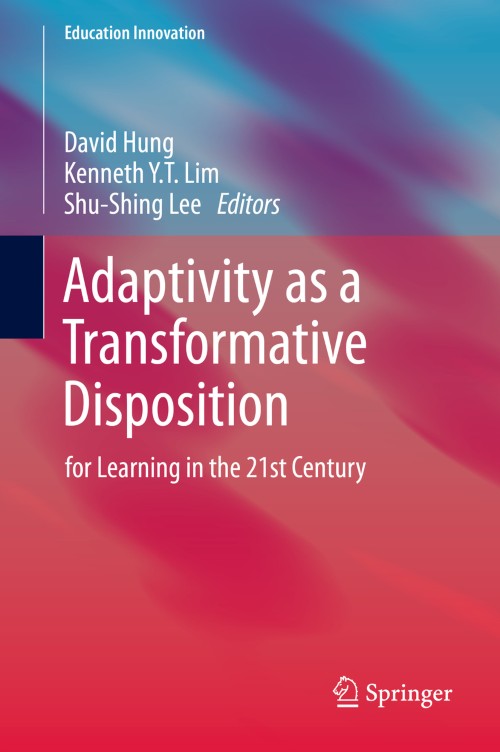
Adaptivity as a Transformative Disposition [electronic resource] : for Learning in the 21st Century / edited by David Hung, Kenneth Y. T. Lim, Shu-Shing Lee.
Erişim Adresi
ISBN
9789814560177
Dil Kodu
İngilizce
Yer Numarası
DK/14418
Basım Bildirimi
1st ed. 2014.
Yayın Bilgisi
Singapore : Springer Nature Singapore : Imprint: Springer, 2014.
Fiziksel Niteleme
XVIII, 322 p. 30 illus., 1 illus. in color. online resource.
Dizi
Education Innovation Series, 2211-4882
İçindekiler Notu
Series Editors’ Foreword -- Foreword by John Seely Brown -- Section 1: Adaptivities at the Learner/Student Scale -- Chapter 1 An Epistemic Shift: A Literacy of Adaptivity as Critical for 21st Century Learning by David Hung, Kenneth Y T Lim, Azi Jamaludin -- Chapter 2: Learner Adaptivity: An Initial Conceptualisation by Elizabeth Koh, Helen Hong and Jimmy Seah -- Chapter 3: Pedagogies of Connected Learning: Adapting Education into the 21st Century by Kristiina Kumpulainen -- Chapter 4: Learning Adaptivity across Contexts by Shu-Shing Lee, David Hung, Kenneth Y. T. Lim and Imran Shaari -- Chapter 5: The Six Learnings Framework: Exploring the Dialectics of Intuition and Adaptivity in Citizenship Education by Kenneth Y. T. Lim and Matthew Y. C. Ong -- Chapter 6: Self–Social Regulation in World of Warcraft: Dialectics of Adaptivity by Azilawati Jamaludin -- Chapter 7: Developing a Habitude: When Learning Isn’t Always Fun by David Hung, Imran Shaari, Daphnee Lee, and Shu-Shing Lee -- Section 2: Adaptivities at the School and District Scale -- Chapter 8: School Leaders and Learning Cultures in School: The Case for Intelligent Leadership by Harry Daniels and Anne Edwards -- Chapter 9: Adaptivity as a Transformative Disposition of Schools for Student Learning in the 21st Century by Bill Mulford -- Chapter 10: Adaptivities in Teacher Learning within the Context of Communities of Practice: A School District’s Learning Journey by David Hung, Shu-Shing Lee, and Swathi Vishnumahanti -- Chapter 11: Creativity and Adaptivity in Arts: The Nexus and Affordances by Liang See Tan and Letchmi Devi Ponnusamy -- Section 3: Adaptivities at the Systems Scale -- Chapter 12: Teachers as Active Contributors in Quality of Education: A Special Reference to the Finnish Context by Hannele Niemi -- Chapter 13: Fostering Adaptivity through Systemic Reform: Transforming Education through the Framework of Preparing Student Abilities and Competencies through Education in Singapore (PACES) by Horn MunCheah and Kenneth Y. T. Lim -- Chapter 14: Evolvement of Low-achievement Policy in Singapore’s Highly Adaptable Education System by Siao See Teng, Li-Yi Wang, and Ching Leen Chiam -- Chapter 15: Adaptivities in the Singapore Education System: From Great to Excellent by David Hung, Shu-Shing Lee, and Kenneth Y. T. Lim -- Chapter 16: Ecological Perspective on Scaling: Balancing Structural and Individual Adaptivities by David Hung, Shu-Shing Lee, Laik Woon Teh, Yew Meng Kwan, Swathi Vishnumahanti, and Ambar Widiastuti -- Chapter 17: Conclusion: Diffusing Adaptivities through Micro-cultures of 21st Century Learning Practices and Teacher Professionalism by David Hung, Kenneth Y. T. Lim, and Shu-Shing Lee.
Özet, vb.
This volume introduces the concept of ‘adaptivity’ as occurring when, say, individuals cross boundaries. Through illustrations from both formal and informal learning, the book seeks to provide learning designs and frameworks for adaptivity. This book is unique as it ties together: a) social-individual dialectics; and b) adaptive learning as it relates to creativity and imagination. It highlights case studies from social / new media contexts, school learning milieux, and formal and informal situations. It approaches adaptive learning from the perspectives of students, teachers, school leaders, and participants in social media and other digitally mediated environments. The book is a valuable resource for practitioners and academics who are interested in adaptivity as a learning disposition.
Konu
Literacy.
Language and languages __ Study and teaching.
Learning, Psychology of.
Literacy.
Language Education.
Instructional Psychology.
Language and languages __ Study and teaching.
Learning, Psychology of.
Literacy.
Language Education.
Instructional Psychology.
Diğer Yazarlar
Kurum Adı
Eseri Alıntıla
Referansları kullanmadan önce gözden geçirmeniz ve varsa gerekli düzeltmeleri yapmanız önerilir.
Dijital Kaynak
MARC Görünümü
LEADER 05588nam a22005415i 4500
001 813173
003 TR_AnAIT
005 20260130231222
007 cr nn 008mamaa
008 131119s2014 si | s |||| 0|eng d
020 |a9789814560177|9978-981-4560-17-7
024 7 |a10.1007/978-981-4560-17-7|2doi
041 |aeng
049 |aTürk Tarih Kurumu Kütüphanesi
050 4|aLC149-161
072 7|aCFC|2bicssc
072 7|aEDU029020|2bisacsh
072 7|aCFC|2thema
082 04|a374.0124|223
090 |aDK/14418
245 10|aAdaptivity as a Transformative Disposition|h[electronic resource] :|bfor Learning in the 21st Century /|cedited by David Hung, Kenneth Y. T. Lim, Shu-Shing Lee.
250 |a1st ed. 2014.
264 1|aSingapore :|bSpringer Nature Singapore :|bImprint: Springer,|c2014.
300 |aXVIII, 322 p. 30 illus., 1 illus. in color.|bonline resource.
336 |atext|btxt|2rdacontent
337 |acomputer|bc|2rdamedia
338 |aonline resource|bcr|2rdacarrier
347 |atext file|bPDF|2rda
490 1 |aEducation Innovation Series,|x2211-4882
505 0 |aSeries Editors’ Foreword -- Foreword by John Seely Brown -- Section 1: Adaptivities at the Learner/Student Scale -- Chapter 1 An Epistemic Shift: A Literacy of Adaptivity as Critical for 21st Century Learning by David Hung, Kenneth Y T Lim, Azi Jamaludin -- Chapter 2: Learner Adaptivity: An Initial Conceptualisation by Elizabeth Koh, Helen Hong and Jimmy Seah -- Chapter 3: Pedagogies of Connected Learning: Adapting Education into the 21st Century by Kristiina Kumpulainen -- Chapter 4: Learning Adaptivity across Contexts by Shu-Shing Lee, David Hung, Kenneth Y. T. Lim and Imran Shaari -- Chapter 5: The Six Learnings Framework: Exploring the Dialectics of Intuition and Adaptivity in Citizenship Education by Kenneth Y. T. Lim and Matthew Y. C. Ong -- Chapter 6: Self–Social Regulation in World of Warcraft: Dialectics of Adaptivity by Azilawati Jamaludin -- Chapter 7: Developing a Habitude: When Learning Isn’t Always Fun by David Hung, Imran Shaari, Daphnee Lee, and Shu-Shing Lee -- Section 2: Adaptivities at the School and District Scale -- Chapter 8: School Leaders and Learning Cultures in School: The Case for Intelligent Leadership by Harry Daniels and Anne Edwards -- Chapter 9: Adaptivity as a Transformative Disposition of Schools for Student Learning in the 21st Century by Bill Mulford -- Chapter 10: Adaptivities in Teacher Learning within the Context of Communities of Practice: A School District’s Learning Journey by David Hung, Shu-Shing Lee, and Swathi Vishnumahanti -- Chapter 11: Creativity and Adaptivity in Arts: The Nexus and Affordances by Liang See Tan and Letchmi Devi Ponnusamy -- Section 3: Adaptivities at the Systems Scale -- Chapter 12: Teachers as Active Contributors in Quality of Education: A Special Reference to the Finnish Context by Hannele Niemi -- Chapter 13: Fostering Adaptivity through Systemic Reform: Transforming Education through the Framework of Preparing Student Abilities and Competencies through Education in Singapore (PACES) by Horn MunCheah and Kenneth Y. T. Lim -- Chapter 14: Evolvement of Low-achievement Policy in Singapore’s Highly Adaptable Education System by Siao See Teng, Li-Yi Wang, and Ching Leen Chiam -- Chapter 15: Adaptivities in the Singapore Education System: From Great to Excellent by David Hung, Shu-Shing Lee, and Kenneth Y. T. Lim -- Chapter 16: Ecological Perspective on Scaling: Balancing Structural and Individual Adaptivities by David Hung, Shu-Shing Lee, Laik Woon Teh, Yew Meng Kwan, Swathi Vishnumahanti, and Ambar Widiastuti -- Chapter 17: Conclusion: Diffusing Adaptivities through Micro-cultures of 21st Century Learning Practices and Teacher Professionalism by David Hung, Kenneth Y. T. Lim, and Shu-Shing Lee.
520 |aThis volume introduces the concept of ‘adaptivity’ as occurring when, say, individuals cross boundaries. Through illustrations from both formal and informal learning, the book seeks to provide learning designs and frameworks for adaptivity. This book is unique as it ties together: a) social-individual dialectics; and b) adaptive learning as it relates to creativity and imagination. It highlights case studies from social / new media contexts, school learning milieux, and formal and informal situations. It approaches adaptive learning from the perspectives of students, teachers, school leaders, and participants in social media and other digitally mediated environments. The book is a valuable resource for practitioners and academics who are interested in adaptivity as a learning disposition.
650 0|aLiteracy.
650 0|aLanguage and languages|xStudy and teaching.
650 0|aLearning, Psychology of.
650 14|aLiteracy.
650 24|aLanguage Education.
650 24|aInstructional Psychology.
700 1 |aHung, David.|eeditor.|4edt|4http://id.loc.gov/vocabulary/relators/edt
700 1 |aLim, Kenneth Y. T.|eeditor.|4edt|4http://id.loc.gov/vocabulary/relators/edt
700 1 |aLee, Shu-Shing.|eeditor.|4edt|4http://id.loc.gov/vocabulary/relators/edt
710 2 |aSpringerLink (Online service)
773 0 |tSpringer Nature eBook
776 08|iPrinted edition:|z9789814560160
776 08|iPrinted edition:|z9789814560184
776 08|iPrinted edition:|z9789811013249
830 0|aEducation Innovation Series,|x2211-4882
856 40|uhttps://doi.org/10.1007/978-981-4560-17-7
912 |aZDB-2-SHU
912 |aZDB-2-SXED
950 |aHumanities, Social Sciences and Law (SpringerNature-11648)
950 |aEducation (R0) (SpringerNature-43721)
001 813173
003 TR_AnAIT
005 20260130231222
007 cr nn 008mamaa
008 131119s2014 si | s |||| 0|eng d
020 |a9789814560177|9978-981-4560-17-7
024 7 |a10.1007/978-981-4560-17-7|2doi
041 |aeng
049 |aTürk Tarih Kurumu Kütüphanesi
050 4|aLC149-161
072 7|aCFC|2bicssc
072 7|aEDU029020|2bisacsh
072 7|aCFC|2thema
082 04|a374.0124|223
090 |aDK/14418
245 10|aAdaptivity as a Transformative Disposition|h[electronic resource] :|bfor Learning in the 21st Century /|cedited by David Hung, Kenneth Y. T. Lim, Shu-Shing Lee.
250 |a1st ed. 2014.
264 1|aSingapore :|bSpringer Nature Singapore :|bImprint: Springer,|c2014.
300 |aXVIII, 322 p. 30 illus., 1 illus. in color.|bonline resource.
336 |atext|btxt|2rdacontent
337 |acomputer|bc|2rdamedia
338 |aonline resource|bcr|2rdacarrier
347 |atext file|bPDF|2rda
490 1 |aEducation Innovation Series,|x2211-4882
505 0 |aSeries Editors’ Foreword -- Foreword by John Seely Brown -- Section 1: Adaptivities at the Learner/Student Scale -- Chapter 1 An Epistemic Shift: A Literacy of Adaptivity as Critical for 21st Century Learning by David Hung, Kenneth Y T Lim, Azi Jamaludin -- Chapter 2: Learner Adaptivity: An Initial Conceptualisation by Elizabeth Koh, Helen Hong and Jimmy Seah -- Chapter 3: Pedagogies of Connected Learning: Adapting Education into the 21st Century by Kristiina Kumpulainen -- Chapter 4: Learning Adaptivity across Contexts by Shu-Shing Lee, David Hung, Kenneth Y. T. Lim and Imran Shaari -- Chapter 5: The Six Learnings Framework: Exploring the Dialectics of Intuition and Adaptivity in Citizenship Education by Kenneth Y. T. Lim and Matthew Y. C. Ong -- Chapter 6: Self–Social Regulation in World of Warcraft: Dialectics of Adaptivity by Azilawati Jamaludin -- Chapter 7: Developing a Habitude: When Learning Isn’t Always Fun by David Hung, Imran Shaari, Daphnee Lee, and Shu-Shing Lee -- Section 2: Adaptivities at the School and District Scale -- Chapter 8: School Leaders and Learning Cultures in School: The Case for Intelligent Leadership by Harry Daniels and Anne Edwards -- Chapter 9: Adaptivity as a Transformative Disposition of Schools for Student Learning in the 21st Century by Bill Mulford -- Chapter 10: Adaptivities in Teacher Learning within the Context of Communities of Practice: A School District’s Learning Journey by David Hung, Shu-Shing Lee, and Swathi Vishnumahanti -- Chapter 11: Creativity and Adaptivity in Arts: The Nexus and Affordances by Liang See Tan and Letchmi Devi Ponnusamy -- Section 3: Adaptivities at the Systems Scale -- Chapter 12: Teachers as Active Contributors in Quality of Education: A Special Reference to the Finnish Context by Hannele Niemi -- Chapter 13: Fostering Adaptivity through Systemic Reform: Transforming Education through the Framework of Preparing Student Abilities and Competencies through Education in Singapore (PACES) by Horn MunCheah and Kenneth Y. T. Lim -- Chapter 14: Evolvement of Low-achievement Policy in Singapore’s Highly Adaptable Education System by Siao See Teng, Li-Yi Wang, and Ching Leen Chiam -- Chapter 15: Adaptivities in the Singapore Education System: From Great to Excellent by David Hung, Shu-Shing Lee, and Kenneth Y. T. Lim -- Chapter 16: Ecological Perspective on Scaling: Balancing Structural and Individual Adaptivities by David Hung, Shu-Shing Lee, Laik Woon Teh, Yew Meng Kwan, Swathi Vishnumahanti, and Ambar Widiastuti -- Chapter 17: Conclusion: Diffusing Adaptivities through Micro-cultures of 21st Century Learning Practices and Teacher Professionalism by David Hung, Kenneth Y. T. Lim, and Shu-Shing Lee.
520 |aThis volume introduces the concept of ‘adaptivity’ as occurring when, say, individuals cross boundaries. Through illustrations from both formal and informal learning, the book seeks to provide learning designs and frameworks for adaptivity. This book is unique as it ties together: a) social-individual dialectics; and b) adaptive learning as it relates to creativity and imagination. It highlights case studies from social / new media contexts, school learning milieux, and formal and informal situations. It approaches adaptive learning from the perspectives of students, teachers, school leaders, and participants in social media and other digitally mediated environments. The book is a valuable resource for practitioners and academics who are interested in adaptivity as a learning disposition.
650 0|aLiteracy.
650 0|aLanguage and languages|xStudy and teaching.
650 0|aLearning, Psychology of.
650 14|aLiteracy.
650 24|aLanguage Education.
650 24|aInstructional Psychology.
700 1 |aHung, David.|eeditor.|4edt|4http://id.loc.gov/vocabulary/relators/edt
700 1 |aLim, Kenneth Y. T.|eeditor.|4edt|4http://id.loc.gov/vocabulary/relators/edt
700 1 |aLee, Shu-Shing.|eeditor.|4edt|4http://id.loc.gov/vocabulary/relators/edt
710 2 |aSpringerLink (Online service)
773 0 |tSpringer Nature eBook
776 08|iPrinted edition:|z9789814560160
776 08|iPrinted edition:|z9789814560184
776 08|iPrinted edition:|z9789811013249
830 0|aEducation Innovation Series,|x2211-4882
856 40|uhttps://doi.org/10.1007/978-981-4560-17-7
912 |aZDB-2-SHU
912 |aZDB-2-SXED
950 |aHumanities, Social Sciences and Law (SpringerNature-11648)
950 |aEducation (R0) (SpringerNature-43721)
Materyaller
Depodan talep edilen materyal sadece kütüphane içerisinde kullanılmaktadır.
Materyal dışarıya ödünç verilmemektedir.
Materyal dışarıya ödünç verilmemektedir.
