LEADER 03936nam a22005295i 4500
001 813191
003 TR_AnAIT
005 20260130231103
007 cr nn 008mamaa
008 121227s1973 ne | s |||| 0|eng d
020 |a9789401025454|9978-94-010-2545-4
024 7 |a10.1007/978-94-010-2545-4|2doi
041 |aeng
049 |aTürk Tarih Kurumu Kütüphanesi
050 4|aB108-708
072 7|aHPCA|2bicssc
072 7|aPHI002000|2bisacsh
072 7|aQDHA|2thema
082 04|a180.0901|223
090 |aDK/14436
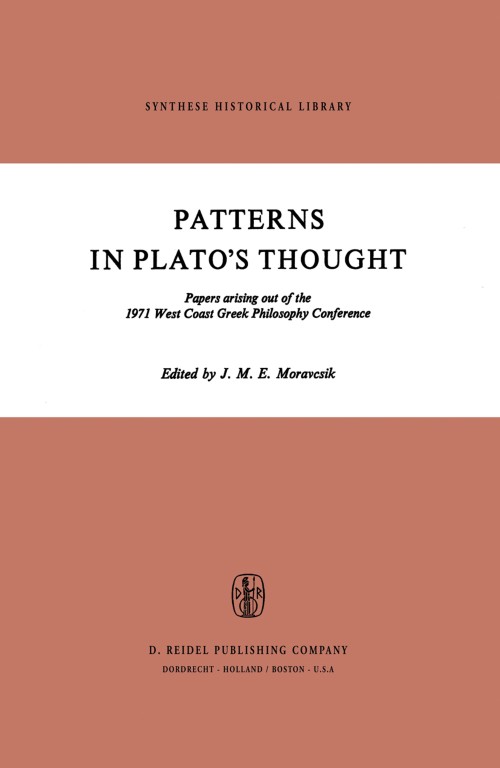
245 10|aPatterns in Plato’s Thought|h[electronic resource] :|bPapers arising out of the 1971 West Coast Greek Philosophy Conference /|cedited by J.M.E. Moravcsik.
250 |a1st ed. 1973.
264 1|aDordrecht :|bSpringer Netherlands :|bImprint: Springer,|c1973.
300 |aVIII, 216 p.|bonline resource.
336 |atext|btxt|2rdacontent
337 |acomputer|bc|2rdamedia
338 |aonline resource|bcr|2rdacarrier
347 |atext file|bPDF|2rda
490 1 |aSynthese Historical Library ;|v6
505 0 |aKnowledge and Its Objects in Plato -- Hintikka on Knowledge and Its Objects in Plato -- The Relation Between Plato’s Symposium and Phaedrus -- Comments on John Moore’s Paper -- The Second ‘Third Man’ -- The Second ‘Third Man’: an Interpretation -- Two Paradoxes in the Theaetetus -- Comments on Lewis -- Plato’s Method of Division -- Plato’s Method of Division -- False Logos and Not-Being in Plato’s Sophist.
520 |aIn his teachings and through his choice of the dialogue-form as a mode of communication, Plato emphasized the communal aspect of intellectual work. The need for having a community work together is nowhere more apparent then when the intellectual task set is that of interpreting the ancient philosophers. Those of us who were fortunate enough to spend some of our years as students at Oxford found that among our most inspiring experiences were the meetings of the Oxford Aristotelian So ciety, as well as the seminars in which B.PhiI. students discussed Plato and Aristotle. Up until the past few years no such group existed on the West Coast. In the fall of 1970 some of us got together to form the West Coast Greek Philosophy Conference, which was within a short time renamed by Prof. T. Rosenmeyer as 'the Aristotelians of the West, Unincorporated'. In our monthly meetings we translate and discuss Greek philosophic texts. For the past two years the group has been working on Aristotle's 'Physics'.
532 8 |aAccessibility summary: This PDF is not accessible. It is based on scanned pages and does not support features such as screen reader compatibility or described non-text content (images, graphs etc). However, it likely supports searchable and selectable text based on OCR (Optical Character Recognition). Users with accessibility needs may not be able to use this content effectively. Please contact us at accessibilitysupport@springernature.com if you require assistance or an alternative format.
532 8 |aInaccessible, or known limited accessibility
532 8 |aNo reading system accessibility options actively disabled
532 8 |aPublisher contact for further accessibility information: accessibilitysupport@springernature.com
650 0|aPhilosophy, Ancient.
650 14|aAncient Philosophy / Classical Philosophy.
700 1 |aMoravcsik, J.M.E.|eeditor.|4edt|4http://id.loc.gov/vocabulary/relators/edt
710 2 |aSpringerLink (Online service)
773 0 |tSpringer Nature eBook
776 08|iPrinted edition:|z9789027702869
776 08|iPrinted edition:|z9789401025461
776 08|iPrinted edition:|z9789401025478
830 0|aSynthese Historical Library ;|v6
856 40|uhttps://doi.org/10.1007/978-94-010-2545-4
912 |aZDB-2-SHU
912 |aZDB-2-SXPR
912 |aZDB-2-BAE
950 |aHumanities, Social Sciences and Law (SpringerNature-11648)
950 |aPhilosophy and Religion (R0) (SpringerNature-43725)