

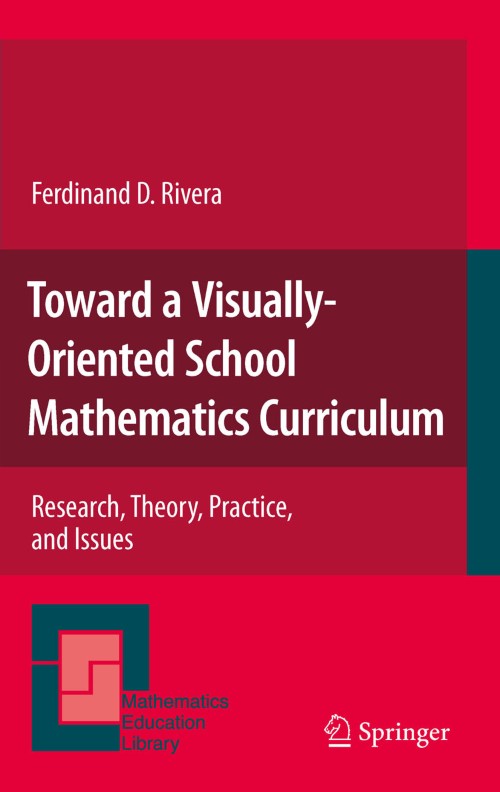
Toward a Visually-Oriented School Mathematics Curriculum [electronic resource] : Research, Theory, Practice, and Issues / by Ferdinand Rivera.
Erişim Adresi
ISBN
9789400700147
Dil Kodu
İngilizce
Yer Numarası
DK/14458
Yazar
Basım Bildirimi
1st ed. 2011.
Yayın Bilgisi
Dordrecht : Springer Netherlands : Imprint: Springer, 2011.
Fiziksel Niteleme
IX, 316 p. online resource.
Dizi
Mathematics Education Library, 2214-983X ; 49
İçindekiler Notu
Chapter 1. Visualization and Progressive Schematization -- Chapter 2. Visual Roots of Mathematical Cognitive Activity -- Chapter 3. Visual Roots of Mathematical Symbols -- Chapter 4. Visuoalphanumeric Representations in Pattern Generalization Activity -- Chapter 5. Visual Thinking and Diagrammatic Reasoning (DR) -- Chapter 6. Cultural and Blind-Specific Issues and Implications to Visual Thinking in Mathematics -- Chapter 7. Instructional Implications: Toward Visual Thinking in Mathematics.
Özet, vb.
What does it mean to have a visual representation of a mathematical object, concept, or process? What visualization strategies support growth in mathematical thinking, reasoning, generalization, and knowledge? Is mathematical seeing culture-free? How can information drawn from studies in blind subjects help us understand the significance of a multimodal approach to learning mathematics? Toward a Visually-Oriented School Mathematics Curriculum explores a unified theory of visualization in school mathematical learning via the notion of progressive modeling. Based on the author’s longitudinal research investigations in elementary and middle school classrooms, the book provides a compelling empirical account of ways in which instruction can effectively orchestrate the transition from personally-constructed visuals, both externally-drawn and internally-derived, into more structured visual representations within the context of a socioculturally grounded mathematical activity. Both for teachers and researchers, a discussion of this topic is relevant in the history of the present. The ubiquity of technological tools and virtual spaces for learning and doing mathematics has aroused interest among concerned stakeholders about the role of mathematics in these contexts. The book begins with a prolegomenon on the author’s reflections on past and present visual studies in mathematics education. In the remaining seven chapters, visualization is pursued in terms of its role in bringing about progressions in mathematical symbolization, abduction, pattern generalization, and diagrammatization. Toward a Visually-Oriented School Mathematics Curriculum views issues surrounding visualization through the eyes of a classroom teacher-researcher; it draws on findings within and outside of mathematics education that help practitioners and scholars gain a better understanding of what it means to pleasurably experience the symmetric visual/symbolic reversal phenomenon – thatis, seeing the visual in the symbolic and the symbolic in the visual.".
Konu
Mathematics __ Study and teaching .
Information visualization.
Mathematics Education.
Data and Information Visualization.
Information visualization.
Mathematics Education.
Data and Information Visualization.
Kurum Adı
Eseri Alıntıla
Referansları kullanmadan önce gözden geçirmeniz ve varsa gerekli düzeltmeleri yapmanız önerilir.
Dijital Kaynak
MARC Görünümü
LEADER 04413nam a22005175i 4500
001 813213
003 TR_AnAIT
005 20260130230934
007 cr nn 008mamaa
008 110106s2011 ne | s |||| 0|eng d
020 |a9789400700147|9978-94-007-0014-7
024 7 |a10.1007/978-94-007-0014-7|2doi
041 |aeng
049 |aTürk Tarih Kurumu Kütüphanesi
050 4|aQA10.92-20
072 7|aJNU|2bicssc
072 7|aPB|2bicssc
072 7|aEDU029010|2bisacsh
072 7|aJNU|2thema
072 7|aPB|2thema
082 04|a510.71|223
090 |aDK/14458
100 1 |aRivera, Ferdinand.|eauthor.|4aut|4http://id.loc.gov/vocabulary/relators/aut
245 10|aToward a Visually-Oriented School Mathematics Curriculum|h[electronic resource] :|bResearch, Theory, Practice, and Issues /|cby Ferdinand Rivera.
250 |a1st ed. 2011.
264 1|aDordrecht :|bSpringer Netherlands :|bImprint: Springer,|c2011.
300 |aIX, 316 p.|bonline resource.
336 |atext|btxt|2rdacontent
337 |acomputer|bc|2rdamedia
338 |aonline resource|bcr|2rdacarrier
347 |atext file|bPDF|2rda
490 1 |aMathematics Education Library,|x2214-983X ;|v49
505 0 |aChapter 1. Visualization and Progressive Schematization -- Chapter 2. Visual Roots of Mathematical Cognitive Activity -- Chapter 3. Visual Roots of Mathematical Symbols -- Chapter 4. Visuoalphanumeric Representations in Pattern Generalization Activity -- Chapter 5. Visual Thinking and Diagrammatic Reasoning (DR) -- Chapter 6. Cultural and Blind-Specific Issues and Implications to Visual Thinking in Mathematics -- Chapter 7. Instructional Implications: Toward Visual Thinking in Mathematics.
520 |aWhat does it mean to have a visual representation of a mathematical object, concept, or process? What visualization strategies support growth in mathematical thinking, reasoning, generalization, and knowledge? Is mathematical seeing culture-free? How can information drawn from studies in blind subjects help us understand the significance of a multimodal approach to learning mathematics? Toward a Visually-Oriented School Mathematics Curriculum explores a unified theory of visualization in school mathematical learning via the notion of progressive modeling. Based on the author’s longitudinal research investigations in elementary and middle school classrooms, the book provides a compelling empirical account of ways in which instruction can effectively orchestrate the transition from personally-constructed visuals, both externally-drawn and internally-derived, into more structured visual representations within the context of a socioculturally grounded mathematical activity. Both for teachers and researchers, a discussion of this topic is relevant in the history of the present. The ubiquity of technological tools and virtual spaces for learning and doing mathematics has aroused interest among concerned stakeholders about the role of mathematics in these contexts. The book begins with a prolegomenon on the author’s reflections on past and present visual studies in mathematics education. In the remaining seven chapters, visualization is pursued in terms of its role in bringing about progressions in mathematical symbolization, abduction, pattern generalization, and diagrammatization. Toward a Visually-Oriented School Mathematics Curriculum views issues surrounding visualization through the eyes of a classroom teacher-researcher; it draws on findings within and outside of mathematics education that help practitioners and scholars gain a better understanding of what it means to pleasurably experience the symmetric visual/symbolic reversal phenomenon – thatis, seeing the visual in the symbolic and the symbolic in the visual.".
650 0|aMathematics|xStudy and teaching .
650 0|aInformation visualization.
650 14|aMathematics Education.
650 24|aData and Information Visualization.
710 2 |aSpringerLink (Online service)
773 0 |tSpringer Nature eBook
776 08|iPrinted edition:|z9789400700130
776 08|iPrinted edition:|z9789400700154
776 08|iPrinted edition:|z9789400734708
830 0|aMathematics Education Library,|x2214-983X ;|v49
856 40|uhttps://doi.org/10.1007/978-94-007-0014-7
912 |aZDB-2-SHU
912 |aZDB-2-SXED
950 |aHumanities, Social Sciences and Law (SpringerNature-11648)
950 |aEducation (R0) (SpringerNature-43721)
001 813213
003 TR_AnAIT
005 20260130230934
007 cr nn 008mamaa
008 110106s2011 ne | s |||| 0|eng d
020 |a9789400700147|9978-94-007-0014-7
024 7 |a10.1007/978-94-007-0014-7|2doi
041 |aeng
049 |aTürk Tarih Kurumu Kütüphanesi
050 4|aQA10.92-20
072 7|aJNU|2bicssc
072 7|aPB|2bicssc
072 7|aEDU029010|2bisacsh
072 7|aJNU|2thema
072 7|aPB|2thema
082 04|a510.71|223
090 |aDK/14458
100 1 |aRivera, Ferdinand.|eauthor.|4aut|4http://id.loc.gov/vocabulary/relators/aut
245 10|aToward a Visually-Oriented School Mathematics Curriculum|h[electronic resource] :|bResearch, Theory, Practice, and Issues /|cby Ferdinand Rivera.
250 |a1st ed. 2011.
264 1|aDordrecht :|bSpringer Netherlands :|bImprint: Springer,|c2011.
300 |aIX, 316 p.|bonline resource.
336 |atext|btxt|2rdacontent
337 |acomputer|bc|2rdamedia
338 |aonline resource|bcr|2rdacarrier
347 |atext file|bPDF|2rda
490 1 |aMathematics Education Library,|x2214-983X ;|v49
505 0 |aChapter 1. Visualization and Progressive Schematization -- Chapter 2. Visual Roots of Mathematical Cognitive Activity -- Chapter 3. Visual Roots of Mathematical Symbols -- Chapter 4. Visuoalphanumeric Representations in Pattern Generalization Activity -- Chapter 5. Visual Thinking and Diagrammatic Reasoning (DR) -- Chapter 6. Cultural and Blind-Specific Issues and Implications to Visual Thinking in Mathematics -- Chapter 7. Instructional Implications: Toward Visual Thinking in Mathematics.
520 |aWhat does it mean to have a visual representation of a mathematical object, concept, or process? What visualization strategies support growth in mathematical thinking, reasoning, generalization, and knowledge? Is mathematical seeing culture-free? How can information drawn from studies in blind subjects help us understand the significance of a multimodal approach to learning mathematics? Toward a Visually-Oriented School Mathematics Curriculum explores a unified theory of visualization in school mathematical learning via the notion of progressive modeling. Based on the author’s longitudinal research investigations in elementary and middle school classrooms, the book provides a compelling empirical account of ways in which instruction can effectively orchestrate the transition from personally-constructed visuals, both externally-drawn and internally-derived, into more structured visual representations within the context of a socioculturally grounded mathematical activity. Both for teachers and researchers, a discussion of this topic is relevant in the history of the present. The ubiquity of technological tools and virtual spaces for learning and doing mathematics has aroused interest among concerned stakeholders about the role of mathematics in these contexts. The book begins with a prolegomenon on the author’s reflections on past and present visual studies in mathematics education. In the remaining seven chapters, visualization is pursued in terms of its role in bringing about progressions in mathematical symbolization, abduction, pattern generalization, and diagrammatization. Toward a Visually-Oriented School Mathematics Curriculum views issues surrounding visualization through the eyes of a classroom teacher-researcher; it draws on findings within and outside of mathematics education that help practitioners and scholars gain a better understanding of what it means to pleasurably experience the symmetric visual/symbolic reversal phenomenon – thatis, seeing the visual in the symbolic and the symbolic in the visual.".
650 0|aMathematics|xStudy and teaching .
650 0|aInformation visualization.
650 14|aMathematics Education.
650 24|aData and Information Visualization.
710 2 |aSpringerLink (Online service)
773 0 |tSpringer Nature eBook
776 08|iPrinted edition:|z9789400700130
776 08|iPrinted edition:|z9789400700154
776 08|iPrinted edition:|z9789400734708
830 0|aMathematics Education Library,|x2214-983X ;|v49
856 40|uhttps://doi.org/10.1007/978-94-007-0014-7
912 |aZDB-2-SHU
912 |aZDB-2-SXED
950 |aHumanities, Social Sciences and Law (SpringerNature-11648)
950 |aEducation (R0) (SpringerNature-43721)
Materyaller
Depodan talep edilen materyal sadece kütüphane içerisinde kullanılmaktadır.
Materyal dışarıya ödünç verilmemektedir.
Materyal dışarıya ödünç verilmemektedir.
