

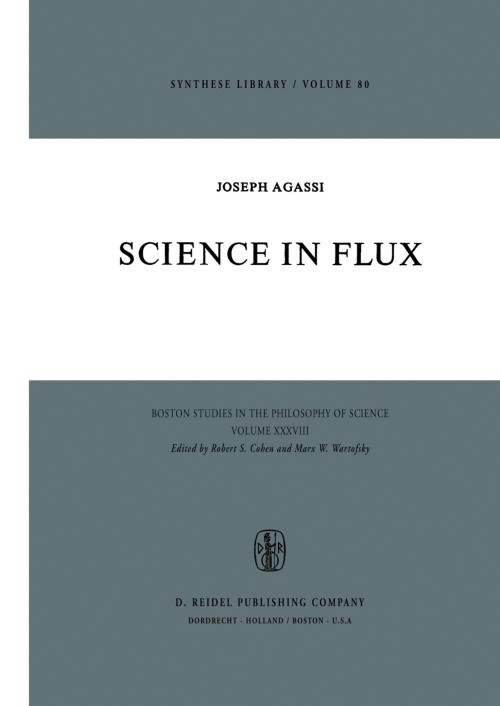
Science in Flux [electronic resource] / by J. Agassi.
Erişim Adresi
ISBN
9789401018104
Dil Kodu
İngilizce
Yer Numarası
DK/14462
Yazar
Basım Bildirimi
1st ed. 1975.
Yayın Bilgisi
Dordrecht : Springer Netherlands : Imprint: Springer, 1975.
Fiziksel Niteleme
XXVI, 559 p. online resource.
Dizi
Boston Studies in the Philosophy and History of Science, 2214-7942 ; 28
İçindekiler Notu
1. A Prologue: On Stability and Flux -- References -- 2. Science in Flux: Footnotes to Popper -- I. Einstein has Upset the View that Science is Stable -- II. The Empirical Support of Some Scientific Theories Requires Explanation -- III. The Desire for Stability Makes Us See More of It than There is -- IV. Popper’s Theory Presents Science as an Endless Series of Debates -- V. Popper Makes Additional Assumptions -- VI. Rationality is a Means to an End -- References -- Appendix: The Role of Corroboration in Popper’s Philosophy -- Notes -- 3. On Novelty -- I. On the Novelty of Ideas in General -- II. Science and Truth -- III. Popper’s View of Science -- Notes -- Appendix: On the Discovery of General Facts -- 4. Replies To Diane: Popper On Learning From Experience81 -- Note -- Appendix: Empiricism Without Inductivism -- 5. Sensationalism -- 1. Sensationalism vs. Theoretical Knowledge -- 2. Sensationalism vs. Empiricism -- 3. Sense-Experience vs. Experience -- 4. Sensationalism vs. Common Sense -- 5. Explanation vs. Consent -- 6. The Roots of Scientific Realism -- 7. Conclusion -- 6. When Should we Ignore Evidence in Favour of a Hypothesis? -- I. Can Observation Reports be Revoked? -- II. Can Refutation be Final? -- III. A Simple Issue Obfuscated -- IV. A Criterion for Rejection of Observation Reports? -- V. Does Popper Offer a Rule of Rejection? -- VI.Do We Need a Rate of Acceptance of Observation Reports? -- Appendix: Random Versus Unsystematic Observations -- 7. Testing as a Bootstrap Operation in Physics -- First Introduction: Reliability is not a Matter for Pure Science -- Second Introduction: The Duhem-Quine Thesis has a New Significance -- I. Conventionalists and the Problem of Induction -- II. Popper is Ambivalent Regarding Goodman’s Problem -- III. Bootstrap Operations in Testing -- IV. The Need forConstraints is Quite Real -- V. Science Constraints Itself by Auxiliary Hypotheses -- VI. Revolutions Occur when Bootstrap Operations Fail -- VII. Conclusion -- Appendix: Precision in Theory and in Measurement -- 8. Towards A Theory Of ‘Ad Hoc’ Hypotheses -- I. Ad hoc Hypotheses which become Factual Evidence -- II. The Conventional Element in Science -- III. Reducing the Conventions -- IV. Metaphysics and ad hoc Hypotheses -- V. What is a Mess? -- Appendix: The Traditional ad hoc Use of Instrumentalism -- 9. The Nature of Scientific Problems and their Roots in Metaphysics -- I. Scientific Research Centers Around a Few Problems -- II. The Anti-Metaphysical Tradition is Outdated -- III. A Historical Note on Science and Metaphysics -- IV. Pseudo-Science is not the Same as Non-Science -- V. Popper’s Theory of Science -- VI. Superstition, Pseudo-Science, and Metaphysics Use Instances in Different Ways -- VII. Metaphysical Doctrines are Often Insufficient Frame-works for Science -- VIII. The Role of Interpretations in Physics -- IX. The History of Science as the History of Its Metaphysical Frameworks -- Appendix: What is a Natural Law? -- 10. Questions of Science and Metaphysics -- I. How Do we Select Questions? -- II. We Select Questions Within Given Metaphysical Frame-works -- III.The Literature on Questions -- IV.The Literature on the Logic of Questions -- V.The Instrumentalist View on the Choice of Questions -- VI. Collingwood’s Peculiarity -- VII. The Logic of Multiple-Choice-Questions -- VIII. Bromberger on Why-Questions -- IX. The Need for a Metaphysical Theory of Causality -- X.Collingwood in a New Garb -- Appendix: The Anti-Scientific Metaphysician -- Notes -- 11. The Confusion Between Physics And Metaphysics in the Standard Histories of Sciences -- Appendix: Reply to Commentators -- 12.TheConfusion Between Science and Technology in the Standard Philosophies of Science -- Appendix: Planning for Success: A Reply to Professor Wisdom -- Notes -- 13. Positive Evidence in Science and Technology -- I. Kant’s Scandal -- II. Whitehead’s Scandal -- III.The Facts About Induction -- IV.Success and Rationality -- V. The Sociology of Knowledge -- Appendix: Duhem’s Instrumentalism and Autonomism -- 14. Positive Evidence as a Social Institution -- Appendix: The Logic of Technological Development -- 15. Imperfect Knowledge -- I. Equating Imperfect Knowledge with Science is Questionable -- II. Equating Imperfect Knowledge with Rational Belief is an Error -- III. Imperfect Knowledge-Claims are Qualified by Publicly Accepted Hypotheses -- Notes -- 16. Criteria for Plausible Arguments -- Note -- Appendix: The Standard Misinterpretation of Skepticism -- 17. Modified Conventionalism -- I. The Problem -- II. Science and Society -- III. Popper’s Problems of Demarcation -- IV. The Three Views Concerning Human Knowledge Revisited -- Appendix: Bartley’s Critique of Popper -- Notes -- 18. Unity and Diversity in Science -- Abstract -- I. Ambivalence Towards Unity: An Impression -- II. The Ethics of Science as a Unifier of Science -- III. Proof as the Unifier of Science -- IV. Manifest Truth as the Unifier of Science -- V. Unity of Science as a Dictator of Unanimity on All Questions -- VI. A Theory of Rational Disagreement -- References -- Appendix on Kant -- 19. Can Religion go Beyond Reason? -- I. Religion and Reason -- II. Dissatisfaction with Science and Religion -- III. Reason and Faith -- IV. The Question of Complementary Relationship -- V. Toward Intellectual Complementation -- VI. Possibilities of Cooperation -- VII. Defects of Both Rationalism and Religion -- VIII. Standards of Rational Thought and Action.-IX. Enlightenment and Self-Reliance -- X. The Sophisticated Religionists: Buber and Polangi -- XI. Science and Universalistic Religion -- Notes -- Appendix on Buber -- 20. Assurance and Agnosticism -- I. The Compleat Agnostic -- II. The Image of Inductive Science -- III. Empirical Facts About Assurance -- IV. The Non-Justificationist Mood -- V. Conversion to Autonomism -- VI. The Assured Agnostic -- Index of Works Cited -- Index of Names -- Index of Subjects.
Konu
Science __ Philosophy.
Philosophy of Science.
Philosophy of Science.
Kurum Adı
Eseri Alıntıla
Referansları kullanmadan önce gözden geçirmeniz ve varsa gerekli düzeltmeleri yapmanız önerilir.
Dijital Kaynak
MARC Görünümü
LEADER 08434nam a22005295i 4500
001 813217
003 TR_AnAIT
005 20260130230912
007 cr nn 008mamaa
008 121227s1975 ne | s |||| 0|eng d
020 |a9789401018104|9978-94-010-1810-4
024 7 |a10.1007/978-94-010-1810-4|2doi
041 |aeng
049 |aTürk Tarih Kurumu Kütüphanesi
050 4|aQ174-175.3
050 4|aB67
072 7|aPDA|2bicssc
072 7|aSCI075000|2bisacsh
072 7|aPDA|2thema
082 04|a501|223
090 |aDK/14462
100 1 |aAgassi, J.|eauthor.|4aut|4http://id.loc.gov/vocabulary/relators/aut
245 10|aScience in Flux|h[electronic resource] /|cby J. Agassi.
250 |a1st ed. 1975.
264 1|aDordrecht :|bSpringer Netherlands :|bImprint: Springer,|c1975.
300 |aXXVI, 559 p.|bonline resource.
336 |atext|btxt|2rdacontent
337 |acomputer|bc|2rdamedia
338 |aonline resource|bcr|2rdacarrier
347 |atext file|bPDF|2rda
490 1 |aBoston Studies in the Philosophy and History of Science,|x2214-7942 ;|v28
505 0 |a1. A Prologue: On Stability and Flux -- References -- 2. Science in Flux: Footnotes to Popper -- I. Einstein has Upset the View that Science is Stable -- II. The Empirical Support of Some Scientific Theories Requires Explanation -- III. The Desire for Stability Makes Us See More of It than There is -- IV. Popper’s Theory Presents Science as an Endless Series of Debates -- V. Popper Makes Additional Assumptions -- VI. Rationality is a Means to an End -- References -- Appendix: The Role of Corroboration in Popper’s Philosophy -- Notes -- 3. On Novelty -- I. On the Novelty of Ideas in General -- II. Science and Truth -- III. Popper’s View of Science -- Notes -- Appendix: On the Discovery of General Facts -- 4. Replies To Diane: Popper On Learning From Experience81 -- Note -- Appendix: Empiricism Without Inductivism -- 5. Sensationalism -- 1. Sensationalism vs. Theoretical Knowledge -- 2. Sensationalism vs. Empiricism -- 3. Sense-Experience vs. Experience -- 4. Sensationalism vs. Common Sense -- 5. Explanation vs. Consent -- 6. The Roots of Scientific Realism -- 7. Conclusion -- 6. When Should we Ignore Evidence in Favour of a Hypothesis? -- I. Can Observation Reports be Revoked? -- II. Can Refutation be Final? -- III. A Simple Issue Obfuscated -- IV. A Criterion for Rejection of Observation Reports? -- V. Does Popper Offer a Rule of Rejection? -- VI.Do We Need a Rate of Acceptance of Observation Reports? -- Appendix: Random Versus Unsystematic Observations -- 7. Testing as a Bootstrap Operation in Physics -- First Introduction: Reliability is not a Matter for Pure Science -- Second Introduction: The Duhem-Quine Thesis has a New Significance -- I. Conventionalists and the Problem of Induction -- II. Popper is Ambivalent Regarding Goodman’s Problem -- III. Bootstrap Operations in Testing -- IV. The Need forConstraints is Quite Real -- V. Science Constraints Itself by Auxiliary Hypotheses -- VI. Revolutions Occur when Bootstrap Operations Fail -- VII. Conclusion -- Appendix: Precision in Theory and in Measurement -- 8. Towards A Theory Of ‘Ad Hoc’ Hypotheses -- I. Ad hoc Hypotheses which become Factual Evidence -- II. The Conventional Element in Science -- III. Reducing the Conventions -- IV. Metaphysics and ad hoc Hypotheses -- V. What is a Mess? -- Appendix: The Traditional ad hoc Use of Instrumentalism -- 9. The Nature of Scientific Problems and their Roots in Metaphysics -- I. Scientific Research Centers Around a Few Problems -- II. The Anti-Metaphysical Tradition is Outdated -- III. A Historical Note on Science and Metaphysics -- IV. Pseudo-Science is not the Same as Non-Science -- V. Popper’s Theory of Science -- VI. Superstition, Pseudo-Science, and Metaphysics Use Instances in Different Ways -- VII. Metaphysical Doctrines are Often Insufficient Frame-works for Science -- VIII. The Role of Interpretations in Physics -- IX. The History of Science as the History of Its Metaphysical Frameworks -- Appendix: What is a Natural Law? -- 10. Questions of Science and Metaphysics -- I. How Do we Select Questions? -- II. We Select Questions Within Given Metaphysical Frame-works -- III.The Literature on Questions -- IV.The Literature on the Logic of Questions -- V.The Instrumentalist View on the Choice of Questions -- VI. Collingwood’s Peculiarity -- VII. The Logic of Multiple-Choice-Questions -- VIII. Bromberger on Why-Questions -- IX. The Need for a Metaphysical Theory of Causality -- X.Collingwood in a New Garb -- Appendix: The Anti-Scientific Metaphysician -- Notes -- 11. The Confusion Between Physics And Metaphysics in the Standard Histories of Sciences -- Appendix: Reply to Commentators -- 12.TheConfusion Between Science and Technology in the Standard Philosophies of Science -- Appendix: Planning for Success: A Reply to Professor Wisdom -- Notes -- 13. Positive Evidence in Science and Technology -- I. Kant’s Scandal -- II. Whitehead’s Scandal -- III.The Facts About Induction -- IV.Success and Rationality -- V. The Sociology of Knowledge -- Appendix: Duhem’s Instrumentalism and Autonomism -- 14. Positive Evidence as a Social Institution -- Appendix: The Logic of Technological Development -- 15. Imperfect Knowledge -- I. Equating Imperfect Knowledge with Science is Questionable -- II. Equating Imperfect Knowledge with Rational Belief is an Error -- III. Imperfect Knowledge-Claims are Qualified by Publicly Accepted Hypotheses -- Notes -- 16. Criteria for Plausible Arguments -- Note -- Appendix: The Standard Misinterpretation of Skepticism -- 17. Modified Conventionalism -- I. The Problem -- II. Science and Society -- III. Popper’s Problems of Demarcation -- IV. The Three Views Concerning Human Knowledge Revisited -- Appendix: Bartley’s Critique of Popper -- Notes -- 18. Unity and Diversity in Science -- Abstract -- I. Ambivalence Towards Unity: An Impression -- II. The Ethics of Science as a Unifier of Science -- III. Proof as the Unifier of Science -- IV. Manifest Truth as the Unifier of Science -- V. Unity of Science as a Dictator of Unanimity on All Questions -- VI. A Theory of Rational Disagreement -- References -- Appendix on Kant -- 19. Can Religion go Beyond Reason? -- I. Religion and Reason -- II. Dissatisfaction with Science and Religion -- III. Reason and Faith -- IV. The Question of Complementary Relationship -- V. Toward Intellectual Complementation -- VI. Possibilities of Cooperation -- VII. Defects of Both Rationalism and Religion -- VIII. Standards of Rational Thought and Action.-IX. Enlightenment and Self-Reliance -- X. The Sophisticated Religionists: Buber and Polangi -- XI. Science and Universalistic Religion -- Notes -- Appendix on Buber -- 20. Assurance and Agnosticism -- I. The Compleat Agnostic -- II. The Image of Inductive Science -- III. Empirical Facts About Assurance -- IV. The Non-Justificationist Mood -- V. Conversion to Autonomism -- VI. The Assured Agnostic -- Index of Works Cited -- Index of Names -- Index of Subjects.
532 8 |aAccessibility summary: This PDF is not accessible. It is based on scanned pages and does not support features such as screen reader compatibility or described non-text content (images, graphs etc). However, it likely supports searchable and selectable text based on OCR (Optical Character Recognition). Users with accessibility needs may not be able to use this content effectively. Please contact us at accessibilitysupport@springernature.com if you require assistance or an alternative format.
532 8 |aInaccessible, or known limited accessibility
532 8 |aNo reading system accessibility options actively disabled
532 8 |aPublisher contact for further accessibility information: accessibilitysupport@springernature.com
650 0|aScience|xPhilosophy.
650 14|aPhilosophy of Science.
710 2 |aSpringerLink (Online service)
773 0 |tSpringer Nature eBook
776 08|iPrinted edition:|z9789027705846
776 08|iPrinted edition:|z9789027706126
776 08|iPrinted edition:|z9789401018111
830 0|aBoston Studies in the Philosophy and History of Science,|x2214-7942 ;|v28
856 40|uhttps://doi.org/10.1007/978-94-010-1810-4
912 |aZDB-2-SHU
912 |aZDB-2-SXPR
912 |aZDB-2-BAE
950 |aHumanities, Social Sciences and Law (SpringerNature-11648)
950 |aPhilosophy and Religion (R0) (SpringerNature-43725)
001 813217
003 TR_AnAIT
005 20260130230912
007 cr nn 008mamaa
008 121227s1975 ne | s |||| 0|eng d
020 |a9789401018104|9978-94-010-1810-4
024 7 |a10.1007/978-94-010-1810-4|2doi
041 |aeng
049 |aTürk Tarih Kurumu Kütüphanesi
050 4|aQ174-175.3
050 4|aB67
072 7|aPDA|2bicssc
072 7|aSCI075000|2bisacsh
072 7|aPDA|2thema
082 04|a501|223
090 |aDK/14462
100 1 |aAgassi, J.|eauthor.|4aut|4http://id.loc.gov/vocabulary/relators/aut
245 10|aScience in Flux|h[electronic resource] /|cby J. Agassi.
250 |a1st ed. 1975.
264 1|aDordrecht :|bSpringer Netherlands :|bImprint: Springer,|c1975.
300 |aXXVI, 559 p.|bonline resource.
336 |atext|btxt|2rdacontent
337 |acomputer|bc|2rdamedia
338 |aonline resource|bcr|2rdacarrier
347 |atext file|bPDF|2rda
490 1 |aBoston Studies in the Philosophy and History of Science,|x2214-7942 ;|v28
505 0 |a1. A Prologue: On Stability and Flux -- References -- 2. Science in Flux: Footnotes to Popper -- I. Einstein has Upset the View that Science is Stable -- II. The Empirical Support of Some Scientific Theories Requires Explanation -- III. The Desire for Stability Makes Us See More of It than There is -- IV. Popper’s Theory Presents Science as an Endless Series of Debates -- V. Popper Makes Additional Assumptions -- VI. Rationality is a Means to an End -- References -- Appendix: The Role of Corroboration in Popper’s Philosophy -- Notes -- 3. On Novelty -- I. On the Novelty of Ideas in General -- II. Science and Truth -- III. Popper’s View of Science -- Notes -- Appendix: On the Discovery of General Facts -- 4. Replies To Diane: Popper On Learning From Experience81 -- Note -- Appendix: Empiricism Without Inductivism -- 5. Sensationalism -- 1. Sensationalism vs. Theoretical Knowledge -- 2. Sensationalism vs. Empiricism -- 3. Sense-Experience vs. Experience -- 4. Sensationalism vs. Common Sense -- 5. Explanation vs. Consent -- 6. The Roots of Scientific Realism -- 7. Conclusion -- 6. When Should we Ignore Evidence in Favour of a Hypothesis? -- I. Can Observation Reports be Revoked? -- II. Can Refutation be Final? -- III. A Simple Issue Obfuscated -- IV. A Criterion for Rejection of Observation Reports? -- V. Does Popper Offer a Rule of Rejection? -- VI.Do We Need a Rate of Acceptance of Observation Reports? -- Appendix: Random Versus Unsystematic Observations -- 7. Testing as a Bootstrap Operation in Physics -- First Introduction: Reliability is not a Matter for Pure Science -- Second Introduction: The Duhem-Quine Thesis has a New Significance -- I. Conventionalists and the Problem of Induction -- II. Popper is Ambivalent Regarding Goodman’s Problem -- III. Bootstrap Operations in Testing -- IV. The Need forConstraints is Quite Real -- V. Science Constraints Itself by Auxiliary Hypotheses -- VI. Revolutions Occur when Bootstrap Operations Fail -- VII. Conclusion -- Appendix: Precision in Theory and in Measurement -- 8. Towards A Theory Of ‘Ad Hoc’ Hypotheses -- I. Ad hoc Hypotheses which become Factual Evidence -- II. The Conventional Element in Science -- III. Reducing the Conventions -- IV. Metaphysics and ad hoc Hypotheses -- V. What is a Mess? -- Appendix: The Traditional ad hoc Use of Instrumentalism -- 9. The Nature of Scientific Problems and their Roots in Metaphysics -- I. Scientific Research Centers Around a Few Problems -- II. The Anti-Metaphysical Tradition is Outdated -- III. A Historical Note on Science and Metaphysics -- IV. Pseudo-Science is not the Same as Non-Science -- V. Popper’s Theory of Science -- VI. Superstition, Pseudo-Science, and Metaphysics Use Instances in Different Ways -- VII. Metaphysical Doctrines are Often Insufficient Frame-works for Science -- VIII. The Role of Interpretations in Physics -- IX. The History of Science as the History of Its Metaphysical Frameworks -- Appendix: What is a Natural Law? -- 10. Questions of Science and Metaphysics -- I. How Do we Select Questions? -- II. We Select Questions Within Given Metaphysical Frame-works -- III.The Literature on Questions -- IV.The Literature on the Logic of Questions -- V.The Instrumentalist View on the Choice of Questions -- VI. Collingwood’s Peculiarity -- VII. The Logic of Multiple-Choice-Questions -- VIII. Bromberger on Why-Questions -- IX. The Need for a Metaphysical Theory of Causality -- X.Collingwood in a New Garb -- Appendix: The Anti-Scientific Metaphysician -- Notes -- 11. The Confusion Between Physics And Metaphysics in the Standard Histories of Sciences -- Appendix: Reply to Commentators -- 12.TheConfusion Between Science and Technology in the Standard Philosophies of Science -- Appendix: Planning for Success: A Reply to Professor Wisdom -- Notes -- 13. Positive Evidence in Science and Technology -- I. Kant’s Scandal -- II. Whitehead’s Scandal -- III.The Facts About Induction -- IV.Success and Rationality -- V. The Sociology of Knowledge -- Appendix: Duhem’s Instrumentalism and Autonomism -- 14. Positive Evidence as a Social Institution -- Appendix: The Logic of Technological Development -- 15. Imperfect Knowledge -- I. Equating Imperfect Knowledge with Science is Questionable -- II. Equating Imperfect Knowledge with Rational Belief is an Error -- III. Imperfect Knowledge-Claims are Qualified by Publicly Accepted Hypotheses -- Notes -- 16. Criteria for Plausible Arguments -- Note -- Appendix: The Standard Misinterpretation of Skepticism -- 17. Modified Conventionalism -- I. The Problem -- II. Science and Society -- III. Popper’s Problems of Demarcation -- IV. The Three Views Concerning Human Knowledge Revisited -- Appendix: Bartley’s Critique of Popper -- Notes -- 18. Unity and Diversity in Science -- Abstract -- I. Ambivalence Towards Unity: An Impression -- II. The Ethics of Science as a Unifier of Science -- III. Proof as the Unifier of Science -- IV. Manifest Truth as the Unifier of Science -- V. Unity of Science as a Dictator of Unanimity on All Questions -- VI. A Theory of Rational Disagreement -- References -- Appendix on Kant -- 19. Can Religion go Beyond Reason? -- I. Religion and Reason -- II. Dissatisfaction with Science and Religion -- III. Reason and Faith -- IV. The Question of Complementary Relationship -- V. Toward Intellectual Complementation -- VI. Possibilities of Cooperation -- VII. Defects of Both Rationalism and Religion -- VIII. Standards of Rational Thought and Action.-IX. Enlightenment and Self-Reliance -- X. The Sophisticated Religionists: Buber and Polangi -- XI. Science and Universalistic Religion -- Notes -- Appendix on Buber -- 20. Assurance and Agnosticism -- I. The Compleat Agnostic -- II. The Image of Inductive Science -- III. Empirical Facts About Assurance -- IV. The Non-Justificationist Mood -- V. Conversion to Autonomism -- VI. The Assured Agnostic -- Index of Works Cited -- Index of Names -- Index of Subjects.
532 8 |aAccessibility summary: This PDF is not accessible. It is based on scanned pages and does not support features such as screen reader compatibility or described non-text content (images, graphs etc). However, it likely supports searchable and selectable text based on OCR (Optical Character Recognition). Users with accessibility needs may not be able to use this content effectively. Please contact us at accessibilitysupport@springernature.com if you require assistance or an alternative format.
532 8 |aInaccessible, or known limited accessibility
532 8 |aNo reading system accessibility options actively disabled
532 8 |aPublisher contact for further accessibility information: accessibilitysupport@springernature.com
650 0|aScience|xPhilosophy.
650 14|aPhilosophy of Science.
710 2 |aSpringerLink (Online service)
773 0 |tSpringer Nature eBook
776 08|iPrinted edition:|z9789027705846
776 08|iPrinted edition:|z9789027706126
776 08|iPrinted edition:|z9789401018111
830 0|aBoston Studies in the Philosophy and History of Science,|x2214-7942 ;|v28
856 40|uhttps://doi.org/10.1007/978-94-010-1810-4
912 |aZDB-2-SHU
912 |aZDB-2-SXPR
912 |aZDB-2-BAE
950 |aHumanities, Social Sciences and Law (SpringerNature-11648)
950 |aPhilosophy and Religion (R0) (SpringerNature-43725)
Materyaller
Depodan talep edilen materyal sadece kütüphane içerisinde kullanılmaktadır.
Materyal dışarıya ödünç verilmemektedir.
Materyal dışarıya ödünç verilmemektedir.
