LEADER 04447nam a22006495i 4500
001 813230
003 TR_AnAIT
005 20260130230846
007 cr nn 008mamaa
008 121227s2001 ne | s |||| 0|eng d
020 |a9789401009775|9978-94-010-0977-5
024 7 |a10.1007/978-94-010-0977-5|2doi
041 |aeng
049 |aTürk Tarih Kurumu Kütüphanesi
050 4|aK201-487
072 7|aLAB|2bicssc
072 7|aPHI000000|2bisacsh
072 7|aLAB|2thema
082 04|a340.1|223
090 |aDK/14475
100 1 |aKiikeri, Markku.|eauthor.|4aut|4http://id.loc.gov/vocabulary/relators/aut
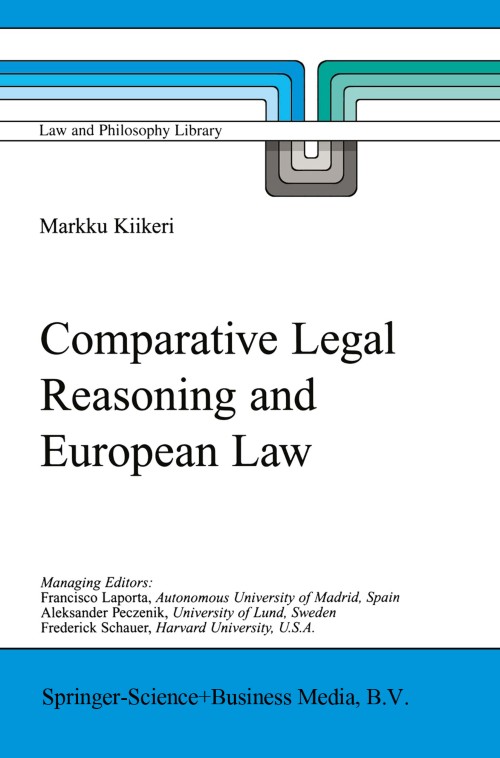
245 10|aComparative Legal Reasoning and European Law|h[electronic resource] /|cby Markku Kiikeri.
250 |a1st ed. 2001.
264 1|aDordrecht :|bSpringer Netherlands :|bImprint: Springer,|c2001.
300 |aXIII, 337 p.|bonline resource.
336 |atext|btxt|2rdacontent
337 |acomputer|bc|2rdamedia
338 |aonline resource|bcr|2rdacarrier
347 |atext file|bPDF|2rda
490 1 |aLaw and Philosophy Library,|x2215-0315 ;|v50
505 0 |a1: Introduction -- 1.General Remarks -- 2.Comparative Law in the Context of European Law -- 3.The Relevance of the Study -- 2: Some Historical and Theoretical Observations -- 1.Preliminary Remarks: The Rhetorical Nature of the Comparative Legal Argument -- 2. Some History -- 3. To the Idea of Comparative Legal Reasoning -- 4. General Conclusions -- 3: Comparative Law in European Legal Adjudication -- 1. Introduction -- 2. Comparative Law in the European Level Case Law -- 3. “Hard Cases” and the Comparative Limits of European Law -- 4: Conclusions -- 1. Comparative European Law and European Comparative Law -- 2. Conclusions on European Law -- Epilogue -- 1. Contemporary Comparative Law -- 2. What Kind of Institutional Justification is Comparative Legal Justification? -- Literature -- Interviews.
520 |aComparative Legal Reasoning and European Law deals with the use of comparative law in European legal adjudication. It describes the different forms of the use of comparative law in legal reasoning, argumentation and justification in several national legal orders and in European level legal institutions. The book begins with an inquiry into the nature of comparative law as a legal source. After the description of the empirical study it ends to the general theory of European law and several hard cases of European law are examined. The book is intended for students and researchers in European law but it also contains aspects to be taken into account in the practical work in European legal orders and legal institutions by judges and legal practitioners.
532 8 |aAccessibility summary: This PDF is not accessible. It is based on scanned pages and does not support features such as screen reader compatibility or described non-text content (images, graphs etc). However, it likely supports searchable and selectable text based on OCR (Optical Character Recognition). Users with accessibility needs may not be able to use this content effectively. Please contact us at accessibilitysupport@springernature.com if you require assistance or an alternative format.
532 8 |aInaccessible, or known limited accessibility
532 8 |aNo reading system accessibility options actively disabled
532 8 |aPublisher contact for further accessibility information: accessibilitysupport@springernature.com
650 0|aLaw|xPhilosophy.
650 0|aEthics.
650 0|aLaw|xHistory.
650 0|aInternational law.
650 0|aPrivate international law.
650 0|aConflict of laws.
650 0|aComparative law.
650 14|aPhilosophy of Law.
650 24|aMoral Philosophy and Applied Ethics.
650 24|aTheories of Law, Philosophy of Law, Legal History.
650 24|aPublic International Law.
650 24|aPrivate International Law, International and Foreign Law, Comparative Law.
710 2 |aSpringerLink (Online service)
773 0 |tSpringer Nature eBook
776 08|iPrinted edition:|z9780792368847
776 08|iPrinted edition:|z9781402002847
776 08|iPrinted edition:|z9789401009782
830 0|aLaw and Philosophy Library,|x2215-0315 ;|v50
856 40|uhttps://doi.org/10.1007/978-94-010-0977-5
912 |aZDB-2-SHU
912 |aZDB-2-SXPR
912 |aZDB-2-BAE
950 |aHumanities, Social Sciences and Law (SpringerNature-11648)
950 |aPhilosophy and Religion (R0) (SpringerNature-43725)