LEADER 04138nam a22005775i 4500
001 813252
003 TR_AnAIT
005 20260130230720
007 cr nn 008mamaa
008 121227s1983 ne | s |||| 0|eng d
020 |a9789400966673|9978-94-009-6667-3
024 7 |a10.1007/978-94-009-6667-3|2doi
041 |aeng
049 |aTürk Tarih Kurumu Kütüphanesi
050 4|aLB3050-3060.87
072 7|aJNKD|2bicssc
072 7|aEDU030000|2bisacsh
072 7|aJNDH|2thema
082 04|a371.26|223
090 |aDK/14497
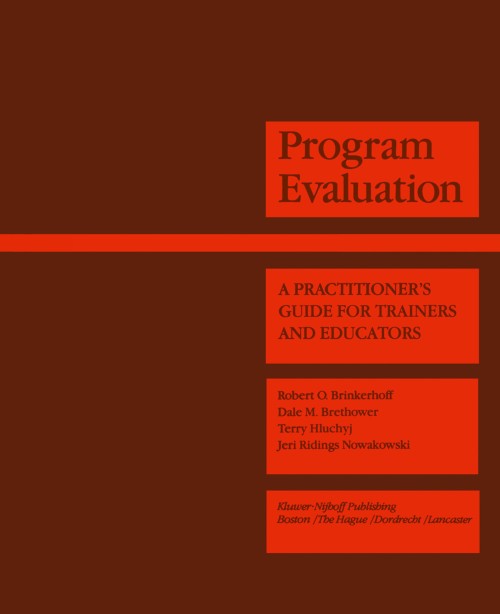
245 10|aProgram Evaluation|h[electronic resource] :|bA Practitioner’s Guide for Trainers and Educators /|cedited by Robert O. Brinkerhoff, D.M. Brethower, Jeri Nowakowski, T. Hluchyj.
250 |a1st ed. 1983.
264 1|aDordrecht :|bSpringer Netherlands :|bImprint: Springer,|c1983.
300 |a128 p.|bonline resource.
336 |atext|btxt|2rdacontent
337 |acomputer|bc|2rdamedia
338 |aonline resource|bcr|2rdacarrier
347 |atext file|bPDF|2rda
490 1 |aEvaluation in Education and Human Services ;|v3
505 0 |aGetting Started -- Products -- 1: Outline of Evaluation Questions -- 2: Outline of Evaluation Questions -- 3: Information Collection Plan -- 4: Analysis and Interpretation Plan -- 5: Report Plan -- 6: Management Plan -- 7: Plan to Evaluate the Evaluation -- Appendices -- A: Selecting What (an Object) to Evaluate -- B: An Example of an Evaluation Design -- C: Extra Worksheets.
520 |aPlease glance over the questions that follow and read the answers to those that are of interest. Q: What does this manual do? A: This manual guides the user through designing an evaluation. A: Who can use it? A: Anyone interested or involved in evaluating professional trammg or inservice education programs. The primary users will be staff members who are doing their own program evaluation-maybe for the first time. (Experienced evaluators or other professional educators can find useful guides and worksheets in it.) Q: If I work through this manual, what will I accomplish? A: You will develop one or more evaluation designs, and perhaps you'll also use the designs to evaluate something to make it better or to document its current value. Q: What is an evaluation design? A: An evaluation design is a conceptual and procedural map for getting important information about training efforts to people who can use it, as shown in the graphic below.
532 8 |aAccessibility summary: This PDF is not accessible. It is based on scanned pages and does not support features such as screen reader compatibility or described non-text content (images, graphs etc). However, it likely supports searchable and selectable text based on OCR (Optical Character Recognition). Users with accessibility needs may not be able to use this content effectively. Please contact us at accessibilitysupport@springernature.com if you require assistance or an alternative format.
532 8 |aInaccessible, or known limited accessibility
532 8 |aNo reading system accessibility options actively disabled
532 8 |aPublisher contact for further accessibility information: accessibilitysupport@springernature.com
650 0|aEducational tests and measurements.
650 0|aEducation.
650 14|aAssessment and Testing.
650 24|aEducation.
700 1 |aBrinkerhoff, Robert O.|eeditor.|4edt|4http://id.loc.gov/vocabulary/relators/edt
700 1 |aBrethower, D.M.|eeditor.|4edt|4http://id.loc.gov/vocabulary/relators/edt
700 1 |aNowakowski, Jeri.|eeditor.|4edt|4http://id.loc.gov/vocabulary/relators/edt
700 1 |aHluchyj, T.|eeditor.|4edt|4http://id.loc.gov/vocabulary/relators/edt
710 2 |aSpringerLink (Online service)
773 0 |tSpringer Nature eBook
776 08|iPrinted edition:|z9780898381221
776 08|iPrinted edition:|z9789400966680
830 0|aEvaluation in Education and Human Services ;|v3
856 40|uhttps://doi.org/10.1007/978-94-009-6667-3
912 |aZDB-2-SHU
912 |aZDB-2-SXED
912 |aZDB-2-BAE
950 |aHumanities, Social Sciences and Law (SpringerNature-11648)
950 |aEducation (R0) (SpringerNature-43721)