

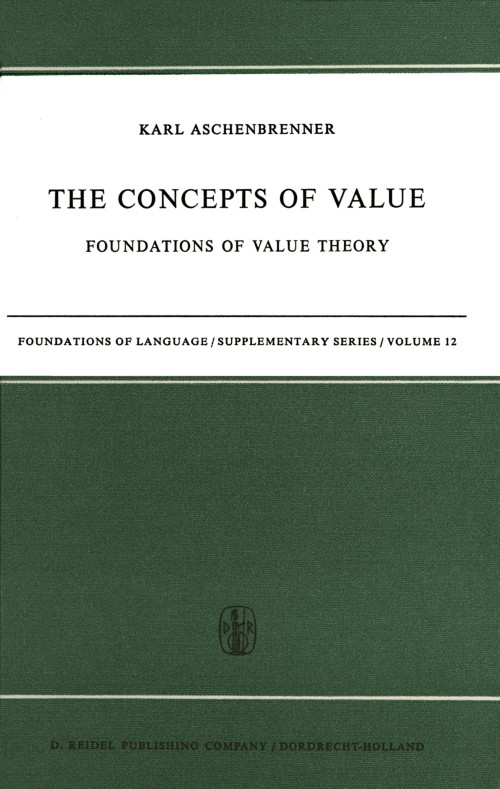
The Concepts of Value [electronic resource] : Foundations of Value Theory / by L. Aschenbrenner.
Erişim Adresi
ISBN
9789401030939
Dil Kodu
İngilizce
Yer Numarası
DK/14505
Yazar
Basım Bildirimi
1st ed. 1971.
Yayın Bilgisi
Dordrecht : Springer Netherlands : Imprint: Springer, 1971.
Fiziksel Niteleme
479 p. online resource.
Dizi
Foundations of Language Supplementary Series, 2214-0239 ; 12
İçindekiler Notu
1. The Purpose of This Study -- 2. Overview of the Inquiry -- 3. Modes of Attending -- 4. The Instruments of Appraisal -- 5. Human Appraisives and General Appraisives -- 6. Definition and the Vocabulary of Appraisal -- 7. The Source and Habitat of Appraisive Terms -- 8. The Appraisives of Natural Languages -- 9. The Objectivity of Appraisals -- 10. The Reality of Value -- 11. Definition and the Understanding of Appraisives -- 12. Appraisive Creativity -- One: Procedures of Appraisal and Judgment -- 1.0 Satisfaction -- 2.0 Response -- 3.0 Appraisal -- 4.0 Enactment -- 5.0 Moral Judgment -- Conclusion of Part One -- Two: The Characterization of Man -- (A) Explanation of Term -- (B) Characterisms -- 6.0 Intellectual Characterization -- 7.0 Behavioral Characterization -- 8.0 Diathetic Characterization -- 9.0 Tendentive Characterization -- 10.0 Sex-Related Characterization -- 11.0 Sociative Characterization -- 12.0 Economic Characterization -- 13.0 Communitive Characterization -- 14.0 Virtue and Vice -- Three: General and Ultimate Appraisal -- 15.0 Commendation -- 16.0 Absolute Valents -- Conclusion of Part Three -- Appendices -- Appendix A. Objects of the Intellect -- A1.0 Significance -- A2.0 Ponence -- A3.0 Inference -- Appendix B. Transcendentives -- B1.0 Religious Appraisives -- B2.0 Transcendental Intensives -- Appendix C. Aesthetic Appraisives -- C1.0 Aesthetic Powers -- C2.0 Aesthetic Characterization -- C3.0 General Aesthetic Appraisives -- Appendix D. Humoristic Appraisives -- Appendix E. Physical Appraisives -- E1.0 Material Appraisives -- E2.0 Environmental Adaptives -- E3.0 Gustatives -- Appendix F. General Metaphysical Appraisives -- F1.0 Metaphysical Appraisives -- F2.0 Magnitudinal Appraisives -- Appendix G. Operatives -- Appendix H. Higher Order Appraisives -- Appendix J. Negations -- Index to Concepts -- Index to Persons and Subject Matter.
Özet, vb.
The task of presenting for explicit view the store of appraisive terms our language affords has been undertaken in the conviction that it will be of interest not only to ethics and other philosophical studies but also to various areas of social science and linguistics. I have principally sought to do justice to the complexities of this vocabulary, the uses to which it is put, and the capacities its use reflects. I have given little thought to whether the inquiry was philosophical and whether it was being conducted in a philosophical manner. Foremost in my thoughts were the tasks that appeared to need doing, among them these: explicit attention was to be given to the vocabulary by means of which we say we commend,judge, appraise, or evaluate subjects and subject matters in our experience; it was to be segregated from other language at least for the purpose of study; the types of appraisive resources that are at hand in a language such as English were to be classified in some convincing and not too artificial manner; and an empirical standpoint was to be developed for a better view of appraisal, evaluation, and judging within the framework of other ways we have of responding to our surround ings such as appetition and emotion on one side and factual registering and theorizing about states of affairs on the other. Such an inquiry has never been undertaken in quite this manner before.
Konu
Ethics.
Moral Philosophy and Applied Ethics.
Moral Philosophy and Applied Ethics.
Kurum Adı
Eseri Alıntıla
Referansları kullanmadan önce gözden geçirmeniz ve varsa gerekli düzeltmeleri yapmanız önerilir.
Dijital Kaynak
MARC Görünümü
LEADER 05766nam a22005295i 4500
001 813260
003 TR_AnAIT
005 20260130230704
007 cr nn 008mamaa
008 121227s1971 ne | s |||| 0|eng d
020 |a9789401030939|9978-94-010-3093-9
024 7 |a10.1007/978-94-010-3093-9|2doi
041 |aeng
049 |aTürk Tarih Kurumu Kütüphanesi
050 4|aBJ1-1725
072 7|aHPQ|2bicssc
072 7|aPHI005000|2bisacsh
072 7|aQDTQ|2thema
082 04|a170|223
090 |aDK/14505
100 1 |aAschenbrenner, L.|eauthor.|4aut|4http://id.loc.gov/vocabulary/relators/aut
245 14|aThe Concepts of Value|h[electronic resource] :|bFoundations of Value Theory /|cby L. Aschenbrenner.
250 |a1st ed. 1971.
264 1|aDordrecht :|bSpringer Netherlands :|bImprint: Springer,|c1971.
300 |a479 p.|bonline resource.
336 |atext|btxt|2rdacontent
337 |acomputer|bc|2rdamedia
338 |aonline resource|bcr|2rdacarrier
347 |atext file|bPDF|2rda
490 1 |aFoundations of Language Supplementary Series,|x2214-0239 ;|v12
505 0 |a1. The Purpose of This Study -- 2. Overview of the Inquiry -- 3. Modes of Attending -- 4. The Instruments of Appraisal -- 5. Human Appraisives and General Appraisives -- 6. Definition and the Vocabulary of Appraisal -- 7. The Source and Habitat of Appraisive Terms -- 8. The Appraisives of Natural Languages -- 9. The Objectivity of Appraisals -- 10. The Reality of Value -- 11. Definition and the Understanding of Appraisives -- 12. Appraisive Creativity -- One: Procedures of Appraisal and Judgment -- 1.0 Satisfaction -- 2.0 Response -- 3.0 Appraisal -- 4.0 Enactment -- 5.0 Moral Judgment -- Conclusion of Part One -- Two: The Characterization of Man -- (A) Explanation of Term -- (B) Characterisms -- 6.0 Intellectual Characterization -- 7.0 Behavioral Characterization -- 8.0 Diathetic Characterization -- 9.0 Tendentive Characterization -- 10.0 Sex-Related Characterization -- 11.0 Sociative Characterization -- 12.0 Economic Characterization -- 13.0 Communitive Characterization -- 14.0 Virtue and Vice -- Three: General and Ultimate Appraisal -- 15.0 Commendation -- 16.0 Absolute Valents -- Conclusion of Part Three -- Appendices -- Appendix A. Objects of the Intellect -- A1.0 Significance -- A2.0 Ponence -- A3.0 Inference -- Appendix B. Transcendentives -- B1.0 Religious Appraisives -- B2.0 Transcendental Intensives -- Appendix C. Aesthetic Appraisives -- C1.0 Aesthetic Powers -- C2.0 Aesthetic Characterization -- C3.0 General Aesthetic Appraisives -- Appendix D. Humoristic Appraisives -- Appendix E. Physical Appraisives -- E1.0 Material Appraisives -- E2.0 Environmental Adaptives -- E3.0 Gustatives -- Appendix F. General Metaphysical Appraisives -- F1.0 Metaphysical Appraisives -- F2.0 Magnitudinal Appraisives -- Appendix G. Operatives -- Appendix H. Higher Order Appraisives -- Appendix J. Negations -- Index to Concepts -- Index to Persons and Subject Matter.
520 |aThe task of presenting for explicit view the store of appraisive terms our language affords has been undertaken in the conviction that it will be of interest not only to ethics and other philosophical studies but also to various areas of social science and linguistics. I have principally sought to do justice to the complexities of this vocabulary, the uses to which it is put, and the capacities its use reflects. I have given little thought to whether the inquiry was philosophical and whether it was being conducted in a philosophical manner. Foremost in my thoughts were the tasks that appeared to need doing, among them these: explicit attention was to be given to the vocabulary by means of which we say we commend,judge, appraise, or evaluate subjects and subject matters in our experience; it was to be segregated from other language at least for the purpose of study; the types of appraisive resources that are at hand in a language such as English were to be classified in some convincing and not too artificial manner; and an empirical standpoint was to be developed for a better view of appraisal, evaluation, and judging within the framework of other ways we have of responding to our surround ings such as appetition and emotion on one side and factual registering and theorizing about states of affairs on the other. Such an inquiry has never been undertaken in quite this manner before.
532 8 |aAccessibility summary: This PDF is not accessible. It is based on scanned pages and does not support features such as screen reader compatibility or described non-text content (images, graphs etc). However, it likely supports searchable and selectable text based on OCR (Optical Character Recognition). Users with accessibility needs may not be able to use this content effectively. Please contact us at accessibilitysupport@springernature.com if you require assistance or an alternative format.
532 8 |aInaccessible, or known limited accessibility
532 8 |aNo reading system accessibility options actively disabled
532 8 |aPublisher contact for further accessibility information: accessibilitysupport@springernature.com
650 0|aEthics.
650 14|aMoral Philosophy and Applied Ethics.
710 2 |aSpringerLink (Online service)
773 0 |tSpringer Nature eBook
776 08|iPrinted edition:|z9789027701855
776 08|iPrinted edition:|z9789401030946
776 08|iPrinted edition:|z9789401030953
830 0|aFoundations of Language Supplementary Series,|x2214-0239 ;|v12
856 40|uhttps://doi.org/10.1007/978-94-010-3093-9
912 |aZDB-2-SHU
912 |aZDB-2-SXPR
912 |aZDB-2-BAE
950 |aHumanities, Social Sciences and Law (SpringerNature-11648)
950 |aPhilosophy and Religion (R0) (SpringerNature-43725)
001 813260
003 TR_AnAIT
005 20260130230704
007 cr nn 008mamaa
008 121227s1971 ne | s |||| 0|eng d
020 |a9789401030939|9978-94-010-3093-9
024 7 |a10.1007/978-94-010-3093-9|2doi
041 |aeng
049 |aTürk Tarih Kurumu Kütüphanesi
050 4|aBJ1-1725
072 7|aHPQ|2bicssc
072 7|aPHI005000|2bisacsh
072 7|aQDTQ|2thema
082 04|a170|223
090 |aDK/14505
100 1 |aAschenbrenner, L.|eauthor.|4aut|4http://id.loc.gov/vocabulary/relators/aut
245 14|aThe Concepts of Value|h[electronic resource] :|bFoundations of Value Theory /|cby L. Aschenbrenner.
250 |a1st ed. 1971.
264 1|aDordrecht :|bSpringer Netherlands :|bImprint: Springer,|c1971.
300 |a479 p.|bonline resource.
336 |atext|btxt|2rdacontent
337 |acomputer|bc|2rdamedia
338 |aonline resource|bcr|2rdacarrier
347 |atext file|bPDF|2rda
490 1 |aFoundations of Language Supplementary Series,|x2214-0239 ;|v12
505 0 |a1. The Purpose of This Study -- 2. Overview of the Inquiry -- 3. Modes of Attending -- 4. The Instruments of Appraisal -- 5. Human Appraisives and General Appraisives -- 6. Definition and the Vocabulary of Appraisal -- 7. The Source and Habitat of Appraisive Terms -- 8. The Appraisives of Natural Languages -- 9. The Objectivity of Appraisals -- 10. The Reality of Value -- 11. Definition and the Understanding of Appraisives -- 12. Appraisive Creativity -- One: Procedures of Appraisal and Judgment -- 1.0 Satisfaction -- 2.0 Response -- 3.0 Appraisal -- 4.0 Enactment -- 5.0 Moral Judgment -- Conclusion of Part One -- Two: The Characterization of Man -- (A) Explanation of Term -- (B) Characterisms -- 6.0 Intellectual Characterization -- 7.0 Behavioral Characterization -- 8.0 Diathetic Characterization -- 9.0 Tendentive Characterization -- 10.0 Sex-Related Characterization -- 11.0 Sociative Characterization -- 12.0 Economic Characterization -- 13.0 Communitive Characterization -- 14.0 Virtue and Vice -- Three: General and Ultimate Appraisal -- 15.0 Commendation -- 16.0 Absolute Valents -- Conclusion of Part Three -- Appendices -- Appendix A. Objects of the Intellect -- A1.0 Significance -- A2.0 Ponence -- A3.0 Inference -- Appendix B. Transcendentives -- B1.0 Religious Appraisives -- B2.0 Transcendental Intensives -- Appendix C. Aesthetic Appraisives -- C1.0 Aesthetic Powers -- C2.0 Aesthetic Characterization -- C3.0 General Aesthetic Appraisives -- Appendix D. Humoristic Appraisives -- Appendix E. Physical Appraisives -- E1.0 Material Appraisives -- E2.0 Environmental Adaptives -- E3.0 Gustatives -- Appendix F. General Metaphysical Appraisives -- F1.0 Metaphysical Appraisives -- F2.0 Magnitudinal Appraisives -- Appendix G. Operatives -- Appendix H. Higher Order Appraisives -- Appendix J. Negations -- Index to Concepts -- Index to Persons and Subject Matter.
520 |aThe task of presenting for explicit view the store of appraisive terms our language affords has been undertaken in the conviction that it will be of interest not only to ethics and other philosophical studies but also to various areas of social science and linguistics. I have principally sought to do justice to the complexities of this vocabulary, the uses to which it is put, and the capacities its use reflects. I have given little thought to whether the inquiry was philosophical and whether it was being conducted in a philosophical manner. Foremost in my thoughts were the tasks that appeared to need doing, among them these: explicit attention was to be given to the vocabulary by means of which we say we commend,judge, appraise, or evaluate subjects and subject matters in our experience; it was to be segregated from other language at least for the purpose of study; the types of appraisive resources that are at hand in a language such as English were to be classified in some convincing and not too artificial manner; and an empirical standpoint was to be developed for a better view of appraisal, evaluation, and judging within the framework of other ways we have of responding to our surround ings such as appetition and emotion on one side and factual registering and theorizing about states of affairs on the other. Such an inquiry has never been undertaken in quite this manner before.
532 8 |aAccessibility summary: This PDF is not accessible. It is based on scanned pages and does not support features such as screen reader compatibility or described non-text content (images, graphs etc). However, it likely supports searchable and selectable text based on OCR (Optical Character Recognition). Users with accessibility needs may not be able to use this content effectively. Please contact us at accessibilitysupport@springernature.com if you require assistance or an alternative format.
532 8 |aInaccessible, or known limited accessibility
532 8 |aNo reading system accessibility options actively disabled
532 8 |aPublisher contact for further accessibility information: accessibilitysupport@springernature.com
650 0|aEthics.
650 14|aMoral Philosophy and Applied Ethics.
710 2 |aSpringerLink (Online service)
773 0 |tSpringer Nature eBook
776 08|iPrinted edition:|z9789027701855
776 08|iPrinted edition:|z9789401030946
776 08|iPrinted edition:|z9789401030953
830 0|aFoundations of Language Supplementary Series,|x2214-0239 ;|v12
856 40|uhttps://doi.org/10.1007/978-94-010-3093-9
912 |aZDB-2-SHU
912 |aZDB-2-SXPR
912 |aZDB-2-BAE
950 |aHumanities, Social Sciences and Law (SpringerNature-11648)
950 |aPhilosophy and Religion (R0) (SpringerNature-43725)
Materyaller
Depodan talep edilen materyal sadece kütüphane içerisinde kullanılmaktadır.
Materyal dışarıya ödünç verilmemektedir.
Materyal dışarıya ödünç verilmemektedir.
