

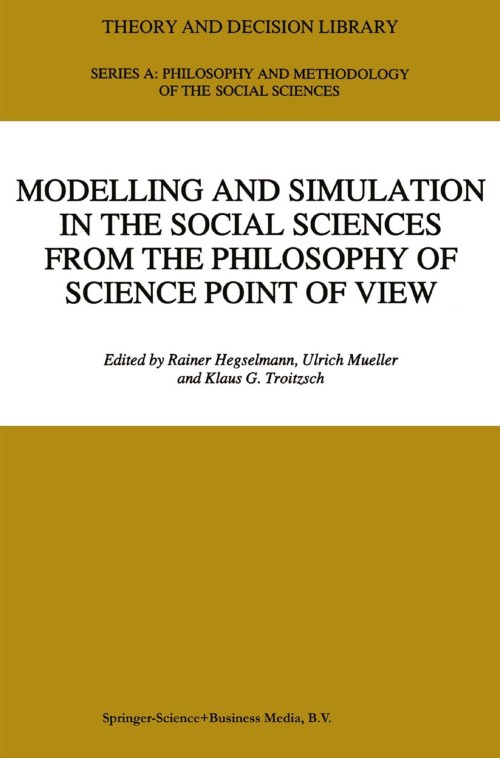
Modelling and Simulation in the Social Sciences from the Philosophy of Science Point of View [electronic resource] / edited by R. Hegselmann, Ulrich Mueller, Klaus G. Troitzsch.
Erişim Adresi
ISBN
9789401586863
Dil Kodu
İngilizce
Yer Numarası
DK/14511
Basım Bildirimi
1st ed. 1996.
Yayın Bilgisi
Dordrecht : Springer Netherlands : Imprint: Springer, 1996.
Fiziksel Niteleme
VIII, 320 p. online resource.
Dizi
Theory and Decision Library A:, Rational Choice in Practical Philosophy and Philosophy of Science, 2352-2119 ; 23
İçindekiler Notu
1 Holism, Individualism and Emergent Properties. An Approach from the Perspective of Simulation -- 2 Simulation and rational practice -- 3 Epistemic Cultures in the Social Sciences. The Modelling Dilemma Dissolved -- 4 Impossible Models -- 5 The World as a Process. Simulations in the Natural and Social Sciences -- 6 Evolutionary Explanations from a Philosophy of Science Point of View -- 7 Some Thoughts on the Methodological Status of the Darmstadt Micro Macro Simulator (DMMS) -- 8 On the Measurement of Action -- 9 Structuralist Models, Idealization, and Approximation -- 10 A Concept of Explanation for Social Interaction Models -- 11 Simulation and Structuralism -- 12 Cellular Automata in the Social Sciences. Perspectives, Restrictions, and Artefacts -- 13 Computer simulations of sustainable cooperation in social dilemmas -- 14 Modeling social change with cellular automata -- 15 Dynamic Social Impact. Robust Predictions from Simple Theory.
Özet, vb.
Model building in the social sciences can increasingly rely on well elaborated formal theories. At the same time inexpensive large computational capacities are now available. Both make computer-based model building and simulation possible in social science, whose central aim is in particular an understanding of social dynamics. Such social dynamics refer to public opinion formation, partner choice, strategy decisions in social dilemma situations and much more. In the context of such modelling approaches, novel problems in philosophy of science arise which must be analysed - the main aim of this book. Interest in social simulation has recently been growing rapidly world- wide, mainly as a result of the increasing availability of powerful personal computers. The field has also been greatly influenced by developments in cellular automata theory (from mathematics) and in distributed artificial intelligence which provided tools readily applicable to social simulation. This book presents a number of modelling and simulation approaches and their relations to problems in philosophy of science. It addresses sociologists and other social scientists interested in formal modelling, mathematical sociology, and computer simulation as well as computer scientists interested in social science applications, and philosophers of social science.
Konu
Sociology __ Methodology.
System theory.
Control theory.
Science __ Philosophy.
Sociological Methods.
Systems Theory, Control.
Philosophy of Science.
System theory.
Control theory.
Science __ Philosophy.
Sociological Methods.
Systems Theory, Control.
Philosophy of Science.
Diğer Yazarlar
Kurum Adı
Eseri Alıntıla
Referansları kullanmadan önce gözden geçirmeniz ve varsa gerekli düzeltmeleri yapmanız önerilir.
Dijital Kaynak
MARC Görünümü
LEADER 05321nam a22006135i 4500
001 813266
003 TR_AnAIT
005 20260130230639
007 cr nn 008mamaa
008 130220s1996 ne | s |||| 0|eng d
020 |a9789401586863|9978-94-015-8686-3
024 7 |a10.1007/978-94-015-8686-3|2doi
041 |aeng
049 |aTürk Tarih Kurumu Kütüphanesi
050 4|aHM511-538
072 7|aJHB|2bicssc
072 7|aSOC026000|2bisacsh
072 7|aJHB|2thema
082 04|a301.01|223
090 |aDK/14511
245 10|aModelling and Simulation in the Social Sciences from the Philosophy of Science Point of View|h[electronic resource] /|cedited by R. Hegselmann, Ulrich Mueller, Klaus G. Troitzsch.
250 |a1st ed. 1996.
264 1|aDordrecht :|bSpringer Netherlands :|bImprint: Springer,|c1996.
300 |aVIII, 320 p.|bonline resource.
336 |atext|btxt|2rdacontent
337 |acomputer|bc|2rdamedia
338 |aonline resource|bcr|2rdacarrier
347 |atext file|bPDF|2rda
490 1 |aTheory and Decision Library A:, Rational Choice in Practical Philosophy and Philosophy of Science,|x2352-2119 ;|v23
505 0 |a1 Holism, Individualism and Emergent Properties. An Approach from the Perspective of Simulation -- 2 Simulation and rational practice -- 3 Epistemic Cultures in the Social Sciences. The Modelling Dilemma Dissolved -- 4 Impossible Models -- 5 The World as a Process. Simulations in the Natural and Social Sciences -- 6 Evolutionary Explanations from a Philosophy of Science Point of View -- 7 Some Thoughts on the Methodological Status of the Darmstadt Micro Macro Simulator (DMMS) -- 8 On the Measurement of Action -- 9 Structuralist Models, Idealization, and Approximation -- 10 A Concept of Explanation for Social Interaction Models -- 11 Simulation and Structuralism -- 12 Cellular Automata in the Social Sciences. Perspectives, Restrictions, and Artefacts -- 13 Computer simulations of sustainable cooperation in social dilemmas -- 14 Modeling social change with cellular automata -- 15 Dynamic Social Impact. Robust Predictions from Simple Theory.
520 |aModel building in the social sciences can increasingly rely on well elaborated formal theories. At the same time inexpensive large computational capacities are now available. Both make computer-based model building and simulation possible in social science, whose central aim is in particular an understanding of social dynamics. Such social dynamics refer to public opinion formation, partner choice, strategy decisions in social dilemma situations and much more. In the context of such modelling approaches, novel problems in philosophy of science arise which must be analysed - the main aim of this book. Interest in social simulation has recently been growing rapidly world- wide, mainly as a result of the increasing availability of powerful personal computers. The field has also been greatly influenced by developments in cellular automata theory (from mathematics) and in distributed artificial intelligence which provided tools readily applicable to social simulation. This book presents a number of modelling and simulation approaches and their relations to problems in philosophy of science. It addresses sociologists and other social scientists interested in formal modelling, mathematical sociology, and computer simulation as well as computer scientists interested in social science applications, and philosophers of social science.
532 8 |aAccessibility summary: This PDF is not accessible. It is based on scanned pages and does not support features such as screen reader compatibility or described non-text content (images, graphs etc). However, it likely supports searchable and selectable text based on OCR (Optical Character Recognition). Users with accessibility needs may not be able to use this content effectively. Please contact us at accessibilitysupport@springernature.com if you require assistance or an alternative format.
532 8 |aInaccessible, or known limited accessibility
532 8 |aNo reading system accessibility options actively disabled
532 8 |aPublisher contact for further accessibility information: accessibilitysupport@springernature.com
650 0|aSociology|xMethodology.
650 0|aSystem theory.
650 0|aControl theory.
650 0|aScience|xPhilosophy.
650 14|aSociological Methods.
650 24|aSystems Theory, Control.
650 24|aPhilosophy of Science.
700 1 |aHegselmann, R.|eeditor.|4edt|4http://id.loc.gov/vocabulary/relators/edt
700 1 |aMueller, Ulrich.|eeditor.|4edt|4http://id.loc.gov/vocabulary/relators/edt
700 1 |aTroitzsch, Klaus G.|eeditor.|4edt|4http://id.loc.gov/vocabulary/relators/edt
710 2 |aSpringerLink (Online service)
773 0 |tSpringer Nature eBook
776 08|iPrinted edition:|z9780792341253
776 08|iPrinted edition:|z9789048147229
776 08|iPrinted edition:|z9789401586870
830 0|aTheory and Decision Library A:, Rational Choice in Practical Philosophy and Philosophy of Science,|x2352-2119 ;|v23
856 40|uhttps://doi.org/10.1007/978-94-015-8686-3
912 |aZDB-2-SHU
912 |aZDB-2-SXS
912 |aZDB-2-BAE
950 |aHumanities, Social Sciences and Law (SpringerNature-11648)
950 |aSocial Sciences (R0) (SpringerNature-43726)
001 813266
003 TR_AnAIT
005 20260130230639
007 cr nn 008mamaa
008 130220s1996 ne | s |||| 0|eng d
020 |a9789401586863|9978-94-015-8686-3
024 7 |a10.1007/978-94-015-8686-3|2doi
041 |aeng
049 |aTürk Tarih Kurumu Kütüphanesi
050 4|aHM511-538
072 7|aJHB|2bicssc
072 7|aSOC026000|2bisacsh
072 7|aJHB|2thema
082 04|a301.01|223
090 |aDK/14511
245 10|aModelling and Simulation in the Social Sciences from the Philosophy of Science Point of View|h[electronic resource] /|cedited by R. Hegselmann, Ulrich Mueller, Klaus G. Troitzsch.
250 |a1st ed. 1996.
264 1|aDordrecht :|bSpringer Netherlands :|bImprint: Springer,|c1996.
300 |aVIII, 320 p.|bonline resource.
336 |atext|btxt|2rdacontent
337 |acomputer|bc|2rdamedia
338 |aonline resource|bcr|2rdacarrier
347 |atext file|bPDF|2rda
490 1 |aTheory and Decision Library A:, Rational Choice in Practical Philosophy and Philosophy of Science,|x2352-2119 ;|v23
505 0 |a1 Holism, Individualism and Emergent Properties. An Approach from the Perspective of Simulation -- 2 Simulation and rational practice -- 3 Epistemic Cultures in the Social Sciences. The Modelling Dilemma Dissolved -- 4 Impossible Models -- 5 The World as a Process. Simulations in the Natural and Social Sciences -- 6 Evolutionary Explanations from a Philosophy of Science Point of View -- 7 Some Thoughts on the Methodological Status of the Darmstadt Micro Macro Simulator (DMMS) -- 8 On the Measurement of Action -- 9 Structuralist Models, Idealization, and Approximation -- 10 A Concept of Explanation for Social Interaction Models -- 11 Simulation and Structuralism -- 12 Cellular Automata in the Social Sciences. Perspectives, Restrictions, and Artefacts -- 13 Computer simulations of sustainable cooperation in social dilemmas -- 14 Modeling social change with cellular automata -- 15 Dynamic Social Impact. Robust Predictions from Simple Theory.
520 |aModel building in the social sciences can increasingly rely on well elaborated formal theories. At the same time inexpensive large computational capacities are now available. Both make computer-based model building and simulation possible in social science, whose central aim is in particular an understanding of social dynamics. Such social dynamics refer to public opinion formation, partner choice, strategy decisions in social dilemma situations and much more. In the context of such modelling approaches, novel problems in philosophy of science arise which must be analysed - the main aim of this book. Interest in social simulation has recently been growing rapidly world- wide, mainly as a result of the increasing availability of powerful personal computers. The field has also been greatly influenced by developments in cellular automata theory (from mathematics) and in distributed artificial intelligence which provided tools readily applicable to social simulation. This book presents a number of modelling and simulation approaches and their relations to problems in philosophy of science. It addresses sociologists and other social scientists interested in formal modelling, mathematical sociology, and computer simulation as well as computer scientists interested in social science applications, and philosophers of social science.
532 8 |aAccessibility summary: This PDF is not accessible. It is based on scanned pages and does not support features such as screen reader compatibility or described non-text content (images, graphs etc). However, it likely supports searchable and selectable text based on OCR (Optical Character Recognition). Users with accessibility needs may not be able to use this content effectively. Please contact us at accessibilitysupport@springernature.com if you require assistance or an alternative format.
532 8 |aInaccessible, or known limited accessibility
532 8 |aNo reading system accessibility options actively disabled
532 8 |aPublisher contact for further accessibility information: accessibilitysupport@springernature.com
650 0|aSociology|xMethodology.
650 0|aSystem theory.
650 0|aControl theory.
650 0|aScience|xPhilosophy.
650 14|aSociological Methods.
650 24|aSystems Theory, Control.
650 24|aPhilosophy of Science.
700 1 |aHegselmann, R.|eeditor.|4edt|4http://id.loc.gov/vocabulary/relators/edt
700 1 |aMueller, Ulrich.|eeditor.|4edt|4http://id.loc.gov/vocabulary/relators/edt
700 1 |aTroitzsch, Klaus G.|eeditor.|4edt|4http://id.loc.gov/vocabulary/relators/edt
710 2 |aSpringerLink (Online service)
773 0 |tSpringer Nature eBook
776 08|iPrinted edition:|z9780792341253
776 08|iPrinted edition:|z9789048147229
776 08|iPrinted edition:|z9789401586870
830 0|aTheory and Decision Library A:, Rational Choice in Practical Philosophy and Philosophy of Science,|x2352-2119 ;|v23
856 40|uhttps://doi.org/10.1007/978-94-015-8686-3
912 |aZDB-2-SHU
912 |aZDB-2-SXS
912 |aZDB-2-BAE
950 |aHumanities, Social Sciences and Law (SpringerNature-11648)
950 |aSocial Sciences (R0) (SpringerNature-43726)
Materyaller
Depodan talep edilen materyal sadece kütüphane içerisinde kullanılmaktadır.
Materyal dışarıya ödünç verilmemektedir.
Materyal dışarıya ödünç verilmemektedir.
