

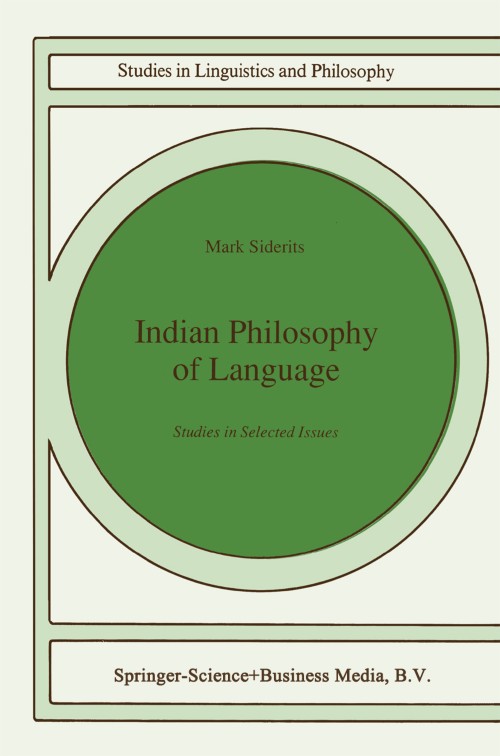
Indian Philosophy of Language [electronic resource] : Studies in Selected Issues / by Mark Siderits.
Erişim Adresi
ISBN
9789401132343
Dil Kodu
İngilizce
Yer Numarası
DK/14532
Yazar
Basım Bildirimi
1st ed. 1991.
Yayın Bilgisi
Dordrecht : Springer Netherlands : Imprint: Springer, 1991.
Fiziksel Niteleme
VIII, 199 p. online resource.
Dizi
Studies in Linguistics and Philosophy, 2215-034X ; 46
İçindekiler Notu
2: The Problem of Sentential Unity -- 2.1 The Asymmetry Thesis -- 2.2 The Related Designation Theory -- 2.3 The Two Views Compared -- 3: The Sense-Reference Distinction -- 3.1 The Sense-Reference Distinction -- 3.2 The Sense-Reference Distinction In Pr?bh?kara -- 3.3 The Sense-Reference Distinction In Buddhist Philosophy Of Language -- 3.4 Related Designation And apoha Semantics -- 4: Talk About the Non-Existent -- 4.1 Are Absences Perceived Or Inferred? -- 4.2 Conceptual Constructions -- 4.3 Affirmation, Denial, And Reference -- 4.4 Talking About The Non-Existent -- 4.5 Objections And Replies -- 4.6 The Alternatives -- References.
Özet, vb.
What can the philosophy of language learn from the classical Indian philosophical tradition? As recently as twenty or thirty years ago this question simply would not have arisen. If a practitioner of analytic philosophy of language of that time had any view of Indian philosophy at all, it was most likely to be the stereotyped picture of a gaggle of navel gazing mystics making vaguely Bradley-esque pronouncements on the oneness of the one that was one once. Much work has been done in the intervening years to overthrow that stereotype. Thanks to the efforts of such scholars as J. N. Mohanty, B. K. Matilal, and Karl Potter, philoso phers working in the analytic tradition have begun to discover something of the range and the rigor of classical Indian work in epistemolgy and metaphysics. Thus for instance, at least some recent discussions of personal identity reflect an awareness that the Indian Buddhist tradition might prove an important source of insights into the ramifications of a reductionist approach to personal identity. In philosophy of language, though, things have not improved all that much. While the old stereotype may no longer prevail among its practitioners, I suspect that they would not view classical Indian philoso phy as an important source of insights into issues in their field. Nor are they to be faulted for this.
Konu
Language and languages __ Philosophy.
Philosophy, Modern.
Semiotics.
Philosophy of Language.
Philosophical Traditions.
Semiotics.
Philosophy, Modern.
Semiotics.
Philosophy of Language.
Philosophical Traditions.
Semiotics.
Kurum Adı
Eseri Alıntıla
Referansları kullanmadan önce gözden geçirmeniz ve varsa gerekli düzeltmeleri yapmanız önerilir.
Dijital Kaynak
MARC Görünümü
LEADER 04613nam a22005775i 4500
001 813287
003 TR_AnAIT
005 20260130230542
007 cr nn 008mamaa
008 121227s1991 ne | s |||| 0|eng d
020 |a9789401132343|9978-94-011-3234-3
024 7 |a10.1007/978-94-011-3234-3|2doi
041 |aeng
049 |aTürk Tarih Kurumu Kütüphanesi
050 4|aP101-120
072 7|aCFA|2bicssc
072 7|aPHI038000|2bisacsh
072 7|aCFA|2thema
082 04|a149.94|223
090 |aDK/14532
100 1 |aSiderits, Mark.|eauthor.|4aut|4http://id.loc.gov/vocabulary/relators/aut
245 10|aIndian Philosophy of Language|h[electronic resource] :|bStudies in Selected Issues /|cby Mark Siderits.
250 |a1st ed. 1991.
264 1|aDordrecht :|bSpringer Netherlands :|bImprint: Springer,|c1991.
300 |aVIII, 199 p.|bonline resource.
336 |atext|btxt|2rdacontent
337 |acomputer|bc|2rdamedia
338 |aonline resource|bcr|2rdacarrier
347 |atext file|bPDF|2rda
490 1 |aStudies in Linguistics and Philosophy,|x2215-034X ;|v46
505 0 |a2: The Problem of Sentential Unity -- 2.1 The Asymmetry Thesis -- 2.2 The Related Designation Theory -- 2.3 The Two Views Compared -- 3: The Sense-Reference Distinction -- 3.1 The Sense-Reference Distinction -- 3.2 The Sense-Reference Distinction In Pr?bh?kara -- 3.3 The Sense-Reference Distinction In Buddhist Philosophy Of Language -- 3.4 Related Designation And apoha Semantics -- 4: Talk About the Non-Existent -- 4.1 Are Absences Perceived Or Inferred? -- 4.2 Conceptual Constructions -- 4.3 Affirmation, Denial, And Reference -- 4.4 Talking About The Non-Existent -- 4.5 Objections And Replies -- 4.6 The Alternatives -- References.
520 |aWhat can the philosophy of language learn from the classical Indian philosophical tradition? As recently as twenty or thirty years ago this question simply would not have arisen. If a practitioner of analytic philosophy of language of that time had any view of Indian philosophy at all, it was most likely to be the stereotyped picture of a gaggle of navel gazing mystics making vaguely Bradley-esque pronouncements on the oneness of the one that was one once. Much work has been done in the intervening years to overthrow that stereotype. Thanks to the efforts of such scholars as J. N. Mohanty, B. K. Matilal, and Karl Potter, philoso phers working in the analytic tradition have begun to discover something of the range and the rigor of classical Indian work in epistemolgy and metaphysics. Thus for instance, at least some recent discussions of personal identity reflect an awareness that the Indian Buddhist tradition might prove an important source of insights into the ramifications of a reductionist approach to personal identity. In philosophy of language, though, things have not improved all that much. While the old stereotype may no longer prevail among its practitioners, I suspect that they would not view classical Indian philoso phy as an important source of insights into issues in their field. Nor are they to be faulted for this.
532 8 |aAccessibility summary: This PDF is not accessible. It is based on scanned pages and does not support features such as screen reader compatibility or described non-text content (images, graphs etc). However, it likely supports searchable and selectable text based on OCR (Optical Character Recognition). Users with accessibility needs may not be able to use this content effectively. Please contact us at accessibilitysupport@springernature.com if you require assistance or an alternative format.
532 8 |aInaccessible, or known limited accessibility
532 8 |aNo reading system accessibility options actively disabled
532 8 |aPublisher contact for further accessibility information: accessibilitysupport@springernature.com
650 0|aLanguage and languages|xPhilosophy.
650 0|aPhilosophy, Modern.
650 0|aSemiotics.
650 14|aPhilosophy of Language.
650 24|aPhilosophical Traditions.
650 24|aSemiotics.
710 2 |aSpringerLink (Online service)
773 0 |tSpringer Nature eBook
776 08|iPrinted edition:|z9780792312628
776 08|iPrinted edition:|z9789401132350
776 08|iPrinted edition:|z9789401054256
830 0|aStudies in Linguistics and Philosophy,|x2215-034X ;|v46
856 40|uhttps://doi.org/10.1007/978-94-011-3234-3
912 |aZDB-2-SHU
912 |aZDB-2-SXPR
912 |aZDB-2-BAE
950 |aHumanities, Social Sciences and Law (SpringerNature-11648)
950 |aPhilosophy and Religion (R0) (SpringerNature-43725)
001 813287
003 TR_AnAIT
005 20260130230542
007 cr nn 008mamaa
008 121227s1991 ne | s |||| 0|eng d
020 |a9789401132343|9978-94-011-3234-3
024 7 |a10.1007/978-94-011-3234-3|2doi
041 |aeng
049 |aTürk Tarih Kurumu Kütüphanesi
050 4|aP101-120
072 7|aCFA|2bicssc
072 7|aPHI038000|2bisacsh
072 7|aCFA|2thema
082 04|a149.94|223
090 |aDK/14532
100 1 |aSiderits, Mark.|eauthor.|4aut|4http://id.loc.gov/vocabulary/relators/aut
245 10|aIndian Philosophy of Language|h[electronic resource] :|bStudies in Selected Issues /|cby Mark Siderits.
250 |a1st ed. 1991.
264 1|aDordrecht :|bSpringer Netherlands :|bImprint: Springer,|c1991.
300 |aVIII, 199 p.|bonline resource.
336 |atext|btxt|2rdacontent
337 |acomputer|bc|2rdamedia
338 |aonline resource|bcr|2rdacarrier
347 |atext file|bPDF|2rda
490 1 |aStudies in Linguistics and Philosophy,|x2215-034X ;|v46
505 0 |a2: The Problem of Sentential Unity -- 2.1 The Asymmetry Thesis -- 2.2 The Related Designation Theory -- 2.3 The Two Views Compared -- 3: The Sense-Reference Distinction -- 3.1 The Sense-Reference Distinction -- 3.2 The Sense-Reference Distinction In Pr?bh?kara -- 3.3 The Sense-Reference Distinction In Buddhist Philosophy Of Language -- 3.4 Related Designation And apoha Semantics -- 4: Talk About the Non-Existent -- 4.1 Are Absences Perceived Or Inferred? -- 4.2 Conceptual Constructions -- 4.3 Affirmation, Denial, And Reference -- 4.4 Talking About The Non-Existent -- 4.5 Objections And Replies -- 4.6 The Alternatives -- References.
520 |aWhat can the philosophy of language learn from the classical Indian philosophical tradition? As recently as twenty or thirty years ago this question simply would not have arisen. If a practitioner of analytic philosophy of language of that time had any view of Indian philosophy at all, it was most likely to be the stereotyped picture of a gaggle of navel gazing mystics making vaguely Bradley-esque pronouncements on the oneness of the one that was one once. Much work has been done in the intervening years to overthrow that stereotype. Thanks to the efforts of such scholars as J. N. Mohanty, B. K. Matilal, and Karl Potter, philoso phers working in the analytic tradition have begun to discover something of the range and the rigor of classical Indian work in epistemolgy and metaphysics. Thus for instance, at least some recent discussions of personal identity reflect an awareness that the Indian Buddhist tradition might prove an important source of insights into the ramifications of a reductionist approach to personal identity. In philosophy of language, though, things have not improved all that much. While the old stereotype may no longer prevail among its practitioners, I suspect that they would not view classical Indian philoso phy as an important source of insights into issues in their field. Nor are they to be faulted for this.
532 8 |aAccessibility summary: This PDF is not accessible. It is based on scanned pages and does not support features such as screen reader compatibility or described non-text content (images, graphs etc). However, it likely supports searchable and selectable text based on OCR (Optical Character Recognition). Users with accessibility needs may not be able to use this content effectively. Please contact us at accessibilitysupport@springernature.com if you require assistance or an alternative format.
532 8 |aInaccessible, or known limited accessibility
532 8 |aNo reading system accessibility options actively disabled
532 8 |aPublisher contact for further accessibility information: accessibilitysupport@springernature.com
650 0|aLanguage and languages|xPhilosophy.
650 0|aPhilosophy, Modern.
650 0|aSemiotics.
650 14|aPhilosophy of Language.
650 24|aPhilosophical Traditions.
650 24|aSemiotics.
710 2 |aSpringerLink (Online service)
773 0 |tSpringer Nature eBook
776 08|iPrinted edition:|z9780792312628
776 08|iPrinted edition:|z9789401132350
776 08|iPrinted edition:|z9789401054256
830 0|aStudies in Linguistics and Philosophy,|x2215-034X ;|v46
856 40|uhttps://doi.org/10.1007/978-94-011-3234-3
912 |aZDB-2-SHU
912 |aZDB-2-SXPR
912 |aZDB-2-BAE
950 |aHumanities, Social Sciences and Law (SpringerNature-11648)
950 |aPhilosophy and Religion (R0) (SpringerNature-43725)
Materyaller
Depodan talep edilen materyal sadece kütüphane içerisinde kullanılmaktadır.
Materyal dışarıya ödünç verilmemektedir.
Materyal dışarıya ödünç verilmemektedir.
