LEADER 03873nam a22004935i 4500
001 813288
003 TR_AnAIT
005 20260130230541
007 cr nn 008mamaa
008 100327s2010 xxu| s |||| 0|eng d
020 |a9781441955296|9978-1-4419-5529-6
024 7 |a10.1007/978-1-4419-5529-6|2doi
041 |aeng
049 |aTürk Tarih Kurumu Kütüphanesi
050 4|aGN
072 7|aJHM|2bicssc
072 7|aSOC002000|2bisacsh
072 7|aJHM|2thema
082 04|a301|223
090 |aDK/14533
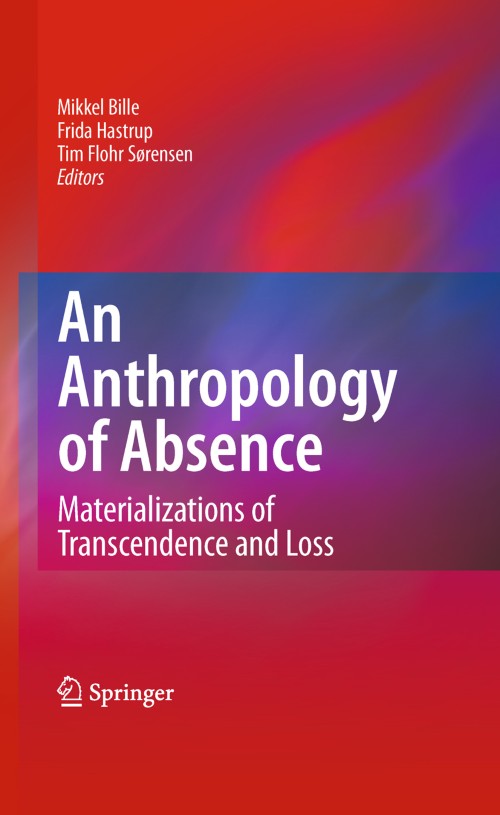
245 13|aAn Anthropology of Absence|h[electronic resource] :|bMaterializations of Transcendence and Loss /|cedited by Mikkel Bille, Frida Hastrup, Tim Flohr Soerensen.
250 |a1st ed. 2010.
264 1|aNew York, NY :|bSpringer New York :|bImprint: Springer,|c2010.
300 |aXI, 221 p.|bonline resource.
336 |atext|btxt|2rdacontent
337 |acomputer|bc|2rdamedia
338 |aonline resource|bcr|2rdacarrier
347 |atext file|bPDF|2rda
505 0 |aToward an Anthropology of Absence -- Introduction: An Anthropology of Absence -- People Without Things -- Embodying Absence -- Missing Bodies Near-at-Hand: The Dissonant Memory and Dormant Graves of the Spanish Civil War -- A Sense of Absence: The Staging of Heroic Deaths and Ongoing Lives among American Organ Donor Families -- Temporalities of Absence -- Derivative Presence: Loss and Lives in Limbo in the West Bank -- Materializations of Disaster: Recovering Lost Plots in a Tsunami-Affected Village in South India -- Materializing Remembrance -- A Saturated Void: Anticipating and Preparing Presence in Contemporary Danish Cemetery Culture -- Bringing Home the Dead: Photographs, Family Imaginaries and Moral Remains -- Ambiguous Materialities -- Absent Powers: Magic and Loss in Post-socialist Mongolia -- Seeking Providence Through Things: The Word of God Versus Black Cumin -- Presencing the Im-Material -- Commentary -- An Anthropology of Absence: Commentary.
520 |aIn studying material culture, anthropologists and archaeologists use meaningful physical objects from a culture to help understand the less tangible aspects of that culture, such as societal structure, rituals, and values. What happens when these objects are destroyed, by war, natural disaster, or other historical events? Through detailed explanations of eleven international case studies, the contributions reveal that the absence of objects can be just as telling as their presence, while the objects created to memorialize a loss also have important cultural implications. Covering everything from organ donation, to funerary rituals, to prisoners of war, The Anthropology of Absence is written at an important intersection of archaeological and anthropological study. Divided into three sections, this volume uses the "presence" of absence to compare cultural perceptions of: material qualities and created memory, the mind/body connection, temporality, and death. This rich text provides a strong theoretical framework for anthropologists and archaeologists studying material culture.
650 0|aAnthropology.
650 0|aCultural property.
650 14|aAnthropology.
650 24|aCultural Heritage.
700 1 |aBille, Mikkel.|eeditor.|4edt|4http://id.loc.gov/vocabulary/relators/edt
700 1 |aHastrup, Frida.|eeditor.|4edt|4http://id.loc.gov/vocabulary/relators/edt
700 1 |aSoerensen, Tim Flohr.|eeditor.|4edt|4http://id.loc.gov/vocabulary/relators/edt
710 2 |aSpringerLink (Online service)
773 0 |tSpringer Nature eBook
776 08|iPrinted edition:|z9781441955289
776 08|iPrinted edition:|z9781441955333
776 08|iPrinted edition:|z9781489983367
856 40|uhttps://doi.org/10.1007/978-1-4419-5529-6
912 |aZDB-2-SHU
912 |aZDB-2-SXS
950 |aHumanities, Social Sciences and Law (SpringerNature-11648)
950 |aSocial Sciences (R0) (SpringerNature-43726)