

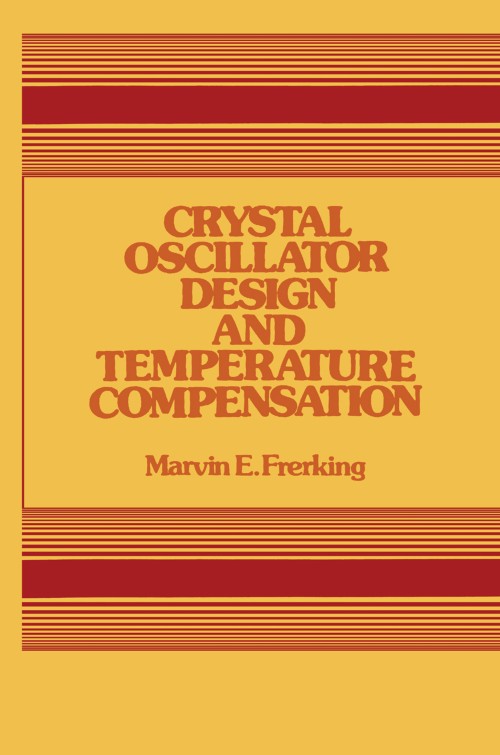
Crystal Oscillator Design and Temperature Compensation [electronic resource] / by Marvin Frerking.
Erişim Adresi
ISBN
9789401160568
Dil Kodu
İngilizce
Yer Numarası
DK/14567
Yazar
Basım Bildirimi
1st ed. 1978.
Yayın Bilgisi
Dordrecht : Springer Netherlands : Imprint: Springer, 1978.
Fiziksel Niteleme
XVI, 240 p. online resource.
İçindekiler Notu
1.Introduction -- 2.Basic Oscillator Theory -- 3.Methods of Design -- 3.1.Experimental Method of Design -- 3.2.Y-Parameter Method of Design -- 3.3.Power Gain Method of Design -- 3.4.Nonlinear Modifications -- 4.Oscillator Frequency Stability -- 4.1.Temperature Effects of Frequency -- 4.2.Long-Term Frequency Drift -- 4.3.Short-Term Frequency Stability -- 5.Quartz Crystal Resonators -- 5.1.Load Capacitance -- 5.2.Pin-To-Pin Capacitance -- 5.3.Resistance -- 5.4.Rated or Test Drive Level -- 5.5.Frequency Stability -- 5.6.Finishing or Calibration Tolerance -- 5.7.Crystal Aging -- 5.8.Q and Stiffness of Crystals -- 5.9.Mechanical Overtone Crystals -- 5.10.Spurious or Unwanted Modes -- 5.11.Vibration, Shock, and Acceleration -- 5.12.Standard Military Crystals -- 5.13.Specifications and Standards -- 6.Discussion of Transistors -- 6.1.Transistor Equivalent Circuits -- 6.2.Y-Parameter Model -- 6.3.Hybrid ? Equivalent Circuit -- 6.4.Nonlinear Models -- 7.Oscillator Circuits -- 7.1.Pierce, Colpitis, and Clapp Oscillators -- 7.2.Pierce Oscillator -- 7.3.Colpitis Oscillator -- 7.4.Clapp Oscillator -- 7.5.Grounded-Base Oscillator -- 7.6.Gate Oscillators -- 7.7.Integrated-Circuit Oscillators -- 8.Preproduction Tests for Crystal Oscillators -- 9.Other Topics -- 9.1.Crystal Switches -- 9.2.Pullable Oscillators -- 9.3.Crystal Ovens -- 9.4.Squegging, Squelching, or Motorboating -- 9.5.Spurious Oscillations -- 10. Temperature Compensation -- 10.1.Analog Temperature Compensation -- 10.2.Hybrid Analog-Digital Compensation -- 10.3.Digital Temperature Compensation -- 10.4.Temperature Compensation with Microprocessors -- Appendix A Derivation of the Complex Equation for Oscillation -- Appendix B Derivation of Y-Parameter Equations for the Pierce Oscillator -- Appendix C Derivation of Y-Parameter Equations for the Grounded-Base Oscillator.-Appendix D Derivation of Approximate Equations for the Clapp Oscillator -- Appendix E Derivation of Approximate Equations for the Pierce Oscillator Analysis -- Appendix F Derivation of Approximate Equations for the Colpitts Oscillator -- Appendix G Large-Signal Transistor Parameters -- Appendix H Large-Signal Transistor Parameters with Emitter Degeneration -- Appendix I Nonlinear Analysis of the Colpitts Oscillator Based on the Principle of Harmonic Balance -- Appendix J Mathematical Development of the Sideband Level versus Phase Deviation Equation -- Appendix K Derivation of Crystal Equations -- Appendix L Sample Crystal Specification.
Özet, vb.
Crystal oscillators have been in use now for well over SO years-one of the first was built by W. G. Cady in 1921. Today, millions of them are made every year, covering a range of frequencies from a few Kilohertz to several hundred Mega hertz and a range of stabilities from a fraction of one percent to a few parts in ten to the thirteenth, with most of them, by far, still in the range of several tens of parts per million.Their major application has long been the stabilization of fre quencies in transmitters and receivers, and indeed, the utilization of the frequency spectrum would be in utter chaos, and the communication systems as we know them today unthinkable,'without crystal oscillators. With the need to accommodate ever increasing numbers of users in a limited spectrum space, this traditional application will continue to grow for the fore seeable future, and ever tighter tolerances will have to be met by an ever larger percentage of these devices.
Konu
Social sciences.
Humanities.
Humanities and Social Sciences.
Humanities.
Humanities and Social Sciences.
Kurum Adı
Eseri Alıntıla
Referansları kullanmadan önce gözden geçirmeniz ve varsa gerekli düzeltmeleri yapmanız önerilir.
Dijital Kaynak
MARC Görünümü
LEADER 05846nam a22005415i 4500
001 813325
003 TR_AnAIT
005 20260130230329
007 cr nn 008mamaa
008 121227s1978 ne | s |||| 0|eng d
020 |a9789401160568|9978-94-011-6056-8
024 7 |a10.1007/978-94-011-6056-8|2doi
041 |aeng
049 |aTürk Tarih Kurumu Kütüphanesi
050 4|aH1-99
050 4|aAZ19.2-999
072 7|aGT|2bicssc
072 7|aNON000000|2bisacsh
072 7|aGT|2thema
082 04|a300|223
082 04|a001.3|223
090 |aDK/14567
100 1 |aFrerking, Marvin.|eauthor.|4aut|4http://id.loc.gov/vocabulary/relators/aut
245 10|aCrystal Oscillator Design and Temperature Compensation|h[electronic resource] /|cby Marvin Frerking.
250 |a1st ed. 1978.
264 1|aDordrecht :|bSpringer Netherlands :|bImprint: Springer,|c1978.
300 |aXVI, 240 p.|bonline resource.
336 |atext|btxt|2rdacontent
337 |acomputer|bc|2rdamedia
338 |aonline resource|bcr|2rdacarrier
347 |atext file|bPDF|2rda
505 0 |a1.Introduction -- 2.Basic Oscillator Theory -- 3.Methods of Design -- 3.1.Experimental Method of Design -- 3.2.Y-Parameter Method of Design -- 3.3.Power Gain Method of Design -- 3.4.Nonlinear Modifications -- 4.Oscillator Frequency Stability -- 4.1.Temperature Effects of Frequency -- 4.2.Long-Term Frequency Drift -- 4.3.Short-Term Frequency Stability -- 5.Quartz Crystal Resonators -- 5.1.Load Capacitance -- 5.2.Pin-To-Pin Capacitance -- 5.3.Resistance -- 5.4.Rated or Test Drive Level -- 5.5.Frequency Stability -- 5.6.Finishing or Calibration Tolerance -- 5.7.Crystal Aging -- 5.8.Q and Stiffness of Crystals -- 5.9.Mechanical Overtone Crystals -- 5.10.Spurious or Unwanted Modes -- 5.11.Vibration, Shock, and Acceleration -- 5.12.Standard Military Crystals -- 5.13.Specifications and Standards -- 6.Discussion of Transistors -- 6.1.Transistor Equivalent Circuits -- 6.2.Y-Parameter Model -- 6.3.Hybrid ? Equivalent Circuit -- 6.4.Nonlinear Models -- 7.Oscillator Circuits -- 7.1.Pierce, Colpitis, and Clapp Oscillators -- 7.2.Pierce Oscillator -- 7.3.Colpitis Oscillator -- 7.4.Clapp Oscillator -- 7.5.Grounded-Base Oscillator -- 7.6.Gate Oscillators -- 7.7.Integrated-Circuit Oscillators -- 8.Preproduction Tests for Crystal Oscillators -- 9.Other Topics -- 9.1.Crystal Switches -- 9.2.Pullable Oscillators -- 9.3.Crystal Ovens -- 9.4.Squegging, Squelching, or Motorboating -- 9.5.Spurious Oscillations -- 10. Temperature Compensation -- 10.1.Analog Temperature Compensation -- 10.2.Hybrid Analog-Digital Compensation -- 10.3.Digital Temperature Compensation -- 10.4.Temperature Compensation with Microprocessors -- Appendix A Derivation of the Complex Equation for Oscillation -- Appendix B Derivation of Y-Parameter Equations for the Pierce Oscillator -- Appendix C Derivation of Y-Parameter Equations for the Grounded-Base Oscillator.-Appendix D Derivation of Approximate Equations for the Clapp Oscillator -- Appendix E Derivation of Approximate Equations for the Pierce Oscillator Analysis -- Appendix F Derivation of Approximate Equations for the Colpitts Oscillator -- Appendix G Large-Signal Transistor Parameters -- Appendix H Large-Signal Transistor Parameters with Emitter Degeneration -- Appendix I Nonlinear Analysis of the Colpitts Oscillator Based on the Principle of Harmonic Balance -- Appendix J Mathematical Development of the Sideband Level versus Phase Deviation Equation -- Appendix K Derivation of Crystal Equations -- Appendix L Sample Crystal Specification.
520 |aCrystal oscillators have been in use now for well over SO years-one of the first was built by W. G. Cady in 1921. Today, millions of them are made every year, covering a range of frequencies from a few Kilohertz to several hundred Mega hertz and a range of stabilities from a fraction of one percent to a few parts in ten to the thirteenth, with most of them, by far, still in the range of several tens of parts per million.Their major application has long been the stabilization of fre quencies in transmitters and receivers, and indeed, the utilization of the frequency spectrum would be in utter chaos, and the communication systems as we know them today unthinkable,'without crystal oscillators. With the need to accommodate ever increasing numbers of users in a limited spectrum space, this traditional application will continue to grow for the fore seeable future, and ever tighter tolerances will have to be met by an ever larger percentage of these devices.
532 8 |aAccessibility summary: This PDF is not accessible. It is based on scanned pages and does not support features such as screen reader compatibility or described non-text content (images, graphs etc). However, it likely supports searchable and selectable text based on OCR (Optical Character Recognition). Users with accessibility needs may not be able to use this content effectively. Please contact us at accessibilitysupport@springernature.com if you require assistance or an alternative format.
532 8 |aInaccessible, or known limited accessibility
532 8 |aNo reading system accessibility options actively disabled
532 8 |aPublisher contact for further accessibility information: accessibilitysupport@springernature.com
650 0|aSocial sciences.
650 0|aHumanities.
650 14|aHumanities and Social Sciences.
710 2 |aSpringerLink (Online service)
773 0 |tSpringer Nature eBook
776 08|iPrinted edition:|z9780442224592
776 08|iPrinted edition:|z9789401160575
776 08|iPrinted edition:|z9789401160582
856 40|uhttps://doi.org/10.1007/978-94-011-6056-8
912 |aZDB-2-SHU
912 |aZDB-2-SXH
912 |aZDB-2-BAE
950 |aHumanities, Social Sciences and Law (SpringerNature-11648)
950 |aHistory (R0) (SpringerNature-43722)
001 813325
003 TR_AnAIT
005 20260130230329
007 cr nn 008mamaa
008 121227s1978 ne | s |||| 0|eng d
020 |a9789401160568|9978-94-011-6056-8
024 7 |a10.1007/978-94-011-6056-8|2doi
041 |aeng
049 |aTürk Tarih Kurumu Kütüphanesi
050 4|aH1-99
050 4|aAZ19.2-999
072 7|aGT|2bicssc
072 7|aNON000000|2bisacsh
072 7|aGT|2thema
082 04|a300|223
082 04|a001.3|223
090 |aDK/14567
100 1 |aFrerking, Marvin.|eauthor.|4aut|4http://id.loc.gov/vocabulary/relators/aut
245 10|aCrystal Oscillator Design and Temperature Compensation|h[electronic resource] /|cby Marvin Frerking.
250 |a1st ed. 1978.
264 1|aDordrecht :|bSpringer Netherlands :|bImprint: Springer,|c1978.
300 |aXVI, 240 p.|bonline resource.
336 |atext|btxt|2rdacontent
337 |acomputer|bc|2rdamedia
338 |aonline resource|bcr|2rdacarrier
347 |atext file|bPDF|2rda
505 0 |a1.Introduction -- 2.Basic Oscillator Theory -- 3.Methods of Design -- 3.1.Experimental Method of Design -- 3.2.Y-Parameter Method of Design -- 3.3.Power Gain Method of Design -- 3.4.Nonlinear Modifications -- 4.Oscillator Frequency Stability -- 4.1.Temperature Effects of Frequency -- 4.2.Long-Term Frequency Drift -- 4.3.Short-Term Frequency Stability -- 5.Quartz Crystal Resonators -- 5.1.Load Capacitance -- 5.2.Pin-To-Pin Capacitance -- 5.3.Resistance -- 5.4.Rated or Test Drive Level -- 5.5.Frequency Stability -- 5.6.Finishing or Calibration Tolerance -- 5.7.Crystal Aging -- 5.8.Q and Stiffness of Crystals -- 5.9.Mechanical Overtone Crystals -- 5.10.Spurious or Unwanted Modes -- 5.11.Vibration, Shock, and Acceleration -- 5.12.Standard Military Crystals -- 5.13.Specifications and Standards -- 6.Discussion of Transistors -- 6.1.Transistor Equivalent Circuits -- 6.2.Y-Parameter Model -- 6.3.Hybrid ? Equivalent Circuit -- 6.4.Nonlinear Models -- 7.Oscillator Circuits -- 7.1.Pierce, Colpitis, and Clapp Oscillators -- 7.2.Pierce Oscillator -- 7.3.Colpitis Oscillator -- 7.4.Clapp Oscillator -- 7.5.Grounded-Base Oscillator -- 7.6.Gate Oscillators -- 7.7.Integrated-Circuit Oscillators -- 8.Preproduction Tests for Crystal Oscillators -- 9.Other Topics -- 9.1.Crystal Switches -- 9.2.Pullable Oscillators -- 9.3.Crystal Ovens -- 9.4.Squegging, Squelching, or Motorboating -- 9.5.Spurious Oscillations -- 10. Temperature Compensation -- 10.1.Analog Temperature Compensation -- 10.2.Hybrid Analog-Digital Compensation -- 10.3.Digital Temperature Compensation -- 10.4.Temperature Compensation with Microprocessors -- Appendix A Derivation of the Complex Equation for Oscillation -- Appendix B Derivation of Y-Parameter Equations for the Pierce Oscillator -- Appendix C Derivation of Y-Parameter Equations for the Grounded-Base Oscillator.-Appendix D Derivation of Approximate Equations for the Clapp Oscillator -- Appendix E Derivation of Approximate Equations for the Pierce Oscillator Analysis -- Appendix F Derivation of Approximate Equations for the Colpitts Oscillator -- Appendix G Large-Signal Transistor Parameters -- Appendix H Large-Signal Transistor Parameters with Emitter Degeneration -- Appendix I Nonlinear Analysis of the Colpitts Oscillator Based on the Principle of Harmonic Balance -- Appendix J Mathematical Development of the Sideband Level versus Phase Deviation Equation -- Appendix K Derivation of Crystal Equations -- Appendix L Sample Crystal Specification.
520 |aCrystal oscillators have been in use now for well over SO years-one of the first was built by W. G. Cady in 1921. Today, millions of them are made every year, covering a range of frequencies from a few Kilohertz to several hundred Mega hertz and a range of stabilities from a fraction of one percent to a few parts in ten to the thirteenth, with most of them, by far, still in the range of several tens of parts per million.Their major application has long been the stabilization of fre quencies in transmitters and receivers, and indeed, the utilization of the frequency spectrum would be in utter chaos, and the communication systems as we know them today unthinkable,'without crystal oscillators. With the need to accommodate ever increasing numbers of users in a limited spectrum space, this traditional application will continue to grow for the fore seeable future, and ever tighter tolerances will have to be met by an ever larger percentage of these devices.
532 8 |aAccessibility summary: This PDF is not accessible. It is based on scanned pages and does not support features such as screen reader compatibility or described non-text content (images, graphs etc). However, it likely supports searchable and selectable text based on OCR (Optical Character Recognition). Users with accessibility needs may not be able to use this content effectively. Please contact us at accessibilitysupport@springernature.com if you require assistance or an alternative format.
532 8 |aInaccessible, or known limited accessibility
532 8 |aNo reading system accessibility options actively disabled
532 8 |aPublisher contact for further accessibility information: accessibilitysupport@springernature.com
650 0|aSocial sciences.
650 0|aHumanities.
650 14|aHumanities and Social Sciences.
710 2 |aSpringerLink (Online service)
773 0 |tSpringer Nature eBook
776 08|iPrinted edition:|z9780442224592
776 08|iPrinted edition:|z9789401160575
776 08|iPrinted edition:|z9789401160582
856 40|uhttps://doi.org/10.1007/978-94-011-6056-8
912 |aZDB-2-SHU
912 |aZDB-2-SXH
912 |aZDB-2-BAE
950 |aHumanities, Social Sciences and Law (SpringerNature-11648)
950 |aHistory (R0) (SpringerNature-43722)
Materyaller
Depodan talep edilen materyal sadece kütüphane içerisinde kullanılmaktadır.
Materyal dışarıya ödünç verilmemektedir.
Materyal dışarıya ödünç verilmemektedir.
