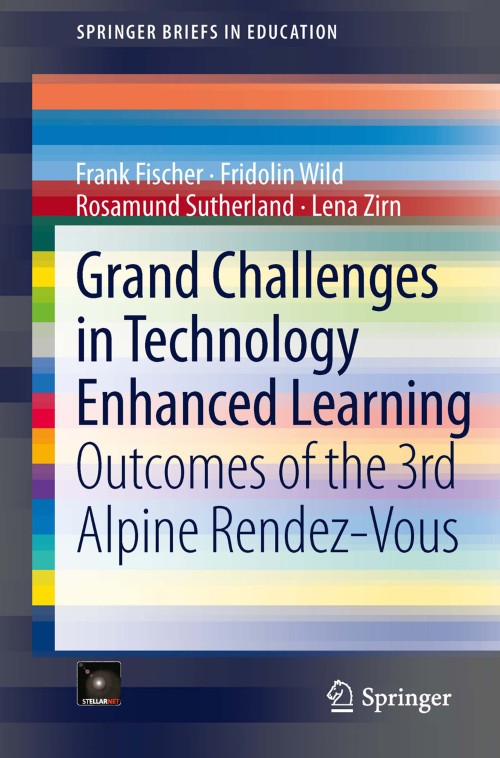
Grand Challenges in Technology Enhanced Learning [electronic resource] : Outcomes of the 3rd Alpine Rendez-Vous / by Frank Fischer, Fridolin Wild, Rosamund Sutherland, Lena Zirn.
Erişim Adresi
ISBN
9783319016672
Dil Kodu
İngilizce
Yer Numarası
DK/14573
Yazar
Basım Bildirimi
1st ed. 2014.
Yayın Bilgisi
Cham : Springer International Publishing : Imprint: Springer, 2014.
Fiziksel Niteleme
VIII, 79 p. 11 illus. online resource.
Dizi
SpringerBriefs in Education, 2211-193X
İçindekiler Notu
Grand Challenge Problems from the Alpine Rendez-Vous - an Introduction -- 1.1 The Concept of Grand Challenge Problems -- 1.2 Development of the Grand Challenge Problems at the Alpine Rendez-Vous -- 2 / Grand Challenge Problems from the Alpine Rendez-Vous .- 2.1 Grand Challenge Problems Focusing on Connecting Learners -- 2.1.1 GCP1: Open Collaboration in Formal Education -- 2.1.2 GCP2: Technology-Supported Representation-Fitness -- 2.1.3 GCP3: Rich-Media Assignments -- 2.1.4 GCP4: Supporting an Open Culture of Design for TEL -- 2.1.5 GCP5: Multi-Level Evaluations of TEL -- Guest Commentaries on Connecting Learners -- 2.1.6 Guest Commentary by Roy Peas -- 2.1.7 Guest Commentary by Michelle Selinger.- 2.2 Grand Challenge Problems Focusing on Orchestrating Learning -- 2.2.1 GCP6: Emotion-Adaptive TEL -- 2.2.2 GCP7: Assessment and Automated Feedback -- 2.2.3 GCP8: One Informed Tutor per Child -- 2.2.4 GCP9: Improving Educational Practices through Data-supported Information Systems -- 2.2.5 GCP10: Semiotic Recommender Systems for Learning -- 2.2.6 GCP11: Enhancing Learning with Improved Information Retrieval.- 2.2.7 GCP12: Open TEL Practices -- Guest Commentaries on Orchestrating Learning -- 2.2.8 Guest Commentary -- 2.2.9 Guest Commentary by Florian Schulz-Pernice -- 2.2.10 Guest Commentary by Jim Slotta -- 2.3 Grand Challenge Problems Focusing on Contextualising Learning -- 2.3.1 GCP13: Learning Reading at Home (Authors: Andrew Manches, Ros Sutherland and Sarah Eagle) -- 2.3.2 GCP14: Technology for Young Children’s Expression of Scientific Ideas (Authors: Andrew Manches & Ros Sutherland) -- 2.3.3 GCP15: Evaluating Informal TEL (Author: Denise M. Whitelock) -- 2.3.4 GCP16: Engaging the Brains Reward System.- 2.3.5 GCP17: Drop-Out Prevention through Attrition Analytics -- 2.3.6 GCP18: New Forms of Assessment for Social TEL Environments -- 2.3.7 GCP19: Guidance for Technology Use in Early Years -- 2.3.8 GCP20: TEL Plasticity -- 2.3.9 GCP21: European TEL DataMart -- Guest Commentaries onContextualising Learning -- 2.3.10 Guest Commentary by Charles Crook -- 2.3.11 Guest Commentary by Allison Littlejohn -- 2.3.12 Guest Commentary by Yves Punie -- 2.3.13 Guest Commentary by Karen Velasco -- GCP22: Open Research Methodology Infrastructure for CSCL.- General Conclusions -- References.
Özet, vb.
This book presents a key piece of the vision and strategy developed in STELLAR. It sets out a new mid-term agenda by defining Grand Challenges for research and development in technology-enhanced learning. Other than mere technology prizes, STELLAR Grand Challenges deal with problems at the interface of social and technical sciences. They pose problems that can be solved only in interdisciplinary collaboration. The descriptions of the Grand Challenge Problems were sent out to a number of stakeholders from industry, academia, and policy-making who responded with insightful, creative and critical comments bringing in their specific perspectives. This book will inspire everyone interested in TEL and its neighboring disciplines in their future projects. All of the listed problems, first hints with respect to the approach, measurable success indicators and funding sources are outlined. The challenges focus on what noted experts regard as important upcoming, pending, and innovative fields of research, the solution of which is within reach in a timeframe of a mere 2 to 15 years of work.
Konu
Educational technology.
User interfaces (Computer systems).
Human-computer interaction.
Learning, Psychology of.
Digital Education and Educational Technology.
User Interfaces and Human Computer Interaction.
Instructional Psychology.
User interfaces (Computer systems).
Human-computer interaction.
Learning, Psychology of.
Digital Education and Educational Technology.
User Interfaces and Human Computer Interaction.
Instructional Psychology.
Diğer Yazarlar
Kurum Adı

Eseri Alıntıla
Referansları kullanmadan önce gözden geçirmeniz ve varsa gerekli düzeltmeleri yapmanız önerilir.
Dijital Kaynak
MARC Görünümü
LEADER 05639nam a22005535i 4500
001 813331
003 TR_AnAIT
005 20260130230313
007 cr nn 008mamaa
008 131015s2014 sz | s |||| 0|eng d
020 |a9783319016672|9978-3-319-01667-2
024 7 |a10.1007/978-3-319-01667-2|2doi
041 |aeng
049 |aTürk Tarih Kurumu Kütüphanesi
050 4|aLB1028.3
072 7|aJNV|2bicssc
072 7|aEDU000000|2bisacsh
072 7|aJNV|2thema
082 04|a371.33|223
090 |aDK/14573
100 1 |aFischer, Frank.|eauthor.|4aut|4http://id.loc.gov/vocabulary/relators/aut
245 10|aGrand Challenges in Technology Enhanced Learning|h[electronic resource] :|bOutcomes of the 3rd Alpine Rendez-Vous /|cby Frank Fischer, Fridolin Wild, Rosamund Sutherland, Lena Zirn.
250 |a1st ed. 2014.
264 1|aCham :|bSpringer International Publishing :|bImprint: Springer,|c2014.
300 |aVIII, 79 p. 11 illus.|bonline resource.
336 |atext|btxt|2rdacontent
337 |acomputer|bc|2rdamedia
338 |aonline resource|bcr|2rdacarrier
347 |atext file|bPDF|2rda
490 1 |aSpringerBriefs in Education,|x2211-193X
505 0 |aGrand Challenge Problems from the Alpine Rendez-Vous - an Introduction -- 1.1 The Concept of Grand Challenge Problems -- 1.2 Development of the Grand Challenge Problems at the Alpine Rendez-Vous -- 2 / Grand Challenge Problems from the Alpine Rendez-Vous .- 2.1 Grand Challenge Problems Focusing on Connecting Learners -- 2.1.1 GCP1: Open Collaboration in Formal Education -- 2.1.2 GCP2: Technology-Supported Representation-Fitness -- 2.1.3 GCP3: Rich-Media Assignments -- 2.1.4 GCP4: Supporting an Open Culture of Design for TEL -- 2.1.5 GCP5: Multi-Level Evaluations of TEL -- Guest Commentaries on Connecting Learners -- 2.1.6 Guest Commentary by Roy Peas -- 2.1.7 Guest Commentary by Michelle Selinger.- 2.2 Grand Challenge Problems Focusing on Orchestrating Learning -- 2.2.1 GCP6: Emotion-Adaptive TEL -- 2.2.2 GCP7: Assessment and Automated Feedback -- 2.2.3 GCP8: One Informed Tutor per Child -- 2.2.4 GCP9: Improving Educational Practices through Data-supported Information Systems -- 2.2.5 GCP10: Semiotic Recommender Systems for Learning -- 2.2.6 GCP11: Enhancing Learning with Improved Information Retrieval.- 2.2.7 GCP12: Open TEL Practices -- Guest Commentaries on Orchestrating Learning -- 2.2.8 Guest Commentary -- 2.2.9 Guest Commentary by Florian Schulz-Pernice -- 2.2.10 Guest Commentary by Jim Slotta -- 2.3 Grand Challenge Problems Focusing on Contextualising Learning -- 2.3.1 GCP13: Learning Reading at Home (Authors: Andrew Manches, Ros Sutherland and Sarah Eagle) -- 2.3.2 GCP14: Technology for Young Children’s Expression of Scientific Ideas (Authors: Andrew Manches & Ros Sutherland) -- 2.3.3 GCP15: Evaluating Informal TEL (Author: Denise M. Whitelock) -- 2.3.4 GCP16: Engaging the Brains Reward System.- 2.3.5 GCP17: Drop-Out Prevention through Attrition Analytics -- 2.3.6 GCP18: New Forms of Assessment for Social TEL Environments -- 2.3.7 GCP19: Guidance for Technology Use in Early Years -- 2.3.8 GCP20: TEL Plasticity -- 2.3.9 GCP21: European TEL DataMart -- Guest Commentaries onContextualising Learning -- 2.3.10 Guest Commentary by Charles Crook -- 2.3.11 Guest Commentary by Allison Littlejohn -- 2.3.12 Guest Commentary by Yves Punie -- 2.3.13 Guest Commentary by Karen Velasco -- GCP22: Open Research Methodology Infrastructure for CSCL.- General Conclusions -- References.
520 |aThis book presents a key piece of the vision and strategy developed in STELLAR. It sets out a new mid-term agenda by defining Grand Challenges for research and development in technology-enhanced learning. Other than mere technology prizes, STELLAR Grand Challenges deal with problems at the interface of social and technical sciences. They pose problems that can be solved only in interdisciplinary collaboration. The descriptions of the Grand Challenge Problems were sent out to a number of stakeholders from industry, academia, and policy-making who responded with insightful, creative and critical comments bringing in their specific perspectives. This book will inspire everyone interested in TEL and its neighboring disciplines in their future projects. All of the listed problems, first hints with respect to the approach, measurable success indicators and funding sources are outlined. The challenges focus on what noted experts regard as important upcoming, pending, and innovative fields of research, the solution of which is within reach in a timeframe of a mere 2 to 15 years of work.
650 0|aEducational technology.
650 0|aUser interfaces (Computer systems).
650 0|aHuman-computer interaction.
650 0|aLearning, Psychology of.
650 14|aDigital Education and Educational Technology.
650 24|aUser Interfaces and Human Computer Interaction.
650 24|aInstructional Psychology.
700 1 |aWild, Fridolin.|eauthor.|4aut|4http://id.loc.gov/vocabulary/relators/aut
700 1 |aSutherland, Rosamund.|eauthor.|4aut|4http://id.loc.gov/vocabulary/relators/aut
700 1 |aZirn, Lena.|eauthor.|4aut|4http://id.loc.gov/vocabulary/relators/aut
710 2 |aSpringerLink (Online service)
773 0 |tSpringer Nature eBook
776 08|iPrinted edition:|z9783319016665
776 08|iPrinted edition:|z9783319016689
830 0|aSpringerBriefs in Education,|x2211-193X
856 40|uhttps://doi.org/10.1007/978-3-319-01667-2
912 |aZDB-2-SHU
912 |aZDB-2-SXED
950 |aHumanities, Social Sciences and Law (SpringerNature-11648)
950 |aEducation (R0) (SpringerNature-43721)
001 813331
003 TR_AnAIT
005 20260130230313
007 cr nn 008mamaa
008 131015s2014 sz | s |||| 0|eng d
020 |a9783319016672|9978-3-319-01667-2
024 7 |a10.1007/978-3-319-01667-2|2doi
041 |aeng
049 |aTürk Tarih Kurumu Kütüphanesi
050 4|aLB1028.3
072 7|aJNV|2bicssc
072 7|aEDU000000|2bisacsh
072 7|aJNV|2thema
082 04|a371.33|223
090 |aDK/14573
100 1 |aFischer, Frank.|eauthor.|4aut|4http://id.loc.gov/vocabulary/relators/aut
245 10|aGrand Challenges in Technology Enhanced Learning|h[electronic resource] :|bOutcomes of the 3rd Alpine Rendez-Vous /|cby Frank Fischer, Fridolin Wild, Rosamund Sutherland, Lena Zirn.
250 |a1st ed. 2014.
264 1|aCham :|bSpringer International Publishing :|bImprint: Springer,|c2014.
300 |aVIII, 79 p. 11 illus.|bonline resource.
336 |atext|btxt|2rdacontent
337 |acomputer|bc|2rdamedia
338 |aonline resource|bcr|2rdacarrier
347 |atext file|bPDF|2rda
490 1 |aSpringerBriefs in Education,|x2211-193X
505 0 |aGrand Challenge Problems from the Alpine Rendez-Vous - an Introduction -- 1.1 The Concept of Grand Challenge Problems -- 1.2 Development of the Grand Challenge Problems at the Alpine Rendez-Vous -- 2 / Grand Challenge Problems from the Alpine Rendez-Vous .- 2.1 Grand Challenge Problems Focusing on Connecting Learners -- 2.1.1 GCP1: Open Collaboration in Formal Education -- 2.1.2 GCP2: Technology-Supported Representation-Fitness -- 2.1.3 GCP3: Rich-Media Assignments -- 2.1.4 GCP4: Supporting an Open Culture of Design for TEL -- 2.1.5 GCP5: Multi-Level Evaluations of TEL -- Guest Commentaries on Connecting Learners -- 2.1.6 Guest Commentary by Roy Peas -- 2.1.7 Guest Commentary by Michelle Selinger.- 2.2 Grand Challenge Problems Focusing on Orchestrating Learning -- 2.2.1 GCP6: Emotion-Adaptive TEL -- 2.2.2 GCP7: Assessment and Automated Feedback -- 2.2.3 GCP8: One Informed Tutor per Child -- 2.2.4 GCP9: Improving Educational Practices through Data-supported Information Systems -- 2.2.5 GCP10: Semiotic Recommender Systems for Learning -- 2.2.6 GCP11: Enhancing Learning with Improved Information Retrieval.- 2.2.7 GCP12: Open TEL Practices -- Guest Commentaries on Orchestrating Learning -- 2.2.8 Guest Commentary -- 2.2.9 Guest Commentary by Florian Schulz-Pernice -- 2.2.10 Guest Commentary by Jim Slotta -- 2.3 Grand Challenge Problems Focusing on Contextualising Learning -- 2.3.1 GCP13: Learning Reading at Home (Authors: Andrew Manches, Ros Sutherland and Sarah Eagle) -- 2.3.2 GCP14: Technology for Young Children’s Expression of Scientific Ideas (Authors: Andrew Manches & Ros Sutherland) -- 2.3.3 GCP15: Evaluating Informal TEL (Author: Denise M. Whitelock) -- 2.3.4 GCP16: Engaging the Brains Reward System.- 2.3.5 GCP17: Drop-Out Prevention through Attrition Analytics -- 2.3.6 GCP18: New Forms of Assessment for Social TEL Environments -- 2.3.7 GCP19: Guidance for Technology Use in Early Years -- 2.3.8 GCP20: TEL Plasticity -- 2.3.9 GCP21: European TEL DataMart -- Guest Commentaries onContextualising Learning -- 2.3.10 Guest Commentary by Charles Crook -- 2.3.11 Guest Commentary by Allison Littlejohn -- 2.3.12 Guest Commentary by Yves Punie -- 2.3.13 Guest Commentary by Karen Velasco -- GCP22: Open Research Methodology Infrastructure for CSCL.- General Conclusions -- References.
520 |aThis book presents a key piece of the vision and strategy developed in STELLAR. It sets out a new mid-term agenda by defining Grand Challenges for research and development in technology-enhanced learning. Other than mere technology prizes, STELLAR Grand Challenges deal with problems at the interface of social and technical sciences. They pose problems that can be solved only in interdisciplinary collaboration. The descriptions of the Grand Challenge Problems were sent out to a number of stakeholders from industry, academia, and policy-making who responded with insightful, creative and critical comments bringing in their specific perspectives. This book will inspire everyone interested in TEL and its neighboring disciplines in their future projects. All of the listed problems, first hints with respect to the approach, measurable success indicators and funding sources are outlined. The challenges focus on what noted experts regard as important upcoming, pending, and innovative fields of research, the solution of which is within reach in a timeframe of a mere 2 to 15 years of work.
650 0|aEducational technology.
650 0|aUser interfaces (Computer systems).
650 0|aHuman-computer interaction.
650 0|aLearning, Psychology of.
650 14|aDigital Education and Educational Technology.
650 24|aUser Interfaces and Human Computer Interaction.
650 24|aInstructional Psychology.
700 1 |aWild, Fridolin.|eauthor.|4aut|4http://id.loc.gov/vocabulary/relators/aut
700 1 |aSutherland, Rosamund.|eauthor.|4aut|4http://id.loc.gov/vocabulary/relators/aut
700 1 |aZirn, Lena.|eauthor.|4aut|4http://id.loc.gov/vocabulary/relators/aut
710 2 |aSpringerLink (Online service)
773 0 |tSpringer Nature eBook
776 08|iPrinted edition:|z9783319016665
776 08|iPrinted edition:|z9783319016689
830 0|aSpringerBriefs in Education,|x2211-193X
856 40|uhttps://doi.org/10.1007/978-3-319-01667-2
912 |aZDB-2-SHU
912 |aZDB-2-SXED
950 |aHumanities, Social Sciences and Law (SpringerNature-11648)
950 |aEducation (R0) (SpringerNature-43721)
Materyaller
Depodan talep edilen materyal sadece kütüphane içerisinde kullanılmaktadır.
Materyal dışarıya ödünç verilmemektedir.
