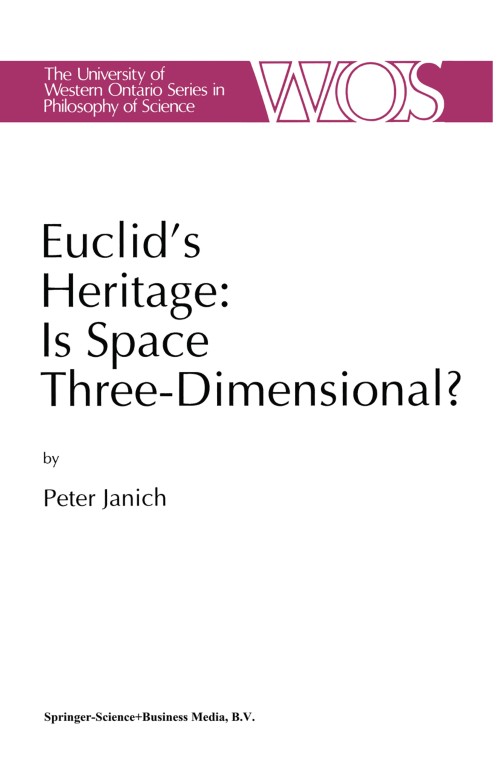
Euclid's Heritage. Is Space Three-Dimensional? [electronic resource] / by P. Janich.
Erişim Adresi
ISBN
9789401580960
Dil Kodu
İngilizce
Yer Numarası
DK/14607
Yazar
Basım Bildirimi
1st ed. 1992.
Yayın Bilgisi
Dordrecht : Springer Netherlands : Imprint: Springer, 1992.
Fiziksel Niteleme
XI, 231 p. online resource.
Dizi
The Western Ontario Series in Philosophy of Science, A Series of Books in Philosophy of Science, Methodology, Epistemology, Logic, History of Science, and Related Fields, 2215-1974 ; 52
İçindekiler Notu
One The History of the Problem -- One / The Purely Spatial Approaches -- Two / Grounding Three-Dimensionality in Motion -- Three / Argument for Three-Dimensionality from Laws of Force -- Four / Causalistic Explanations and Three-Dimensionality -- Five / The Biological and Perception-Theoretical Approaches -- Six / Euclid’s Heritage: A Review of the History of the Problem -- Two Space Is Three-Dimensional: What Does It Mean, and Why Is It True? -- Seven / Knowledge about Space -- Eight / The Construction of the Terminology -- Nine / The Spatial Concept of Dimension and Its Universality -- Appendices -- Index of Names.
Özet, vb.
We live in a space, we get about in it. We also quantify it, we think of it as having dimensions. Ever since Euclid's ancient geometry, we have thought of bodies occupying parts of this space (including our own bodies), the space of our practical orientations (our 'moving abouts'), as having three dimensions. Bodies have volume specified by measures of length, breadth and height. But how do we know that the space we live in has just these three dimensions? It is theoreti cally possible that some spaces might exist that are not correctly described by Euclidean geometry. After all, there are the non Euclidian geometries, descriptions of spaces not conforming to the axioms and theorems of Euclid's geometry. As one might expect, there is a history of philosophers' attempts to 'prove' that space is three-dimensional. The present volume surveys these attempts from Aristotle, through Leibniz and Kant, to more recent philosophy. As you will learn, the historical theories are rife with terminology, with language, already tainted by the as sumed, but by no means obvious, clarity of terms like 'dimension', 'line', 'point' and others. Prior to that language there are actions, ways of getting around in the world, building things, being interested in things, in the more specific case of dimensionality, cutting things. It is to these actions that we must eventually appeal if we are to understand how science is grounded.
Konu
Science __ Philosophy.
Mathematics.
History.
Knowledge, Theory of.
Geometry.
Philosophy of Science.
History of Mathematical Sciences.
Epistemology.
Geometry.
Mathematics.
History.
Knowledge, Theory of.
Geometry.
Philosophy of Science.
History of Mathematical Sciences.
Epistemology.
Geometry.
Kurum Adı

Eseri Alıntıla
Referansları kullanmadan önce gözden geçirmeniz ve varsa gerekli düzeltmeleri yapmanız önerilir.
Dijital Kaynak
MARC Görünümü
LEADER 05016nam a22006255i 4500
001 813365
003 TR_AnAIT
005 20260130225953
007 cr nn 008mamaa
008 130109s1992 ne | s |||| 0|eng d
020 |a9789401580960|9978-94-015-8096-0
024 7 |a10.1007/978-94-015-8096-0|2doi
041 |aeng
049 |aTürk Tarih Kurumu Kütüphanesi
050 4|aQ174-175.3
050 4|aB67
072 7|aPDA|2bicssc
072 7|aSCI075000|2bisacsh
072 7|aPDA|2thema
082 04|a501|223
090 |aDK/14607
100 1 |aJanich, P.|eauthor.|4aut|4http://id.loc.gov/vocabulary/relators/aut
245 10|aEuclid's Heritage. Is Space Three-Dimensional?|h[electronic resource] /|cby P. Janich.
250 |a1st ed. 1992.
264 1|aDordrecht :|bSpringer Netherlands :|bImprint: Springer,|c1992.
300 |aXI, 231 p.|bonline resource.
336 |atext|btxt|2rdacontent
337 |acomputer|bc|2rdamedia
338 |aonline resource|bcr|2rdacarrier
347 |atext file|bPDF|2rda
490 1 |aThe Western Ontario Series in Philosophy of Science, A Series of Books in Philosophy of Science, Methodology, Epistemology, Logic, History of Science, and Related Fields,|x2215-1974 ;|v52
505 0 |aOne The History of the Problem -- One / The Purely Spatial Approaches -- Two / Grounding Three-Dimensionality in Motion -- Three / Argument for Three-Dimensionality from Laws of Force -- Four / Causalistic Explanations and Three-Dimensionality -- Five / The Biological and Perception-Theoretical Approaches -- Six / Euclid’s Heritage: A Review of the History of the Problem -- Two Space Is Three-Dimensional: What Does It Mean, and Why Is It True? -- Seven / Knowledge about Space -- Eight / The Construction of the Terminology -- Nine / The Spatial Concept of Dimension and Its Universality -- Appendices -- Index of Names.
520 |aWe live in a space, we get about in it. We also quantify it, we think of it as having dimensions. Ever since Euclid's ancient geometry, we have thought of bodies occupying parts of this space (including our own bodies), the space of our practical orientations (our 'moving abouts'), as having three dimensions. Bodies have volume specified by measures of length, breadth and height. But how do we know that the space we live in has just these three dimensions? It is theoreti cally possible that some spaces might exist that are not correctly described by Euclidean geometry. After all, there are the non Euclidian geometries, descriptions of spaces not conforming to the axioms and theorems of Euclid's geometry. As one might expect, there is a history of philosophers' attempts to 'prove' that space is three-dimensional. The present volume surveys these attempts from Aristotle, through Leibniz and Kant, to more recent philosophy. As you will learn, the historical theories are rife with terminology, with language, already tainted by the as sumed, but by no means obvious, clarity of terms like 'dimension', 'line', 'point' and others. Prior to that language there are actions, ways of getting around in the world, building things, being interested in things, in the more specific case of dimensionality, cutting things. It is to these actions that we must eventually appeal if we are to understand how science is grounded.
532 8 |aAccessibility summary: This PDF is not accessible. It is based on scanned pages and does not support features such as screen reader compatibility or described non-text content (images, graphs etc). However, it likely supports searchable and selectable text based on OCR (Optical Character Recognition). Users with accessibility needs may not be able to use this content effectively. Please contact us at accessibilitysupport@springernature.com if you require assistance or an alternative format.
532 8 |aInaccessible, or known limited accessibility
532 8 |aNo reading system accessibility options actively disabled
532 8 |aPublisher contact for further accessibility information: accessibilitysupport@springernature.com
650 0|aScience|xPhilosophy.
650 0|aMathematics.
650 0|aHistory.
650 0|aKnowledge, Theory of.
650 0|aGeometry.
650 14|aPhilosophy of Science.
650 24|aHistory of Mathematical Sciences.
650 24|aEpistemology.
650 24|aGeometry.
710 2 |aSpringerLink (Online service)
773 0 |tSpringer Nature eBook
776 08|iPrinted edition:|z9780792320258
776 08|iPrinted edition:|z9789048142170
776 08|iPrinted edition:|z9789401580977
830 0|aThe Western Ontario Series in Philosophy of Science, A Series of Books in Philosophy of Science, Methodology, Epistemology, Logic, History of Science, and Related Fields,|x2215-1974 ;|v52
856 40|uhttps://doi.org/10.1007/978-94-015-8096-0
912 |aZDB-2-SHU
912 |aZDB-2-SXPR
912 |aZDB-2-BAE
950 |aHumanities, Social Sciences and Law (SpringerNature-11648)
950 |aPhilosophy and Religion (R0) (SpringerNature-43725)
001 813365
003 TR_AnAIT
005 20260130225953
007 cr nn 008mamaa
008 130109s1992 ne | s |||| 0|eng d
020 |a9789401580960|9978-94-015-8096-0
024 7 |a10.1007/978-94-015-8096-0|2doi
041 |aeng
049 |aTürk Tarih Kurumu Kütüphanesi
050 4|aQ174-175.3
050 4|aB67
072 7|aPDA|2bicssc
072 7|aSCI075000|2bisacsh
072 7|aPDA|2thema
082 04|a501|223
090 |aDK/14607
100 1 |aJanich, P.|eauthor.|4aut|4http://id.loc.gov/vocabulary/relators/aut
245 10|aEuclid's Heritage. Is Space Three-Dimensional?|h[electronic resource] /|cby P. Janich.
250 |a1st ed. 1992.
264 1|aDordrecht :|bSpringer Netherlands :|bImprint: Springer,|c1992.
300 |aXI, 231 p.|bonline resource.
336 |atext|btxt|2rdacontent
337 |acomputer|bc|2rdamedia
338 |aonline resource|bcr|2rdacarrier
347 |atext file|bPDF|2rda
490 1 |aThe Western Ontario Series in Philosophy of Science, A Series of Books in Philosophy of Science, Methodology, Epistemology, Logic, History of Science, and Related Fields,|x2215-1974 ;|v52
505 0 |aOne The History of the Problem -- One / The Purely Spatial Approaches -- Two / Grounding Three-Dimensionality in Motion -- Three / Argument for Three-Dimensionality from Laws of Force -- Four / Causalistic Explanations and Three-Dimensionality -- Five / The Biological and Perception-Theoretical Approaches -- Six / Euclid’s Heritage: A Review of the History of the Problem -- Two Space Is Three-Dimensional: What Does It Mean, and Why Is It True? -- Seven / Knowledge about Space -- Eight / The Construction of the Terminology -- Nine / The Spatial Concept of Dimension and Its Universality -- Appendices -- Index of Names.
520 |aWe live in a space, we get about in it. We also quantify it, we think of it as having dimensions. Ever since Euclid's ancient geometry, we have thought of bodies occupying parts of this space (including our own bodies), the space of our practical orientations (our 'moving abouts'), as having three dimensions. Bodies have volume specified by measures of length, breadth and height. But how do we know that the space we live in has just these three dimensions? It is theoreti cally possible that some spaces might exist that are not correctly described by Euclidean geometry. After all, there are the non Euclidian geometries, descriptions of spaces not conforming to the axioms and theorems of Euclid's geometry. As one might expect, there is a history of philosophers' attempts to 'prove' that space is three-dimensional. The present volume surveys these attempts from Aristotle, through Leibniz and Kant, to more recent philosophy. As you will learn, the historical theories are rife with terminology, with language, already tainted by the as sumed, but by no means obvious, clarity of terms like 'dimension', 'line', 'point' and others. Prior to that language there are actions, ways of getting around in the world, building things, being interested in things, in the more specific case of dimensionality, cutting things. It is to these actions that we must eventually appeal if we are to understand how science is grounded.
532 8 |aAccessibility summary: This PDF is not accessible. It is based on scanned pages and does not support features such as screen reader compatibility or described non-text content (images, graphs etc). However, it likely supports searchable and selectable text based on OCR (Optical Character Recognition). Users with accessibility needs may not be able to use this content effectively. Please contact us at accessibilitysupport@springernature.com if you require assistance or an alternative format.
532 8 |aInaccessible, or known limited accessibility
532 8 |aNo reading system accessibility options actively disabled
532 8 |aPublisher contact for further accessibility information: accessibilitysupport@springernature.com
650 0|aScience|xPhilosophy.
650 0|aMathematics.
650 0|aHistory.
650 0|aKnowledge, Theory of.
650 0|aGeometry.
650 14|aPhilosophy of Science.
650 24|aHistory of Mathematical Sciences.
650 24|aEpistemology.
650 24|aGeometry.
710 2 |aSpringerLink (Online service)
773 0 |tSpringer Nature eBook
776 08|iPrinted edition:|z9780792320258
776 08|iPrinted edition:|z9789048142170
776 08|iPrinted edition:|z9789401580977
830 0|aThe Western Ontario Series in Philosophy of Science, A Series of Books in Philosophy of Science, Methodology, Epistemology, Logic, History of Science, and Related Fields,|x2215-1974 ;|v52
856 40|uhttps://doi.org/10.1007/978-94-015-8096-0
912 |aZDB-2-SHU
912 |aZDB-2-SXPR
912 |aZDB-2-BAE
950 |aHumanities, Social Sciences and Law (SpringerNature-11648)
950 |aPhilosophy and Religion (R0) (SpringerNature-43725)
Materyaller
Depodan talep edilen materyal sadece kütüphane içerisinde kullanılmaktadır.
Materyal dışarıya ödünç verilmemektedir.
