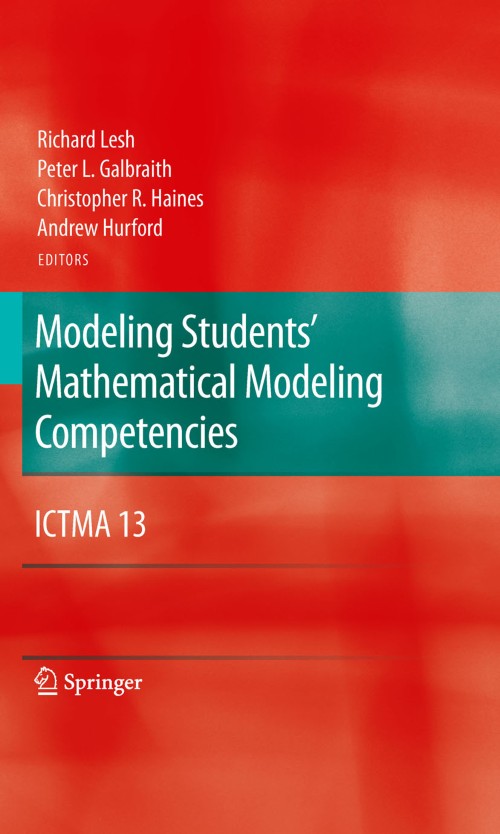
Modeling Students' Mathematical Modeling Competencies [electronic resource] : ICTMA 13 / edited by Richard Lesh, Peter L. Galbraith, Christopher R. Haines, Andrew Hurford.
Erişim Adresi
ISBN
9781441905611
Dil Kodu
İngilizce
Yer Numarası
DK/14656
Basım Bildirimi
1st ed. 2010.
Yayın Bilgisi
New York, NY : Springer US : Imprint: Springer, 2010.
Fiziksel Niteleme
XIV, 650 p. online resource.
İçindekiler Notu
The Nature of Models & Modeling -- Introduction: ICTMA and the Teaching of Modeling and Applications -- to Part I Modeling: What Is It? Why Do It? -- What Are Models? -- Modeling Theory for Math and Science Education -- Modeling a Crucial Aspect of Students’ Mathematical Modeling -- Modeling Perspectives in Math Education Research -- Where Are Models & Modelers Found? -- Modeling to Address Techno-Mathematical Literacies in Work -- Mathematical Modeling in Engineering Design Projects -- The Mathematical Expertise of Mechanical Engineers – The Case of Mechanism Design -- What Do Modeling Processes Look Like? -- Modeling and Quantitative Reasoning: The Summer Jobs Problem -- Tracing Students’ Modeling Processes in School -- What Creates The Need For Modeling -- Turning Ideas into Modeling Problems -- Remarks on a Modeling Cycle and Interpreting Behaviours -- Model Eliciting Environments as “Nurseries” for Modeling Probabilistic Situations -- Models as Tools, Especially for Making Sense of Problems -- In-Depth Use of Modeling in Engineering Coursework to Enhance Problem Solving -- Generative Activities: Making Sense of 1098 Functions -- How Do Models Develop? -- Modeling the Sensorial Perception in the Classroom -- Assessing a Modeling Process of a Linear Pattern Task -- Single Solution, Multiple Perspectives -- How is Modeling Different than Solving? -- Problem Solving Versus Modeling -- Investigating the Relationship Between the Problem and the Solver: Who Decides What Math Gets Used? -- Communication: The Essential Difference Between Mathematical Modeling and Problem Solving -- Analysis of Modeling Problem Solutions with Methods of Problem Solving -- Modeling in School Classrooms -- Modeling in K-16 Mathematics Classrooms – and Beyond -- How Can Students Recognize the Need for Modeling?.-Modeling with Complex Data in the Primary School -- Two Cases Studies of Fifth Grade Students Reasoning About Levers -- Don’t Disrespect Me: Affect in an Urban Math Class -- How Do Classroom Modling Communities Develop? -- Interdisciplinary Modeling Instruction: Helping Fifth Graders Learn About Levers -- Modeling Discourse in Secondary Science and Mathematics Classrooms -- A Middle Grade Teacher’s Guide to Model Eliciting Activities -- The Students’ Discussions in the Modeling Environment -- The Social Organization of a Middle School Mathematics Group Discussion -- Identifying Challenges within Transition Phases of Mathematical Modeling Activities at Year 9 -- Realistic Mathematical Modeling and Problem Posing -- Modeling in Class and the Development of Beliefs about the Usefulness of Mathematics -- How Do Teachers Develop Models of Modeling? -- Insights into Teachers’ Unconscious Behaviour in Modeling Contexts -- Future Teachers’ Professional Knowledge on Modeling -- Theory Meets Practice: Working Pragmatically Within Different Cultures and Traditions -- Secondary Teachers Learn and Refine Their Knowledge During Modeling Activities in a Learning Community Environment -- An Investigation of Teachers’ Shared Interpretations of Their Roles in Supporting and Enhancing Group Functioning -- Mathematical Modeling: Implications for Teaching -- A Professional Development Course with an Introduction of Models and Modeling in Science -- Modeling as Isomorphism: The Case of Teacher Education -- Mathematical Modeling and the Teachers’ Tensions -- A Case Study of Two Teachers: Teacher Questions and Student Explanations -- Pre-service Teachers’ Perceptions of Model Eliciting Activities -- How Do New Technologies Influence Modeling In School? -- Modeling Practices with The Geometer’sSketchpad -- A Principal Components Model of Simcalc Mathworlds -- Modeling Random Binomial Rabbit Hops -- Investigating Mathematical Search Behavior Using Network Analysis -- Mathematical Modeling and Virtual Environments -- What is The History of Modeling in Schools? -- On the Use of Realistic Fermi Problems in Introducing Mathematical Modelling in Upper Secondary Mathematics -- The Dutch Maths Curriculum: 25 Years of Modelling.
Özet, vb.
As we enter the 21st century, there is an urgent need for new approaches to mathematics education emphasizing its relevance in young learners’ futures. Modeling Students’ Mathematical Modeling Competencies explores the vital trend toward using real-world problems as a basis for teaching mathematics skills, competencies, and applications. Blending theoretical constructs and practical considerations, the book presents papers from the latest conference of the ICTMA, beginning with the basics (Why are models necessary? Where can we find them?) and moving through intricate concepts of how students perceive math, how instructors teach—and how both can become better learners. Dispatches as varied as classroom case studies, analyses of math in engineering work, and an in-depth review of modeling-based curricula in the Netherlands illustrate modeling activities on the job, methods of overcoming math resistance, and the movement toward replicable models and lifelong engagement. A sampling of topics covered: How students recognize the usefulness of mathematics Creating the modeling-oriented classroom Assessing and evaluating students’ modeling capabilities The relationship between modeling and problem-solving Instructor methods for developing their own models of modeling New technologies for modeling in the classroom Modeling Students’ Mathematical Modeling Competencies offers welcome clarity and focus to the international research and professional community in mathematics, science, and engineering education, as well as those involved in the sciences of teaching and learning these subjects.
Konu
Mathematics __ Study and teaching .
Mathematics.
Science __ Study and teaching.
Mathematics Education.
Mathematics.
Science Education.
Mathematics.
Science __ Study and teaching.
Mathematics Education.
Mathematics.
Science Education.
Kurum Adı

Eseri Alıntıla
Referansları kullanmadan önce gözden geçirmeniz ve varsa gerekli düzeltmeleri yapmanız önerilir.
Dijital Kaynak
MARC Görünümü
LEADER 07775nam a22005535i 4500
001 813414
003 TR_AnAIT
005 20260130225603
007 cr nn 008mamaa
008 110414s2010 xxu| s |||| 0|eng d
020 |a9781441905611|9978-1-4419-0561-1
024 7 |a10.1007/978-1-4419-0561-1|2doi
041 |aeng
049 |aTürk Tarih Kurumu Kütüphanesi
050 4|aQA10.92-20
072 7|aJNU|2bicssc
072 7|aPB|2bicssc
072 7|aEDU029010|2bisacsh
072 7|aJNU|2thema
072 7|aPB|2thema
082 04|a510.71|223
090 |aDK/14656
245 10|aModeling Students' Mathematical Modeling Competencies|h[electronic resource] :|bICTMA 13 /|cedited by Richard Lesh, Peter L. Galbraith, Christopher R. Haines, Andrew Hurford.
250 |a1st ed. 2010.
264 1|aNew York, NY :|bSpringer US :|bImprint: Springer,|c2010.
300 |aXIV, 650 p.|bonline resource.
336 |atext|btxt|2rdacontent
337 |acomputer|bc|2rdamedia
338 |aonline resource|bcr|2rdacarrier
347 |atext file|bPDF|2rda
505 0 |aThe Nature of Models & Modeling -- Introduction: ICTMA and the Teaching of Modeling and Applications -- to Part I Modeling: What Is It? Why Do It? -- What Are Models? -- Modeling Theory for Math and Science Education -- Modeling a Crucial Aspect of Students’ Mathematical Modeling -- Modeling Perspectives in Math Education Research -- Where Are Models & Modelers Found? -- Modeling to Address Techno-Mathematical Literacies in Work -- Mathematical Modeling in Engineering Design Projects -- The Mathematical Expertise of Mechanical Engineers – The Case of Mechanism Design -- What Do Modeling Processes Look Like? -- Modeling and Quantitative Reasoning: The Summer Jobs Problem -- Tracing Students’ Modeling Processes in School -- What Creates The Need For Modeling -- Turning Ideas into Modeling Problems -- Remarks on a Modeling Cycle and Interpreting Behaviours -- Model Eliciting Environments as “Nurseries” for Modeling Probabilistic Situations -- Models as Tools, Especially for Making Sense of Problems -- In-Depth Use of Modeling in Engineering Coursework to Enhance Problem Solving -- Generative Activities: Making Sense of 1098 Functions -- How Do Models Develop? -- Modeling the Sensorial Perception in the Classroom -- Assessing a Modeling Process of a Linear Pattern Task -- Single Solution, Multiple Perspectives -- How is Modeling Different than Solving? -- Problem Solving Versus Modeling -- Investigating the Relationship Between the Problem and the Solver: Who Decides What Math Gets Used? -- Communication: The Essential Difference Between Mathematical Modeling and Problem Solving -- Analysis of Modeling Problem Solutions with Methods of Problem Solving -- Modeling in School Classrooms -- Modeling in K-16 Mathematics Classrooms – and Beyond -- How Can Students Recognize the Need for Modeling?.-Modeling with Complex Data in the Primary School -- Two Cases Studies of Fifth Grade Students Reasoning About Levers -- Don’t Disrespect Me: Affect in an Urban Math Class -- How Do Classroom Modling Communities Develop? -- Interdisciplinary Modeling Instruction: Helping Fifth Graders Learn About Levers -- Modeling Discourse in Secondary Science and Mathematics Classrooms -- A Middle Grade Teacher’s Guide to Model Eliciting Activities -- The Students’ Discussions in the Modeling Environment -- The Social Organization of a Middle School Mathematics Group Discussion -- Identifying Challenges within Transition Phases of Mathematical Modeling Activities at Year 9 -- Realistic Mathematical Modeling and Problem Posing -- Modeling in Class and the Development of Beliefs about the Usefulness of Mathematics -- How Do Teachers Develop Models of Modeling? -- Insights into Teachers’ Unconscious Behaviour in Modeling Contexts -- Future Teachers’ Professional Knowledge on Modeling -- Theory Meets Practice: Working Pragmatically Within Different Cultures and Traditions -- Secondary Teachers Learn and Refine Their Knowledge During Modeling Activities in a Learning Community Environment -- An Investigation of Teachers’ Shared Interpretations of Their Roles in Supporting and Enhancing Group Functioning -- Mathematical Modeling: Implications for Teaching -- A Professional Development Course with an Introduction of Models and Modeling in Science -- Modeling as Isomorphism: The Case of Teacher Education -- Mathematical Modeling and the Teachers’ Tensions -- A Case Study of Two Teachers: Teacher Questions and Student Explanations -- Pre-service Teachers’ Perceptions of Model Eliciting Activities -- How Do New Technologies Influence Modeling In School? -- Modeling Practices with The Geometer’sSketchpad -- A Principal Components Model of Simcalc Mathworlds -- Modeling Random Binomial Rabbit Hops -- Investigating Mathematical Search Behavior Using Network Analysis -- Mathematical Modeling and Virtual Environments -- What is The History of Modeling in Schools? -- On the Use of Realistic Fermi Problems in Introducing Mathematical Modelling in Upper Secondary Mathematics -- The Dutch Maths Curriculum: 25 Years of Modelling.
520 |aAs we enter the 21st century, there is an urgent need for new approaches to mathematics education emphasizing its relevance in young learners’ futures. Modeling Students’ Mathematical Modeling Competencies explores the vital trend toward using real-world problems as a basis for teaching mathematics skills, competencies, and applications. Blending theoretical constructs and practical considerations, the book presents papers from the latest conference of the ICTMA, beginning with the basics (Why are models necessary? Where can we find them?) and moving through intricate concepts of how students perceive math, how instructors teach—and how both can become better learners. Dispatches as varied as classroom case studies, analyses of math in engineering work, and an in-depth review of modeling-based curricula in the Netherlands illustrate modeling activities on the job, methods of overcoming math resistance, and the movement toward replicable models and lifelong engagement. A sampling of topics covered: How students recognize the usefulness of mathematics Creating the modeling-oriented classroom Assessing and evaluating students’ modeling capabilities The relationship between modeling and problem-solving Instructor methods for developing their own models of modeling New technologies for modeling in the classroom Modeling Students’ Mathematical Modeling Competencies offers welcome clarity and focus to the international research and professional community in mathematics, science, and engineering education, as well as those involved in the sciences of teaching and learning these subjects.
650 0|aMathematics|xStudy and teaching .
650 0|aMathematics.
650 0|aScience|xStudy and teaching.
650 14|aMathematics Education.
650 24|aMathematics.
650 24|aScience Education.
700 1 |aLesh, Richard.|eeditor.|4edt|4http://id.loc.gov/vocabulary/relators/edt
700 1 |aGalbraith, Peter L.|eeditor.|4edt|4http://id.loc.gov/vocabulary/relators/edt
700 1 |aHaines, Christopher R.|eeditor.|4edt|4http://id.loc.gov/vocabulary/relators/edt
700 1 |aHurford, Andrew.|eeditor.|4edt|4http://id.loc.gov/vocabulary/relators/edt
710 2 |aSpringerLink (Online service)
773 0 |tSpringer Nature eBook
776 08|iPrinted edition:|z9781441905604
776 08|iPrinted edition:|z9781441905628
776 08|iPrinted edition:|z9781489983893
856 40|uhttps://doi.org/10.1007/978-1-4419-0561-1
912 |aZDB-2-SHU
912 |aZDB-2-SXED
950 |aHumanities, Social Sciences and Law (SpringerNature-11648)
950 |aEducation (R0) (SpringerNature-43721)
001 813414
003 TR_AnAIT
005 20260130225603
007 cr nn 008mamaa
008 110414s2010 xxu| s |||| 0|eng d
020 |a9781441905611|9978-1-4419-0561-1
024 7 |a10.1007/978-1-4419-0561-1|2doi
041 |aeng
049 |aTürk Tarih Kurumu Kütüphanesi
050 4|aQA10.92-20
072 7|aJNU|2bicssc
072 7|aPB|2bicssc
072 7|aEDU029010|2bisacsh
072 7|aJNU|2thema
072 7|aPB|2thema
082 04|a510.71|223
090 |aDK/14656
245 10|aModeling Students' Mathematical Modeling Competencies|h[electronic resource] :|bICTMA 13 /|cedited by Richard Lesh, Peter L. Galbraith, Christopher R. Haines, Andrew Hurford.
250 |a1st ed. 2010.
264 1|aNew York, NY :|bSpringer US :|bImprint: Springer,|c2010.
300 |aXIV, 650 p.|bonline resource.
336 |atext|btxt|2rdacontent
337 |acomputer|bc|2rdamedia
338 |aonline resource|bcr|2rdacarrier
347 |atext file|bPDF|2rda
505 0 |aThe Nature of Models & Modeling -- Introduction: ICTMA and the Teaching of Modeling and Applications -- to Part I Modeling: What Is It? Why Do It? -- What Are Models? -- Modeling Theory for Math and Science Education -- Modeling a Crucial Aspect of Students’ Mathematical Modeling -- Modeling Perspectives in Math Education Research -- Where Are Models & Modelers Found? -- Modeling to Address Techno-Mathematical Literacies in Work -- Mathematical Modeling in Engineering Design Projects -- The Mathematical Expertise of Mechanical Engineers – The Case of Mechanism Design -- What Do Modeling Processes Look Like? -- Modeling and Quantitative Reasoning: The Summer Jobs Problem -- Tracing Students’ Modeling Processes in School -- What Creates The Need For Modeling -- Turning Ideas into Modeling Problems -- Remarks on a Modeling Cycle and Interpreting Behaviours -- Model Eliciting Environments as “Nurseries” for Modeling Probabilistic Situations -- Models as Tools, Especially for Making Sense of Problems -- In-Depth Use of Modeling in Engineering Coursework to Enhance Problem Solving -- Generative Activities: Making Sense of 1098 Functions -- How Do Models Develop? -- Modeling the Sensorial Perception in the Classroom -- Assessing a Modeling Process of a Linear Pattern Task -- Single Solution, Multiple Perspectives -- How is Modeling Different than Solving? -- Problem Solving Versus Modeling -- Investigating the Relationship Between the Problem and the Solver: Who Decides What Math Gets Used? -- Communication: The Essential Difference Between Mathematical Modeling and Problem Solving -- Analysis of Modeling Problem Solutions with Methods of Problem Solving -- Modeling in School Classrooms -- Modeling in K-16 Mathematics Classrooms – and Beyond -- How Can Students Recognize the Need for Modeling?.-Modeling with Complex Data in the Primary School -- Two Cases Studies of Fifth Grade Students Reasoning About Levers -- Don’t Disrespect Me: Affect in an Urban Math Class -- How Do Classroom Modling Communities Develop? -- Interdisciplinary Modeling Instruction: Helping Fifth Graders Learn About Levers -- Modeling Discourse in Secondary Science and Mathematics Classrooms -- A Middle Grade Teacher’s Guide to Model Eliciting Activities -- The Students’ Discussions in the Modeling Environment -- The Social Organization of a Middle School Mathematics Group Discussion -- Identifying Challenges within Transition Phases of Mathematical Modeling Activities at Year 9 -- Realistic Mathematical Modeling and Problem Posing -- Modeling in Class and the Development of Beliefs about the Usefulness of Mathematics -- How Do Teachers Develop Models of Modeling? -- Insights into Teachers’ Unconscious Behaviour in Modeling Contexts -- Future Teachers’ Professional Knowledge on Modeling -- Theory Meets Practice: Working Pragmatically Within Different Cultures and Traditions -- Secondary Teachers Learn and Refine Their Knowledge During Modeling Activities in a Learning Community Environment -- An Investigation of Teachers’ Shared Interpretations of Their Roles in Supporting and Enhancing Group Functioning -- Mathematical Modeling: Implications for Teaching -- A Professional Development Course with an Introduction of Models and Modeling in Science -- Modeling as Isomorphism: The Case of Teacher Education -- Mathematical Modeling and the Teachers’ Tensions -- A Case Study of Two Teachers: Teacher Questions and Student Explanations -- Pre-service Teachers’ Perceptions of Model Eliciting Activities -- How Do New Technologies Influence Modeling In School? -- Modeling Practices with The Geometer’sSketchpad -- A Principal Components Model of Simcalc Mathworlds -- Modeling Random Binomial Rabbit Hops -- Investigating Mathematical Search Behavior Using Network Analysis -- Mathematical Modeling and Virtual Environments -- What is The History of Modeling in Schools? -- On the Use of Realistic Fermi Problems in Introducing Mathematical Modelling in Upper Secondary Mathematics -- The Dutch Maths Curriculum: 25 Years of Modelling.
520 |aAs we enter the 21st century, there is an urgent need for new approaches to mathematics education emphasizing its relevance in young learners’ futures. Modeling Students’ Mathematical Modeling Competencies explores the vital trend toward using real-world problems as a basis for teaching mathematics skills, competencies, and applications. Blending theoretical constructs and practical considerations, the book presents papers from the latest conference of the ICTMA, beginning with the basics (Why are models necessary? Where can we find them?) and moving through intricate concepts of how students perceive math, how instructors teach—and how both can become better learners. Dispatches as varied as classroom case studies, analyses of math in engineering work, and an in-depth review of modeling-based curricula in the Netherlands illustrate modeling activities on the job, methods of overcoming math resistance, and the movement toward replicable models and lifelong engagement. A sampling of topics covered: How students recognize the usefulness of mathematics Creating the modeling-oriented classroom Assessing and evaluating students’ modeling capabilities The relationship between modeling and problem-solving Instructor methods for developing their own models of modeling New technologies for modeling in the classroom Modeling Students’ Mathematical Modeling Competencies offers welcome clarity and focus to the international research and professional community in mathematics, science, and engineering education, as well as those involved in the sciences of teaching and learning these subjects.
650 0|aMathematics|xStudy and teaching .
650 0|aMathematics.
650 0|aScience|xStudy and teaching.
650 14|aMathematics Education.
650 24|aMathematics.
650 24|aScience Education.
700 1 |aLesh, Richard.|eeditor.|4edt|4http://id.loc.gov/vocabulary/relators/edt
700 1 |aGalbraith, Peter L.|eeditor.|4edt|4http://id.loc.gov/vocabulary/relators/edt
700 1 |aHaines, Christopher R.|eeditor.|4edt|4http://id.loc.gov/vocabulary/relators/edt
700 1 |aHurford, Andrew.|eeditor.|4edt|4http://id.loc.gov/vocabulary/relators/edt
710 2 |aSpringerLink (Online service)
773 0 |tSpringer Nature eBook
776 08|iPrinted edition:|z9781441905604
776 08|iPrinted edition:|z9781441905628
776 08|iPrinted edition:|z9781489983893
856 40|uhttps://doi.org/10.1007/978-1-4419-0561-1
912 |aZDB-2-SHU
912 |aZDB-2-SXED
950 |aHumanities, Social Sciences and Law (SpringerNature-11648)
950 |aEducation (R0) (SpringerNature-43721)
Materyaller
Depodan talep edilen materyal sadece kütüphane içerisinde kullanılmaktadır.
Materyal dışarıya ödünç verilmemektedir.
