

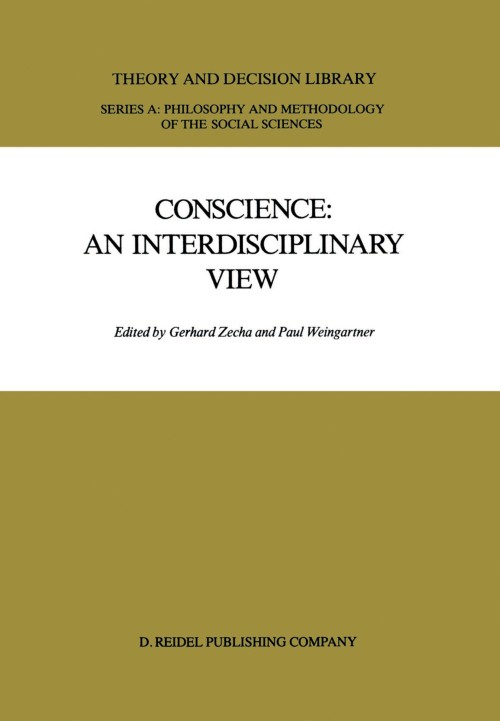
Conscience: An Interdisciplinary View [electronic resource] : Salzburg Colloquium on Ethics in the Sciences and Humanities / edited by G. Zecha, P. Weingartner.
Erişim Adresi
ISBN
9789400938212
Dil Kodu
İngilizce
Yer Numarası
DK/14715
Basım Bildirimi
1st ed. 1987.
Yayın Bilgisi
Dordrecht : Springer Netherlands : Imprint: Springer, 1987.
Fiziksel Niteleme
XV, 304 p. online resource.
Dizi
Theory and Decision Library A:, Rational Choice in Practical Philosophy and Philosophy of Science, 2352-2119 ; 1
İçindekiler Notu
1 / Conscience: Foundational Aspects -- Conscience as Principled Responsibility: On the Philosophy of Stage Six -- Discussion -- The Phenomenon of Conscience: Subject-Orientation and Object-Orientation -- Discussion -- 2 / Conscience: Social and Educational Aspects -- Value-Neutrality, Conscience, and the Social Sciences -- Discussion -- Moral Competence and Education in Democratic Society -- Discussion -- The Idea of Conscience in High School Students. Development of Judgments of Responsibility in Democratic Just Community Programs -- Discussion -- 3 / Conscience: Special Topics -- Conscience in Conflict? -- Discussion -- Aquinas’ Theory of Conscience from a Logical Point of View -- Discussion -- The Ambivalent Relationship of Law and Freedom of Conscience: Intensification and Relaxation of Conscience Through the Legal System -- Discussion -- Psychoanalysis and Ethics -- Discussion -- Index of Names -- Index of Subjects.
Özet, vb.
Value change and uncertainty about the validity of traditional moral convictions are frequently observed when scientific re search confronts us with new moral problems or challenges the moral responsibility of the scientist. Which ethics is to be relied on? Which principles are the most reasonable, the most humane ones? For want of an appropriate answer, moral authorities of ten point to conscience, the individual conscience, which seems to be man's unique, directly accessible and final source of moral contention. But what is meant by 'conscience'? There is hardly a notion as widely used and at the same time as controversial as that of conscience. In the history of ethics we can distinguish several trends in the interpretation of the concept and function of conscience. The Greeks used the word O"uvEt81lm~ to denote a kind of 'accompa nying knowledge' that mostly referred to negatively experienced behavior. In Latin, the expression conscientia meant a knowing together pointing beyond the individual consciousness to the common knowledge of other people. In the Bible, especially in the New Testament, O"uvEt81l0"t~ is used for the guiding con sciousness of the morality of one's own action.
Konu
Philosophy and social sciences.
Ethics.
Law __ Philosophy.
Philosophy of the Social Sciences.
Moral Philosophy and Applied Ethics.
Philosophy of Law.
Ethics.
Law __ Philosophy.
Philosophy of the Social Sciences.
Moral Philosophy and Applied Ethics.
Philosophy of Law.
Diğer Yazarlar
Kurum Adı
Eseri Alıntıla
Referansları kullanmadan önce gözden geçirmeniz ve varsa gerekli düzeltmeleri yapmanız önerilir.
Dijital Kaynak
MARC Görünümü
LEADER 05044nam a22005895i 4500
001 813473
003 TR_AnAIT
005 20260130225223
007 cr nn 008mamaa
008 121227s1987 ne | s |||| 0|eng d
020 |a9789400938212|9978-94-009-3821-2
024 7 |a10.1007/978-94-009-3821-2|2doi
041 |aeng
049 |aTürk Tarih Kurumu Kütüphanesi
050 4|aB63
072 7|aHPS|2bicssc
072 7|aPHI034000|2bisacsh
072 7|aQDTS|2thema
082 04|a300.1|223
090 |aDK/14715
245 10|aConscience: An Interdisciplinary View|h[electronic resource] :|bSalzburg Colloquium on Ethics in the Sciences and Humanities /|cedited by G. Zecha, P. Weingartner.
250 |a1st ed. 1987.
264 1|aDordrecht :|bSpringer Netherlands :|bImprint: Springer,|c1987.
300 |aXV, 304 p.|bonline resource.
336 |atext|btxt|2rdacontent
337 |acomputer|bc|2rdamedia
338 |aonline resource|bcr|2rdacarrier
347 |atext file|bPDF|2rda
490 1 |aTheory and Decision Library A:, Rational Choice in Practical Philosophy and Philosophy of Science,|x2352-2119 ;|v1
505 0 |a1 / Conscience: Foundational Aspects -- Conscience as Principled Responsibility: On the Philosophy of Stage Six -- Discussion -- The Phenomenon of Conscience: Subject-Orientation and Object-Orientation -- Discussion -- 2 / Conscience: Social and Educational Aspects -- Value-Neutrality, Conscience, and the Social Sciences -- Discussion -- Moral Competence and Education in Democratic Society -- Discussion -- The Idea of Conscience in High School Students. Development of Judgments of Responsibility in Democratic Just Community Programs -- Discussion -- 3 / Conscience: Special Topics -- Conscience in Conflict? -- Discussion -- Aquinas’ Theory of Conscience from a Logical Point of View -- Discussion -- The Ambivalent Relationship of Law and Freedom of Conscience: Intensification and Relaxation of Conscience Through the Legal System -- Discussion -- Psychoanalysis and Ethics -- Discussion -- Index of Names -- Index of Subjects.
520 |aValue change and uncertainty about the validity of traditional moral convictions are frequently observed when scientific re search confronts us with new moral problems or challenges the moral responsibility of the scientist. Which ethics is to be relied on? Which principles are the most reasonable, the most humane ones? For want of an appropriate answer, moral authorities of ten point to conscience, the individual conscience, which seems to be man's unique, directly accessible and final source of moral contention. But what is meant by 'conscience'? There is hardly a notion as widely used and at the same time as controversial as that of conscience. In the history of ethics we can distinguish several trends in the interpretation of the concept and function of conscience. The Greeks used the word O"uvEt81lm~ to denote a kind of 'accompa nying knowledge' that mostly referred to negatively experienced behavior. In Latin, the expression conscientia meant a knowing together pointing beyond the individual consciousness to the common knowledge of other people. In the Bible, especially in the New Testament, O"uvEt81l0"t~ is used for the guiding con sciousness of the morality of one's own action.
532 8 |aAccessibility summary: This PDF is not accessible. It is based on scanned pages and does not support features such as screen reader compatibility or described non-text content (images, graphs etc). However, it likely supports searchable and selectable text based on OCR (Optical Character Recognition). Users with accessibility needs may not be able to use this content effectively. Please contact us at accessibilitysupport@springernature.com if you require assistance or an alternative format.
532 8 |aInaccessible, or known limited accessibility
532 8 |aNo reading system accessibility options actively disabled
532 8 |aPublisher contact for further accessibility information: accessibilitysupport@springernature.com
650 0|aPhilosophy and social sciences.
650 0|aEthics.
650 0|aLaw|xPhilosophy.
650 14|aPhilosophy of the Social Sciences.
650 24|aMoral Philosophy and Applied Ethics.
650 24|aPhilosophy of Law.
700 1 |aZecha, G.|eeditor.|4edt|4http://id.loc.gov/vocabulary/relators/edt
700 1 |aWeingartner, P.|eeditor.|4edt|4http://id.loc.gov/vocabulary/relators/edt
710 2 |aSpringerLink (Online service)
773 0 |tSpringer Nature eBook
776 08|iPrinted edition:|z9789027724526
776 08|iPrinted edition:|z9789400938229
776 08|iPrinted edition:|z9789401082006
830 0|aTheory and Decision Library A:, Rational Choice in Practical Philosophy and Philosophy of Science,|x2352-2119 ;|v1
856 40|uhttps://doi.org/10.1007/978-94-009-3821-2
912 |aZDB-2-SHU
912 |aZDB-2-SXPR
912 |aZDB-2-BAE
950 |aHumanities, Social Sciences and Law (SpringerNature-11648)
950 |aPhilosophy and Religion (R0) (SpringerNature-43725)
001 813473
003 TR_AnAIT
005 20260130225223
007 cr nn 008mamaa
008 121227s1987 ne | s |||| 0|eng d
020 |a9789400938212|9978-94-009-3821-2
024 7 |a10.1007/978-94-009-3821-2|2doi
041 |aeng
049 |aTürk Tarih Kurumu Kütüphanesi
050 4|aB63
072 7|aHPS|2bicssc
072 7|aPHI034000|2bisacsh
072 7|aQDTS|2thema
082 04|a300.1|223
090 |aDK/14715
245 10|aConscience: An Interdisciplinary View|h[electronic resource] :|bSalzburg Colloquium on Ethics in the Sciences and Humanities /|cedited by G. Zecha, P. Weingartner.
250 |a1st ed. 1987.
264 1|aDordrecht :|bSpringer Netherlands :|bImprint: Springer,|c1987.
300 |aXV, 304 p.|bonline resource.
336 |atext|btxt|2rdacontent
337 |acomputer|bc|2rdamedia
338 |aonline resource|bcr|2rdacarrier
347 |atext file|bPDF|2rda
490 1 |aTheory and Decision Library A:, Rational Choice in Practical Philosophy and Philosophy of Science,|x2352-2119 ;|v1
505 0 |a1 / Conscience: Foundational Aspects -- Conscience as Principled Responsibility: On the Philosophy of Stage Six -- Discussion -- The Phenomenon of Conscience: Subject-Orientation and Object-Orientation -- Discussion -- 2 / Conscience: Social and Educational Aspects -- Value-Neutrality, Conscience, and the Social Sciences -- Discussion -- Moral Competence and Education in Democratic Society -- Discussion -- The Idea of Conscience in High School Students. Development of Judgments of Responsibility in Democratic Just Community Programs -- Discussion -- 3 / Conscience: Special Topics -- Conscience in Conflict? -- Discussion -- Aquinas’ Theory of Conscience from a Logical Point of View -- Discussion -- The Ambivalent Relationship of Law and Freedom of Conscience: Intensification and Relaxation of Conscience Through the Legal System -- Discussion -- Psychoanalysis and Ethics -- Discussion -- Index of Names -- Index of Subjects.
520 |aValue change and uncertainty about the validity of traditional moral convictions are frequently observed when scientific re search confronts us with new moral problems or challenges the moral responsibility of the scientist. Which ethics is to be relied on? Which principles are the most reasonable, the most humane ones? For want of an appropriate answer, moral authorities of ten point to conscience, the individual conscience, which seems to be man's unique, directly accessible and final source of moral contention. But what is meant by 'conscience'? There is hardly a notion as widely used and at the same time as controversial as that of conscience. In the history of ethics we can distinguish several trends in the interpretation of the concept and function of conscience. The Greeks used the word O"uvEt81lm~ to denote a kind of 'accompa nying knowledge' that mostly referred to negatively experienced behavior. In Latin, the expression conscientia meant a knowing together pointing beyond the individual consciousness to the common knowledge of other people. In the Bible, especially in the New Testament, O"uvEt81l0"t~ is used for the guiding con sciousness of the morality of one's own action.
532 8 |aAccessibility summary: This PDF is not accessible. It is based on scanned pages and does not support features such as screen reader compatibility or described non-text content (images, graphs etc). However, it likely supports searchable and selectable text based on OCR (Optical Character Recognition). Users with accessibility needs may not be able to use this content effectively. Please contact us at accessibilitysupport@springernature.com if you require assistance or an alternative format.
532 8 |aInaccessible, or known limited accessibility
532 8 |aNo reading system accessibility options actively disabled
532 8 |aPublisher contact for further accessibility information: accessibilitysupport@springernature.com
650 0|aPhilosophy and social sciences.
650 0|aEthics.
650 0|aLaw|xPhilosophy.
650 14|aPhilosophy of the Social Sciences.
650 24|aMoral Philosophy and Applied Ethics.
650 24|aPhilosophy of Law.
700 1 |aZecha, G.|eeditor.|4edt|4http://id.loc.gov/vocabulary/relators/edt
700 1 |aWeingartner, P.|eeditor.|4edt|4http://id.loc.gov/vocabulary/relators/edt
710 2 |aSpringerLink (Online service)
773 0 |tSpringer Nature eBook
776 08|iPrinted edition:|z9789027724526
776 08|iPrinted edition:|z9789400938229
776 08|iPrinted edition:|z9789401082006
830 0|aTheory and Decision Library A:, Rational Choice in Practical Philosophy and Philosophy of Science,|x2352-2119 ;|v1
856 40|uhttps://doi.org/10.1007/978-94-009-3821-2
912 |aZDB-2-SHU
912 |aZDB-2-SXPR
912 |aZDB-2-BAE
950 |aHumanities, Social Sciences and Law (SpringerNature-11648)
950 |aPhilosophy and Religion (R0) (SpringerNature-43725)
Materyaller
Depodan talep edilen materyal sadece kütüphane içerisinde kullanılmaktadır.
Materyal dışarıya ödünç verilmemektedir.
Materyal dışarıya ödünç verilmemektedir.
