

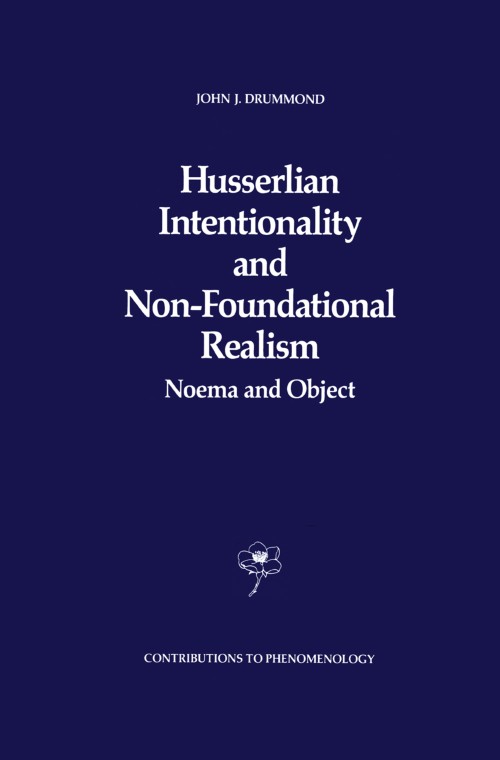
Husserlian Intentionality and Non-Foundational Realism [electronic resource] : Noema and Object / by J.J. Drummond.
Erişim Adresi
ISBN
9789400919747
Dil Kodu
İngilizce
Yer Numarası
DK/14729
Yazar
Basım Bildirimi
1st ed. 1990.
Yayın Bilgisi
Dordrecht : Springer Netherlands : Imprint: Springer, 1990.
Fiziksel Niteleme
XII, 298 p. online resource.
Dizi
Contributions to Phenomenology, In Cooperation with The Center for Advanced Research in Phenomenology, 2215-1915 ; 4
İçindekiler Notu
Notes -- I: Intentionality and the Reduction -- 1. Intentionality: A Philosophical Context -- 2. Intentionality: Husserl’s Early Theory -- 3. The Reduction -- II: Noema and Object -- 4. Contra Gurwitsch -- 5. Contra the Fregean Approach -- 6. Identities and Manifolds -- 7. Noemata, Senses, and Meanings -- 8. Possibilities and the Actual World -- III: Non-Foundational Realism -- 9. Husserl and Foundationalism -- 10. Husserl and Realism.
Özet, vb.
The rift which has long divided the philosophical world into opposed schools-the "Continental" school owing its origins to the phenomenology of Husserl and the "analytic" school derived from Frege-is finally closing. But this closure is occurring in ways both different and in certain respects at odds with one another. On the one hand scholars are seeking to rediscover the concerns and positions common to both schools, positions from which we can continue fruitfully to address important philosophical issues. On the other hand successors to both traditions have developed criticisms of basic assumptions shared by the two schools. They have suggested that we must move not merely beyond the conflict between these two "modem" schools but beyond the kind of philosophy represented in the unity of the two schools and thereby move towards a new "postmodern" philosophical style. On the one hand, then and for example, Husserl scholarship has in recent years witnessed the development of an interpretation of Husserl which more closely aligns his phenomenology with the philosophical concerns of the "analytic" tradition. In certain respects, this should come as no surprise and is long overdue. It is true, after all, that the early Husserl occupied himself with many of the same philosophical issues as did Frege and the earliest thinkers of the analytic tradition. Examples include the concept of number, the nature of mathematical analysis, meaning and reference, truth, formalization, and the relationship between logic and mathematics.
Konu
Phenomenology .
Philosophy, Modern.
Phenomenology.
Early Modern Philosophy.
Philosophy, Modern.
Phenomenology.
Early Modern Philosophy.
Kurum Adı
Eseri Alıntıla
Referansları kullanmadan önce gözden geçirmeniz ve varsa gerekli düzeltmeleri yapmanız önerilir.
Dijital Kaynak
MARC Görünümü
LEADER 04663nam a22005535i 4500
001 813487
003 TR_AnAIT
005 20260130225055
007 cr nn 008mamaa
008 121227s1990 ne | s |||| 0|eng d
020 |a9789400919747|9978-94-009-1974-7
024 7 |a10.1007/978-94-009-1974-7|2doi
041 |aeng
049 |aTürk Tarih Kurumu Kütüphanesi
050 4|aB829.5.A-Z
072 7|aHPCF3|2bicssc
072 7|aPHI018000|2bisacsh
072 7|aQDHR5|2thema
082 04|a142.7|223
090 |aDK/14729
100 1 |aDrummond, J.J.|eauthor.|4aut|4http://id.loc.gov/vocabulary/relators/aut
245 10|aHusserlian Intentionality and Non-Foundational Realism|h[electronic resource] :|bNoema and Object /|cby J.J. Drummond.
250 |a1st ed. 1990.
264 1|aDordrecht :|bSpringer Netherlands :|bImprint: Springer,|c1990.
300 |aXII, 298 p.|bonline resource.
336 |atext|btxt|2rdacontent
337 |acomputer|bc|2rdamedia
338 |aonline resource|bcr|2rdacarrier
347 |atext file|bPDF|2rda
490 1 |aContributions to Phenomenology, In Cooperation with The Center for Advanced Research in Phenomenology,|x2215-1915 ;|v4
505 0 |aNotes -- I: Intentionality and the Reduction -- 1. Intentionality: A Philosophical Context -- 2. Intentionality: Husserl’s Early Theory -- 3. The Reduction -- II: Noema and Object -- 4. Contra Gurwitsch -- 5. Contra the Fregean Approach -- 6. Identities and Manifolds -- 7. Noemata, Senses, and Meanings -- 8. Possibilities and the Actual World -- III: Non-Foundational Realism -- 9. Husserl and Foundationalism -- 10. Husserl and Realism.
520 |aThe rift which has long divided the philosophical world into opposed schools-the "Continental" school owing its origins to the phenomenology of Husserl and the "analytic" school derived from Frege-is finally closing. But this closure is occurring in ways both different and in certain respects at odds with one another. On the one hand scholars are seeking to rediscover the concerns and positions common to both schools, positions from which we can continue fruitfully to address important philosophical issues. On the other hand successors to both traditions have developed criticisms of basic assumptions shared by the two schools. They have suggested that we must move not merely beyond the conflict between these two "modem" schools but beyond the kind of philosophy represented in the unity of the two schools and thereby move towards a new "postmodern" philosophical style. On the one hand, then and for example, Husserl scholarship has in recent years witnessed the development of an interpretation of Husserl which more closely aligns his phenomenology with the philosophical concerns of the "analytic" tradition. In certain respects, this should come as no surprise and is long overdue. It is true, after all, that the early Husserl occupied himself with many of the same philosophical issues as did Frege and the earliest thinkers of the analytic tradition. Examples include the concept of number, the nature of mathematical analysis, meaning and reference, truth, formalization, and the relationship between logic and mathematics.
532 8 |aAccessibility summary: This PDF is not accessible. It is based on scanned pages and does not support features such as screen reader compatibility or described non-text content (images, graphs etc). However, it likely supports searchable and selectable text based on OCR (Optical Character Recognition). Users with accessibility needs may not be able to use this content effectively. Please contact us at accessibilitysupport@springernature.com if you require assistance or an alternative format.
532 8 |aInaccessible, or known limited accessibility
532 8 |aNo reading system accessibility options actively disabled
532 8 |aPublisher contact for further accessibility information: accessibilitysupport@springernature.com
650 0|aPhenomenology .
650 0|aPhilosophy, Modern.
650 14|aPhenomenology.
650 24|aEarly Modern Philosophy.
710 2 |aSpringerLink (Online service)
773 0 |tSpringer Nature eBook
776 08|iPrinted edition:|z9780792306511
776 08|iPrinted edition:|z9789400919754
776 08|iPrinted edition:|z9789401073820
830 0|aContributions to Phenomenology, In Cooperation with The Center for Advanced Research in Phenomenology,|x2215-1915 ;|v4
856 40|uhttps://doi.org/10.1007/978-94-009-1974-7
912 |aZDB-2-SHU
912 |aZDB-2-SXPR
912 |aZDB-2-BAE
950 |aHumanities, Social Sciences and Law (SpringerNature-11648)
950 |aPhilosophy and Religion (R0) (SpringerNature-43725)
001 813487
003 TR_AnAIT
005 20260130225055
007 cr nn 008mamaa
008 121227s1990 ne | s |||| 0|eng d
020 |a9789400919747|9978-94-009-1974-7
024 7 |a10.1007/978-94-009-1974-7|2doi
041 |aeng
049 |aTürk Tarih Kurumu Kütüphanesi
050 4|aB829.5.A-Z
072 7|aHPCF3|2bicssc
072 7|aPHI018000|2bisacsh
072 7|aQDHR5|2thema
082 04|a142.7|223
090 |aDK/14729
100 1 |aDrummond, J.J.|eauthor.|4aut|4http://id.loc.gov/vocabulary/relators/aut
245 10|aHusserlian Intentionality and Non-Foundational Realism|h[electronic resource] :|bNoema and Object /|cby J.J. Drummond.
250 |a1st ed. 1990.
264 1|aDordrecht :|bSpringer Netherlands :|bImprint: Springer,|c1990.
300 |aXII, 298 p.|bonline resource.
336 |atext|btxt|2rdacontent
337 |acomputer|bc|2rdamedia
338 |aonline resource|bcr|2rdacarrier
347 |atext file|bPDF|2rda
490 1 |aContributions to Phenomenology, In Cooperation with The Center for Advanced Research in Phenomenology,|x2215-1915 ;|v4
505 0 |aNotes -- I: Intentionality and the Reduction -- 1. Intentionality: A Philosophical Context -- 2. Intentionality: Husserl’s Early Theory -- 3. The Reduction -- II: Noema and Object -- 4. Contra Gurwitsch -- 5. Contra the Fregean Approach -- 6. Identities and Manifolds -- 7. Noemata, Senses, and Meanings -- 8. Possibilities and the Actual World -- III: Non-Foundational Realism -- 9. Husserl and Foundationalism -- 10. Husserl and Realism.
520 |aThe rift which has long divided the philosophical world into opposed schools-the "Continental" school owing its origins to the phenomenology of Husserl and the "analytic" school derived from Frege-is finally closing. But this closure is occurring in ways both different and in certain respects at odds with one another. On the one hand scholars are seeking to rediscover the concerns and positions common to both schools, positions from which we can continue fruitfully to address important philosophical issues. On the other hand successors to both traditions have developed criticisms of basic assumptions shared by the two schools. They have suggested that we must move not merely beyond the conflict between these two "modem" schools but beyond the kind of philosophy represented in the unity of the two schools and thereby move towards a new "postmodern" philosophical style. On the one hand, then and for example, Husserl scholarship has in recent years witnessed the development of an interpretation of Husserl which more closely aligns his phenomenology with the philosophical concerns of the "analytic" tradition. In certain respects, this should come as no surprise and is long overdue. It is true, after all, that the early Husserl occupied himself with many of the same philosophical issues as did Frege and the earliest thinkers of the analytic tradition. Examples include the concept of number, the nature of mathematical analysis, meaning and reference, truth, formalization, and the relationship between logic and mathematics.
532 8 |aAccessibility summary: This PDF is not accessible. It is based on scanned pages and does not support features such as screen reader compatibility or described non-text content (images, graphs etc). However, it likely supports searchable and selectable text based on OCR (Optical Character Recognition). Users with accessibility needs may not be able to use this content effectively. Please contact us at accessibilitysupport@springernature.com if you require assistance or an alternative format.
532 8 |aInaccessible, or known limited accessibility
532 8 |aNo reading system accessibility options actively disabled
532 8 |aPublisher contact for further accessibility information: accessibilitysupport@springernature.com
650 0|aPhenomenology .
650 0|aPhilosophy, Modern.
650 14|aPhenomenology.
650 24|aEarly Modern Philosophy.
710 2 |aSpringerLink (Online service)
773 0 |tSpringer Nature eBook
776 08|iPrinted edition:|z9780792306511
776 08|iPrinted edition:|z9789400919754
776 08|iPrinted edition:|z9789401073820
830 0|aContributions to Phenomenology, In Cooperation with The Center for Advanced Research in Phenomenology,|x2215-1915 ;|v4
856 40|uhttps://doi.org/10.1007/978-94-009-1974-7
912 |aZDB-2-SHU
912 |aZDB-2-SXPR
912 |aZDB-2-BAE
950 |aHumanities, Social Sciences and Law (SpringerNature-11648)
950 |aPhilosophy and Religion (R0) (SpringerNature-43725)
Materyaller
Depodan talep edilen materyal sadece kütüphane içerisinde kullanılmaktadır.
Materyal dışarıya ödünç verilmemektedir.
Materyal dışarıya ödünç verilmemektedir.
