

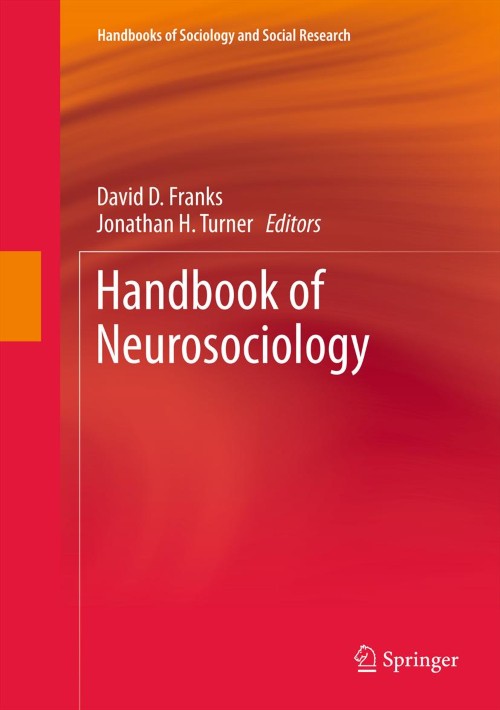
Handbook of Neurosociology [electronic resource] / edited by David D. Franks, Jonathan H. Turner.
Erişim Adresi
ISBN
9789400744738
Dil Kodu
İngilizce
Yer Numarası
DK/14789
Basım Bildirimi
1st ed. 2013.
Yayın Bilgisi
Dordrecht : Springer Netherlands : Imprint: Springer, 2013.
Fiziksel Niteleme
XII, 406 p. 21 illus. online resource.
Dizi
Handbooks of Sociology and Social Research, 2542-839X
İçindekiler Notu
Forward Douglas Massey.- Chapter 1. Introduction: Summaries and Comments; David D. Franks and Jonathan H. Turner -- PART I. LARGE ISSUES.- Chapter 2: Neural Social Science; George Lakoff -- Chapter 3: Why We Need Neurosociology as Well as Social Neuroscience; David D. Franks.- Chapter 4: Social Cognitions and the Problems of Minds; John Shook.- Chapter 5: Social Neuroscience of Human Aggression: Genetic, Hormonal and Neural Underpinnings; Pranjal Metha, Stefan Geotz and Justin Carre -- Chapter 6: Social Neuroscience and the Modern Synthesis of Social and Biological Levels of Analysis; Greg J. Norman, Louise C. Hawkley, Maike Luman, John T. Cacioppo and Gary G. Berntson -- Chapter 7: Can the Two Cultures Reconcile? Reconstruction and Neuropragmatism; Tibor Solymoski -- Chapter 8: Notes Towards a Neuroethics; David D. Franks -- Chapter 9: Emergence in Sociology and Neuroscience; David D. Franks -- PART II. NEUROLOGY, SELF, INTERACTION, AND SOCIALITY.- Chapter 10: Neurology and Interpersonal Behavior: The Basic Challenge for Nuerosociology; Jonathan H. Turner.- Chapter 11: Neurology Supports of G. H. Mead and Relations to Symbolic Interaction; David D. Franks.- Chapter 12: What are the Neurobiological Foundations of Identities and Identity Related Processes; Richard Niemeyer.- Chapter 13: The Emergent Self: How Distributed Neural Networks Support Self-Representations; Istvan Molnar-Szakacs and Lucina Uddin -- Chapter 14: The Human Mirror Neuron System, Social Control and Language; Shook-Lei Liew and Lisa Aziz- Zadeh.- Chapter 15: A Neurosociological Theory of Weberian Rationality: Its Cognitive, Conative, and Neurobiological Foundations; Warren D. TenHouten -- Chapter 16: Theory of Mind; Rosemary Hopcroft.- Chapter 17: Attachment, Interaction and Synchronization: How Innate Mechanisms in Attachment Give Rise to Emergent Structure in Networks and Communities; Thomas S. Smith.- PART III. EVOLUTION OF THE BRAIN.- Chapter 18: The Mind of a Hominin: An Evolutionary Story; Alexandra Maryanski.- Chapter 19: The Evolution of the Neurological Basis for Sociality; Jonathan H. Turner and Alexandra Maryanski.- Chapter 20: Neurophysiology of Rewards: Implications for Sociology; Michael Hammond -- PART IV. THE NEUROLOGY OF SOCIAL ISSUES AND PROBLEMS.- Chapter 21: The Effect of Persistent Poverty on the Brain; Jeffery Davis -- Chapter 22: Prejudice, and Stereotyping; Todd Nelson -- Chapter 23: Testosterone, Dominance and Violence; Allan Mazur -- Chapter 24: Comprehending the Neurological Substratum of Paraverbal Communications: The Invention of SplitSpec Technology; Stanford Gregory and William Kalkhoff -- Chapter 25: Neurosociology and Mental Health, by Anne Eisenberg. .
Özet, vb.
Until recently, a handbook on neurosociology would have been viewed with skepticism by sociologists, who have long been protective of their disciplinary domain against perceived encroachment by biology. But a number of developments in the last decade or so have made sociologists more receptive to biological factors in sociology and social psychology. Much of this has been encouraged by the editors of this volume, David Franks and Jonathan Turner. This new interest has been increased by the explosion of research in neuroscience on brain functioning and brain-environment interaction (via new MRI technologies), with implications for social and psychological functioning. This handbook emphasizes the integration of perspectives within sociology as well as between fields in social neuroscience. For example, Franks represents a social constructionist position following from G.H. Mead’s voluntaristic theory of the act while Turner is more social structural and positivistic. Furthermore, this handbook not only contains contributions from sociologists, but leading figures from the psychological perspective of social neuroscience.
Konu
Sociology.
Neuropsychology.
Neurology .
Sociology.
Neuropsychology.
Neurology.
Neuropsychology.
Neurology .
Sociology.
Neuropsychology.
Neurology.
Diğer Yazarlar
Kurum Adı
Eseri Alıntıla
Referansları kullanmadan önce gözden geçirmeniz ve varsa gerekli düzeltmeleri yapmanız önerilir.
Dijital Kaynak
MARC Görünümü
LEADER 05823nam a22005535i 4500
001 813547
003 TR_AnAIT
005 20260130224724
007 cr nn 008mamaa
008 120706s2013 ne | s |||| 0|eng d
020 |a9789400744738|9978-94-007-4473-8
024 7 |a10.1007/978-94-007-4473-8|2doi
041 |aeng
049 |aTürk Tarih Kurumu Kütüphanesi
050 4|aHM
072 7|aJHB|2bicssc
072 7|aJHB|2bicssc
072 7|aSOC026000|2bisacsh
072 7|aJHB|2thema
072 7|aJHB|2thema
082 04|a301|223
090 |aDK/14789
245 10|aHandbook of Neurosociology|h[electronic resource] /|cedited by David D. Franks, Jonathan H. Turner.
250 |a1st ed. 2013.
264 1|aDordrecht :|bSpringer Netherlands :|bImprint: Springer,|c2013.
300 |aXII, 406 p. 21 illus.|bonline resource.
336 |atext|btxt|2rdacontent
337 |acomputer|bc|2rdamedia
338 |aonline resource|bcr|2rdacarrier
347 |atext file|bPDF|2rda
490 1 |aHandbooks of Sociology and Social Research,|x2542-839X
505 0 |aForward Douglas Massey.- Chapter 1. Introduction: Summaries and Comments; David D. Franks and Jonathan H. Turner -- PART I. LARGE ISSUES.- Chapter 2: Neural Social Science; George Lakoff -- Chapter 3: Why We Need Neurosociology as Well as Social Neuroscience; David D. Franks.- Chapter 4: Social Cognitions and the Problems of Minds; John Shook.- Chapter 5: Social Neuroscience of Human Aggression: Genetic, Hormonal and Neural Underpinnings; Pranjal Metha, Stefan Geotz and Justin Carre -- Chapter 6: Social Neuroscience and the Modern Synthesis of Social and Biological Levels of Analysis; Greg J. Norman, Louise C. Hawkley, Maike Luman, John T. Cacioppo and Gary G. Berntson -- Chapter 7: Can the Two Cultures Reconcile? Reconstruction and Neuropragmatism; Tibor Solymoski -- Chapter 8: Notes Towards a Neuroethics; David D. Franks -- Chapter 9: Emergence in Sociology and Neuroscience; David D. Franks -- PART II. NEUROLOGY, SELF, INTERACTION, AND SOCIALITY.- Chapter 10: Neurology and Interpersonal Behavior: The Basic Challenge for Nuerosociology; Jonathan H. Turner.- Chapter 11: Neurology Supports of G. H. Mead and Relations to Symbolic Interaction; David D. Franks.- Chapter 12: What are the Neurobiological Foundations of Identities and Identity Related Processes; Richard Niemeyer.- Chapter 13: The Emergent Self: How Distributed Neural Networks Support Self-Representations; Istvan Molnar-Szakacs and Lucina Uddin -- Chapter 14: The Human Mirror Neuron System, Social Control and Language; Shook-Lei Liew and Lisa Aziz- Zadeh.- Chapter 15: A Neurosociological Theory of Weberian Rationality: Its Cognitive, Conative, and Neurobiological Foundations; Warren D. TenHouten -- Chapter 16: Theory of Mind; Rosemary Hopcroft.- Chapter 17: Attachment, Interaction and Synchronization: How Innate Mechanisms in Attachment Give Rise to Emergent Structure in Networks and Communities; Thomas S. Smith.- PART III. EVOLUTION OF THE BRAIN.- Chapter 18: The Mind of a Hominin: An Evolutionary Story; Alexandra Maryanski.- Chapter 19: The Evolution of the Neurological Basis for Sociality; Jonathan H. Turner and Alexandra Maryanski.- Chapter 20: Neurophysiology of Rewards: Implications for Sociology; Michael Hammond -- PART IV. THE NEUROLOGY OF SOCIAL ISSUES AND PROBLEMS.- Chapter 21: The Effect of Persistent Poverty on the Brain; Jeffery Davis -- Chapter 22: Prejudice, and Stereotyping; Todd Nelson -- Chapter 23: Testosterone, Dominance and Violence; Allan Mazur -- Chapter 24: Comprehending the Neurological Substratum of Paraverbal Communications: The Invention of SplitSpec Technology; Stanford Gregory and William Kalkhoff -- Chapter 25: Neurosociology and Mental Health, by Anne Eisenberg. .
520 |aUntil recently, a handbook on neurosociology would have been viewed with skepticism by sociologists, who have long been protective of their disciplinary domain against perceived encroachment by biology. But a number of developments in the last decade or so have made sociologists more receptive to biological factors in sociology and social psychology. Much of this has been encouraged by the editors of this volume, David Franks and Jonathan Turner. This new interest has been increased by the explosion of research in neuroscience on brain functioning and brain-environment interaction (via new MRI technologies), with implications for social and psychological functioning. This handbook emphasizes the integration of perspectives within sociology as well as between fields in social neuroscience. For example, Franks represents a social constructionist position following from G.H. Mead’s voluntaristic theory of the act while Turner is more social structural and positivistic. Furthermore, this handbook not only contains contributions from sociologists, but leading figures from the psychological perspective of social neuroscience.
650 0|aSociology.
650 0|aNeuropsychology.
650 0|aNeurology .
650 14|aSociology.
650 24|aNeuropsychology.
650 24|aNeurology.
700 1 |aFranks, David D.|eeditor.|4edt|4http://id.loc.gov/vocabulary/relators/edt
700 1 |aTurner, Jonathan H.|eeditor.|4edt|4http://id.loc.gov/vocabulary/relators/edt
710 2 |aSpringerLink (Online service)
773 0 |tSpringer Nature eBook
776 08|iPrinted edition:|z9789400744721
776 08|iPrinted edition:|z9789400744745
776 08|iPrinted edition:|z9789400774094
830 0|aHandbooks of Sociology and Social Research,|x2542-839X
856 40|uhttps://doi.org/10.1007/978-94-007-4473-8
912 |aZDB-2-SHU
912 |aZDB-2-SXS
950 |aHumanities, Social Sciences and Law (SpringerNature-11648)
950 |aSocial Sciences (R0) (SpringerNature-43726)
001 813547
003 TR_AnAIT
005 20260130224724
007 cr nn 008mamaa
008 120706s2013 ne | s |||| 0|eng d
020 |a9789400744738|9978-94-007-4473-8
024 7 |a10.1007/978-94-007-4473-8|2doi
041 |aeng
049 |aTürk Tarih Kurumu Kütüphanesi
050 4|aHM
072 7|aJHB|2bicssc
072 7|aJHB|2bicssc
072 7|aSOC026000|2bisacsh
072 7|aJHB|2thema
072 7|aJHB|2thema
082 04|a301|223
090 |aDK/14789
245 10|aHandbook of Neurosociology|h[electronic resource] /|cedited by David D. Franks, Jonathan H. Turner.
250 |a1st ed. 2013.
264 1|aDordrecht :|bSpringer Netherlands :|bImprint: Springer,|c2013.
300 |aXII, 406 p. 21 illus.|bonline resource.
336 |atext|btxt|2rdacontent
337 |acomputer|bc|2rdamedia
338 |aonline resource|bcr|2rdacarrier
347 |atext file|bPDF|2rda
490 1 |aHandbooks of Sociology and Social Research,|x2542-839X
505 0 |aForward Douglas Massey.- Chapter 1. Introduction: Summaries and Comments; David D. Franks and Jonathan H. Turner -- PART I. LARGE ISSUES.- Chapter 2: Neural Social Science; George Lakoff -- Chapter 3: Why We Need Neurosociology as Well as Social Neuroscience; David D. Franks.- Chapter 4: Social Cognitions and the Problems of Minds; John Shook.- Chapter 5: Social Neuroscience of Human Aggression: Genetic, Hormonal and Neural Underpinnings; Pranjal Metha, Stefan Geotz and Justin Carre -- Chapter 6: Social Neuroscience and the Modern Synthesis of Social and Biological Levels of Analysis; Greg J. Norman, Louise C. Hawkley, Maike Luman, John T. Cacioppo and Gary G. Berntson -- Chapter 7: Can the Two Cultures Reconcile? Reconstruction and Neuropragmatism; Tibor Solymoski -- Chapter 8: Notes Towards a Neuroethics; David D. Franks -- Chapter 9: Emergence in Sociology and Neuroscience; David D. Franks -- PART II. NEUROLOGY, SELF, INTERACTION, AND SOCIALITY.- Chapter 10: Neurology and Interpersonal Behavior: The Basic Challenge for Nuerosociology; Jonathan H. Turner.- Chapter 11: Neurology Supports of G. H. Mead and Relations to Symbolic Interaction; David D. Franks.- Chapter 12: What are the Neurobiological Foundations of Identities and Identity Related Processes; Richard Niemeyer.- Chapter 13: The Emergent Self: How Distributed Neural Networks Support Self-Representations; Istvan Molnar-Szakacs and Lucina Uddin -- Chapter 14: The Human Mirror Neuron System, Social Control and Language; Shook-Lei Liew and Lisa Aziz- Zadeh.- Chapter 15: A Neurosociological Theory of Weberian Rationality: Its Cognitive, Conative, and Neurobiological Foundations; Warren D. TenHouten -- Chapter 16: Theory of Mind; Rosemary Hopcroft.- Chapter 17: Attachment, Interaction and Synchronization: How Innate Mechanisms in Attachment Give Rise to Emergent Structure in Networks and Communities; Thomas S. Smith.- PART III. EVOLUTION OF THE BRAIN.- Chapter 18: The Mind of a Hominin: An Evolutionary Story; Alexandra Maryanski.- Chapter 19: The Evolution of the Neurological Basis for Sociality; Jonathan H. Turner and Alexandra Maryanski.- Chapter 20: Neurophysiology of Rewards: Implications for Sociology; Michael Hammond -- PART IV. THE NEUROLOGY OF SOCIAL ISSUES AND PROBLEMS.- Chapter 21: The Effect of Persistent Poverty on the Brain; Jeffery Davis -- Chapter 22: Prejudice, and Stereotyping; Todd Nelson -- Chapter 23: Testosterone, Dominance and Violence; Allan Mazur -- Chapter 24: Comprehending the Neurological Substratum of Paraverbal Communications: The Invention of SplitSpec Technology; Stanford Gregory and William Kalkhoff -- Chapter 25: Neurosociology and Mental Health, by Anne Eisenberg. .
520 |aUntil recently, a handbook on neurosociology would have been viewed with skepticism by sociologists, who have long been protective of their disciplinary domain against perceived encroachment by biology. But a number of developments in the last decade or so have made sociologists more receptive to biological factors in sociology and social psychology. Much of this has been encouraged by the editors of this volume, David Franks and Jonathan Turner. This new interest has been increased by the explosion of research in neuroscience on brain functioning and brain-environment interaction (via new MRI technologies), with implications for social and psychological functioning. This handbook emphasizes the integration of perspectives within sociology as well as between fields in social neuroscience. For example, Franks represents a social constructionist position following from G.H. Mead’s voluntaristic theory of the act while Turner is more social structural and positivistic. Furthermore, this handbook not only contains contributions from sociologists, but leading figures from the psychological perspective of social neuroscience.
650 0|aSociology.
650 0|aNeuropsychology.
650 0|aNeurology .
650 14|aSociology.
650 24|aNeuropsychology.
650 24|aNeurology.
700 1 |aFranks, David D.|eeditor.|4edt|4http://id.loc.gov/vocabulary/relators/edt
700 1 |aTurner, Jonathan H.|eeditor.|4edt|4http://id.loc.gov/vocabulary/relators/edt
710 2 |aSpringerLink (Online service)
773 0 |tSpringer Nature eBook
776 08|iPrinted edition:|z9789400744721
776 08|iPrinted edition:|z9789400744745
776 08|iPrinted edition:|z9789400774094
830 0|aHandbooks of Sociology and Social Research,|x2542-839X
856 40|uhttps://doi.org/10.1007/978-94-007-4473-8
912 |aZDB-2-SHU
912 |aZDB-2-SXS
950 |aHumanities, Social Sciences and Law (SpringerNature-11648)
950 |aSocial Sciences (R0) (SpringerNature-43726)
Materyaller
Depodan talep edilen materyal sadece kütüphane içerisinde kullanılmaktadır.
Materyal dışarıya ödünç verilmemektedir.
Materyal dışarıya ödünç verilmemektedir.
