LEADER 03596nam a22004695i 4500
001 813570
003 TR_AnAIT
005 20260130224603
007 cr nn 008mamaa
008 141203s2014 ne | s |||| 0|eng d
020 |a9789462098602|9978-94-6209-860-2
024 7 |a10.1007/978-94-6209-860-2|2doi
041 |aeng
049 |aTürk Tarih Kurumu Kütüphanesi
050 4|aL1-991
072 7|aJN|2bicssc
072 7|aEDU000000|2bisacsh
072 7|aJN|2thema
082 04|a370|223
090 |aDK/14812
100 1 |aGoddijn, Aad.|eauthor.|4aut|4http://id.loc.gov/vocabulary/relators/aut
245 10|aGeometry with Applications and Proofs|h[electronic resource] :|bAdvanced Geometry for Senior High School,Student Text and Background Information /|cby Aad Goddijn, Martin Kindt, Wolfgang Reuter.
250 |a1st ed. 2014.
264 1|aRotterdam :|bSensePublishers :|bImprint: SensePublishers,|c2014.
300 |aVI, 342 p.|bonline resource.
336 |atext|btxt|2rdacontent
337 |acomputer|bc|2rdamedia
338 |aonline resource|bcr|2rdacarrier
347 |atext file|bPDF|2rda
490 1 |aDutch Design in Mathematics Education
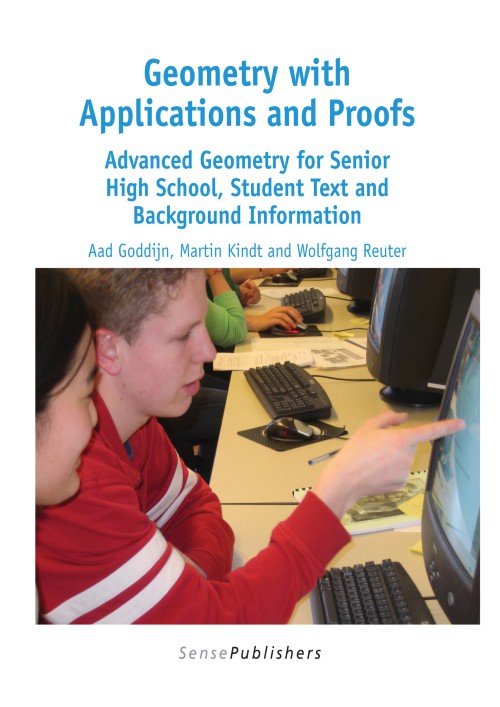
520 |aThis book shows how geometry can be learned by starting with real world problems which are solved by intuition, common sense reasoning and experiments. Gradually the more formal demands of mathematical proofs get their proper place and make it possible to explore new applications. This process helps students to feel the need for precise definitions and procedures, to contribute to the construction of an axiomatic system, and to experience the power of systematic reasoning. The course is designed for students in a Nature & Technology strand which prepares for studying the sciences or technology at university level. Its goal was basically to reintroduce ‘proof’ in a meaningful way in the late 1990s Dutch secondary education curriculum. Following the educational view of the Freudenthal Institute this is not done by stating Euclid’s axioms on page one, but rather a starting point is chosen in students’ intuitions and tentative solutions of problems that are experienced as real and relevant. The photograph on the cover shows students exploring one of the problems from the midpart of the course in the computerlab.
532 8 |aAccessibility summary: This PDF eBook is produced by a third-party. We have requested that the file be made accessible and compliant with the European Accessibility Act (EAA). However, we have not been able to fully verify its compliance with recognized accessibility standards (such as PDF/UA or WCAG). For detailed accessibility information, please refer to the original publisher’s website. If you require an accessible version of this content, please contact accessibilitysupport@springernature.com. We are committed to improving accessibility and will work with the publisher to meet your needs wherever possible.
532 8 |aPublisher contact for further accessibility information: accessibilitysupport@springernature.com
650 0|aEducation.
650 14|aEducation.
700 1 |aKindt, Martin.|eauthor.|4aut|4http://id.loc.gov/vocabulary/relators/aut
700 1 |aReuter, Wolfgang.|eauthor.|4aut|4http://id.loc.gov/vocabulary/relators/aut
710 2 |aSpringerLink (Online service)
773 0 |tSpringer Nature eBook
830 0|aDutch Design in Mathematics Education
856 40|uhttps://doi.org/10.1007/978-94-6209-860-2
912 |aZDB-2-SHU
912 |aZDB-2-SXED
950 |aHumanities, Social Sciences and Law (SpringerNature-11648)
950 |aEducation (R0) (SpringerNature-43721)