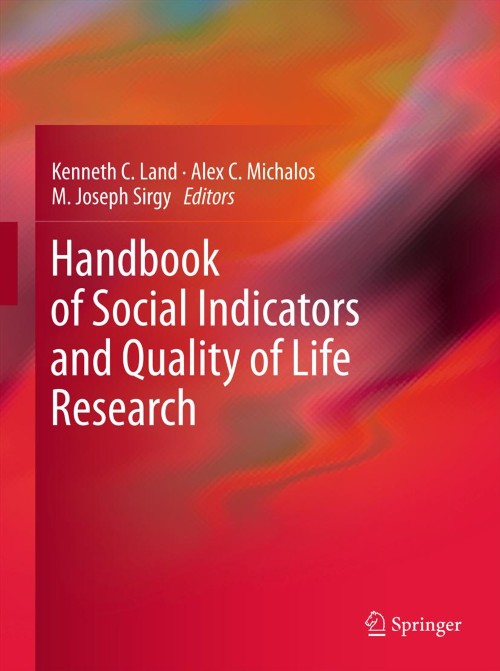
Handbook of Social Indicators and Quality of Life Research [electronic resource] / edited by Kenneth C. Land, Alex C. Michalos, M. Joseph Sirgy.
Erişim Adresi
ISBN
9789400724211
Dil Kodu
İngilizce
Yer Numarası
DK/14818
Basım Bildirimi
1st ed. 2012.
Yayın Bilgisi
Dordrecht : Springer Netherlands : Imprint: Springer, 2012.
Fiziksel Niteleme
X, 593 p. 91 illus. online resource.
İçindekiler Notu
Acknowledgments -- Prologue: The Development and Evolution of Research on Social Indicators and Quality-of-Life (QOL): Kenneth C. Land, Alex C. Michalos, and M. Joseph Sirgy -- 1. The Good Life: Eight Century to Third Century BCE: Alex C. Michalos, and Steve R. Robinson -- 2. Happiness, Also Known as Life Satisfaction and Subjective Well-Being: Ruut Veenhoven -- 3. Subjective Well-Being Homeostasis: Robert A. Cummins, Anna L.D. Lau, and Melanie Davern -- 4. Positive Psychology and the Quality-of-Life: Cross Sectional and Time Series Evidence: Richard A. Easterlin, and Laura Angelescu -- 6. National Accounts of Well-Being: Ed Diener, and William Tov -- 7. Time Use as a Social Indicator: John P. Robinson, and Steve Martin -- 8. Issues in Composite Index Construction: The Measurement of Overall Quality of Life: Michael R. Hagerty, and Kenneth C. Land -- 9. Measuring the Quality of Life and the Construction of Social Indicators: Filomena Maggino, and Bruno Zumbo -- 10. Quality of Life in General Medicine, Psychiatry and Mental Health: Michael Frisch -- 11. Education and Quality of Life: Jason D. Edgerton, Lance W. Roberts, and Suzanne von Below -- 12. Review of Research to Quality-of-Work-Life (QWL) Programs: Joe Sirgy, Nora P. Reilly, Jiyun Wu, and David Efraty -- 13. Spirituality, Religion and Subjective Quality of Life: Ralph Piedmont, and Philip Freedman -- 14. Consumer Well-Being (CWB): Various Conceptualizations and Measures: Dong-Jin Lee, and M. Joseph Sirgy -- 15. Perceived Quality of Life of Children and Youth: Scott Huebner, Rich Gilman, and Claudia Ma -- 16. The Quality of Life of Adults: Elizabeth Eckermann -- 17. Cross-National Comparisons of Quality of Life in Developed Nations, Including the Impact of Globalization: Wolfgang Glatzer -- 18.Quality of Life in Developing Nations: Laura Camfield -- 19. Economies in Transition: Revisiting Challenges to Quality of Life: Richard J. Estes -- 20. Quality of Life in Australia: Robert A. Cummins, Jacqueline Woerner,Adrian Tomyn, and Adele Gibson -- 21. Quality of Life in Est Asia: The Case of Hong Kong: Daniel T.L. Shek -- 22. The Quality of Life of Muslim Populations: The Case of Algeria: Habib Tiliouine, and Mohamed Meziane -- 23. Quality of Life in Latin America and the Caribbean: Mariano Rojas -- 24. Quality of Life in Argentina: Graciela Tonon -- 25. ‘’Failed’’ and ‘’Failing’’ States: Is Quality of Life Possible?: Richard J. Estes.-.
Özet, vb.
The aim of the Handbook of Social Indicators and Quality of Life Research is to create an overview of the field of Quality of Life (QOL) studies in the early years of the 21st century that can be updated and improved upon as the field evolves and the century unfolds. Social indicators are statistical time series “…used to monitor the social system, helping to identify changes and to guide intervention to alter the course of social change”. Examples include unemployment rates, crime rates, estimates of life expectancy, health status indices, school enrollment rates, average achievement scores, election voting rates, and measures of subjective well-being such as satisfaction with life-as-a-whole and with specific domains or aspects of life. This book provides a review of the historical development of the field including the history of QOL in medicine and mental health as well as the research related to quality-of-work-life (QWL) programs. It discusses several of QOL main concepts: happiness, positive psychology, and subjective wellbeing. Relations between spirituality and religiousness and QOL are examined as are the effects of educational attainment on QOL and marketing, and the associations with economic growth. The book goes on to investigate methodological approaches and issues that should be considered in measuring and analysing quality of life from a quantitative perspective. The final chapters are dedicated to research on elements of QOL in a broad range of countries and populations.
Konu
Social sciences.
Quality of life.
Political science.
Anthropology.
Society.
Quality of Life Research.
Political Science.
Anthropology.
Quality of life.
Political science.
Anthropology.
Society.
Quality of Life Research.
Political Science.
Anthropology.
Diğer Yazarlar
Kurum Adı

Eseri Alıntıla
Referansları kullanmadan önce gözden geçirmeniz ve varsa gerekli düzeltmeleri yapmanız önerilir.
Dijital Kaynak
MARC Görünümü
LEADER 05972nam a22005655i 4500
001 813576
003 TR_AnAIT
005 20260130224457
007 cr nn 008mamaa
008 111124s2012 ne | s |||| 0|eng d
020 |a9789400724211|9978-94-007-2421-1
024 7 |a10.1007/978-94-007-2421-1|2doi
041 |aeng
049 |aTürk Tarih Kurumu Kütüphanesi
050 4|aH1-970.9
072 7|aJ|2bicssc
072 7|aJHB|2bicssc
072 7|aSOC000000|2bisacsh
072 7|aJ|2thema
072 7|aJHB|2thema
082 04|a300|223
090 |aDK/14818
245 10|aHandbook of Social Indicators and Quality of Life Research|h[electronic resource] /|cedited by Kenneth C. Land, Alex C. Michalos, M. Joseph Sirgy.
250 |a1st ed. 2012.
264 1|aDordrecht :|bSpringer Netherlands :|bImprint: Springer,|c2012.
300 |aX, 593 p. 91 illus.|bonline resource.
336 |atext|btxt|2rdacontent
337 |acomputer|bc|2rdamedia
338 |aonline resource|bcr|2rdacarrier
347 |atext file|bPDF|2rda
505 0 |aAcknowledgments -- Prologue: The Development and Evolution of Research on Social Indicators and Quality-of-Life (QOL): Kenneth C. Land, Alex C. Michalos, and M. Joseph Sirgy -- 1. The Good Life: Eight Century to Third Century BCE: Alex C. Michalos, and Steve R. Robinson -- 2. Happiness, Also Known as Life Satisfaction and Subjective Well-Being: Ruut Veenhoven -- 3. Subjective Well-Being Homeostasis: Robert A. Cummins, Anna L.D. Lau, and Melanie Davern -- 4. Positive Psychology and the Quality-of-Life: Cross Sectional and Time Series Evidence: Richard A. Easterlin, and Laura Angelescu -- 6. National Accounts of Well-Being: Ed Diener, and William Tov -- 7. Time Use as a Social Indicator: John P. Robinson, and Steve Martin -- 8. Issues in Composite Index Construction: The Measurement of Overall Quality of Life: Michael R. Hagerty, and Kenneth C. Land -- 9. Measuring the Quality of Life and the Construction of Social Indicators: Filomena Maggino, and Bruno Zumbo -- 10. Quality of Life in General Medicine, Psychiatry and Mental Health: Michael Frisch -- 11. Education and Quality of Life: Jason D. Edgerton, Lance W. Roberts, and Suzanne von Below -- 12. Review of Research to Quality-of-Work-Life (QWL) Programs: Joe Sirgy, Nora P. Reilly, Jiyun Wu, and David Efraty -- 13. Spirituality, Religion and Subjective Quality of Life: Ralph Piedmont, and Philip Freedman -- 14. Consumer Well-Being (CWB): Various Conceptualizations and Measures: Dong-Jin Lee, and M. Joseph Sirgy -- 15. Perceived Quality of Life of Children and Youth: Scott Huebner, Rich Gilman, and Claudia Ma -- 16. The Quality of Life of Adults: Elizabeth Eckermann -- 17. Cross-National Comparisons of Quality of Life in Developed Nations, Including the Impact of Globalization: Wolfgang Glatzer -- 18.Quality of Life in Developing Nations: Laura Camfield -- 19. Economies in Transition: Revisiting Challenges to Quality of Life: Richard J. Estes -- 20. Quality of Life in Australia: Robert A. Cummins, Jacqueline Woerner,Adrian Tomyn, and Adele Gibson -- 21. Quality of Life in Est Asia: The Case of Hong Kong: Daniel T.L. Shek -- 22. The Quality of Life of Muslim Populations: The Case of Algeria: Habib Tiliouine, and Mohamed Meziane -- 23. Quality of Life in Latin America and the Caribbean: Mariano Rojas -- 24. Quality of Life in Argentina: Graciela Tonon -- 25. ‘’Failed’’ and ‘’Failing’’ States: Is Quality of Life Possible?: Richard J. Estes.-.
520 |aThe aim of the Handbook of Social Indicators and Quality of Life Research is to create an overview of the field of Quality of Life (QOL) studies in the early years of the 21st century that can be updated and improved upon as the field evolves and the century unfolds. Social indicators are statistical time series “…used to monitor the social system, helping to identify changes and to guide intervention to alter the course of social change”. Examples include unemployment rates, crime rates, estimates of life expectancy, health status indices, school enrollment rates, average achievement scores, election voting rates, and measures of subjective well-being such as satisfaction with life-as-a-whole and with specific domains or aspects of life. This book provides a review of the historical development of the field including the history of QOL in medicine and mental health as well as the research related to quality-of-work-life (QWL) programs. It discusses several of QOL main concepts: happiness, positive psychology, and subjective wellbeing. Relations between spirituality and religiousness and QOL are examined as are the effects of educational attainment on QOL and marketing, and the associations with economic growth. The book goes on to investigate methodological approaches and issues that should be considered in measuring and analysing quality of life from a quantitative perspective. The final chapters are dedicated to research on elements of QOL in a broad range of countries and populations.
650 0|aSocial sciences.
650 0|aQuality of life.
650 0|aPolitical science.
650 0|aAnthropology.
650 14|aSociety.
650 24|aQuality of Life Research.
650 24|aPolitical Science.
650 24|aAnthropology.
700 1 |aLand, Kenneth C.|eeditor.|4edt|4http://id.loc.gov/vocabulary/relators/edt
700 1 |aMichalos, Alex C.|eeditor.|4edt|4http://id.loc.gov/vocabulary/relators/edt
700 1 |aSirgy, M. Joseph.|eeditor.|4edt|4http://id.loc.gov/vocabulary/relators/edt
710 2 |aSpringerLink (Online service)
773 0 |tSpringer Nature eBook
776 08|iPrinted edition:|z9789400724204
776 08|iPrinted edition:|z9789400724228
776 08|iPrinted edition:|z9789401779081
856 40|uhttps://doi.org/10.1007/978-94-007-2421-1
912 |aZDB-2-SHU
912 |aZDB-2-SXS
950 |aHumanities, Social Sciences and Law (SpringerNature-11648)
950 |aSocial Sciences (R0) (SpringerNature-43726)
001 813576
003 TR_AnAIT
005 20260130224457
007 cr nn 008mamaa
008 111124s2012 ne | s |||| 0|eng d
020 |a9789400724211|9978-94-007-2421-1
024 7 |a10.1007/978-94-007-2421-1|2doi
041 |aeng
049 |aTürk Tarih Kurumu Kütüphanesi
050 4|aH1-970.9
072 7|aJ|2bicssc
072 7|aJHB|2bicssc
072 7|aSOC000000|2bisacsh
072 7|aJ|2thema
072 7|aJHB|2thema
082 04|a300|223
090 |aDK/14818
245 10|aHandbook of Social Indicators and Quality of Life Research|h[electronic resource] /|cedited by Kenneth C. Land, Alex C. Michalos, M. Joseph Sirgy.
250 |a1st ed. 2012.
264 1|aDordrecht :|bSpringer Netherlands :|bImprint: Springer,|c2012.
300 |aX, 593 p. 91 illus.|bonline resource.
336 |atext|btxt|2rdacontent
337 |acomputer|bc|2rdamedia
338 |aonline resource|bcr|2rdacarrier
347 |atext file|bPDF|2rda
505 0 |aAcknowledgments -- Prologue: The Development and Evolution of Research on Social Indicators and Quality-of-Life (QOL): Kenneth C. Land, Alex C. Michalos, and M. Joseph Sirgy -- 1. The Good Life: Eight Century to Third Century BCE: Alex C. Michalos, and Steve R. Robinson -- 2. Happiness, Also Known as Life Satisfaction and Subjective Well-Being: Ruut Veenhoven -- 3. Subjective Well-Being Homeostasis: Robert A. Cummins, Anna L.D. Lau, and Melanie Davern -- 4. Positive Psychology and the Quality-of-Life: Cross Sectional and Time Series Evidence: Richard A. Easterlin, and Laura Angelescu -- 6. National Accounts of Well-Being: Ed Diener, and William Tov -- 7. Time Use as a Social Indicator: John P. Robinson, and Steve Martin -- 8. Issues in Composite Index Construction: The Measurement of Overall Quality of Life: Michael R. Hagerty, and Kenneth C. Land -- 9. Measuring the Quality of Life and the Construction of Social Indicators: Filomena Maggino, and Bruno Zumbo -- 10. Quality of Life in General Medicine, Psychiatry and Mental Health: Michael Frisch -- 11. Education and Quality of Life: Jason D. Edgerton, Lance W. Roberts, and Suzanne von Below -- 12. Review of Research to Quality-of-Work-Life (QWL) Programs: Joe Sirgy, Nora P. Reilly, Jiyun Wu, and David Efraty -- 13. Spirituality, Religion and Subjective Quality of Life: Ralph Piedmont, and Philip Freedman -- 14. Consumer Well-Being (CWB): Various Conceptualizations and Measures: Dong-Jin Lee, and M. Joseph Sirgy -- 15. Perceived Quality of Life of Children and Youth: Scott Huebner, Rich Gilman, and Claudia Ma -- 16. The Quality of Life of Adults: Elizabeth Eckermann -- 17. Cross-National Comparisons of Quality of Life in Developed Nations, Including the Impact of Globalization: Wolfgang Glatzer -- 18.Quality of Life in Developing Nations: Laura Camfield -- 19. Economies in Transition: Revisiting Challenges to Quality of Life: Richard J. Estes -- 20. Quality of Life in Australia: Robert A. Cummins, Jacqueline Woerner,Adrian Tomyn, and Adele Gibson -- 21. Quality of Life in Est Asia: The Case of Hong Kong: Daniel T.L. Shek -- 22. The Quality of Life of Muslim Populations: The Case of Algeria: Habib Tiliouine, and Mohamed Meziane -- 23. Quality of Life in Latin America and the Caribbean: Mariano Rojas -- 24. Quality of Life in Argentina: Graciela Tonon -- 25. ‘’Failed’’ and ‘’Failing’’ States: Is Quality of Life Possible?: Richard J. Estes.-.
520 |aThe aim of the Handbook of Social Indicators and Quality of Life Research is to create an overview of the field of Quality of Life (QOL) studies in the early years of the 21st century that can be updated and improved upon as the field evolves and the century unfolds. Social indicators are statistical time series “…used to monitor the social system, helping to identify changes and to guide intervention to alter the course of social change”. Examples include unemployment rates, crime rates, estimates of life expectancy, health status indices, school enrollment rates, average achievement scores, election voting rates, and measures of subjective well-being such as satisfaction with life-as-a-whole and with specific domains or aspects of life. This book provides a review of the historical development of the field including the history of QOL in medicine and mental health as well as the research related to quality-of-work-life (QWL) programs. It discusses several of QOL main concepts: happiness, positive psychology, and subjective wellbeing. Relations between spirituality and religiousness and QOL are examined as are the effects of educational attainment on QOL and marketing, and the associations with economic growth. The book goes on to investigate methodological approaches and issues that should be considered in measuring and analysing quality of life from a quantitative perspective. The final chapters are dedicated to research on elements of QOL in a broad range of countries and populations.
650 0|aSocial sciences.
650 0|aQuality of life.
650 0|aPolitical science.
650 0|aAnthropology.
650 14|aSociety.
650 24|aQuality of Life Research.
650 24|aPolitical Science.
650 24|aAnthropology.
700 1 |aLand, Kenneth C.|eeditor.|4edt|4http://id.loc.gov/vocabulary/relators/edt
700 1 |aMichalos, Alex C.|eeditor.|4edt|4http://id.loc.gov/vocabulary/relators/edt
700 1 |aSirgy, M. Joseph.|eeditor.|4edt|4http://id.loc.gov/vocabulary/relators/edt
710 2 |aSpringerLink (Online service)
773 0 |tSpringer Nature eBook
776 08|iPrinted edition:|z9789400724204
776 08|iPrinted edition:|z9789400724228
776 08|iPrinted edition:|z9789401779081
856 40|uhttps://doi.org/10.1007/978-94-007-2421-1
912 |aZDB-2-SHU
912 |aZDB-2-SXS
950 |aHumanities, Social Sciences and Law (SpringerNature-11648)
950 |aSocial Sciences (R0) (SpringerNature-43726)
Materyaller
Depodan talep edilen materyal sadece kütüphane içerisinde kullanılmaktadır.
Materyal dışarıya ödünç verilmemektedir.
