

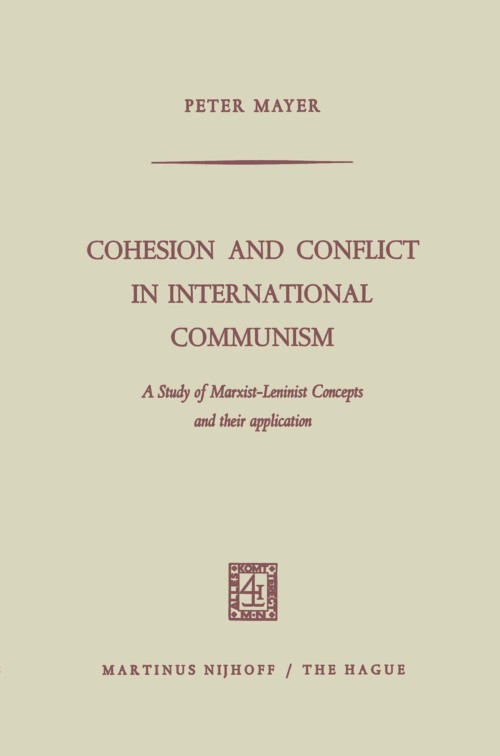
Cohesion and Conflict in International Communism [electronic resource] : A Study of Marxist-Leninist Concepts and Their Application / by Peter Mayer.
Erişim Adresi
ISBN
9789401504959
Dil Kodu
İngilizce
Yer Numarası
DK/14844
Yazar
Basım Bildirimi
1st ed. 1968.
Yayın Bilgisi
Dordrecht : Springer Netherlands : Imprint: Springer, 1968.
Fiziksel Niteleme
257 p. online resource.
İçindekiler Notu
I. The Unity Theory VS. Socialism in One Country -- From “Proletarian internationalism” to “Socialism in One Country” -- II. The Soviet View of the Socialist World State: Development and Control Factor Aspects -- The Soviet Conception of the Communist Camp Future -- III. A Consideration of Chinese Contributions to “Marxism,” Including “Prolonged Struggle” and “revolutionary Fervor” -- The Chinese Communist View of Permissible and Impermissible “Paths to Socialism” -- IV. The Sino-Soviet Dispute, and Some Implications for the Future of the World Communist Movement -- The Dialectics of Dispute: Tactics and Strategy of Communist Concepts in the Thermonuclear Age -- Unity or Diversity -- Factors Tending Toward Unity in the Communist Camp -- The Breakdown in Communications -- The Changing Political Realities -- The Italian and German Party Congresses, 1962 and 1963 -- Communist Dogma or “Creative Marxism”? -- V. The Soviet Union and East Europe: Conflict, Support and Opposition -- Institutionalized Divergence: The Case of Yugoslavia -- Albania: China’s Window to Europe -- Poland: Nationalism Contained by Territorial Claims -- Hungary: From Repression to Permissiveness? -- Rumania: Path to Economic Independence -- Bulgaria: Unconditional Support for the U.S.S.R. -- Czechoslovakia: Politics take Precedence over Ideology -- East Germany: The Permanent Satellite -- Conclusion -- VI. The International Communist Movement: A Reappraisal of Some Theoretical Concepts.
Özet, vb.
The current conflict which threatens the very existence of the inter national communist movement as a single coherent entity must be looked for in the roots of Marxian philosophy. The central concept of pre-Leninist communism is contained in the notion of "proletarian internationalism. " Yet the emergence of the communist party-states has been squarely predicated on the requirements of single national states, as viewed through the training and experience of the various communist leaders. Thus the Soviet version has been shaped by the nationalism of Lenin, Stalin, and Khrushchev. The only aberrant case, the internationalism of Trotsky, was doomed to failure. The Chinese version of "communism" has as its root concepts the spirit of "prolonged" struggle against a superior enemy, whose ultimate defeat is ensured through the dialectics of political growth. The non communist societies are by definition "decadent. " The movement came to power by exploiting the nationalism engendered within China by the Japanese invasion. Its mass support was based on the peasantry, although the transparent fiction of "proletarian leadership" was strictly maintained. Further, "communism" is a term which has lost its original encompassing definition. Peking now narrowly defines it as policies consonant with "the thought of Mao Tse-tung. " Thus both the Soviet and the Chinese interpretation of "commun ism" are based on a concept which was anathema to the intellectual founders of the movement.
Konu
Political science.
History.
Ethnology.
Culture.
Political Science.
History.
Regional Cultural Studies.
History.
Ethnology.
Culture.
Political Science.
History.
Regional Cultural Studies.
Kurum Adı
Eseri Alıntıla
Referansları kullanmadan önce gözden geçirmeniz ve varsa gerekli düzeltmeleri yapmanız önerilir.
Dijital Kaynak
MARC Görünümü
LEADER 05478nam a22005535i 4500
001 813602
003 TR_AnAIT
005 20260130224353
007 cr nn 008mamaa
008 121227s1968 ne | s |||| 0|eng d
020 |a9789401504959|9978-94-015-0495-9
024 7 |a10.1007/978-94-015-0495-9|2doi
041 |aeng
049 |aTürk Tarih Kurumu Kütüphanesi
050 4|aJA1-92
072 7|aJPA|2bicssc
072 7|aPOL000000|2bisacsh
072 7|aJPA|2thema
082 04|a320|223
090 |aDK/14844
100 1 |aMayer, Peter.|eauthor.|4aut|4http://id.loc.gov/vocabulary/relators/aut
245 10|aCohesion and Conflict in International Communism|h[electronic resource] :|bA Study of Marxist-Leninist Concepts and Their Application /|cby Peter Mayer.
250 |a1st ed. 1968.
264 1|aDordrecht :|bSpringer Netherlands :|bImprint: Springer,|c1968.
300 |a257 p.|bonline resource.
336 |atext|btxt|2rdacontent
337 |acomputer|bc|2rdamedia
338 |aonline resource|bcr|2rdacarrier
347 |atext file|bPDF|2rda
505 0 |aI. The Unity Theory VS. Socialism in One Country -- From “Proletarian internationalism” to “Socialism in One Country” -- II. The Soviet View of the Socialist World State: Development and Control Factor Aspects -- The Soviet Conception of the Communist Camp Future -- III. A Consideration of Chinese Contributions to “Marxism,” Including “Prolonged Struggle” and “revolutionary Fervor” -- The Chinese Communist View of Permissible and Impermissible “Paths to Socialism” -- IV. The Sino-Soviet Dispute, and Some Implications for the Future of the World Communist Movement -- The Dialectics of Dispute: Tactics and Strategy of Communist Concepts in the Thermonuclear Age -- Unity or Diversity -- Factors Tending Toward Unity in the Communist Camp -- The Breakdown in Communications -- The Changing Political Realities -- The Italian and German Party Congresses, 1962 and 1963 -- Communist Dogma or “Creative Marxism”? -- V. The Soviet Union and East Europe: Conflict, Support and Opposition -- Institutionalized Divergence: The Case of Yugoslavia -- Albania: China’s Window to Europe -- Poland: Nationalism Contained by Territorial Claims -- Hungary: From Repression to Permissiveness? -- Rumania: Path to Economic Independence -- Bulgaria: Unconditional Support for the U.S.S.R. -- Czechoslovakia: Politics take Precedence over Ideology -- East Germany: The Permanent Satellite -- Conclusion -- VI. The International Communist Movement: A Reappraisal of Some Theoretical Concepts.
520 |aThe current conflict which threatens the very existence of the inter national communist movement as a single coherent entity must be looked for in the roots of Marxian philosophy. The central concept of pre-Leninist communism is contained in the notion of "proletarian internationalism. " Yet the emergence of the communist party-states has been squarely predicated on the requirements of single national states, as viewed through the training and experience of the various communist leaders. Thus the Soviet version has been shaped by the nationalism of Lenin, Stalin, and Khrushchev. The only aberrant case, the internationalism of Trotsky, was doomed to failure. The Chinese version of "communism" has as its root concepts the spirit of "prolonged" struggle against a superior enemy, whose ultimate defeat is ensured through the dialectics of political growth. The non communist societies are by definition "decadent. " The movement came to power by exploiting the nationalism engendered within China by the Japanese invasion. Its mass support was based on the peasantry, although the transparent fiction of "proletarian leadership" was strictly maintained. Further, "communism" is a term which has lost its original encompassing definition. Peking now narrowly defines it as policies consonant with "the thought of Mao Tse-tung. " Thus both the Soviet and the Chinese interpretation of "commun ism" are based on a concept which was anathema to the intellectual founders of the movement.
532 8 |aAccessibility summary: This PDF is not accessible. It is based on scanned pages and does not support features such as screen reader compatibility or described non-text content (images, graphs etc). However, it likely supports searchable and selectable text based on OCR (Optical Character Recognition). Users with accessibility needs may not be able to use this content effectively. Please contact us at accessibilitysupport@springernature.com if you require assistance or an alternative format.
532 8 |aInaccessible, or known limited accessibility
532 8 |aNo reading system accessibility options actively disabled
532 8 |aPublisher contact for further accessibility information: accessibilitysupport@springernature.com
650 0|aPolitical science.
650 0|aHistory.
650 0|aEthnology.
650 0|aCulture.
650 14|aPolitical Science.
650 24|aHistory.
650 24|aRegional Cultural Studies.
710 2 |aSpringerLink (Online service)
773 0 |tSpringer Nature eBook
776 08|iPrinted edition:|z9789401500302
776 08|iPrinted edition:|z9789401504966
856 40|uhttps://doi.org/10.1007/978-94-015-0495-9
912 |aZDB-2-SHU
912 |aZDB-2-SXPI
912 |aZDB-2-BAE
950 |aHumanities, Social Sciences and Law (SpringerNature-11648)
950 |aPolitical Science and International Studies (R0) (SpringerNature-43724)
001 813602
003 TR_AnAIT
005 20260130224353
007 cr nn 008mamaa
008 121227s1968 ne | s |||| 0|eng d
020 |a9789401504959|9978-94-015-0495-9
024 7 |a10.1007/978-94-015-0495-9|2doi
041 |aeng
049 |aTürk Tarih Kurumu Kütüphanesi
050 4|aJA1-92
072 7|aJPA|2bicssc
072 7|aPOL000000|2bisacsh
072 7|aJPA|2thema
082 04|a320|223
090 |aDK/14844
100 1 |aMayer, Peter.|eauthor.|4aut|4http://id.loc.gov/vocabulary/relators/aut
245 10|aCohesion and Conflict in International Communism|h[electronic resource] :|bA Study of Marxist-Leninist Concepts and Their Application /|cby Peter Mayer.
250 |a1st ed. 1968.
264 1|aDordrecht :|bSpringer Netherlands :|bImprint: Springer,|c1968.
300 |a257 p.|bonline resource.
336 |atext|btxt|2rdacontent
337 |acomputer|bc|2rdamedia
338 |aonline resource|bcr|2rdacarrier
347 |atext file|bPDF|2rda
505 0 |aI. The Unity Theory VS. Socialism in One Country -- From “Proletarian internationalism” to “Socialism in One Country” -- II. The Soviet View of the Socialist World State: Development and Control Factor Aspects -- The Soviet Conception of the Communist Camp Future -- III. A Consideration of Chinese Contributions to “Marxism,” Including “Prolonged Struggle” and “revolutionary Fervor” -- The Chinese Communist View of Permissible and Impermissible “Paths to Socialism” -- IV. The Sino-Soviet Dispute, and Some Implications for the Future of the World Communist Movement -- The Dialectics of Dispute: Tactics and Strategy of Communist Concepts in the Thermonuclear Age -- Unity or Diversity -- Factors Tending Toward Unity in the Communist Camp -- The Breakdown in Communications -- The Changing Political Realities -- The Italian and German Party Congresses, 1962 and 1963 -- Communist Dogma or “Creative Marxism”? -- V. The Soviet Union and East Europe: Conflict, Support and Opposition -- Institutionalized Divergence: The Case of Yugoslavia -- Albania: China’s Window to Europe -- Poland: Nationalism Contained by Territorial Claims -- Hungary: From Repression to Permissiveness? -- Rumania: Path to Economic Independence -- Bulgaria: Unconditional Support for the U.S.S.R. -- Czechoslovakia: Politics take Precedence over Ideology -- East Germany: The Permanent Satellite -- Conclusion -- VI. The International Communist Movement: A Reappraisal of Some Theoretical Concepts.
520 |aThe current conflict which threatens the very existence of the inter national communist movement as a single coherent entity must be looked for in the roots of Marxian philosophy. The central concept of pre-Leninist communism is contained in the notion of "proletarian internationalism. " Yet the emergence of the communist party-states has been squarely predicated on the requirements of single national states, as viewed through the training and experience of the various communist leaders. Thus the Soviet version has been shaped by the nationalism of Lenin, Stalin, and Khrushchev. The only aberrant case, the internationalism of Trotsky, was doomed to failure. The Chinese version of "communism" has as its root concepts the spirit of "prolonged" struggle against a superior enemy, whose ultimate defeat is ensured through the dialectics of political growth. The non communist societies are by definition "decadent. " The movement came to power by exploiting the nationalism engendered within China by the Japanese invasion. Its mass support was based on the peasantry, although the transparent fiction of "proletarian leadership" was strictly maintained. Further, "communism" is a term which has lost its original encompassing definition. Peking now narrowly defines it as policies consonant with "the thought of Mao Tse-tung. " Thus both the Soviet and the Chinese interpretation of "commun ism" are based on a concept which was anathema to the intellectual founders of the movement.
532 8 |aAccessibility summary: This PDF is not accessible. It is based on scanned pages and does not support features such as screen reader compatibility or described non-text content (images, graphs etc). However, it likely supports searchable and selectable text based on OCR (Optical Character Recognition). Users with accessibility needs may not be able to use this content effectively. Please contact us at accessibilitysupport@springernature.com if you require assistance or an alternative format.
532 8 |aInaccessible, or known limited accessibility
532 8 |aNo reading system accessibility options actively disabled
532 8 |aPublisher contact for further accessibility information: accessibilitysupport@springernature.com
650 0|aPolitical science.
650 0|aHistory.
650 0|aEthnology.
650 0|aCulture.
650 14|aPolitical Science.
650 24|aHistory.
650 24|aRegional Cultural Studies.
710 2 |aSpringerLink (Online service)
773 0 |tSpringer Nature eBook
776 08|iPrinted edition:|z9789401500302
776 08|iPrinted edition:|z9789401504966
856 40|uhttps://doi.org/10.1007/978-94-015-0495-9
912 |aZDB-2-SHU
912 |aZDB-2-SXPI
912 |aZDB-2-BAE
950 |aHumanities, Social Sciences and Law (SpringerNature-11648)
950 |aPolitical Science and International Studies (R0) (SpringerNature-43724)
Materyaller
Depodan talep edilen materyal sadece kütüphane içerisinde kullanılmaktadır.
Materyal dışarıya ödünç verilmemektedir.
Materyal dışarıya ödünç verilmemektedir.
