

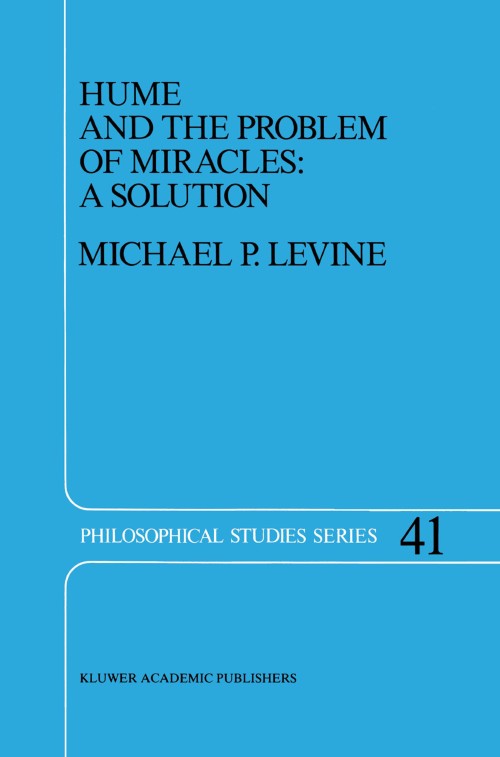
Hume and the Problem of Miracles: A Solution [electronic resource] / by M.P. Levine.
Erişim Adresi
ISBN
9789400922457
Dil Kodu
İngilizce
Yer Numarası
DK/14851
Yazar
Basım Bildirimi
1st ed. 1989.
Yayın Bilgisi
Dordrecht : Springer Netherlands : Imprint: Springer, 1989.
Fiziksel Niteleme
VIII, 212 p. online resource.
Dizi
Philosophical Studies Series, 2542-8349 ; 41
İçindekiler Notu
I Hume’s Analysis of Causation in Relation to His Analysis of Miracles -- 1. Hume’s Account of A Posteriori Reasoning -- 2. Miracles and Reasoning based on Experience -- 3. The Indian and The Ice: Understanding and Rejecting Hume’s Argument -- 4. A Better But Less Interesting Humean Argument -- 5. Miracles and The Logical Entailment Analysis of Causation -- 6. Are Miracles Violations of Laws of Nature? -- Notes to Part I -- II Can Anyone Ever Know That a Miracle Has Occurred? -- 7. What Is Involved In Knowing That a Miracle has Occurred? -- 8. Hume’s Account of Tillotson and the Alleged “Argument of a Like Nature” -- 9. Testimony and Sensory Evidence: Reasons For Belief in Miracles? -- 10. Tillotson’s Argument: Its Application to Justified Belief in Miracles -- 11. Conclusion: Miracles and Contemporary Epistemology -- Notes to Part II -- Index of Names -- Index of Subjects.
Özet, vb.
This book developed from sections of my doctoral dissertation, "The Possibility of Religious Knowledge: Causation, Coherentism and Foundationalism," Brown University, 1982. However, it actually had its beginnings much earlier when, as an undergraduate at the University of Virginia, I first read Hume's "Of Miracles" and became interested in it. (Fascinated would be too strong. ) My teacher put the following marginal comment in a paper I wrote about it: "Suppose someone told you that they had been impregnated by an angel whispering into their ear. Wouldn't you think they had gone dotty?" She had spent time in England. I thought about it. I agreed that I would not have believed such testimony, but did not think this had much to do with Hume's argument against belief in miracles. What surprised me even more was the secondary literature. I became convinced that Hume's argument was misunderstood. My main thesis is established in Part I. This explains Hume's argument against justified belief in miracles and shows how it follows from, and is intrinsically connected with, his more general metaphysics. Part II Part I. It should give the reader a more complete understanding builds on of both the structure of Hume's argument and of his crucial and questionable premises. Chapters 5 and 11 are perhaps the most technical in the book, but they are also the least necessary. They can be skipped by the reader who is only interested in Hume on miracles.
Konu
Knowledge, Theory of.
Philosophy.
Epistemology.
Philosophy.
Philosophy.
Epistemology.
Philosophy.
Kurum Adı
Eseri Alıntıla
Referansları kullanmadan önce gözden geçirmeniz ve varsa gerekli düzeltmeleri yapmanız önerilir.
Dijital Kaynak
MARC Görünümü
LEADER 04837nam a22005535i 4500
001 813609
003 TR_AnAIT
005 20260130224331
007 cr nn 008mamaa
008 121227s1989 ne | s |||| 0|eng d
020 |a9789400922457|9978-94-009-2245-7
024 7 |a10.1007/978-94-009-2245-7|2doi
041 |aeng
049 |aTürk Tarih Kurumu Kütüphanesi
050 4|aBD143-237
072 7|aHPK|2bicssc
072 7|aPHI004000|2bisacsh
072 7|aQDTK|2thema
082 04|a120|223
090 |aDK/14851
100 1 |aLevine, M.P.|eauthor.|4aut|4http://id.loc.gov/vocabulary/relators/aut
245 10|aHume and the Problem of Miracles: A Solution|h[electronic resource] /|cby M.P. Levine.
250 |a1st ed. 1989.
264 1|aDordrecht :|bSpringer Netherlands :|bImprint: Springer,|c1989.
300 |aVIII, 212 p.|bonline resource.
336 |atext|btxt|2rdacontent
337 |acomputer|bc|2rdamedia
338 |aonline resource|bcr|2rdacarrier
347 |atext file|bPDF|2rda
490 1 |aPhilosophical Studies Series,|x2542-8349 ;|v41
505 0 |aI Hume’s Analysis of Causation in Relation to His Analysis of Miracles -- 1. Hume’s Account of A Posteriori Reasoning -- 2. Miracles and Reasoning based on Experience -- 3. The Indian and The Ice: Understanding and Rejecting Hume’s Argument -- 4. A Better But Less Interesting Humean Argument -- 5. Miracles and The Logical Entailment Analysis of Causation -- 6. Are Miracles Violations of Laws of Nature? -- Notes to Part I -- II Can Anyone Ever Know That a Miracle Has Occurred? -- 7. What Is Involved In Knowing That a Miracle has Occurred? -- 8. Hume’s Account of Tillotson and the Alleged “Argument of a Like Nature” -- 9. Testimony and Sensory Evidence: Reasons For Belief in Miracles? -- 10. Tillotson’s Argument: Its Application to Justified Belief in Miracles -- 11. Conclusion: Miracles and Contemporary Epistemology -- Notes to Part II -- Index of Names -- Index of Subjects.
520 |aThis book developed from sections of my doctoral dissertation, "The Possibility of Religious Knowledge: Causation, Coherentism and Foundationalism," Brown University, 1982. However, it actually had its beginnings much earlier when, as an undergraduate at the University of Virginia, I first read Hume's "Of Miracles" and became interested in it. (Fascinated would be too strong. ) My teacher put the following marginal comment in a paper I wrote about it: "Suppose someone told you that they had been impregnated by an angel whispering into their ear. Wouldn't you think they had gone dotty?" She had spent time in England. I thought about it. I agreed that I would not have believed such testimony, but did not think this had much to do with Hume's argument against belief in miracles. What surprised me even more was the secondary literature. I became convinced that Hume's argument was misunderstood. My main thesis is established in Part I. This explains Hume's argument against justified belief in miracles and shows how it follows from, and is intrinsically connected with, his more general metaphysics. Part II Part I. It should give the reader a more complete understanding builds on of both the structure of Hume's argument and of his crucial and questionable premises. Chapters 5 and 11 are perhaps the most technical in the book, but they are also the least necessary. They can be skipped by the reader who is only interested in Hume on miracles.
532 8 |aAccessibility summary: This PDF is not accessible. It is based on scanned pages and does not support features such as screen reader compatibility or described non-text content (images, graphs etc). However, it likely supports searchable and selectable text based on OCR (Optical Character Recognition). Users with accessibility needs may not be able to use this content effectively. Please contact us at accessibilitysupport@springernature.com if you require assistance or an alternative format.
532 8 |aInaccessible, or known limited accessibility
532 8 |aNo reading system accessibility options actively disabled
532 8 |aPublisher contact for further accessibility information: accessibilitysupport@springernature.com
650 0|aKnowledge, Theory of.
650 0|aPhilosophy.
650 14|aEpistemology.
650 24|aPhilosophy.
710 2 |aSpringerLink (Online service)
773 0 |tSpringer Nature eBook
776 08|iPrinted edition:|z9780792300434
776 08|iPrinted edition:|z9789400922464
776 08|iPrinted edition:|z9789401075053
830 0|aPhilosophical Studies Series,|x2542-8349 ;|v41
856 40|uhttps://doi.org/10.1007/978-94-009-2245-7
912 |aZDB-2-SHU
912 |aZDB-2-SXPR
912 |aZDB-2-BAE
950 |aHumanities, Social Sciences and Law (SpringerNature-11648)
950 |aPhilosophy and Religion (R0) (SpringerNature-43725)
001 813609
003 TR_AnAIT
005 20260130224331
007 cr nn 008mamaa
008 121227s1989 ne | s |||| 0|eng d
020 |a9789400922457|9978-94-009-2245-7
024 7 |a10.1007/978-94-009-2245-7|2doi
041 |aeng
049 |aTürk Tarih Kurumu Kütüphanesi
050 4|aBD143-237
072 7|aHPK|2bicssc
072 7|aPHI004000|2bisacsh
072 7|aQDTK|2thema
082 04|a120|223
090 |aDK/14851
100 1 |aLevine, M.P.|eauthor.|4aut|4http://id.loc.gov/vocabulary/relators/aut
245 10|aHume and the Problem of Miracles: A Solution|h[electronic resource] /|cby M.P. Levine.
250 |a1st ed. 1989.
264 1|aDordrecht :|bSpringer Netherlands :|bImprint: Springer,|c1989.
300 |aVIII, 212 p.|bonline resource.
336 |atext|btxt|2rdacontent
337 |acomputer|bc|2rdamedia
338 |aonline resource|bcr|2rdacarrier
347 |atext file|bPDF|2rda
490 1 |aPhilosophical Studies Series,|x2542-8349 ;|v41
505 0 |aI Hume’s Analysis of Causation in Relation to His Analysis of Miracles -- 1. Hume’s Account of A Posteriori Reasoning -- 2. Miracles and Reasoning based on Experience -- 3. The Indian and The Ice: Understanding and Rejecting Hume’s Argument -- 4. A Better But Less Interesting Humean Argument -- 5. Miracles and The Logical Entailment Analysis of Causation -- 6. Are Miracles Violations of Laws of Nature? -- Notes to Part I -- II Can Anyone Ever Know That a Miracle Has Occurred? -- 7. What Is Involved In Knowing That a Miracle has Occurred? -- 8. Hume’s Account of Tillotson and the Alleged “Argument of a Like Nature” -- 9. Testimony and Sensory Evidence: Reasons For Belief in Miracles? -- 10. Tillotson’s Argument: Its Application to Justified Belief in Miracles -- 11. Conclusion: Miracles and Contemporary Epistemology -- Notes to Part II -- Index of Names -- Index of Subjects.
520 |aThis book developed from sections of my doctoral dissertation, "The Possibility of Religious Knowledge: Causation, Coherentism and Foundationalism," Brown University, 1982. However, it actually had its beginnings much earlier when, as an undergraduate at the University of Virginia, I first read Hume's "Of Miracles" and became interested in it. (Fascinated would be too strong. ) My teacher put the following marginal comment in a paper I wrote about it: "Suppose someone told you that they had been impregnated by an angel whispering into their ear. Wouldn't you think they had gone dotty?" She had spent time in England. I thought about it. I agreed that I would not have believed such testimony, but did not think this had much to do with Hume's argument against belief in miracles. What surprised me even more was the secondary literature. I became convinced that Hume's argument was misunderstood. My main thesis is established in Part I. This explains Hume's argument against justified belief in miracles and shows how it follows from, and is intrinsically connected with, his more general metaphysics. Part II Part I. It should give the reader a more complete understanding builds on of both the structure of Hume's argument and of his crucial and questionable premises. Chapters 5 and 11 are perhaps the most technical in the book, but they are also the least necessary. They can be skipped by the reader who is only interested in Hume on miracles.
532 8 |aAccessibility summary: This PDF is not accessible. It is based on scanned pages and does not support features such as screen reader compatibility or described non-text content (images, graphs etc). However, it likely supports searchable and selectable text based on OCR (Optical Character Recognition). Users with accessibility needs may not be able to use this content effectively. Please contact us at accessibilitysupport@springernature.com if you require assistance or an alternative format.
532 8 |aInaccessible, or known limited accessibility
532 8 |aNo reading system accessibility options actively disabled
532 8 |aPublisher contact for further accessibility information: accessibilitysupport@springernature.com
650 0|aKnowledge, Theory of.
650 0|aPhilosophy.
650 14|aEpistemology.
650 24|aPhilosophy.
710 2 |aSpringerLink (Online service)
773 0 |tSpringer Nature eBook
776 08|iPrinted edition:|z9780792300434
776 08|iPrinted edition:|z9789400922464
776 08|iPrinted edition:|z9789401075053
830 0|aPhilosophical Studies Series,|x2542-8349 ;|v41
856 40|uhttps://doi.org/10.1007/978-94-009-2245-7
912 |aZDB-2-SHU
912 |aZDB-2-SXPR
912 |aZDB-2-BAE
950 |aHumanities, Social Sciences and Law (SpringerNature-11648)
950 |aPhilosophy and Religion (R0) (SpringerNature-43725)
Materyaller
Depodan talep edilen materyal sadece kütüphane içerisinde kullanılmaktadır.
Materyal dışarıya ödünç verilmemektedir.
Materyal dışarıya ödünç verilmemektedir.
