

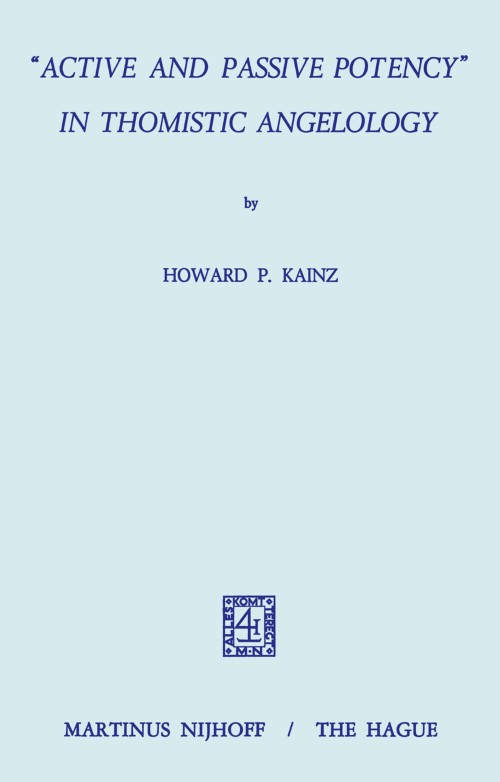
“Active and Passive Potency” in Thomistic Angelology [electronic resource] / by H.P. Kainz.
Erişim Adresi
ISBN
9789401028004
Dil Kodu
İngilizce
Yer Numarası
DK/14867
Yazar
Basım Bildirimi
1st ed. 1972.
Yayın Bilgisi
Dordrecht : Springer Netherlands : Imprint: Springer, 1972.
Fiziksel Niteleme
111 p. online resource.
İçindekiler Notu
Preface -- A. “Separate Substances” and/or “Angels”? -- B. Separate Substances Revisited : The Present Situation -- I. Introduction -- II. The Thomistic Doctrine on Potency -- A. The distinction of Actual from Potential Being -- B. Potency as a Principle of Being -- C. The Primordial Types — Active and Passive -- D. Subdivisions of Active and Passive Potency -- III. The Powers of Separate Substances -- A. Problems Arising in the Investigation of These Powers -- B. Means of Demonstration Proposed by St. Thomas -- C. The Relationship of Physical Bases to Metaphysical Conclusions -- D. The Power of Self-Motion in Separate Substances -- E. The Power of Intellection in Separate Substances -- F. The Power of Volition in Separate Substances -- G. The Hierarchical Disposition of Separate Substances on the Basis of These Powers -- IV. The Capacities of Separate Substances -- A. Means of Investigation of These Capacities -- B. The Capacity for Existence (Esse) in Separate Substances -- C. The Capacity for Justification in Separate Substances -- D. The Capacity for Local Transmutability in Separate Substances -- E. The Relative Capacities of the Angelic Hierarchies -- Index of Names.
Özet, vb.
A. "SEPARATE SUBSTANCES" AND lOR" ANGELS"? It is interesting to note that, in an expressly theological treatise such as the Summa theologiae, St. Thomas generally uses the term "angel", in preference to "separate substance"; while in works with a less explicit theological intent - e. g. the Summa contra gentiles and the De substantiis separatis 1 - he generally prefers the term "separate substance". But at any rate there is little doubt that the two terms, "separate sub stance" and "angel" have a certain interchangeability and equivalence in the works of St. Thomas. In other words, "the separate substance" is equivalent to "the angel, insofar as its existence and attributes are knowable through human reason alone". And this has led Karl Barth 2 to charge that St. Thomas' angelology is primarily a philosophical presenta tion, with little relevance to theology. 1 We might say that these works are "philosophical" insofar as arguments from reason are emphasized in them, rather than arguments from revelation or faith. However, as Lescoe points out (in the Introduction to his edition of the De substantUs separatis, p. 8), the treatise on separate substances leads up to theological subject-matter in Ch. 's XVII ff- namely, an exposition of Catholic teaching as found in Sacred Scripture, the Fathers, and especially Dionysius. And Chenu maintains that the Summa contra gentiles is basically a theological work, because it not only leads up to theological subject-matter in Bk.
Konu
Knowledge, Theory of.
Metaphysics.
Language and languages __ Philosophy.
Epistemology.
Metaphysics.
Philosophy of Language.
Metaphysics.
Language and languages __ Philosophy.
Epistemology.
Metaphysics.
Philosophy of Language.
Kurum Adı
Eseri Alıntıla
Referansları kullanmadan önce gözden geçirmeniz ve varsa gerekli düzeltmeleri yapmanız önerilir.
Dijital Kaynak
MARC Görünümü
LEADER 05098nam a22005415i 4500
001 813626
003 TR_AnAIT
005 20260130224142
007 cr nn 008mamaa
008 121227s1972 ne | s |||| 0|eng d
020 |a9789401028004|9978-94-010-2800-4
024 7 |a10.1007/978-94-010-2800-4|2doi
041 |aeng
049 |aTürk Tarih Kurumu Kütüphanesi
050 4|aBD143-237
072 7|aHPK|2bicssc
072 7|aPHI004000|2bisacsh
072 7|aQDTK|2thema
082 04|a120|223
090 |aDK/14867
100 1 |aKainz, H.P.|eauthor.|4aut|4http://id.loc.gov/vocabulary/relators/aut
245 10|a“Active and Passive Potency” in Thomistic Angelology|h[electronic resource] /|cby H.P. Kainz.
250 |a1st ed. 1972.
264 1|aDordrecht :|bSpringer Netherlands :|bImprint: Springer,|c1972.
300 |a111 p.|bonline resource.
336 |atext|btxt|2rdacontent
337 |acomputer|bc|2rdamedia
338 |aonline resource|bcr|2rdacarrier
347 |atext file|bPDF|2rda
505 0 |aPreface -- A. “Separate Substances” and/or “Angels”? -- B. Separate Substances Revisited : The Present Situation -- I. Introduction -- II. The Thomistic Doctrine on Potency -- A. The distinction of Actual from Potential Being -- B. Potency as a Principle of Being -- C. The Primordial Types — Active and Passive -- D. Subdivisions of Active and Passive Potency -- III. The Powers of Separate Substances -- A. Problems Arising in the Investigation of These Powers -- B. Means of Demonstration Proposed by St. Thomas -- C. The Relationship of Physical Bases to Metaphysical Conclusions -- D. The Power of Self-Motion in Separate Substances -- E. The Power of Intellection in Separate Substances -- F. The Power of Volition in Separate Substances -- G. The Hierarchical Disposition of Separate Substances on the Basis of These Powers -- IV. The Capacities of Separate Substances -- A. Means of Investigation of These Capacities -- B. The Capacity for Existence (Esse) in Separate Substances -- C. The Capacity for Justification in Separate Substances -- D. The Capacity for Local Transmutability in Separate Substances -- E. The Relative Capacities of the Angelic Hierarchies -- Index of Names.
520 |aA. "SEPARATE SUBSTANCES" AND lOR" ANGELS"? It is interesting to note that, in an expressly theological treatise such as the Summa theologiae, St. Thomas generally uses the term "angel", in preference to "separate substance"; while in works with a less explicit theological intent - e. g. the Summa contra gentiles and the De substantiis separatis 1 - he generally prefers the term "separate substance". But at any rate there is little doubt that the two terms, "separate sub stance" and "angel" have a certain interchangeability and equivalence in the works of St. Thomas. In other words, "the separate substance" is equivalent to "the angel, insofar as its existence and attributes are knowable through human reason alone". And this has led Karl Barth 2 to charge that St. Thomas' angelology is primarily a philosophical presenta tion, with little relevance to theology. 1 We might say that these works are "philosophical" insofar as arguments from reason are emphasized in them, rather than arguments from revelation or faith. However, as Lescoe points out (in the Introduction to his edition of the De substantUs separatis, p. 8), the treatise on separate substances leads up to theological subject-matter in Ch. 's XVII ff- namely, an exposition of Catholic teaching as found in Sacred Scripture, the Fathers, and especially Dionysius. And Chenu maintains that the Summa contra gentiles is basically a theological work, because it not only leads up to theological subject-matter in Bk.
532 8 |aAccessibility summary: This PDF is not accessible. It is based on scanned pages and does not support features such as screen reader compatibility or described non-text content (images, graphs etc). However, it likely supports searchable and selectable text based on OCR (Optical Character Recognition). Users with accessibility needs may not be able to use this content effectively. Please contact us at accessibilitysupport@springernature.com if you require assistance or an alternative format.
532 8 |aInaccessible, or known limited accessibility
532 8 |aNo reading system accessibility options actively disabled
532 8 |aPublisher contact for further accessibility information: accessibilitysupport@springernature.com
650 0|aKnowledge, Theory of.
650 0|aMetaphysics.
650 0|aLanguage and languages|xPhilosophy.
650 14|aEpistemology.
650 24|aMetaphysics.
650 24|aPhilosophy of Language.
710 2 |aSpringerLink (Online service)
773 0 |tSpringer Nature eBook
776 08|iPrinted edition:|z9789024712953
776 08|iPrinted edition:|z9789401028011
856 40|uhttps://doi.org/10.1007/978-94-010-2800-4
912 |aZDB-2-SHU
912 |aZDB-2-SXPR
912 |aZDB-2-BAE
950 |aHumanities, Social Sciences and Law (SpringerNature-11648)
950 |aPhilosophy and Religion (R0) (SpringerNature-43725)
001 813626
003 TR_AnAIT
005 20260130224142
007 cr nn 008mamaa
008 121227s1972 ne | s |||| 0|eng d
020 |a9789401028004|9978-94-010-2800-4
024 7 |a10.1007/978-94-010-2800-4|2doi
041 |aeng
049 |aTürk Tarih Kurumu Kütüphanesi
050 4|aBD143-237
072 7|aHPK|2bicssc
072 7|aPHI004000|2bisacsh
072 7|aQDTK|2thema
082 04|a120|223
090 |aDK/14867
100 1 |aKainz, H.P.|eauthor.|4aut|4http://id.loc.gov/vocabulary/relators/aut
245 10|a“Active and Passive Potency” in Thomistic Angelology|h[electronic resource] /|cby H.P. Kainz.
250 |a1st ed. 1972.
264 1|aDordrecht :|bSpringer Netherlands :|bImprint: Springer,|c1972.
300 |a111 p.|bonline resource.
336 |atext|btxt|2rdacontent
337 |acomputer|bc|2rdamedia
338 |aonline resource|bcr|2rdacarrier
347 |atext file|bPDF|2rda
505 0 |aPreface -- A. “Separate Substances” and/or “Angels”? -- B. Separate Substances Revisited : The Present Situation -- I. Introduction -- II. The Thomistic Doctrine on Potency -- A. The distinction of Actual from Potential Being -- B. Potency as a Principle of Being -- C. The Primordial Types — Active and Passive -- D. Subdivisions of Active and Passive Potency -- III. The Powers of Separate Substances -- A. Problems Arising in the Investigation of These Powers -- B. Means of Demonstration Proposed by St. Thomas -- C. The Relationship of Physical Bases to Metaphysical Conclusions -- D. The Power of Self-Motion in Separate Substances -- E. The Power of Intellection in Separate Substances -- F. The Power of Volition in Separate Substances -- G. The Hierarchical Disposition of Separate Substances on the Basis of These Powers -- IV. The Capacities of Separate Substances -- A. Means of Investigation of These Capacities -- B. The Capacity for Existence (Esse) in Separate Substances -- C. The Capacity for Justification in Separate Substances -- D. The Capacity for Local Transmutability in Separate Substances -- E. The Relative Capacities of the Angelic Hierarchies -- Index of Names.
520 |aA. "SEPARATE SUBSTANCES" AND lOR" ANGELS"? It is interesting to note that, in an expressly theological treatise such as the Summa theologiae, St. Thomas generally uses the term "angel", in preference to "separate substance"; while in works with a less explicit theological intent - e. g. the Summa contra gentiles and the De substantiis separatis 1 - he generally prefers the term "separate substance". But at any rate there is little doubt that the two terms, "separate sub stance" and "angel" have a certain interchangeability and equivalence in the works of St. Thomas. In other words, "the separate substance" is equivalent to "the angel, insofar as its existence and attributes are knowable through human reason alone". And this has led Karl Barth 2 to charge that St. Thomas' angelology is primarily a philosophical presenta tion, with little relevance to theology. 1 We might say that these works are "philosophical" insofar as arguments from reason are emphasized in them, rather than arguments from revelation or faith. However, as Lescoe points out (in the Introduction to his edition of the De substantUs separatis, p. 8), the treatise on separate substances leads up to theological subject-matter in Ch. 's XVII ff- namely, an exposition of Catholic teaching as found in Sacred Scripture, the Fathers, and especially Dionysius. And Chenu maintains that the Summa contra gentiles is basically a theological work, because it not only leads up to theological subject-matter in Bk.
532 8 |aAccessibility summary: This PDF is not accessible. It is based on scanned pages and does not support features such as screen reader compatibility or described non-text content (images, graphs etc). However, it likely supports searchable and selectable text based on OCR (Optical Character Recognition). Users with accessibility needs may not be able to use this content effectively. Please contact us at accessibilitysupport@springernature.com if you require assistance or an alternative format.
532 8 |aInaccessible, or known limited accessibility
532 8 |aNo reading system accessibility options actively disabled
532 8 |aPublisher contact for further accessibility information: accessibilitysupport@springernature.com
650 0|aKnowledge, Theory of.
650 0|aMetaphysics.
650 0|aLanguage and languages|xPhilosophy.
650 14|aEpistemology.
650 24|aMetaphysics.
650 24|aPhilosophy of Language.
710 2 |aSpringerLink (Online service)
773 0 |tSpringer Nature eBook
776 08|iPrinted edition:|z9789024712953
776 08|iPrinted edition:|z9789401028011
856 40|uhttps://doi.org/10.1007/978-94-010-2800-4
912 |aZDB-2-SHU
912 |aZDB-2-SXPR
912 |aZDB-2-BAE
950 |aHumanities, Social Sciences and Law (SpringerNature-11648)
950 |aPhilosophy and Religion (R0) (SpringerNature-43725)
Materyaller
Depodan talep edilen materyal sadece kütüphane içerisinde kullanılmaktadır.
Materyal dışarıya ödünç verilmemektedir.
Materyal dışarıya ödünç verilmemektedir.
