

Beyond the Comparative [electronic resource] / edited by John C. Weidman, W. James Jacob.
Erişim Adresi
ISBN
9789460917226
Dil Kodu
İngilizce
Yer Numarası
DK/14889
Basım Bildirimi
1st ed. 2011.
Yayın Bilgisi
Rotterdam : SensePublishers : Imprint: SensePublishers, 2011.
Fiziksel Niteleme
XXIV, 415 p. online resource.
Dizi
Pittsburgh Studies in Comparative and International Education ; 1
Özet, vb.
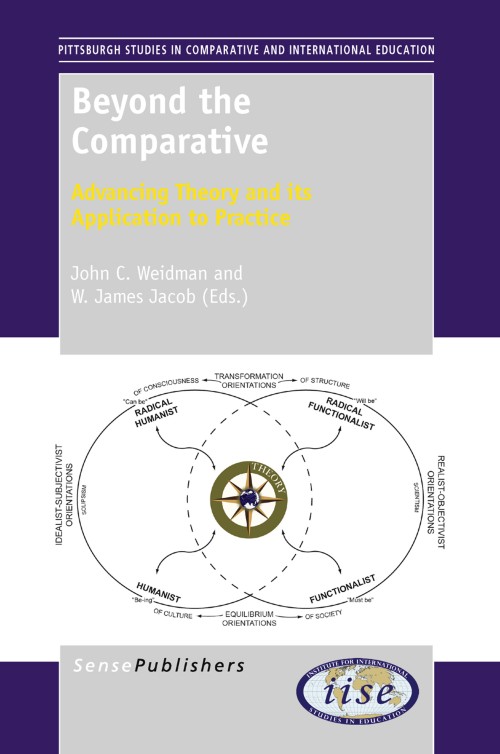
We are pleased to introduce this inaugural volume in the PSCIE Series—Beyond the Comparative: Advancing Theory and Its Application to Practice—which expands on the life work of University of Pittsburgh Professor Rolland G. Paulston (1929-2006). Recognized as a stalwart in the field of comparative and international education, Paulston’s most widely recognized contribution is in social cartography. He demonstrated that mapping comparative, international, and development education (CIDE) is no easy task and, depending on the perspective of the mapper, there may be multiple cartographies to chart. The 35 contributors to this volume, representing a range of senior and junior scholars from various CIDE backgrounds and perspectives, celebrate the life and work of Paulston by addressing issues, perspectives and approaches related to charting the future course of the field. The volume reports on new research in several genres as well as conceptual analysis. As the title suggests, authors were encouraged to go “beyond” established canons of CIDE. The cover art, The CIDE Theoretical Compass, was conceptualized by the editors and depicts that theory selection and theory generation are an ongoing and important process in comparative, international, and development education (CIDE). The image was designed by artist Natalie Jacob, which positions the CIDE Theoretical Compass over Rolland G. Paulston’s 1993 concentric circle map.
Konu
International education .
Comparative education.
International and Comparative Education.
Comparative education.
International and Comparative Education.
Diğer Yazarlar
Kurum Adı
