LEADER 03610nam a22005895i 4500
001 813660
003 TR_AnAIT
005 20260130223948
007 cr nn 008mamaa
008 100301s2010 ne | s |||| 0|eng d
020 |a9789048130771|9978-90-481-3077-1
024 7 |a10.1007/978-90-481-3077-1|2doi
041 |aeng
049 |aTürk Tarih Kurumu Kütüphanesi
050 4|aB1-5802
072 7|aHPC|2bicssc
072 7|aPHI009000|2bisacsh
072 7|aQDH|2thema
082 04|a109|223
090 |aDK/14901
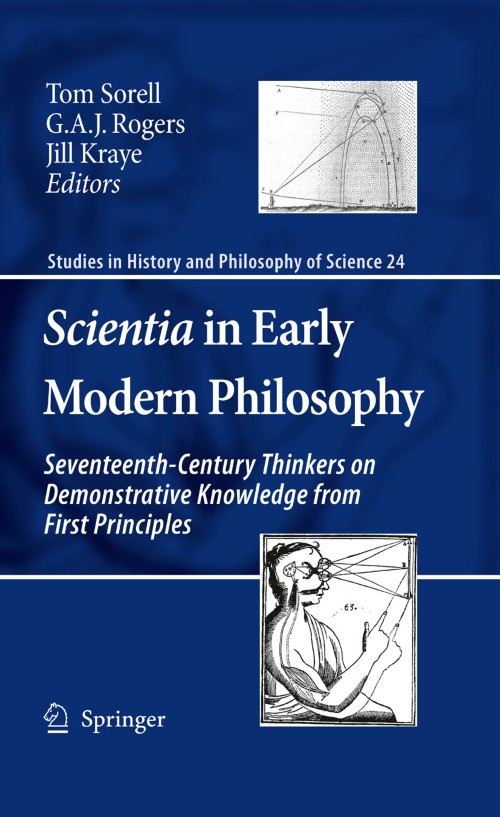
245 10|aScientia in Early Modern Philosophy|h[electronic resource] :|bSeventeenth-Century Thinkers on Demonstrative Knowledge from First Principles /|cedited by Tom Sorell, G.A. Rogers, Jill Kraye.
250 |a1st ed. 2010.
264 1|aDordrecht :|bSpringer Netherlands :|bImprint: Springer,|c2010.
300 |aXV, 139 p.|bonline resource.
336 |atext|btxt|2rdacontent
337 |acomputer|bc|2rdamedia
338 |aonline resource|bcr|2rdacarrier
347 |atext file|bPDF|2rda
490 1 |aStudies in History and Philosophy of Science,|x2215-1958 ;|v24
505 0 |aPhilosophia, Historia, Mathematica: Shifting Sands in the Disciplinary Geography of the Seventeenth Century -- The Unity of Natural Philosophy and the End of Scientia -- Matter, Mortality, and the Changing Ideal of Science -- Scientia and Inductio Scientifica in the Logica Hamburgensis of Joachim Jungius -- Scientia and the Sciences in Descartes -- Scientia and Self-knowledge in Descartes -- Spinoza’s Theory of Scientia Intuitiva -- Scientia in Hobbes -- John Locke and the Limits of Scientia.
520 |aScientia is the term that early modern philosophers applied to a certain kind of demonstrative knowledge, the kind whose starting points were appropriate first principles. In pre-modern philosophy, too, scientia was the name for demonstrative knowledge from first principles. But pre-modern and early modern conceptions differ systematically from one another. This book offers a variety of glimpses of this difference by exploring the works of individual philosophers as well as philosophical movements and groupings of the period. Some of the figures are transitional, falling neatly on neither side of the allegiances usually marked by the scholastic/modern distinction. Among the philosophers whose views on scientia are surveyed are Hobbes, Descartes, Spinoza, Gassendi, Locke, and Jungius. The contributors are among the best-known and most influential historians of early modern philosophy.
650 0|aPhilosophy|xHistory.
650 0|aScience|xHistory.
650 0|aPhilosophy, Modern.
650 0|aHistory.
650 0|aCultural property.
650 14|aHistory of Philosophy.
650 24|aHistory of Science.
650 24|aEarly Modern Philosophy.
650 24|aHistory.
650 24|aCultural Heritage.
700 1 |aSorell, Tom.|eeditor.|4edt|4http://id.loc.gov/vocabulary/relators/edt
700 1 |aRogers, G.A.|eeditor.|4edt|4http://id.loc.gov/vocabulary/relators/edt
700 1 |aKraye, Jill.|eeditor.|4edt|4http://id.loc.gov/vocabulary/relators/edt
710 2 |aSpringerLink (Online service)
773 0 |tSpringer Nature eBook
776 08|iPrinted edition:|z9789048130764
776 08|iPrinted edition:|z9789048130788
776 08|iPrinted edition:|z9789400730809
830 0|aStudies in History and Philosophy of Science,|x2215-1958 ;|v24
856 40|uhttps://doi.org/10.1007/978-90-481-3077-1
912 |aZDB-2-SHU
912 |aZDB-2-SXPR
950 |aHumanities, Social Sciences and Law (SpringerNature-11648)
950 |aPhilosophy and Religion (R0) (SpringerNature-43725)