

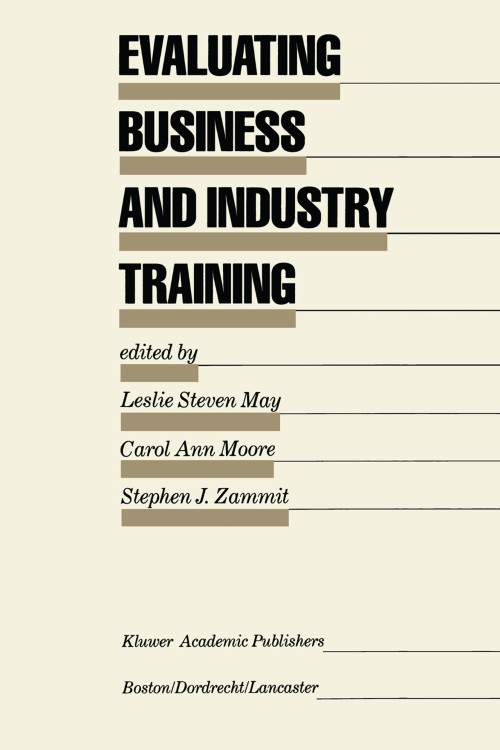
Evaluating Business and Industry Training [electronic resource] / edited by Leslie Steven May, Carol Ann Moore, Stephen J. Zammit.
Erişim Adresi
ISBN
9789401174237
Dil Kodu
İngilizce
Yer Numarası
DK/14910
Basım Bildirimi
1st ed. 1987.
Yayın Bilgisi
Dordrecht : Springer Netherlands : Imprint: Springer, 1987.
Fiziksel Niteleme
320 p. online resource.
Dizi
Evaluation in Education and Human Services ; 17
İçindekiler Notu
I Organizational Context of Training Evaluation -- 1 The Role of Training in Implementing Strategic Change -- 2 Strategic Evaluation of Training -- 3 The Organizational Context of Training Evaluation for Staff Development -- 4 Evaluating Training Programs for Decision Making -- 5 Management Education: Articulating the Unspoken, Riding the Herd, Wasting Money, or Preparing for Tomorrow? -- II Evaluation of Training Products -- 6 Evaluation Issues in the Educational Product Life-Cycle -- 7 Applying Quality Management Concepts and Techniques to Training Evaluation -- 8 Content Validity as an Evaluation Strategy for Examining Training Programs -- 9 The Role of Media in the Evaluation of Training -- 10 Management Education: An Emerging Role for Systematic Evaluation -- III Evaluating and Maximizing the Use of Evaluation Results -- 11 Establishing Corporate Evaluation Policy: Cost Versus Benefit -- 12 Communicating Evaluation Results: The External Evaluator Perspective -- 13 Communicating Evaluation Results: The Internal Evaluator Perspective -- 14 Implementing a Testing Strategy Within a Training Program -- 15 Use of Training Data in Personnel Decision Making.
Özet, vb.
In the abstract, training is seen as valuable by most people in business and industry. However, in the rush of providing training programs "on time" and "within budget," evaluation of training is frequently left behind as a "nice to have" addition, if practical. In addition, the training function itself is left with the dilemma of proving its worth to management without a substantive history of evaluation. This book is designed to provide managers, educators, and trainers alike the opportunity to explore the issues and benefits of evaluating business and industry training. The purpose is to motivate more effective decisions for training investments based on information about the value of training in attaining business goals. Without evaluation, the value of specific training efforts cannot be adequately measured, the value of training investments overall cannot be fully assessed, and the contributions of the training function to the corporation's goals cannot be duly recognized. Articles are grouped into three sections, althou~h many themes appear across sections. The first section estabhshes the context of training evaluation in a business organization. The second section emphasizes evaluation of training products and services; and the third section discusses costs and benefits of evaluation, and communication and use of evaluation results in decision making. In Section I, the context of training evaluation is established from a variety of perspectives. First, training and trainin~ evaluation are discussed in the context of corporate strateglc goals.
Konu
Educational tests and measurements.
Personnel management.
International education .
Comparative education.
Assessment and Testing.
Human Resource Management.
International and Comparative Education.
Personnel management.
International education .
Comparative education.
Assessment and Testing.
Human Resource Management.
International and Comparative Education.
Diğer Yazarlar
Kurum Adı
Eseri Alıntıla
Referansları kullanmadan önce gözden geçirmeniz ve varsa gerekli düzeltmeleri yapmanız önerilir.
Dijital Kaynak
MARC Görünümü
LEADER 05647nam a22006135i 4500
001 813669
003 TR_AnAIT
005 20260130223923
007 cr nn 008mamaa
008 121227s1987 ne | s |||| 0|eng d
020 |a9789401174237|9978-94-011-7423-7
024 7 |a10.1007/978-94-011-7423-7|2doi
041 |aeng
049 |aTürk Tarih Kurumu Kütüphanesi
050 4|aLB3050-3060.87
072 7|aJNKD|2bicssc
072 7|aEDU030000|2bisacsh
072 7|aJNDH|2thema
082 04|a371.26|223
090 |aDK/14910
245 10|aEvaluating Business and Industry Training|h[electronic resource] /|cedited by Leslie Steven May, Carol Ann Moore, Stephen J. Zammit.
250 |a1st ed. 1987.
264 1|aDordrecht :|bSpringer Netherlands :|bImprint: Springer,|c1987.
300 |a320 p.|bonline resource.
336 |atext|btxt|2rdacontent
337 |acomputer|bc|2rdamedia
338 |aonline resource|bcr|2rdacarrier
347 |atext file|bPDF|2rda
490 1 |aEvaluation in Education and Human Services ;|v17
505 0 |aI Organizational Context of Training Evaluation -- 1 The Role of Training in Implementing Strategic Change -- 2 Strategic Evaluation of Training -- 3 The Organizational Context of Training Evaluation for Staff Development -- 4 Evaluating Training Programs for Decision Making -- 5 Management Education: Articulating the Unspoken, Riding the Herd, Wasting Money, or Preparing for Tomorrow? -- II Evaluation of Training Products -- 6 Evaluation Issues in the Educational Product Life-Cycle -- 7 Applying Quality Management Concepts and Techniques to Training Evaluation -- 8 Content Validity as an Evaluation Strategy for Examining Training Programs -- 9 The Role of Media in the Evaluation of Training -- 10 Management Education: An Emerging Role for Systematic Evaluation -- III Evaluating and Maximizing the Use of Evaluation Results -- 11 Establishing Corporate Evaluation Policy: Cost Versus Benefit -- 12 Communicating Evaluation Results: The External Evaluator Perspective -- 13 Communicating Evaluation Results: The Internal Evaluator Perspective -- 14 Implementing a Testing Strategy Within a Training Program -- 15 Use of Training Data in Personnel Decision Making.
520 |aIn the abstract, training is seen as valuable by most people in business and industry. However, in the rush of providing training programs "on time" and "within budget," evaluation of training is frequently left behind as a "nice to have" addition, if practical. In addition, the training function itself is left with the dilemma of proving its worth to management without a substantive history of evaluation. This book is designed to provide managers, educators, and trainers alike the opportunity to explore the issues and benefits of evaluating business and industry training. The purpose is to motivate more effective decisions for training investments based on information about the value of training in attaining business goals. Without evaluation, the value of specific training efforts cannot be adequately measured, the value of training investments overall cannot be fully assessed, and the contributions of the training function to the corporation's goals cannot be duly recognized. Articles are grouped into three sections, althou~h many themes appear across sections. The first section estabhshes the context of training evaluation in a business organization. The second section emphasizes evaluation of training products and services; and the third section discusses costs and benefits of evaluation, and communication and use of evaluation results in decision making. In Section I, the context of training evaluation is established from a variety of perspectives. First, training and trainin~ evaluation are discussed in the context of corporate strateglc goals.
532 8 |aAccessibility summary: This PDF is not accessible. It is based on scanned pages and does not support features such as screen reader compatibility or described non-text content (images, graphs etc). However, it likely supports searchable and selectable text based on OCR (Optical Character Recognition). Users with accessibility needs may not be able to use this content effectively. Please contact us at accessibilitysupport@springernature.com if you require assistance or an alternative format.
532 8 |aInaccessible, or known limited accessibility
532 8 |aNo reading system accessibility options actively disabled
532 8 |aPublisher contact for further accessibility information: accessibilitysupport@springernature.com
650 0|aEducational tests and measurements.
650 0|aPersonnel management.
650 0|aInternational education .
650 0|aComparative education.
650 14|aAssessment and Testing.
650 24|aHuman Resource Management.
650 24|aInternational and Comparative Education.
700 1 |aMay, Leslie Steven.|eeditor.|4edt|4http://id.loc.gov/vocabulary/relators/edt
700 1 |aMoore, Carol Ann.|eeditor.|4edt|4http://id.loc.gov/vocabulary/relators/edt
700 1 |aZammit, Stephen J.|eeditor.|4edt|4http://id.loc.gov/vocabulary/relators/edt
710 2 |aSpringerLink (Online service)
773 0 |tSpringer Nature eBook
776 08|iPrinted edition:|z9780898381979
776 08|iPrinted edition:|z9789401174244
776 08|iPrinted edition:|z9789401174251
830 0|aEvaluation in Education and Human Services ;|v17
856 40|uhttps://doi.org/10.1007/978-94-011-7423-7
912 |aZDB-2-SHU
912 |aZDB-2-SXED
912 |aZDB-2-BAE
950 |aHumanities, Social Sciences and Law (SpringerNature-11648)
950 |aEducation (R0) (SpringerNature-43721)
001 813669
003 TR_AnAIT
005 20260130223923
007 cr nn 008mamaa
008 121227s1987 ne | s |||| 0|eng d
020 |a9789401174237|9978-94-011-7423-7
024 7 |a10.1007/978-94-011-7423-7|2doi
041 |aeng
049 |aTürk Tarih Kurumu Kütüphanesi
050 4|aLB3050-3060.87
072 7|aJNKD|2bicssc
072 7|aEDU030000|2bisacsh
072 7|aJNDH|2thema
082 04|a371.26|223
090 |aDK/14910
245 10|aEvaluating Business and Industry Training|h[electronic resource] /|cedited by Leslie Steven May, Carol Ann Moore, Stephen J. Zammit.
250 |a1st ed. 1987.
264 1|aDordrecht :|bSpringer Netherlands :|bImprint: Springer,|c1987.
300 |a320 p.|bonline resource.
336 |atext|btxt|2rdacontent
337 |acomputer|bc|2rdamedia
338 |aonline resource|bcr|2rdacarrier
347 |atext file|bPDF|2rda
490 1 |aEvaluation in Education and Human Services ;|v17
505 0 |aI Organizational Context of Training Evaluation -- 1 The Role of Training in Implementing Strategic Change -- 2 Strategic Evaluation of Training -- 3 The Organizational Context of Training Evaluation for Staff Development -- 4 Evaluating Training Programs for Decision Making -- 5 Management Education: Articulating the Unspoken, Riding the Herd, Wasting Money, or Preparing for Tomorrow? -- II Evaluation of Training Products -- 6 Evaluation Issues in the Educational Product Life-Cycle -- 7 Applying Quality Management Concepts and Techniques to Training Evaluation -- 8 Content Validity as an Evaluation Strategy for Examining Training Programs -- 9 The Role of Media in the Evaluation of Training -- 10 Management Education: An Emerging Role for Systematic Evaluation -- III Evaluating and Maximizing the Use of Evaluation Results -- 11 Establishing Corporate Evaluation Policy: Cost Versus Benefit -- 12 Communicating Evaluation Results: The External Evaluator Perspective -- 13 Communicating Evaluation Results: The Internal Evaluator Perspective -- 14 Implementing a Testing Strategy Within a Training Program -- 15 Use of Training Data in Personnel Decision Making.
520 |aIn the abstract, training is seen as valuable by most people in business and industry. However, in the rush of providing training programs "on time" and "within budget," evaluation of training is frequently left behind as a "nice to have" addition, if practical. In addition, the training function itself is left with the dilemma of proving its worth to management without a substantive history of evaluation. This book is designed to provide managers, educators, and trainers alike the opportunity to explore the issues and benefits of evaluating business and industry training. The purpose is to motivate more effective decisions for training investments based on information about the value of training in attaining business goals. Without evaluation, the value of specific training efforts cannot be adequately measured, the value of training investments overall cannot be fully assessed, and the contributions of the training function to the corporation's goals cannot be duly recognized. Articles are grouped into three sections, althou~h many themes appear across sections. The first section estabhshes the context of training evaluation in a business organization. The second section emphasizes evaluation of training products and services; and the third section discusses costs and benefits of evaluation, and communication and use of evaluation results in decision making. In Section I, the context of training evaluation is established from a variety of perspectives. First, training and trainin~ evaluation are discussed in the context of corporate strateglc goals.
532 8 |aAccessibility summary: This PDF is not accessible. It is based on scanned pages and does not support features such as screen reader compatibility or described non-text content (images, graphs etc). However, it likely supports searchable and selectable text based on OCR (Optical Character Recognition). Users with accessibility needs may not be able to use this content effectively. Please contact us at accessibilitysupport@springernature.com if you require assistance or an alternative format.
532 8 |aInaccessible, or known limited accessibility
532 8 |aNo reading system accessibility options actively disabled
532 8 |aPublisher contact for further accessibility information: accessibilitysupport@springernature.com
650 0|aEducational tests and measurements.
650 0|aPersonnel management.
650 0|aInternational education .
650 0|aComparative education.
650 14|aAssessment and Testing.
650 24|aHuman Resource Management.
650 24|aInternational and Comparative Education.
700 1 |aMay, Leslie Steven.|eeditor.|4edt|4http://id.loc.gov/vocabulary/relators/edt
700 1 |aMoore, Carol Ann.|eeditor.|4edt|4http://id.loc.gov/vocabulary/relators/edt
700 1 |aZammit, Stephen J.|eeditor.|4edt|4http://id.loc.gov/vocabulary/relators/edt
710 2 |aSpringerLink (Online service)
773 0 |tSpringer Nature eBook
776 08|iPrinted edition:|z9780898381979
776 08|iPrinted edition:|z9789401174244
776 08|iPrinted edition:|z9789401174251
830 0|aEvaluation in Education and Human Services ;|v17
856 40|uhttps://doi.org/10.1007/978-94-011-7423-7
912 |aZDB-2-SHU
912 |aZDB-2-SXED
912 |aZDB-2-BAE
950 |aHumanities, Social Sciences and Law (SpringerNature-11648)
950 |aEducation (R0) (SpringerNature-43721)
Materyaller
Depodan talep edilen materyal sadece kütüphane içerisinde kullanılmaktadır.
Materyal dışarıya ödünç verilmemektedir.
Materyal dışarıya ödünç verilmemektedir.
